Floor Hardener Cost & Coverage: How Much Smartop Do You Need for Industrial Flooring?
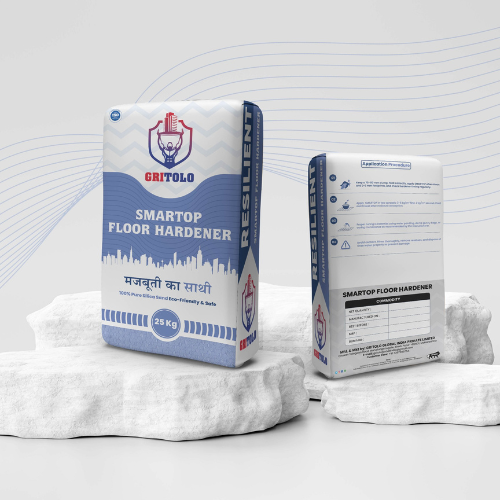
Smartop Floor Hardener is applied at 3–7 kg per sq m depending on traffic intensity. A 40 kg bag covers 5.7 to 13 sq m. Material cost runs approximately ₹8–18 per sq ft — against ₹100–200 per sq ft installed for epoxy (including re-coating every 5–8 years). Dry-shake hardener is the cheapest serious industrial floor finish per sq ft over a 20-year asset life.
If you are specifying or procuring flooring for a warehouse, factory, car park, or logistics hub in India, two questions come up immediately: how much floor hardener do I need, and what does it actually cost per square foot compared to the alternatives? This article answers both directly, with coverage calculations, a project quantity estimator table, and a long-term cost comparison against epoxy and PU resin systems.
This post is the commercial companion to Gritolo’s main Smartop guide (linked below). That guide covers what floor hardener is and how it works. This one is for buyers, project managers, and QS teams who are at the quantity and cost stage — and need numbers, not explanations.
What Does a Floor Hardener Actually Do?
Dry-shake floor hardener is broadcast onto fresh concrete during finishing and power-troweled in, creating a monolithic, high-density surface cap. It does not sit on top of the concrete — it becomes the concrete surface. Gritolo Smartop uses quartz/silica aggregate at Mohs hardness 7–8 (significantly harder than the concrete itself), which is why it increases abrasion resistance by 200–300% over untreated M25 slab.
The critical commercial point: this hardening happens during the concreting contract. There is no separate flooring contractor, no waiting period for the slab to cure before application, and no re-treatment required for the life of the floor. That is the economic case in one paragraph — and it is why dry-shake hardener dominates the industrial floor market in India for everything except chemically aggressive environments.
For the full technical explanation of how Smartop works, colour options, and industry applications, read: Smartop Floor Hardener: What It Is, How It Works, and Where to Use It.
Smartop Floor Hardener Specs and Coverage Rate
Here are the complete specifications and coverage figures for Gritolo Smartop, drawn directly from our product data sheet:
| Product name | Gritolo Smartop Floor Hardener |
| Type | Non-metallic dry-shake floor hardener |
| Aggregate | High-purity quartz / silica (Mohs hardness 7–8) |
| Available colours | Terracotta Red · Forest Green · Natural Grey |
| Dosage — light duty | 3 kg per sq m (foot traffic, light commercial) |
| Dosage — medium duty | 4–5 kg per sq m (forklifts, light industrial) |
| Dosage — heavy duty | 5–7 kg per sq m (heavy machinery, logistics) |
| Coverage (40 kg bag) at 3 kg/sq m | ~13 sq m per bag |
| Coverage (40 kg bag) at 5 kg/sq m | ~8 sq m per bag |
| Coverage (40 kg bag) at 7 kg/sq m | ~5.7 sq m per bag |
| Wear resistance improvement | 200–300% over untreated M25 concrete |
| Minimum concrete grade | M25 (recommended) |
| Concrete base requirement | Fresh wet concrete — dry-shake applied before final trowel |
| Pot life / open time | Application window: bleed-water evaporation to final trowel |
| Light foot traffic | 24 hours after final trowel |
| Forklift / vehicle load | 7–14 days (after slab reaches adequate compressive strength) |
| Full compressive strength | 28 days |
| Rust risk | None — non-metallic (no iron filings) |
| IS reference | Applied to M25+ concrete per IS 456 slab specification |
How to Calculate Smartop Coverage for Your Project
Multiply your floor area (in sq m) by the dosage rate for your traffic category, then divide by 40 (the bag weight in kg) to get the number of bags required. Add 5–10% for perimeter overspray and variation in broadcast evenness.
Example calculation for a 2,000 sq m medium-duty warehouse at 5 kg/sq m: 2,000 × 5 = 10,000 kg ÷ 40 = 250 bags + 10% = 275 bags. At ₹1,000–2,200 per 40 kg bag (depending on brand and order volume), total material cost = ₹2.75 to ₹6.05 lakh for this project.
One Colour Rule for Coloured Floors
If you are specifying Smartop in Terracotta Red or Forest Green for zone colour-coding or safety demarcation, always use the higher end of the dosage range — minimum 5 kg per sq m, ideally 6–7 kg per sq m. Below this threshold, the base grey concrete can show through in high-traffic areas as the surface wears. Heavier dosage at the outset is significantly cheaper than a patchy, inconsistent colour finish.
Project Quantity Estimator: How Many Bags Do You Need?
Use this table as a starting point for procurement planning. All figures use 5 kg/sq m (medium industrial duty) except car parks (4 kg/sq m) and heavy plant (7 kg/sq m).
| Project | Floor Area | Dosage | Bags Needed (40 kg) | Est. Material Cost* |
| Small workshop / garage | 200 sq m | 5 kg/sq m | 25 bags | ₹25,000–55,000 |
| Medium warehouse | 1,000 sq m | 5 kg/sq m | 125 bags | ₹1.25–2.75 lakh |
| Large logistics hub | 5,000 sq m | 5 kg/sq m | 625 bags | ₹6.25–13.75 lakh |
| Multi-level car park | 3,000 sq m | 4 kg/sq m | 300 bags | ₹3.0–6.6 lakh |
| Heavy industrial plant | 2,000 sq m | 7 kg/sq m | 350 bags | ₹3.5–7.7 lakh |
Estimated material cost range based on current Indian market pricing for quality non-metallic floor hardener (₹1,000–2,200 per 40 kg bag). Labour is included within the concrete + VDF contract and is not a separate line item.
Do Not Under-Dose to Save Cost
Under-dosing dry-shake floor hardener — applying 2–3 kg/sq m on a floor that needs 5–7 kg/sq m — produces a thin, under-strength surface cap that wears through rapidly in forklift aisles and under racking legs. The cost of remediation (liquid densifier application, downtime, partial floor re-work) far exceeds the saving from using fewer bags. Specify correctly by traffic category, not by bag budget.
Application Process: Dry-Shake Method Step by Step
Coverage and cost are only realised if the application is correctly timed and executed. The dry-shake process is unforgiving of poor timing — here is the precise sequence:
- Pour and level the concrete slab. Minimum Grade M25 recommended for any industrial floor receiving Smartop. Vacuum-dewatered (VDF) concrete is strongly recommended for large warehouse and logistics projects — it reduces the surface water-cement ratio before hardener application, increasing the final surface density and hardener integration. Level with screed and vibrate thoroughly to remove voids.
- Monitor and wait for bleed water to evaporate. This is the most critical judgement call in the entire process. Bleed water rises to the fresh concrete surface as trapped water migrates upward after placement. You must wait until this surface sheen has completely evaporated before applying the first shake. Applying too early — while bleed water still stands — dilutes the hardener compound and causes surface delamination. Applying too late — after the concrete has stiffened — prevents proper integration. In Pune’s summer conditions, this window can open within 30 minutes; in humid monsoon weather, it may take 90 minutes or longer. Assign a dedicated, experienced supervisor to this stage exclusively.
- Apply the first shake — two-thirds of total dosage. Broadcast approximately two-thirds of the calculated Smartop quantity evenly across the work area. The powder will absorb moisture from the concrete surface and darken. Allow it to uniformly darken — approximately 3–5 minutes — before troweling.
- Power-trowel the first application. Using a walk-behind or ride-on power trowel with float blades, work the first application into the concrete surface with overlapping passes. The troweling action drives the hardener aggregate and cement into the paste and begins to densify the surface.
- Apply the second shake — remaining one-third of dosage. Broadcast the remaining Smartop evenly across the surface. Allow to darken uniformly, as before.
- Final power-trowel to finish. Apply a second troweling pass — using finish blades for a smooth, high-density surface. The number of finish passes determines the final surface texture. More passes produce a harder, smoother, more reflective surface; fewer passes leave a more open-textured finish that can improve slip resistance in wet environments.
- Cure the surface immediately. Apply a quality liquid curing compound or lay polyethylene sheet immediately after final troweling. This is particularly important in hot, dry, or windy Indian site conditions, where premature moisture loss can cause surface crazing and weakened hardener integration. Do not skip curing.
- Manage trafficking and loading. Light foot traffic: 24 hours. Forklift and vehicle traffic: 7–14 days minimum. Full heavy industrial loading: after 28 days.
When to Call in Specialist Supervision
For warehouse floors exceeding 2,000 sq m in a single pour, or for projects in difficult weather conditions (peak summer in Maharashtra or heavy monsoon humidity), consider engaging a specialist VDF concrete flooring contractor alongside the Gritolo Smartop supply. The concrete and hardener work in combination — the best hardener on a poorly executed concrete pour will not deliver its full performance.
Floor Hardener vs Epoxy Coating: Which Is Cheaper Long-Term?
This is the core commercial question for most project managers evaluating industrial flooring options. The short answer: over any period beyond 8 years, dry-shake floor hardener is significantly cheaper than epoxy on a total cost of ownership basis. Here is the full comparison:
| Floor System | Material Cost/sq ft | Application Cost/sq ft | Lifespan | Re-treatment |
| Smartop (dry-shake) on VDF concrete | ₹8–18 | Included in concreting cost — no separate contract | 20–30 years | None — fit and forget |
| Epoxy coating (standard 2-coat) | ₹60–120 | ₹40–80 (separate flooring contractor) | 5–8 years | Full re-coat every 5–8 years |
| PU resin screed (cold store / washdown) | ₹120–200 | ₹60–120 (specialist applicator required) | 8–12 years | Re-coating every 8–10 years |
| Industrial floor tiles (vitrified / heavy-duty) | ₹80–200+ (tile + adhesive) | ₹40–100 (separate tiling contractor) | 15–25 years | Grout repointing, broken tile replacement |
How to Think About the 20-Year Cost
A 5,000 sq m warehouse floor with Smartop dry-shake hardener at 5 kg/sq m has a one-time material cost of approximately ₹6–14 lakh (included within the concrete contract, no separate application cost). Over 20 years: no re-treatment, no re-coating, no specialist contractors, just standard cleaning.
The same floor in epoxy at ₹140 per sq ft installed (₹150/sq ft total) = ₹80 lakh at first installation, plus full re-coat at years 5–6 and years 11–12 = approximately ₹2.4 crore over 20 years in flooring costs alone — 15× the hardener investment for comparable abrasion resistance on a standard logistics floor.
Epoxy earns its premium where genuine chemical resistance is non-negotiable — pharmaceutical cleanrooms, battery acid environments, clinically sterile food processing. For the vast majority of Indian industrial and logistics floors, this premium is not justified by the performance differential.
Is There Any Scenario Where Epoxy Is Still the Right Choice?
Yes — three genuine exceptions:
- Environments with constant strong acid or solvent exposure (chemical manufacturing, battery production) where dry-shake hardener’s chemical resistance to oils and mild chemicals is insufficient.
- Pharmaceutical cleanrooms and food-grade sterile processing areas requiring a seamless, clinically cleanable surface that can be sterilised with aggressive chemicals.
- Existing hardened concrete floors where dry-shake is no longer an option — epoxy or liquid densifier are the only practical surface improvement methods for floors that have already cured.
Outside these three scenarios, a well-specified and correctly applied Smartop floor hardener outperforms epoxy on cost, durability, and operational simplicity across India’s standard industrial and logistics floor requirements.
Local Insights: Industrial Floor Specification Across Maharashtra
In Pune’s Chakan and Talegaon industrial zones — one of India’s most active automotive manufacturing belts — floor specification on new shed construction has increasingly moved toward VDF concrete with non-metallic dry-shake hardener as the standard, rather than epoxy. The combination of competitive concreting contractors already equipped for VDF work, the absence of any additional flooring subcontract, and 24-hour trafficking capability fits the compressed build schedules typical of industrial shed projects in this corridor.
In Bhiwandi and Panvel on Mumbai’s logistics periphery, where large-format e-commerce and third-party logistics warehouses are being built at pace, floor flatness and hardener quality are increasingly specified by international 3PL operators who specify FM2 flatness standards and minimum 5 kg/sq m hardener dosage in their building briefs. Gritolo’s Smartop consistently meets these specifications, and the Forest Green colour option has found particular traction in facilities where aisle demarcation and safety zone marking are part of the fitout specification.
Frequently Asked Questions
Q1. How long before industrial floor hardener can take vehicle load?
A1. Light foot traffic is safe within 24 hours of final troweling. Forklift and vehicle trafficking must wait 7–14 days for the concrete slab to reach adequate compressive strength under normal Indian ambient conditions. Full heavy sustained industrial loading should be deferred until the slab has reached 28-day strength.
Q2. How much Smartop floor hardener do I need per square metre?
A2. Light duty (foot traffic): 3 kg per sq m. Medium duty (forklifts, garages): 4–5 kg per sq m. Heavy industrial (heavy machinery, logistics hubs): 5–7 kg per sq m. A 40 kg bag covers approximately 5.7–13 sq m depending on the dosage rate applied.
Q3. What is the cost of floor hardener per square foot in India?
A3. Smartop dry-shake floor hardener adds approximately ₹8–18 per sq ft in material cost at typical dosage rates. Compared to epoxy at ₹100–200 per sq ft installed and requiring re-coating every 5–8 years, dry-shake hardener is substantially cheaper over any industrial floor’s working life.
Q4. Can floor hardener be applied to existing old concrete floors?
A4. No. Dry-shake floor hardener must be applied to fresh, wet concrete during the finishing stage — it integrates with the cement paste as the concrete cures. For existing hardened floors, liquid densifier or epoxy coating are the appropriate surface treatment alternatives.
Q5. What is the difference between metallic and non-metallic floor hardener?
A5. Non-metallic (Smartop) uses quartz and silica aggregates and will never rust, making it suitable for wet areas, food processing plants, and outdoor use. Metallic hardeners use iron filings for extreme impact resistance but rust on moisture exposure, restricting them to dry foundries and heavy steel fabrication plants.
Q6. Does floor hardener work without VDF concrete?
A6. Yes. Dry-shake hardener can be applied to any fresh concrete that has been levelled and floated. VDF is recommended for large industrial floor areas because it reduces the surface water-cement ratio before hardener application, but it is not mandatory for smaller or lighter-duty projects.
Internal Reference: Related Gritolo Resources
- Technical guide (what Smartop is, colour options, industry applications): Smartop Floor Hardener: What It Is, How It Works, and Where to Use It
- For AAC block wall construction before industrial shed flooring: Block Jointing Mortar vs Traditional Cement Mortar: Cost, Coverage & Which to Use
- For wall plastering after block laying: Tile Adhesive Guide: T1 vs T2 vs T3 vs T4 — Which Grade Do You Actually Need?
- Browse all Gritolo construction materials: Gritolo Shop
For project-specific quantity calculations, technical data sheets, or bulk order pricing: Contact the Gritolo Team | +91 7397985754