Tile Adhesive Guide: T1 vs T2 vs T3 vs T4 — Which Grade Do You Actually Need?
For standard vitrified tiles up to 600×600 mm on interior floors, use T2 (TA-V200). For large-format tiles of 800×800 mm and above, exterior walls, or tile-on-tile renovation, use T3 (TA-M300). T1 suits ceramic tiles on dry interior surfaces only. T4 is for swimming pools, natural stone, and industrial floors. All four grades are IS 15477:2019 compliant.
Which tile adhesive grade matches your project — T1, T2, T3, or T4? The answer depends on three things: the type and size of tile you are laying, whether the surface is a wall or floor, and whether the location is interior or exterior. Get the grade right and your tiles will bond reliably for decades. Get it wrong and the most common outcome is hollow-sounding tiles, debonding, or complete tile fall-off within 12–24 months.
This is Gritolo’s pillar guide to tile adhesive selection in India. It consolidates the full T1-to-T4 decision into one scannable reference — with concrete specs, coverage figures, and direct product links — so you can specify with confidence rather than guessing at the builder’s merchant.
What Are the Tile Adhesive Grades? T1, T2, T3, T4 Explained
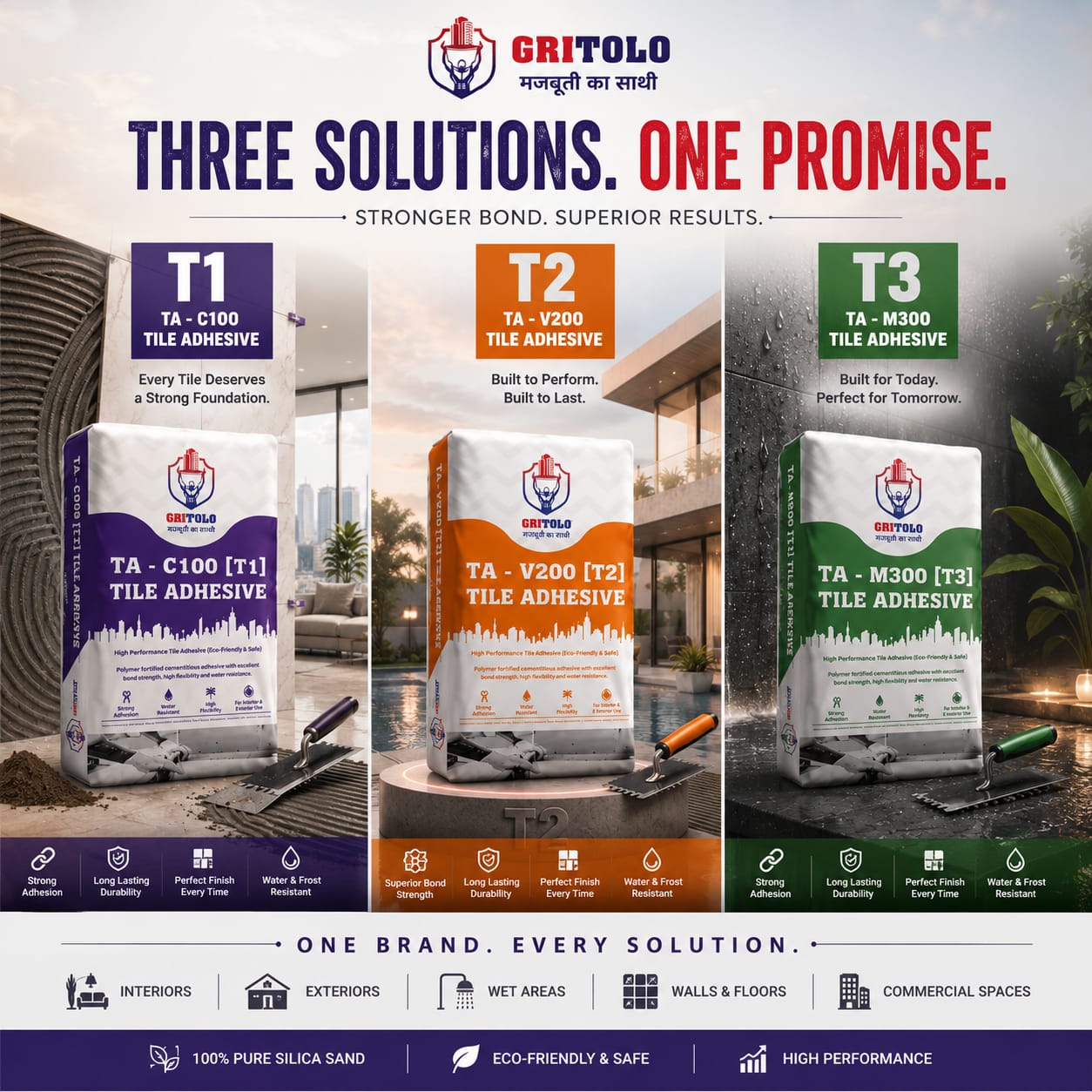
India’s tile adhesive classification follows IS 15477:2019 — the Bureau of Indian Standards specification for cementitious tile adhesives. This standard defines four performance types, numbered T1 (lowest) through T4 (highest), based on tested benchmarks for tensile bond strength, slip resistance, open time, and deformability. Here is the full spec comparison for all four Gritolo grades:
| Grade | IS 15477 | Bond Strength | Open Time | Tile Size Max | Best For |
| T1 — TA-C100 | Type 1 | ~0.5 N/mm² | 15–20 min | 300×300 mm | Ceramic tiles, interior dry floors |
| T2 — TA-V200 | Type 2 | ~1.0 N/mm² | 20–25 min | 600×600 mm | Vitrified tiles, interior floor/walls, wet areas |
| T3 — TA-M300 | Type 3 | >1.0 N/mm² (S1/S2 flex) | 20–25 min | 800×800 mm+ | Large format, exterior, tile-on-tile, pool surrounds |
| T4 — TA-G400 | Type 4 | Maximum (S2 flex) | 20–25 min | Any / slabs | Swimming pools, natural stone, industrial floors, facades |
What Does S1/S2 Flexibility Mean in Practice?
Deformability class — S1 or S2 — is one of the most important and least understood specifications for tile adhesive in India. S1 means the adhesive can flex at least 2.5 mm before failing; S2 means at least 5 mm. For context: a 1000×1000 mm vitrified tile on an exterior wall in Pune, where surface temperatures swing between 15°C overnight and 55°C+ in summer, expands and contracts by approximately 0.3–0.4 mm across its face in a single day. Without S1 flexibility in the adhesive, that movement shears the bond progressively over time — which is why T3 and T4 are mandatory, not optional, for exterior applications.
Price Context
Tile adhesive price in India ranges from roughly ₹250–400 per 20 kg for T1 grade up to ₹600–1,200+ per 20 kg for T3/T4 grades, depending on brand and polymer content. Calculated per square foot of installed tile, the difference between T2 and T3 is typically ₹2–5 per sq ft — a fraction of the ₹80–300/sq ft cost of the tile itself. If a tile installation fails, the rework cost is 5–10× the cost of the adhesive upgrade that would have prevented it.
Wall Tiles vs Floor Tiles: Do They Need Different Adhesive?
Yes — and this is one of the most underappreciated differences in tile adhesive selection. Floor tiles bear vertical load from above, spread across the adhesive bed. Wall tiles bear only their own weight, hanging in shear against the pull of gravity. This means wall tile adhesive must have genuine anti-slip (T-class) slip resistance to hold heavy tiles in position before the adhesive sets — a property that T1 adhesives simply do not provide.
| Application | Minimum Grade | Key Requirement | Gritolo Product |
| Interior floor — ceramic | T1 | Basic polymer bond | TA – C100 [T1] |
| Interior floor — vitrified | T2 | Polymer bond on non-porous back | TA – V200 [T2] |
| Interior floor — large format | T3 | S1 flexibility + back-butter | TA – M300 [T3] |
| Wall tiles — small/medium | T2 | Slip resistance (T-class) | TA – V200 [T2] |
| Wall tiles — large/heavy | T3 | High slip resistance (T-class) | TA – M300 [T3] |
| Exterior wall / facade | T3 | S1/S2 flex, weatherproof | TA – M300 [T3] |
| Swimming pool interior | T4 | Water immersion resistance | TA – G400 [T4] |
| Natural stone / granite | T4 | Non-staining, max bond strength | TA – G400 [T4] |
Why Does Slip Resistance Matter More on Walls Than Floors?
When you press a vitrified tile into an adhesive bed on the floor, gravity helps seat it. On a wall, gravity is trying to pull the tile downward from the moment it is placed. If the adhesive does not have sufficient initial grip — what the IS standard measures as slip resistance — the tile will slowly slide down the wall before the adhesive has set, creating an uneven installation and, in the worst case, a safety hazard.
T1 adhesive has essentially no meaningful slip resistance. T2 provides moderate slip resistance — adequate for small to medium tiles on walls up to moderate heights. T3’s engineered slip resistance holds large, heavy tiles vertically for the full setting period, which is why it is the correct specification for any wall tiling with tiles above approximately 600×600 mm.
How Much Tile Adhesive Do You Need Per Square Foot?
Coverage is not fixed — it varies directly with the trowel notch size you use, which in turn should match your tile format. Using the wrong notch size either starves the bond of adhesive or wastes material. Use this table for accurate quantity planning:
| Trowel Notch Size | Bed Thickness | Coverage (20 kg bag) | Tile Size Suitability |
| V-notch 3 mm | ~2–3 mm | ~40–45 sq ft | Small ceramic, mosaic (up to 300×300 mm) |
| Square notch 6 mm | ~4–5 mm | ~25–30 sq ft | Standard vitrified (up to 600×600 mm) |
| Square notch 10 mm | ~6–8 mm | ~15–20 sq ft | Large format (800×800 mm+) |
| Square notch 12 mm | ~8–10 mm | ~12–15 sq ft | Very large format / heavy stone slabs |
How to Calculate the Number of Bags for Your Project
Divide your total tile area (in sq ft) by the coverage per bag for your trowel size, then add 10% for cuts and wastage at edges. For example, a 500 sq ft floor with 600×600 mm vitrified tiles using a 6 mm square notch would need: (500 ÷ 27) + 10% = approximately 21 bags of 20 kg adhesive.
If you are back-buttering large-format tiles — which you should be for 800×800 mm and above — add a further 15–20% to your quantity estimate to account for the additional adhesive applied to the tile back.
Mixing Ratio — All Gritolo Tile Adhesive Grades
Add adhesive powder to clean water (not water to powder) at approximately 20–22% water by weight — roughly 4–4.5 litres per 20 kg bag. Mix with a slow-speed paddle mixer for 2–3 minutes, allow to rest for 5 minutes to activate the polymer system, then remix briefly. Pot life is approximately 1.5–2 hours; open time after spreading is 20–25 minutes. Never add extra water to a stiffening mix.
The 5 Most Common Tile Adhesive Mistakes — and How to Avoid Them
Knowing the right grade is only half the job. Here are the application and specification errors that cause the vast majority of tile failures on Indian construction sites:
- Using T1 for vitrified tiles. T1 has ~0.5 N/mm² bond strength and no meaningful chemical adhesion for non-porous vitrified tile backs. T2 minimum for any vitrified tile.
- Spreading adhesive too far ahead and letting it skin over. Once the adhesive surface skins, it will not bond even though the material beneath feels workable. Always tile within the 20–25 minute open time.
- Skipping back-buttering on large-format tiles. For tiles 600×600 mm and above, apply a thin skim coat to the tile back in addition to the substrate bed. Air voids from tile warpage cause hollow patches and eventual cracking under load.
- Using interior-grade adhesive outdoors. T1 or T2 on exterior walls, terraces, or pool surrounds will fail within 1–2 monsoon cycles. T3 minimum for any exterior surface.
- No expansion joints in large tiled areas. Provide perimeter joints at wall-floor junctions and intermediate movement joints at 4–5 m intervals in both directions. Fill with flexible sealant, not grout.
For a deeper breakdown of each mistake, causes, warning signs, and remedies, read: 5 Mistakes That Cause Tile Falling After Installation.
Which Gritolo Tile Adhesive Do You Need? The Decision Flowchart
Follow these four questions in sequence to reach the correct product every time:
- Is your tile ceramic and up to 300×300 mm on a dry interior surface? → TA – C100 [T1]
- Is your tile vitrified up to 600×600 mm, or in a wet interior area (bathroom, kitchen)? → TA – V200 [T2]
- Is your tile 800×800 mm or larger, on an exterior surface, or is this a tile-on-tile renovation? → TA – M300 [T3]
- Is this a swimming pool interior, natural stone, or industrial floor? → TA – G400 [T4]
When in Doubt, Specify One Grade Higher
The cost difference between T2 and T3 on a typical flat is ₹2,000–5,000. The cost of retiling that flat after a bond failure is ₹40,000–1,50,000 depending on size. When there is genuine uncertainty about substrate condition, tile weight, or future use of the space, specify T3 rather than T2. Over-specifying adhesive grade is not a problem. Under-specifying is.
Local Insights: Tile Adhesive Specification Patterns Across Maharashtra
Gritolo’s technical team works across Pune, Mumbai, and the wider Maharashtra region, and a few patterns are worth flagging specifically for builders and contractors in this market.
In Pune’s high-rise residential corridors — Wakad, Baner, Hinjewadi, Kharadi — the standard specification for apartment flooring has shifted almost universally to 800×800 mm vitrified tiles, yet site procurement very commonly supplies T2 adhesive rather than T3. The delta between these two grades at point of purchase is small; the delta in installation durability over a 5–10 year asset life is substantial. Developers who have updated their specifications to T3 for all large-format applications consistently report fewer post-possession warranty calls on flooring.
In Mumbai’s commercial and hospitality sector, where Italian and Spanish large-format porcelain tiles of 1200×600 mm or larger are frequently specified in lobbies and corridors, T3 is standard on well-managed projects. However, for contractor-managed residential conversions and self-builds in the MMR periphery, T1 applied to vitrified tiles remains a surprisingly common cause of preventable tile failure.
Frequently Asked Questions
Which tile adhesive grade do I need for vitrified tiles?
Use T2 (Gritolo TA-V200) for standard vitrified tiles up to 600×600 mm. For large-format vitrified tiles of 800×800 mm and above, use T3 (Gritolo TA-M300). Both comply with IS 15477:2019.
Can you use the same adhesive for indoor and outdoor tiles?
No. Interior-grade T1 and T2 adhesives are not suitable for exterior surfaces. Outdoor tiles require T3 minimum, which has S1/S2 flexibility to handle India’s thermal cycling and monsoon moisture exposure. Using interior adhesive outdoors leads to debonding within 1–2 years.
How much tile adhesive do I need per square foot?
A 20 kg bag covers roughly 40–45 sq ft with a 3 mm V-notch (small tiles), 25–30 sq ft with a 6 mm square notch (standard vitrified), and 12–15 sq ft with a 12 mm notch (large format). Always add 10% for wastage and cuts, plus 15–20% extra if back-buttering large-format tiles.
What is the tile adhesive price per square foot in India?
Tile adhesive costs roughly ₹3–8 per sq ft for T1/T2 grades, rising to ₹8–15 per sq ft for T3/T4. Rework after bond failure typically costs 5–10× the adhesive saving. Always specify by application requirement, not by bag price.
How long does tile adhesive take to cure?
Gritolo tile adhesives achieve initial set within 20–30 minutes of tile placement. Light foot traffic is possible at 24 hours. Full compressive strength — up to 36.9 MPa for T2/T3 grades — develops over 28 days.
Can I use T3 adhesive where T2 is the specification?
Yes. Specifying a higher grade than strictly required is always safe. The reverse — using T1 or T2 where T3 is the correct specification — is the error that causes tile failure.
Products and Related Posts
- TA – C100 [T1]: View Product & TDS— Ceramic tiles, interior dry floors
- TA – V200 [T2]: View Product & TDS— Vitrified tiles up to 600×600 mm
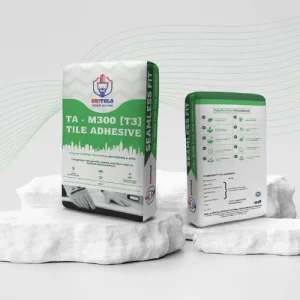
- TA – M300 [T3]: View Product & TDS— Large format, exterior, tile-on-tile
- TA – G400 [T4]: View Product & TDS— Swimming pools, natural stone, industrial
- In-depth guide: How to Choose Tile Adhesive for Large-Format Vitrified Tiles in India— covers T2 vs T3 polymer chemistry and S1/S2 deformability in detail
- Related: 5 Mistakes That Cause Tile Falling After Installation— full breakdown of each failure mode
For project-specific adhesive advice, bulk orders, or technical data sheets: Contact the Gritolo Team | +91 7397985754
Gritolo Technical Team
The Gritolo Technical Team is based in Pune and works directly with contractors, interior designers, and developers on tile adhesive specification across Maharashtra’s residential, commercial, and infrastructure projects. We manufacture the full TA-C100 to TA-G400 range in-house under IS 15477 standards. The bond strength figures, coverage rates, and application guidance in this article come from our own product data sheets and lab testing — not generic industry estimates. We see the consequences of wrong-grade adhesive choices regularly on site, which is why we published this pillar guide to consolidate everything in one place.
Contact us: https://gritolo.com/contact | +91 7397985754