The Evolution of Indian Construction
The Indian construction industry is undergoing a massive transformation. Gone are the days when construction relied solely on traditional site-mixed cement, sand, and labor-intensive methods. Today, builders, contractors, and developers are rapidly shifting toward engineered construction chemicals that offer consistency, durability, and efficiency.
From high-rise buildings in metro cities to residential homes in tier-2 towns, the demand for advanced materials is rising. Why? Because modern structures require precision, speed, and long-term performance—something traditional methods often fail to deliver.
This shift has led to the growing popularity of construction chemicals in India, including tile adhesives, ready mix plaster, block jointing mortar, and floor hardeners. These solutions are designed to solve real-world problems like cracking, uneven finishes, and material wastage.
In this guide, we’ll break down everything you need to know about modern construction chemicals and how they are reshaping the future of building in India.
Why Traditional Mortar is Failing Modern Buildings
Traditional mortar—made by mixing cement, sand, and water on-site—has been used for decades. However, it comes with serious limitations in today’s construction environment.
1. Cracking Issues
One of the biggest problems with traditional mortar is shrinkage cracking. Since the mix is not standardized, inconsistencies lead to weak bonding and surface cracks over time.
2. Poor Quality Control
Manual mixing depends heavily on labor skills. Even slight variations in sand quality or water ratio can result in:
- Weak bonding
- Uneven surfaces
- Reduced durability
3. Time-Consuming Process
Traditional methods require:
- Sand sieving
- Manual mixing
- Continuous curing
This slows down project timelines significantly.
4. High Material Wastage
On-site mixing leads to:
- Excess usage of materials
- Spillage and errors
- Increased cost per square foot
5. Incompatibility with Modern Materials
Modern materials like vitrified tiles, AAC blocks, and large-format tiles demand high-performance bonding solutions, which traditional mortar simply cannot provide.
This is why builders are now shifting toward engineered construction chemicals in India for better results and efficiency.
The Deep Dive into Tile Adhesives
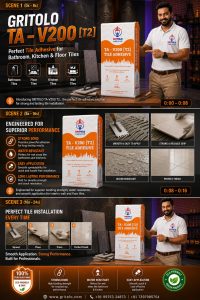
Tile adhesives are one of the most essential construction chemicals today. They provide superior bonding, flexibility, and durability compared to traditional cement mortar.
Types of Tile Adhesives (T1, T2, T3, T4 Explained)
Tile adhesives are classified based on strength and application:
T1 Adhesive (Basic Grade)
- Suitable for small ceramic tiles
- Used in low-traffic areas
- Cost-effective option
T2 Adhesive (Standard Grade)
- Ideal for medium-sized tiles
- Suitable for walls and floors
- Better bonding strength than T1
T3 Adhesive (High Performance)
- Used for vitrified tiles and large formats
- Suitable for both indoor and outdoor use
- Strong grip and water resistance
T4 Adhesive (Premium Grade)
- Designed for heavy-duty applications
- Ideal for large slabs, stone, and high-load areas
- Maximum bonding strength and durability
Why Different Applications Need Different Adhesives
Wall-to-Wall Applications
- Require lighter adhesives
- Need anti-slip properties
- Prevent tiles from sliding
Floor-to-Floor Applications
- Require high compressive strength
- Must handle heavy loads and traffic
- Need flexibility to avoid cracks
Using the wrong adhesive can lead to:
- Tile detachment
- Hollow sounds
- Long-term structural damage
Why Tile Adhesives Are Better Than Cement
- 3X stronger bonding
- Faster application
- Reduced curing time
- Minimal wastage
- Better finish
This is why choosing the best tile adhesive brands in India is critical for long-lasting results.
Ready Mix Plaster – The Game Changer
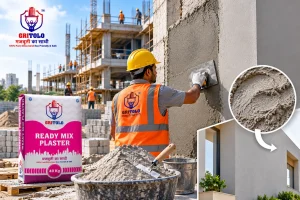
Ready mix plaster is revolutionizing wall finishing in modern construction.
⚖️ Ready Mix Plaster vs Traditional Plaster
| Factor | Traditional Plaster | Ready Mix Plaster |
|---|---|---|
| Quality | Inconsistent | Factory-controlled |
| Sand Sieving | Required | Not needed |
| Application Speed | Slow | Fast |
| Wastage | High | Minimal |
| Finish | Uneven | Smooth |
Key Benefits of Ready Mix Plaster
- Consistent quality in every batch
- Faster project completion
- Reduced labor dependency
- Smooth and crack-free finish
- Eco-friendly and sustainable
Cost-Benefit Analysis (5 Years)
Although ready mix plaster may seem slightly expensive initially, it saves money in the long run:
- Lower maintenance costs
- Reduced repair work
- Faster project delivery
- Less labor cost
This makes ready mix plaster benefits far outweigh traditional methods.
Structural Integrity with Block Jointing Mortar
Modern construction increasingly uses AAC (Autoclaved Aerated Concrete) blocks due to their lightweight and thermal properties.
However, using traditional cement mortar with AAC blocks is a major mistake.
Block Jointing Mortar vs Cement
| Feature | Cement Mortar | Block Jointing Mortar |
|---|---|---|
| Thickness | 10–12 mm | 3–5 mm |
| Bond Strength | Low | High |
| Material Usage | High | Low |
| Cracking | Common | Minimal |
Why Use Block Jointing Mortar?
- Stronger bonding
- Faster application
- Reduced dead load
- Better alignment of blocks
For modern construction, block jointing mortar vs cement is no longer a debate—specialized mortar clearly wins.
Advanced Floor Solutions
Flooring plays a crucial role in durability, especially in industrial and commercial spaces.
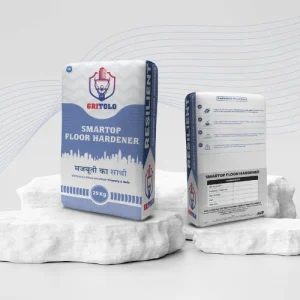
What Are Floor Hardeners?
Floor hardeners are materials applied to concrete surfaces to:
- Increase strength
- Improve wear resistance
- Reduce dust formation
Industrial vs Residential Use
Industrial Floors:
- Heavy machinery load
- High traffic
- Need abrasion resistance
Residential Floors:
- Moderate usage
- Focus on finish and durability
Benefits of Floor Hardeners
- Longer lifespan
- Low maintenance
- Improved surface strength
- Cost-effective over time
Advanced solutions like Smart floor hardeners are becoming essential in modern infrastructure projects.
Building Smarter with Construction Chemicals
The future of construction in India lies in efficiency, durability, and innovation. Traditional methods are no longer sufficient for modern building demands.
From tile adhesives to ready mix plaster and block jointing mortar, construction chemicals are transforming how structures are built.
By choosing the right materials, builders can:
- Reduce costs
- Improve quality
- Increase project speed
Investing in construction chemicals in India is no longer optional—it’s essential.
FAQ (People Also Ask)
Q1. What are construction chemicals?
A1. Construction chemicals are specialized materials used to improve strength, durability, and performance in construction projects.
Q2. Which is the best tile adhesive in India?
A2. The best tile adhesive depends on your application (T1–T4), tile size, and surface type.
Q3. Is ready mix plaster better than cement plaster?
A3. Yes, it offers better consistency, faster application, and reduced wastage.
Q4. Why use block jointing mortar?
A4. It provides stronger bonding and is ideal for AAC blocks compared to traditional cement.
A5. Are floor hardeners necessary?
Q5. Yes, especially for industrial floors where durability and load resistance are critical.