Non-Shrink Grout Uses: Machine Foundations, Base Plates and Concrete Gaps
Industrial construction and infrastructure projects require materials that can provide reliable support, fill spaces and transfer loads between structural components. One important material used for these purposes is non-shrink grout. It is commonly used beneath machine foundations, steel base plates, structural supports and other locations where a stable, well-filled connection is required.
In industrial facilities, even a small gap beneath a machine base plate can affect how loads are transferred to the concrete foundation. Similarly, an unfilled void beneath a structural bearing or an improperly grouted precast connection can create problems during service. Selecting an appropriate grout and following the correct installation procedure are therefore essential parts of construction quality.
Non-shrink grout uses extend across manufacturing plants, warehouses, commercial buildings, infrastructure projects, equipment installations and structural repair work. Depending on its formulation and approved applications, it can be used to fill spaces beneath equipment, support base plates, grout precast components and fill selected concrete cavities.
However, not every grout is suitable for every application. The correct product must be selected according to the gap dimensions, flow requirements, load conditions, substrate, exposure environment and project specification.
In this guide, we explain what non-shrink grout is, where it is used, how it supports machine foundations and base plates, how it fills concrete gaps, and what contractors should consider during product selection and application. We also introduce Gritolo Powergrout GT2 and its published technical information.
What Is Non-Shrink Grout?
Non-shrink grout is a specially formulated material designed to fill a space while controlling volume changes during its setting and hardening process. It is commonly supplied as a pre-blended powder that is mixed with a specified quantity of water before application.
Cementitious non-shrink grouts generally contain selected cementitious binders, graded aggregates, fillers and additives. Depending on the formulation, these components help provide workability, flow characteristics, strength development and shrinkage compensation.
Unlike ordinary site-mixed cement mortar, a factory-formulated grout is designed for particular installation conditions. Some products are intended to flow into narrow or complex spaces, while others are designed for a stiffer or dry-pack consistency.
Important characteristics of non-shrink grout
1. Controlled volume change
Non-shrink grout is formulated to control shrinkage during setting and hardening. This is important where the grout is expected to maintain contact between two surfaces.
2. Flowability
Certain products are designed to flow through confined spaces beneath base plates, machinery and structural supports. Flowability varies by product and mixing consistency.
3. Compressive strength
Grout used for load-bearing applications must meet the strength requirements specified by the project engineer. Strength values should be evaluated using the manufacturer’s stated test method and curing conditions.
4. Workability
A suitable grout should be workable enough to place within the available installation time without compromising its intended performance.
5. Load transfer
When correctly selected and installed, non-shrink grout can provide continuous bearing contact between a concrete foundation and an equipment or structural base.
6. Application flexibility
Different grout formulations are available for machine foundations, base plates, precast connections, cavities and other precision-grouting requirements.
It is important to understand that the term “non-shrink” does not mean that a material can never experience dimensional changes or installation defects. Performance depends on the formulation, mixing, placement, curing and service conditions.
Why Is Non-Shrink Grout Used in Construction?
Construction components often need to be connected through a controlled filling material. For example, a steel base plate may be positioned above a concrete foundation, leaving a gap between the two surfaces.
The grout fills this space and helps create the intended bearing connection.
The main reasons for using non-shrink grout include:
- Filling gaps beneath equipment and structural base plates.
- Supporting machine foundations and industrial equipment.
- Maintaining contact between steel and concrete surfaces.
- Filling selected voids and recesses.
- Supporting precast concrete connections where specified.
- Grouting bearing plates and other structural components.
- Providing a suitable filling material for certain repair and anchoring applications.
Non-shrink grout vs ordinary cement mortar
| Parameter | Non-shrink grout | Ordinary cement mortar |
|---|---|---|
| Formulation | Factory-designed formulation for specified grouting applications | Often prepared using cement, sand and water |
| Volume control | Designed for controlled shrinkage compensation | Shrinkage depends on mix proportions and curing |
| Flow characteristics | Available in flowable and other specified consistencies | Usually more plastic or stiff |
| Application | Precision grouting, base plates and selected voids | General masonry, plastering and other mortar work |
| Strength | Product-specific tested performance | Depends on mix design and site preparation |
| Placement | Follows specific grouting procedures | Conventional mortar placement methods |
The two materials are not interchangeable. A conventional mortar should not automatically be used where the project specification requires a precision non-shrink grout.
Non-Shrink Grout Uses in Industrial Construction
Non-shrink grout has several applications in industrial and civil engineering projects. The specific uses depend on the product’s approved technical scope.
Machine Foundations
Machine foundations are one of the most important applications of non-shrink grout.
Industrial equipment such as pumps, compressors, generators, turbines, production machinery and processing systems is installed on concrete foundations or plinths.
The equipment is usually positioned and aligned before the space beneath its base is filled with grout.
The grout provides a bearing layer between the equipment base and the prepared concrete foundation.
Why is grout used for machine foundations?
- To fill the space between the machine base and foundation.
- To provide the designed bearing contact.
- To support load transfer to the concrete foundation.
- To fill spaces around prepared support points.
- To help maintain the intended equipment alignment when the complete system is properly designed and installed.
Example: A manufacturing plant installs a large industrial pump on a reinforced concrete foundation. The pump is positioned and levelled using the specified installation arrangement. The space beneath the machine base is then filled with a suitable precision grout.
After the grout has reached the specified condition, the equipment installation can proceed according to the approved method statement.
The grout selection must consider equipment loads, vibration, operating temperature, chemical exposure, foundation design and the manufacturer’s installation requirements.
For highly dynamic machinery, severe impact or demanding chemical environments, an epoxy grout or another specialist system may be more appropriate than a standard cementitious grout. Engineering review is recommended.
Steel Base Plate Grouting
Steel base plates are commonly used to connect structural steel columns, industrial equipment and support systems to concrete foundations.
A base plate transfers loads from the supported component to the foundation through the designed connection.
However, the concrete surface and underside of the steel plate may not make complete contact immediately after positioning. A controlled gap is often provided for grouting.
Non-shrink grout is placed in this gap to create the intended bearing interface.
Common applications include:
- Steel column base plates.
- Industrial equipment base plates.
- Structural support plates.
- Machinery mounting plates.
- Pipe support bases.
- Pre-engineered building support connections, where specified.
Why is proper base plate grouting important?
A properly designed and installed grout layer helps distribute the intended bearing pressure over the contact area. It also fills spaces that would otherwise remain unsupported.
The installation should include correct levelling, formwork, grout placement and curing. The anchor bolts and base plate must be designed and installed according to the structural drawings.
Grout should not be expected to correct an incorrectly designed base plate or an unsuitable foundation.
Filling Gaps Under Equipment Supports
Industrial facilities often contain equipment mounted on steel supports, brackets, frames and concrete pedestals.
During installation, small or large gaps may remain between the support and the prepared concrete surface.
Depending on the product’s approved thickness and placement requirements, non-shrink grout may be used to fill these spaces.
Examples include:
- Equipment support frames.
- Pump skids.
- Compressor support systems.
- Steel support structures.
- Industrial mounting arrangements.
- Selected bearing and support assemblies.
The grout should be selected according to the gap geometry and required flow characteristics. Very narrow gaps, deep pours or complicated formwork may require a specialised product or placement method.
Precast Concrete Connections
Precast construction involves manufacturing concrete elements separately and assembling them at the project location.
Connections between precast components may contain pockets, recesses, joints or designated grouting spaces.
Depending on the structural design, a suitable grout may be specified to fill these spaces.
Examples include:
- Precast column connections.
- Structural pockets.
- Selected beam and column connection details.
- Precast support components.
- Designated connection recesses.
The grout must be compatible with the connection design, reinforcement arrangement and structural requirements.
Do not assume that a general-purpose grout can be used for every precast connection. Follow the engineer’s specification and the product manufacturer’s approval.
Concrete Gaps, Cavities and Recesses
Another important application of non-shrink grout is filling selected gaps and cavities in concrete structures.
These may occur during construction, installation or repair work.
Examples include:
- Designed grouting recesses.
- Voids beneath bearing plates.
- Selected equipment pockets.
- Prepared concrete cavities.
- Spaces around specified support components.
- Certain precast connection gaps.
Before filling a concrete gap, identify why the gap exists.
A designed recess is different from an accidental structural crack. A grout suitable for filling a prepared pocket may not be appropriate for repairing a moving crack or a structural defect.
For structural cracks, leakage paths or damaged concrete, obtain an appropriate repair specification before selecting a product.
Micro Piles and Pile Caps
Certain non-shrink grout products are designed for applications involving micro piles, pile caps and related foundation components.
The grout may be used in a specified filling or connection role as part of the engineered foundation system.
Important considerations include:
- The designed load path.
- Grout strength requirements.
- Reinforcement and anchoring details.
- Placement depth.
- Flow and filling requirements.
- Groundwater and exposure conditions.
- The structural engineer’s approved method.
The grout should never be selected solely because it is described as high strength. Its suitability for the actual foundation detail must be confirmed.
Structural Support and Bearing Applications
Non-shrink grouts are also used in selected structural bearing applications.
Examples may include bearing plates, bridge bearing arrangements and support connections where the design requires a precision grout.
These applications can involve demanding load, movement and exposure conditions. The product must meet the project specification and the relevant engineering requirements.
How Does Non-Shrink Grout Work Beneath Machine Foundations?
To understand the importance of grout in machine installations, consider the space between a concrete foundation and a steel machine base.
If the two surfaces are not in full contact, the equipment may be supported only at selected points. This can create uneven bearing conditions.
A properly specified grout fills the intended space and forms a bearing layer after hardening.
Step 1: Position the machine
The machine is placed on its prepared foundation using the specified levelling arrangement.
Step 2: Align the equipment
The installation team checks the machine’s level, elevation and alignment according to the equipment manufacturer’s requirements.
Step 3: Prepare the concrete
The concrete surface is cleaned and prepared to provide a suitable bonding and bearing interface.
Step 4: Install formwork
Temporary formwork is installed around the grouting area. It must be sufficiently strong and sealed to prevent grout leakage.
Step 5: Mix the grout
The grout is mixed using the specified water quantity and mixing procedure.
Step 6: Place the grout
The material is placed from the designated side or pouring point so that it can fill the prepared space and allow air to escape.
Step 7: Cure and protect
The grout is protected and cured according to the manufacturer’s instructions.
Step 8: Complete the equipment installation
Anchor tightening, removal of temporary supports and equipment commissioning are carried out only at the stages approved by the project engineer and equipment manufacturer.
The installation sequence is important because grouting, anchor tensioning and equipment alignment can influence one another.
How to Select the Right Non-Shrink Grout
Choosing the correct non-shrink grout requires more than comparing product strength values.
The product must be suitable for the actual application and placement conditions.
Identify the Application
First, determine where the grout will be used.
Is it required for:
- Machine foundations?
- Steel base plates?
- Structural support plates?
- Precast connections?
- Concrete recesses?
- Micro piles or pile caps?
- Selected concrete repairs?
Different applications can require different material characteristics.
Check the Required Compressive Strength
Compressive strength is an important parameter for many grout applications.
However, strength should not be considered in isolation.
Check:
- 1-day strength, where early loading is relevant.
- 3-day and 7-day strength, where specified.
- 28-day compressive strength.
- Test method.
- Specimen dimensions.
- Curing conditions.
- Project design requirements.
A strength value measured using one specimen size or test method should not be directly compared with a value measured using another method without considering the differences.
Evaluate Flowability
Flowability is important when grout must pass beneath a base plate or fill a confined space.
The product should be capable of reaching the required area without excessive segregation, bleeding or trapped air under the specified placement conditions.
The required consistency should be selected according to the application and product instructions.
Check the Grouting Thickness
Every grout product has a recommended minimum and maximum placement thickness or application range.
Before purchasing, check whether the product can be used in the intended gap.
For deeper or larger pours, the manufacturer may specify special placement procedures or a different product.
Consider Operating Conditions
For industrial equipment, consider:
- Static and dynamic loads.
- Vibration.
- Impact.
- Operating temperature.
- Exposure to oils and chemicals.
- Water exposure.
- Maintenance requirements.
A standard cementitious grout may be suitable for many applications, but certain severe operating conditions may require epoxy or another specialist grout.
Review the Product Technical Data Sheet
Always obtain the latest technical data sheet before specifying or applying grout.
Important details include:
- Product description.
- Intended applications.
- Mixing-water ratio.
- Flow characteristics.
- Compressive strength.
- Working time.
- Application thickness.
- Substrate preparation.
- Placement method.
- Curing requirements.
- Storage and shelf life.
The technical data sheet and approved project specification should guide product selection.
Gritolo Powergrout GT2 for Precision Grouting Applications
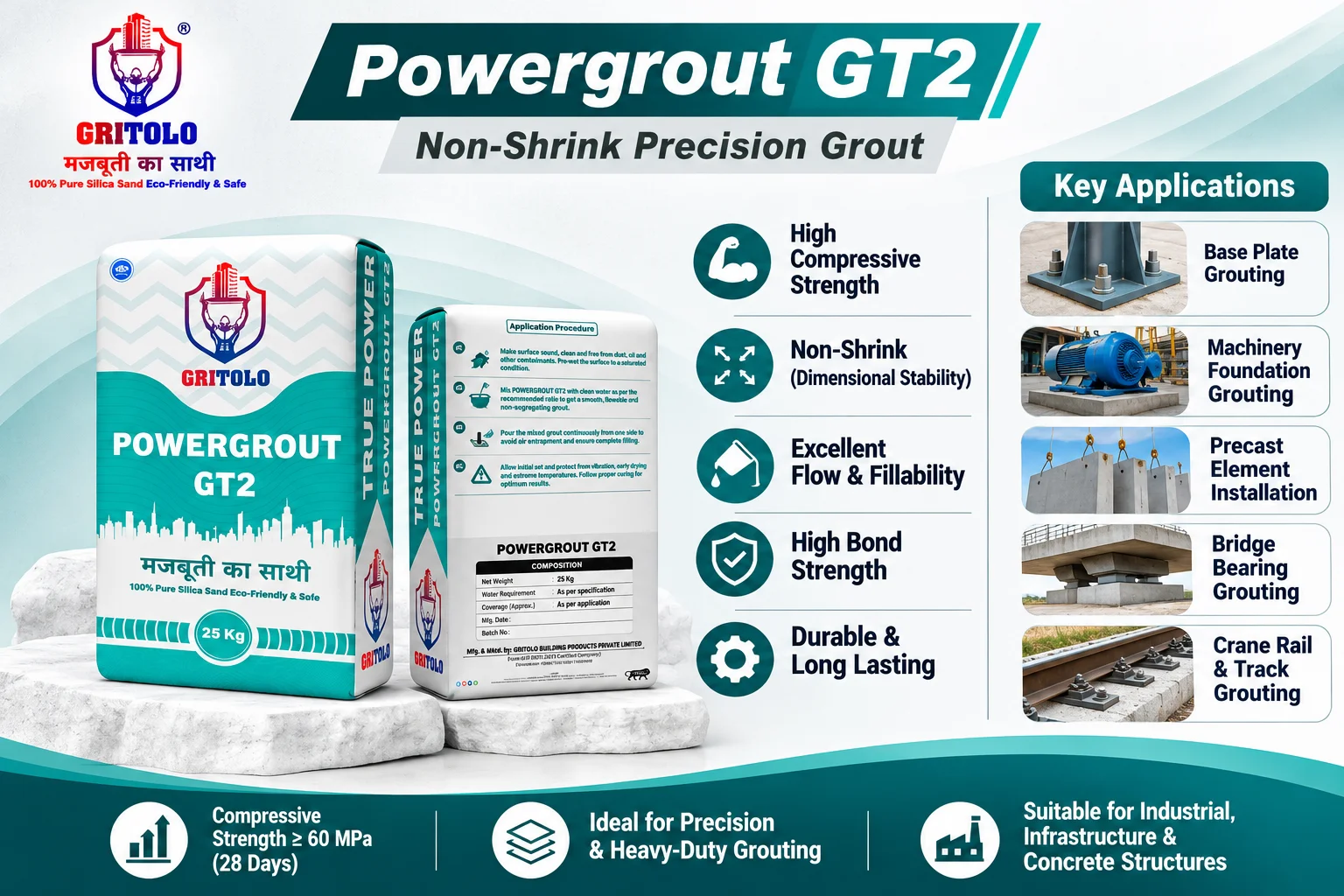
Gritolo Powergrout GT2 is a cement-based, non-shrink grout developed for precision grouting applications in construction and civil engineering.
According to Gritolo’s published product information, Powergrout GT2 is a single-component grout enhanced with polymers and selected fillers. It is described as self-compacting and suitable for demanding applications such as machine foundations, foundation base plates and precast elements.
Published applications of Powergrout GT2
The Gritolo product page identifies the following application areas:
- Foundation base plates.
- Machine foundations.
- Micro piles and pile caps.
- Shear wall bond beams.
- Precast element anchoring.
- High-strength pavers and block manufacturing.
Published compressive strength information
Gritolo publishes the following compressive strength figures for Powergrout GT2:
| Test method | Specimen size | 1 day | 3 days | 7 days | 28 days |
|---|---|---|---|---|---|
| ASTM method | 50 mm cube | 30–35 MPa | 40–45 MPa | 60–65 MPa | Up to 80 MPa |
| IS method | 70.6 mm cube | 25–30 MPa | 35–40 MPa | 55–60 MPa | Up to 80 MPa |
These are figures published by Gritolo on its product page. Confirm the current approved technical data sheet, test conditions and applicable product specification before using these values for engineering design or project approval.
Why consider Powergrout GT2?
1. Non-shrink formulation
The product is described as a non-shrink grout intended for precision filling applications.
2. Self-compacting characteristics
Its published product description identifies self-compacting properties for easier placement in suitable grouting applications.
3. High-strength application
Gritolo publishes a 28-day compressive strength of up to 80 MPa under the stated test methods.
4. Multiple application areas
Its published application list includes machine foundations, base plates, precast elements, micro piles and pile caps.
5. Single-component product
The product is supplied as a single-component grout requiring preparation according to the manufacturer’s mixing instructions.
Which Powergrout GT2 applications should you consider?
For a machine foundation or steel base plate, first confirm that the product’s current technical data sheet covers the required gap thickness, placement consistency, load conditions and exposure environment.
For concrete cavities or structural connections, obtain technical confirmation that the specific repair or filling application is within the approved product scope.
Explore the Gritolo Powergrout GT2 product page for published product information and technical details.
Step-by-Step Application of Non-Shrink Grout
Correct installation is essential for achieving the intended performance of non-shrink grout.
The following is a general application sequence for cementitious precision grouting. Always follow the product-specific method statement and technical data sheet.
Step 1: Inspect the Foundation
Check that the concrete foundation is sufficiently strong, stable and ready for grouting.
Confirm that the concrete has reached the required condition and that any specified curing period has been completed.
Step 2: Prepare the Surface
Remove:
- Dust.
- Loose concrete.
- Laitance.
- Oil and grease.
- Paint and unsuitable coatings.
- Other contaminants that may interfere with bonding.
Use a suitable mechanical or cleaning method without damaging the sound concrete below.
Step 3: Prepare the Steel Base
Clean the underside of the base plate and remove contaminants that may interfere with the intended installation.
Check the steel surface requirements specified by the equipment manufacturer and grout supplier.
Step 4: Install Formwork
Provide strong, leak-resistant formwork around the grouting area.
The formwork should allow grout to enter the gap and air to escape.
For larger base plates, the pouring arrangement and headbox may need to be planned in advance.
Step 5: Pre-Wet the Concrete if Required
Some cementitious grout systems require the concrete substrate to be pre-wetted and brought to a saturated surface-dry condition.
Remove standing water immediately before placement.
Follow the product instructions because moisture preparation requirements can vary.
Step 6: Measure the Mixing Water
Use the exact water quantity specified by the manufacturer.
Do not add excess water to make the grout flow more easily. This may affect the intended performance.
Step 7: Mix Thoroughly
Use suitable mechanical mixing equipment.
Follow the specified mixing time and sequence until the mixture reaches the recommended consistency.
Avoid introducing unnecessary air into the mixture.
Step 8: Place the Grout Continuously
Place the grout from one side or the designated pouring point to allow the material to flow beneath the base plate.
Maintain a suitable head of grout where the installation method requires it.
Avoid placing material from multiple directions if doing so could trap air.
Step 9: Allow Air to Escape
Ensure that the installation arrangement includes suitable air-release paths.
Do not obstruct vent openings or create conditions that prevent complete filling.
Step 10: Protect and Cure
Protect the fresh grout from rapid moisture loss, direct sunlight, strong wind, rain and other unsuitable conditions.
Use the curing method specified by the manufacturer.
Step 11: Inspect the Completed Grouting
After the grout has hardened sufficiently, inspect the installation for visible defects, leakage paths or incomplete filling.
Do not load the equipment or tighten anchors beyond the approved installation sequence until the specified strength and acceptance requirements have been met.
Common Mistakes to Avoid During Non-Shrink Grouting
Even a suitable grout can perform poorly when installation procedures are not followed.
Mistake 1: Selecting Grout Only by Compressive Strength
A high compressive strength value does not automatically make a grout suitable for every application.
Solution: Check strength, flowability, volume stability, working time, thickness and exposure requirements together.
Mistake 2: Poor Concrete Surface Preparation
Dust, laitance, grease and weak concrete can interfere with the intended contact.
Solution: Prepare the substrate thoroughly and remove unsound material before grouting.
Mistake 3: Adding Excess Water
Too much water may change the grout’s consistency and performance.
Solution: Measure water accurately and follow the manufacturer’s mixing instructions.
Mistake 4: Using Inadequate Formwork
Weak or poorly sealed formwork can allow grout to escape.
Solution: Check the formwork before mixing. Seal joints and provide sufficient strength to withstand the placement pressure.
Mistake 5: Trapping Air Beneath Base Plates
Incorrect pouring arrangements may prevent grout from reaching all areas beneath a base plate.
Solution: Plan the pouring point, flow direction and venting arrangement before placement.
Mistake 6: Grouting Before Equipment Alignment
If the machine is not correctly positioned and aligned, the grout may lock an incorrect installation position.
Solution: Complete alignment checks and obtain the required approval before grouting.
Mistake 7: Ignoring the Recommended Thickness
Using a grout outside its approved placement thickness may lead to poor installation results.
Solution: Confirm the gap dimensions and select a product designed for that thickness.
Mistake 8: Not Protecting Fresh Grout
Rapid moisture loss or unsuitable environmental conditions can affect the hardening process.
Solution: Follow the manufacturer’s curing and protection requirements.
Mistake 9: Loading the Installation Too Early
Applying loads before the grout has achieved the required strength can compromise the installation.
Solution: Follow the specified strength and loading criteria before commissioning equipment.
Mistake 10: Using Cementitious Grout in Every Industrial Environment
Some equipment may operate under severe vibration, impact, chemical exposure or elevated temperatures.
Solution: Obtain engineering advice and consider a specialist epoxy or other grout system where required.
Non-Shrink Cementitious Grout vs Epoxy Grout
Non-shrink cementitious grout and epoxy grout are both used in precision grouting, but they are not identical materials.
| Parameter | Cementitious non-shrink grout | Epoxy grout |
|---|---|---|
| Base material | Cementitious binder and aggregates | Epoxy resin and hardener system |
| Mixing | Commonly mixed with a specified quantity of water | Mixed according to resin and hardener instructions |
| Typical applications | Machine bases, base plates, selected structural connections | Selected high-demand machinery and chemical-exposure applications |
| Flow | Product-specific | Product-specific |
| Chemical resistance | Depends on formulation and exposure | Often selected where higher chemical resistance is required |
| Cost | Often more economical for suitable applications | Can have a higher material cost |
| Selection | Based on project design and grout specifications | Based on project design and grout specifications |
When should cementitious non-shrink grout be considered?
It may be appropriate for equipment bases, structural base plates and selected precast or concrete grouting applications when the product meets the project requirements.
When should epoxy grout be considered?
Epoxy grout may be considered for applications requiring specific chemical resistance, high impact resistance or other specialist properties.
The final decision should be based on engineering requirements, operating conditions, manufacturer guidance and total installation cost.
How to Estimate Non-Shrink Grout Quantity
Estimating grout quantity before beginning work helps contractors plan material procurement and reduce project delays.
For a simple rectangular gap, the approximate wet volume can be calculated using:
Volume = Length × Width × Gap Thickness
All dimensions must be converted into the same units.
Example calculation
Assume a steel base plate has:
- Length = 1,000 mm
- Width = 800 mm
- Grout gap = 50 mm
Convert the dimensions into metres:
- Length = 1.0 m
- Width = 0.8 m
- Gap = 0.05 m
Volume:
1.0 × 0.8 × 0.05 = 0.04 cubic metres.
Therefore, the theoretical space to be filled is 0.04 m³, or 40 litres.
This is the geometric volume only. Actual material requirements may be affected by the formwork arrangement, irregularities, equipment pockets, leakage, wastage and the grout’s yield.
How many bags are required?
Number of bags = Required grout volume ÷ Published yield per bag
For example, if the approved product TDS states a yield of 13 litres per bag:
40 ÷ 13 = approximately 3.08 bags.
The theoretical requirement would be slightly more than three bags. The contractor should order an appropriate additional allowance based on the actual site conditions and project requirements.
The 13-litre yield in this example is illustrative only, not a stated yield for Gritolo Powergrout GT2. Use the current approved product yield for actual calculations.
For irregular concrete cavities, use measured dimensions or an appropriate volume estimate prepared by the site engineer.
Safety and Quality Control During Grouting
Non-shrink grout installation should be carried out using appropriate safety and quality-control procedures.
Personal protection
Cement-based grout is alkaline when wet and can irritate skin and eyes.
Workers should use:
- Suitable gloves.
- Safety goggles.
- Protective clothing.
- Appropriate footwear.
- Dust protection during powder handling where required.
Follow the product’s safety data sheet for detailed precautions.
Quality-control checks
Before placement, verify:
- Correct product and batch.
- Product shelf life.
- Packaging condition.
- Mixing-water quantity.
- Mixing equipment.
- Ambient and substrate conditions.
- Formwork arrangement.
- Pouring and venting provisions.
During and after placement, record the batch details, mixing procedure, application time, curing method and required test results according to the project quality plan.
For critical machinery and structural applications, inspection and acceptance should be carried out by qualified personnel.
Frequently Asked Questions About Non-Shrink Grout
Q1. What is non-shrink grout used for?
Non-shrink grout is used to fill designated spaces beneath machine foundations, steel base plates, structural supports and selected precast concrete connections. It can also be used for suitable concrete cavities and recesses where the product is approved.
Q2. Why is non-shrink grout used under machine foundations?
It fills the space between the machine base and concrete foundation, helping provide the intended bearing contact and load-transfer interface. The grout must be selected according to the equipment’s operating and design conditions.
Q3. Can non-shrink grout be used under steel base plates?
Yes. Suitable cementitious non-shrink grout is commonly used beneath steel base plates when specified by the structural or equipment design. Proper alignment, surface preparation, formwork and placement are important.
Q4. Can non-shrink grout fill concrete gaps?
It can fill selected concrete gaps, recesses and cavities when the product’s approved application range and placement thickness allow it. It should not be used as a universal repair material for every crack or structural defect.
Q5. What is the difference between non-shrink grout and cement mortar?
Non-shrink grout is a factory-formulated material designed for controlled volume change and specific grouting performance. Ordinary cement mortar is generally used for other construction tasks and should not automatically replace precision grout.
Q6. Is non-shrink grout suitable for heavy machinery?
It can be suitable for some heavy machinery foundations, provided that the selected product meets the required strength, stiffness, flowability, thickness and durability criteria. Highly dynamic machinery may require a specialist grout system.
Q7. Is non-shrink grout waterproof?
Do not assume that every non-shrink grout is waterproof. Water resistance depends on the formulation, installation and exposure conditions. A separate waterproofing system may be required.
Q8. How do I calculate non-shrink grout quantity?
Calculate the space volume using length × width × thickness. Divide the required volume by the manufacturer’s published yield per bag. Add a suitable allowance for site conditions and wastage.
Q9. Can non-shrink grout be used for anchor bolts?
Some grout products are approved for specified anchoring applications. However, anchor bolt installation often requires a dedicated anchoring grout or resin system. Check the product approval and structural design before use.
Q10. What is Gritolo Powergrout GT2?
Gritolo Powergrout GT2 is a cement-based non-shrink grout described by Gritolo as a single-component, polymer-enhanced product for precision grouting. Its published applications include machine foundations, foundation base plates, micro piles, pile caps and precast element anchoring.
Q11. What compressive strength does Powergrout GT2 provide?
Gritolo publishes compressive strength values of up to 80 MPa at 28 days under its stated ASTM and IS test methods. Refer to the current approved technical data sheet for the applicable specifications and test conditions.
Q12. Can non-shrink grout be used for precast concrete elements?
Certain grout products are designed for selected precast connections and anchoring applications. Confirm that the product meets the structural connection specification before use.
Conclusion
Non-shrink grout is an important construction material for applications that require controlled filling and a reliable bearing connection between components. Its uses include machine foundations, steel base plates, equipment supports, precast connections and selected concrete gaps or recesses.
However, choosing the right grout requires more than looking at a product’s compressive strength. Contractors and engineers should evaluate the application, gap dimensions, flow requirements, substrate condition, load characteristics, operating environment and curing requirements.
Correct surface preparation, accurate mixing, suitable formwork, continuous placement and proper curing are equally important for achieving the intended performance.
Gritolo Powergrout GT2 is one product option for precision grouting applications. Gritolo’s published product information identifies it for machine foundations, foundation base plates and other specified construction applications, with compressive strength values of up to 80 MPa at 28 days under the stated test methods.
Before specifying or applying the product, review its latest technical data sheet and confirm that it meets the project’s engineering requirements.
Looking for a non-shrink grout solution for machine foundations or base plates?
Explore Gritolo Powergrout GT2 to review its published applications and product information. Contact the Gritolo team for application-specific guidance and technical documentation.