Smartop Floor Hardener: What It Is, How It Works, and Where to Use It
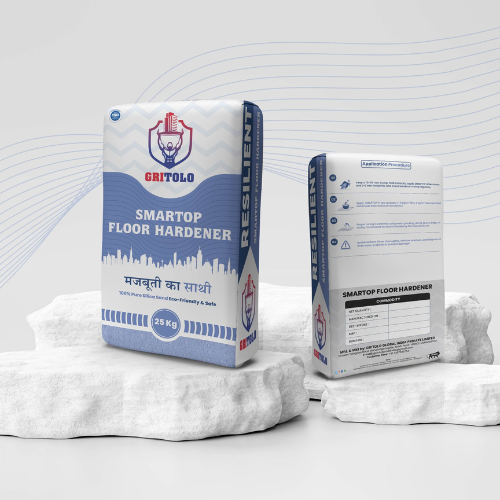
Smartop Floor Hardener is Gritolo’s premium non-metallic, dry-shake floor hardener for industrial use in India. It is a factory-blended powder — high-strength cement, quartz/silica aggregates, and performance polymers — that is shaken onto fresh concrete and power-troweled in to create a dense, monolithic, abrasion-resistant surface. It increases wear resistance by 200–300% over bare concrete, eliminates concrete dusting, resists oils and greases, and is available in Terracotta Red, Forest Green, and Natural Grey. It requires no re-coating and is ideal for warehouses, factories, parking areas, and food processing plants across India.
If you are specifying or managing an industrial floor anywhere in India — a warehouse, a logistics hub, a manufacturing plant, or a multi-level car park — the question of floor treatment is going to come up sooner or later. Bare concrete is not enough. It dusts. It wears under forklifts and foot traffic. It absorbs oil spills. And once it deteriorates, the repair and downtime costs can far exceed the cost of protecting the floor properly from day one.
This guide covers everything a project manager, civil engineer, contractor, or procurement specialist needs to know about Smartop Floor Hardener — Gritolo’s own-manufactured, non-metallic dry-shake floor hardener purpose-built for Indian industrial conditions. We cover how it works at a technical level, why non-metallic outperforms metallic for the vast majority of Indian projects, how to apply it correctly, where it should and should not be used, and how it compares to epoxy and other alternatives.
What Is Dry-Shake Floor Hardener? The Science Explained
Dry-shake floor hardener is a factory-blended powder compound containing high-strength hydraulic cement, precisely graded mineral or metallic aggregates, and performance-enhancing polymers. The name comes directly from its application method: the dry powder is literally shaken (broadcast) over fresh, still-wet concrete immediately after the initial float, then power-troweled into the surface.
This is not a coating. It is not applied after the concrete has cured. The critical distinction is that the dry-shake process integrates the hardener compound with the concrete paste itself — as the troweling drives the powder in, it reacts with the concrete’s free water and the cement paste rising to the surface to form a high-density ‘cap’ layer that is entirely monolithic with the slab beneath. The result is a hardened surface that cannot delaminate or peel away, unlike paint, epoxy coatings, or tiles.
Why This Matters for Industrial Floors in India
India’s industrial floors face a specific combination of stresses — heavy forklift traffic, temperature swings across seasons, oil and grease spills, and the structural movement that comes with large, live-loaded slabs. A coating applied on top of concrete can resist some of these stresses, but it remains bonded to the surface only by adhesion. A dry-shake hardener becomes the surface — which is why it outlasts coatings by decades in demanding conditions.
Smartop Floor Hardener: What Makes It Different
Gritolo’s Smartop Floor Hardener is a non-metallic dry-shake compound, which places it in the quartz and silica aggregate category under the IS and international floor hardener classification system. Here is what that means in practice:
- Aggregate type: High-quality quartz and silica aggregates, precision-graded to maximise packing density within the cement matrix. These aggregates rate 7–8 on the Mohs hardness scale — significantly harder than the concrete surface itself.
- Polymer content: Advanced polymer additives improve the binding matrix, enhance the working consistency during application, and increase the final surface density and chemical resistance.
- Cement binder: High-strength hydraulic cement ensures reliable integration with the base concrete, regardless of the ambient conditions typical on Indian sites.
- Zero rust risk: Unlike metallic floor hardeners containing iron filings or steel chips, Smartop contains no ferrous material whatsoever. It will not rust, oxidise, or produce brown staining — even in humid or wet environments.
- Available colours: Terracotta Red, Forest Green, and Natural Grey — giving site managers and architects the ability to permanently colour-code walkways, safety zones, and work areas without paint that fades and peels.
Gritolo Smartop increases the abrasion resistance of treated concrete floors by 200–300% compared to untreated bare concrete of the same grade — based on standard abrasion resistance testing. This means a floor that might show significant surface wear within 3–5 years without treatment can realistically last 15–20 years or more with Smartop, depending on traffic conditions.
Metallic vs Non-Metallic Floor Hardener: Which Should You Specify for Your Project?
One of the most common questions from engineers and procurement teams specifying a floor hardener for industrial use in India is whether to choose metallic or non-metallic. The answer is almost always non-metallic — and here is the detailed comparison to explain exactly why, with the exceptions clearly noted.
| Feature | Smartop (Non-Metallic) | Metallic Hardener | Epoxy Coating |
| Composition | Quartz / Silica aggregates + cement + polymers | Iron filings / steel chips + cement | Liquid resin system |
| Abrasion resistance | Very high (200–300% over bare concrete) | Extreme | High (depends on coat thickness) |
| Rust risk | None — will not rust or stain | Rusts if exposed to moisture | None |
| Impact resistance | High | Extreme | Moderate to high |
| Chemical resist. | Good (oils, greases, mild chemicals) | Good | Excellent (acids, solvents) |
| Available colours | Terracotta Red, Forest Green, Natural Grey | Grey only | Wide range (topcoat) |
| Water / wet areas | Suitable | Not suitable — rusts | Suitable |
| Best for | Warehouses, factories, parking, food processing | Foundries, heavy steel industries | Labs, pharma, food-grade sterile areas |
| Cost (per sq ft) | Low – medium | High | High to very high |
| Maintenance | Fit and forget — cleaning only | Periodic rust treatment | Re-coating every 5–8 years |
When to Choose Non-Metallic (Smartop) — 95% of Indian Industrial Projects
- Warehouses and distribution centres — forklifts, pallet jacks, and pedestrian traffic
- Manufacturing plants — medium to heavy machinery on floors not exposed to foundry-level impact
- Multi-storey and surface car parks — vehicle traffic, moisture exposure, and the requirement to avoid rust staining
- Food processing plants and cold storage facilities — hygiene, no rust contamination risk, and cleanability
- Pharmaceutical and healthcare facilities — non-metallic, non-conductive, and cleanable
- Commercial loading bays and logistics hubs — heavy truck traffic, chemical spills, and operational intensity
When Metallic Hardener May Be Considered — the Narrow Exceptions
- Foundries and heavy forge shops where extreme point-impact loads from dropped heavy steel are the primary stress
- Tank repair shops and heavy steel fabrication areas where moisture is controlled and rust staining is not a concern
For the vast majority of industrial construction in India — from Pune’s Chakan belt to Mumbai’s warehousing corridors, from Chennai’s auto-component factories to Hyderabad’s pharmaceutical parks — non-metallic floor hardener such as Smartop is the correct and preferred specification.
Where to Use Smartop Floor Hardener: Industry-by-Industry Guide
Warehouses and Logistics Centres
This is Smartop’s home territory. The combination of constant forklift traffic, point loads from racking bases, heavy pallet drops, and the frequent passage of loaded trolleys makes warehouse flooring one of the most demanding applications for any floor surface. Bare concrete in a busy warehouse can show visible surface wear — rutting in forklift lanes, dusting in pedestrian areas — within 18–24 months. A Smartop-hardened floor distributes those loads more effectively and resists the abrasive grinding action of forklift wheels without any additional ongoing treatment.
For e-commerce fulfilment centres and modern logistics parks in India, where operations run on tight margins and floor downtime is simply not acceptable, Smartop offers a fit-and-forget solution from day one of operations.
Manufacturing and Industrial Plants
In manufacturing plants across Pune’s Pimpri-Chinchwad MIDC, Chakan, and Talegaon industrial zones, concrete floor quality is a recurring concern. Production lines place uneven loads on floor slabs; machinery vibration causes surface fatigue; coolant, oil, and chemical spills are part of daily operations. Smartop’s chemical resistance to oils, greases, and mild industrial chemicals directly addresses these conditions, whilst the coloured variant (Forest Green or Terracotta Red) allows clear demarcation of production zones and emergency access routes that remains visible for the lifetime of the floor.
Multi-Storey Car Parks and Surface Parking
Car parks are a deceptively demanding environment for concrete floors. Tyre rubber abrasion, fuel and oil drips, water ingress during monsoon, de-icing chemicals in colder regions, and the structural movement inherent in large exposed slabs all combine to stress the floor surface. The fact that Smartop does not rust makes it especially appropriate for parking structures where persistent damp from rain or car wash runoff would make a metallic hardener an unsuitable choice.
Food Processing and Cold Storage
Food processing facilities and cold storage warehouses in India have strict hygiene requirements that make floor specification particularly critical. Smartop’s non-metallic, non-rusting composition means there is no risk of iron contamination reaching production areas. The dense, low-porosity surface created by power-troweling also resists liquid penetration, making cleaning down easier and more effective — an important operational benefit in FSSAI-regulated environments.
Commercial and Institutional Floors
Beyond heavy industry, Smartop is equally appropriate for commercial workshops, institutional garages, hospital service areas, and large retail storage zones — any application where a durable, low-maintenance, presentable floor is required without the cost and periodic re-application of epoxy systems.
Step-by-Step Application Guide: How to Apply Dry-Shake Floor Hardener
Correct application is where the performance of a dry-shake floor hardener is made or lost. The timing window is tight and demands experienced, attentive site supervision. Follow this sequence precisely.
- Pour base concrete to design specification. Minimum Grade M25 concrete is recommended for floors receiving Smartop treatment. Ensure the sub-base is compacted and the concrete is poured, screeded, and floated uniformly.
- Monitor bleed water. Wait until the bleed water sheen on the concrete surface has completely evaporated. This is the critical timing call. Applying the dry shake too early — whilst bleed water is still present — will dilute and weaken the hardener layer. Applying too late, once the concrete has stiffened beyond workability, prevents proper integration. In Indian site conditions, this window typically opens 30–90 minutes after pouring, depending on temperature, humidity, and the concrete mix’s water-cement ratio.
- Apply the first shake — two-thirds of the dosage. Broadcast approximately two-thirds of the calculated dosage evenly across the surface. The Smartop powder will absorb moisture from the concrete and begin to darken. Allow it to become uniformly dark (typically 3–5 minutes) before troweling.
- Power-trowel the first application. Using a walk-behind or ride-on power trowel with float blades, work the first application into the concrete surface. The troweling action drives the hardener into the paste and begins to densify the surface. Overlap passes to avoid trowel marks.
- Apply the second shake — remaining one-third of dosage. Apply the remaining third of the dosage to provide a uniform final layer. Allow to darken again as before.
- Final power-trowel to finish. Follow up with a second troweling pass using finish blades if a smooth, high-density surface is required. The number of finish passes determines the final surface texture — more passes produce a smoother, harder finish.
- Apply a liquid curing compound or polyethene sheet immediately after troweling to retain moisture and ensure the hardener cures properly. In hot, dry, or windy Indian site conditions, curing is especially important to prevent premature drying, which can cause surface crazing or cracking.
Traffic management. Light foot traffic can typically commence within 24 hours. Forklift and heavy machinery trafficking should be deferred until the slab achieves adequate compressive strength — generally 7–14 days under normal Indian ambient conditions.
Critical On-Site Warning
The dry-shake window is unforgiving. Missing the correct bleed-water evaporation point is the most common cause of dry-shake floor hardener failure on Indian sites — either a diluted, under-strength finish from early application, or a poorly integrated, flaking surface from late application. Assign an experienced, dedicated supervisor to monitor this stage and do not allow other site activities to distract from it.
Dosage Reference: How Much Smartop Floor Hardener Do You Need?
Dosage for dry-shake floor hardener varies directly with the expected load and traffic intensity. Use this table for project planning and quantity estimation:
| Traffic / Use Category | Recommended Dosage | Typical Coverage (40 kg bag) |
| Light commercial / pedestrian | 3 – 4 kg per sq m | 10 – 13 sq m |
| Medium industrial / forklifts | 4 – 5 kg per sq m | 8 – 10 sq m |
| Heavy industrial / heavy machinery | 5 – 7 kg per sq m | 6 – 8 sq m |
For tender estimation, add a 5–10% wastage allowance to account for broadcast overspray at edges and any reapplication in areas that are difficult to access.
Smartop vs Epoxy vs Tiling: Choosing the Right Industrial Floor System
Engineers and project managers sometimes face a broader question beyond dry-shake hardener type — whether to specify dry-shake, epoxy, or a tiled floor system altogether. Here is a direct comparison to help make that call:
Dry-shake floor hardener is the right choice when the floor will face high-abrasion mechanical traffic (forklifts, machinery), when budget and time constraints favour a single-stage application during construction rather than a separate post-construction flooring contract, and when a durable, minimal-maintenance lifetime finish is the priority. Smartop fits this profile precisely.
Epoxy flooring is genuinely the right choice only for environments requiring resistance to strong acids and solvents, clinically sterile surfaces (pharmaceutical clean rooms, surgical areas), or where the floor surface must be impermeable to a specific range of chemicals beyond oils and greases. For everything else — warehouses, factories, car parks, food processing — epoxy’s higher cost, 5–8 year re-coating requirement, and susceptibility to surface delamination under heavy point loads make it a more expensive, higher-maintenance alternative that does not outperform a well-applied dry-shake floor.
Tiling is appropriate for areas requiring aesthetic flexibility, easy panel replacement, or specific hygiene requirements in food zones — but tiles cannot compete with a monolithic hardened floor on impact resistance, seamlessness for industrial vehicles, or lifetime maintenance cost.
Industrial Floor Hardener Specification Across Maharashtra and India
Pune’s Industrial Belt — MIDC, Chakan, Talegaon, Ranjangaon
Gritolo’s Smartop Floor Hardener is actively used across Pune’s industrial belt, where the concentration of automotive ancillary manufacturers, logistics parks, and engineering firms creates consistent demand for industrial-grade flooring solutions. In these environments, the combination of forklift intensity, oil and coolant exposure, and the need for operational continuity without floor downtime makes a dry-shake hardener specification the standard engineering choice.
Contractors in this region frequently encounter the challenge of tight construction schedules — the floor must be production-ready quickly. Smartop’s 24-hour pedestrian trafficking capability, combined with the fact that it requires no separate flooring contractor or post-cure application window, fits neatly into the compressed timelines of industrial shed construction across the Pune corridor.
Mumbai’s Logistics and Warehousing Sector
The expansion of organised warehousing in the Mumbai Metropolitan Region — particularly in Bhiwandi, Panvel, and Turbhe — has driven increasing specification of quality floor hardeners as logistics operators bring Indian Distribution Centre standards closer to international benchmarks. For these operators, the colour-coding capability of Smartop (using Forest Green for fire escape routes, Terracotta Red for hazard zones, and Natural Grey for general floor areas) provides a practical, permanent safety demarcation solution that paint cannot offer.
Pan-India Industrial Growth
Beyond Maharashtra, India’s expanding industrial park ecosystem — from Tamil Nadu’s automotive clusters to Gujarat’s chemical manufacturing zones and Rajasthan’s emerging logistics hubs — shares a common requirement: floor surfaces that perform from day one and do not require re-treatment within the asset’s working life. Smartop addresses this requirement across climatic zones, from humid coastal environments to the drier conditions of central and northern India.
Frequently Asked Questions
Q1. What is Smartop Floor Hardener and how does it work?
A1. Smartop is Gritolo’s non-metallic dry-shake floor hardener. It is a factory-blended powder of high-strength cement, quartz and silica aggregates, and performance polymers. It is shaken onto fresh wet concrete immediately after bleed-water evaporation and power-troweled into the surface, creating a dense, monolithic, abrasion-resistant cap that increases concrete wear resistance by 200–300%.
Q2. Why use a floor hardener for industrial use in India instead of epoxy?
A2. Dry-shake floor hardener like Smartop is significantly more cost-effective per square foot, becomes part of the concrete slab rather than a surface coating, requires no re-coating over its life, and performs better under heavy forklift and machinery traffic. Epoxy is the right choice only for environments needing resistance to strong acids or requiring clinically sterile surfaces.
Q3. What is the difference between metallic and non-metallic floor hardener?
A3. Non-metallic (Smartop) uses quartz and silica aggregates — it does not rust, suits wet environments, and is appropriate for food processing and general industry. Metallic hardeners use iron filings for extreme impact resistance but rust on moisture exposure, limiting them to dry-use foundries and heavy steel plants. For 95% of Indian industrial projects, non-metallic is the superior choice.
Q4. What dosage of Smartop Floor Hardener is required per square metre?
A4. Dosage ranges from 3–4 kg per sq m for light commercial and pedestrian use to 5–7 kg per sq m for heavy industrial applications. Select dosage based on expected traffic intensity and machinery type.
Q5. What colours does Smartop Floor Hardener come in?
A5. Gritolo Smartop is available in three standard colours: Terracotta Red, Forest Green, and Natural Grey. These allow permanent colour-coding of walkways, safety zones, and operational areas — without paint that fades or peels.
Q6. Can Smartop be used in food processing plants?
A6. Yes. Smartop’s non-metallic, non-rusting composition makes it entirely suitable for food processing plants, cold storage facilities, and similar hygiene-sensitive environments where metallic hardeners would present a contamination risk.
Q7. How soon can a Smartop-hardened floor take traffic after application?
A7. Light foot traffic is typically possible within 24 hours. Forklift and heavy machinery use should be deferred for 7–14 days until the concrete slab achieves adequate compressive strength under standard Indian ambient conditions.
Related Gritolo Products and Resources
For further technical reading on Gritolo’s product range and construction chemistry:
- Smartop Floor Hardener product page: View Product & Data Sheet
- Full application guide from Gritolo: Dry Shake Floor Hardener — Complete Industrial Guide
- If your project involves AAC block walling before industrial flooring, see our guide on Block Jointing Mortar for AAC Blocks.
- For tiling specifications in ancillary areas, see our guide on Tile Adhesive Grades T1–T4 for Indian Builders.
- Browse Gritolo’s full industrial and construction materials range: Gritolo Shop
For bulk orders, site consultation, or technical data sheets specific to your project: Contact the Gritolo Team
Gritolo Technical Team
The Gritolo Technical Team comprises construction materials specialists based in Pune with direct, hands-on experience in floor hardener specification and application across Maharashtra’s industrial, warehousing, and commercial projects. Gritolo Global India Pvt Ltd manufactures Smartop Floor Hardener in-house under stringent quality control, and the technical guidance in this article is drawn from actual product data, site application experience, and contractor feedback — not generic industry commentary. Our floor hardener recommendations are grounded in real projects across Pune’s industrial belt, Mumbai’s logistics corridors, and infrastructure projects across Pan-India.
Contact us: https://gritolo.com/contact | Phone: +91 7397985754