Which Tile Adhesive Grade Should You Use? T1, T2, T3, T4 Explained for Indian Builders
Quick Answer
In India, tile adhesives are graded T1 to T4 under IS 15477:2019. T1 is for basic ceramic tiles on interior walls and floors. T2 suits vitrified tiles and medium-format applications. T3 handles large-format tiles, exterior surfaces, and wet areas. T4 is the heavy-duty grade for swimming pools, industrial floors, and stone cladding. Choosing the wrong grade leads to tile debonding, cracking, and costly repairs — so getting this right from the start matters enormously.
If you have ever stood in a building materials shop in Pune, Mumbai, or anywhere across India and stared blankly at bags labelled T1, T2, T3, and T4, you are not alone. Contractors, civil engineers, and even experienced tilers often find these classifications confusing. And yet, the grade of tile adhesive you choose has a direct bearing on whether your tiles stay firmly bonded for decades — or start to hollow, crack, and detach within a few years.
This guide breaks down every tile adhesive grade in plain language. We cover what each grade means, where it should be used, what IS 15477 actually says, and how to match the right Gritolo product to your specific project conditions. Whether you are tiling a residential bathroom in Pune, a commercial kitchen floor in Hyderabad, or an exterior facade in Mumbai, this article has you covered.
What Is IS 15477 — And Why Does It Matter for Tile Adhesive in India?
IS 15477 is the Bureau of Indian Standards (BIS) specification for cementitious tile adhesives. The current edition — IS 15477:2019 — classifies tile adhesives into four types based on performance characteristics including tensile adhesion strength, slip resistance, open time, and suitability for wet or dry conditions.
When a tile adhesive bag states “IS 15477: Type 1” or “IS 15477: Type 4”, it means the product has been formulated and tested to meet that specific performance standard. This is not mere marketing language — it is a quality benchmark that responsible manufacturers adhere to.
Unfortunately, many products available in the Indian market are not IS 15477 compliant. Always look for the IS certification on the packaging, or ask your supplier for the technical data sheet.
Pro Tip for Indian Builders
Before purchasing any tile adhesive in India, ask the supplier for the IS 15477 certificate and the product’s Technical Data Sheet (TDS). Any reputable brand like Gritolo will provide this readily. If a supplier cannot produce documentation, treat it as a red flag.
Understanding the T1 T2 T3 T4 Tile Adhesive Difference at a Glance
Before we go deep into each grade, here is a comprehensive comparison table to help you understand the key differences quickly:
| Grade | IS 15477 Type | Best For | Tile Size | Surface | Gritolo Product |
| T1 | Type 1 | Ceramic walls & floors (interior) | Small to medium (up to 30×30 cm) | Interior walls, floors | TA – C100 |
| T2 | Type 2 | Vitrified, larger format tiles | Medium to large (up to 60×60 cm) | Interior floor, bathroom walls | TA – V200 |
| T3 | Type 3 | Large-format, exterior, wet areas | Large (60×60 cm and above) | Exterior walls, terraces, wet rooms | TA – M300 |
| T4 | Type 4 | Heavy-duty, industrial, swimming pools | Very large / heavy stone | Swimming pools, commercial floors, facades | TA – G400 |
Now let us explore each grade in depth, with real-world applications relevant to Indian construction practices.
T1 Tile Adhesive — The Entry-Level Grade for Ceramic Tiles
What Is T1 Tile Adhesive?
T1 tile adhesive corresponds to Type 1 under IS 15477:2019. It is a polymer-modified, cement-based adhesive designed for fixing ceramic tiles and mosaics on interior walls and floors. The polymer modification gives it better workability and slightly improved adhesion compared to traditional cement-sand mix, whilst keeping costs at a manageable level.
Gritolo’s TA – C100 [T1] is a premium example of this grade — creamy in consistency, with a balanced open time that gives tilers enough working window without sacrificing final bond strength.
Where Should You Use T1 Tile Adhesive?
- Interior floor tiling in living rooms, bedrooms, and corridors
- Interior wall tiling in kitchens (dry backsplash areas)
- Fixing standard ceramic tiles up to approximately 30×30 cm
- Budget-sensitive residential projects where tiles will not face heavy thermal stress
- Mosaic tile installation on interior walls
Where Should You NOT Use T1?
- Exterior walls or facades — inadequate for thermal cycling and moisture exposure
- Wet areas like bathrooms, shower cubicles, or swimming pools — insufficient water resistance
- Large-format vitrified tiles — T1 does not provide the required open time or slip resistance
- Industrial floors or high-traffic commercial areas
Common Mistake in Indian Construction
Many contractors use T1 adhesive for bathroom floor tiles simply because it is cheaper. This frequently leads to tile hollow or debonding within 12–18 months due to moisture ingress and thermal movement. Use T2 or T3 for wet area applications — the small cost difference is always worthwhile.
Gritolo Product: TA – C100 [T1] — View Product
T2 Tile Adhesive — The Versatile Mid-Range Grade
What Is T2 Tile Adhesive?
T2 corresponds to Type 2 under IS 15477:2019. It offers improved tensile adhesion strength over T1, better slip resistance, and a longer open time. This grade is specifically suited to vitrified tiles, which have a low porosity surface that demands a higher-performance adhesive to achieve adequate bond.
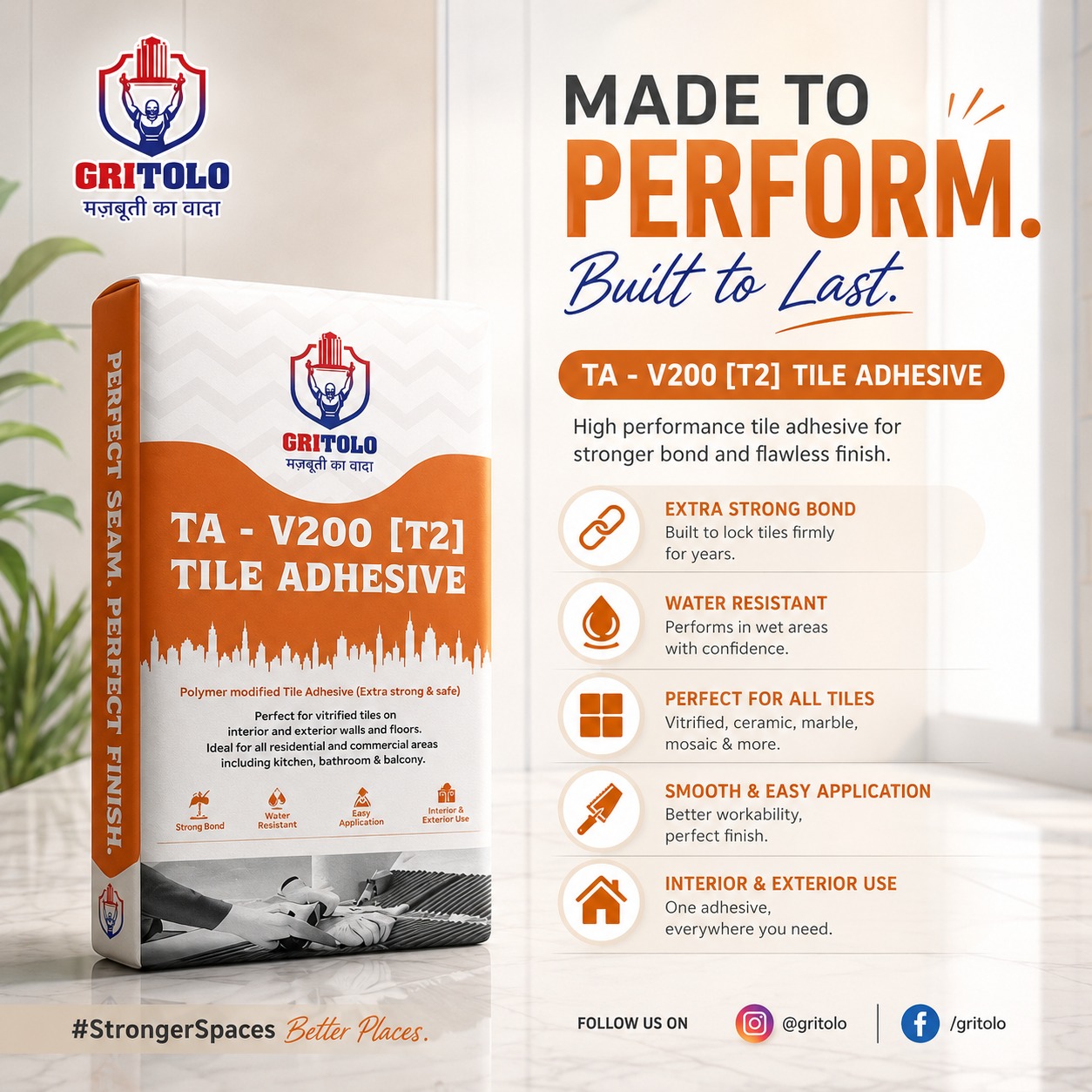
Gritolo’s TA – V200 [T2] is engineered for exactly these conditions. The ‘V’ in the product name stands for Vitrified — a naming convention that makes product selection intuitive for builders and tilers across India.
Where Should You Use T2 Tile Adhesive?
- Vitrified floor tiles in residential and light commercial projects
- Bathroom walls and floors (dry side — use T3 for wet zones and shower areas)
- Kitchen floors with medium foot traffic
- Tiles up to 60×60 cm format
- Interior floor overlays on existing substrates
Why Vitrified Tiles Need T2 and Not T1
Vitrified tiles undergo a vitrification process at extremely high temperatures, which makes them dense, non-porous, and highly smooth on the back face. Because of this low porosity, the mechanical key between tile and adhesive is significantly reduced compared to a standard ceramic tile. T2 adhesives compensate for this with higher polymer content and greater initial grab, ensuring the bond cures properly even on low-absorption tile backs.
Using T1 adhesive on vitrified tiles — a very common mistake on Indian sites — is a primary cause of tile debonding in residential buildings. The adhesive simply does not develop adequate bond strength on that smooth, glassy tile back.
Gritolo Product: TA – V200 [T2] — View Product
T3 Tile Adhesive — The Professional Grade for Large Format and Exterior Applications
What Is T3 Tile Adhesive?
T3 corresponds to Type 3 under IS 15477:2019. It is a high-performance, polymer-modified adhesive designed for large-format tiles, exterior applications, and areas subjected to thermal movement, moisture cycling, and mechanical stress. T3 adhesives typically feature improved deformability, higher open time, and superior resistance to water ingress compared to T1 and T2 grades.
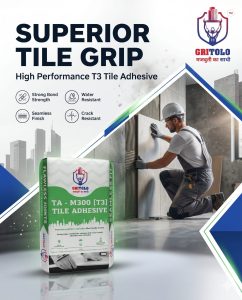
Gritolo’s TA – M300 [T3] is the go-to choice for architects and contractors working on anything beyond standard interior tiling. If you are tiling an exterior terrace in Pune’s rainy climate, a large hotel lobby with 80×80 cm tiles, or a hospital wet room, T3 is your minimum specification.
Where Should You Use T3 Tile Adhesive?
- Large-format tiles (60×60 cm, 80×80 cm, and upwards)
- Exterior wall cladding and facades
- Terraces, balconies, and podium decks exposed to rain and sun
- Wet rooms, shower enclosures, and bathroom floors
- Swimming pool surrounds (but use T4 for the pool interior itself)
- Areas with underfloor heating systems
- Rectified porcelain tiles and natural stone tiles
- Commercial kitchens and food processing areas
Why Exterior Tiling in India Demands T3 or Higher
India’s climate is particularly demanding on tile adhesive bonds. In Maharashtra, for instance, the monsoon season brings intense moisture followed by dry heat — a cycle that causes significant thermal and moisture-related movement in walls and substrates. Low-grade adhesives cannot accommodate this movement and crack, allowing water to penetrate and undermine the bond.
T3 adhesives are formulated with sufficient flexibility and water resistance to handle these conditions. For any facade or exterior surface in Indian climatic zones, specifying anything below T3 is simply not best practice.
Gritolo Product: TA – M300 [T3] — View Product
T4 Tile Adhesive — The Heavy-Duty Grade for Demanding Applications
What Is T4 Tile Adhesive?
T4 is the highest-performance classification under IS 15477:2019. It is designed for the most demanding conditions: permanent water immersion (such as swimming pools), heavy industrial floors, large and heavy natural stone cladding on high-rise facades, and any application where both maximum bond strength and maximum deformability are required simultaneously.
Gritolo’s TA – G400 [T4] represents the pinnacle of the Gritolo tile adhesive range. It offers exceptional tensile adhesion, high flexibility, resistance to prolonged water immersion, and the ability to accommodate the thermal and structural movement of large, heavy tile assemblies.
Where Should You Use T4 Tile Adhesive?
- Swimming pool interiors — both floors and walls subjected to constant water immersion
- Large natural stone tiles — granite, marble, and sandstone on floors and walls
- Industrial floors in factories, warehouses, and food processing plants
- High-rise building facades with heavy stone or large porcelain cladding
- Water features and ornamental fountains
- Hospitals and pharmaceutical facilities requiring maximum hygiene and bond integrity
- Subway stations, airports, and other high-footfall infrastructure
The Swimming Pool Question: Why Only T4 Will Do
One of the most frequently asked questions from Indian contractors concerns swimming pool tile adhesive. The answer is unequivocal: for the interior surfaces of a swimming pool — walls, floor, and waterline band — you must use a T4-grade adhesive. Here is why.
Pool tiles are in permanent contact with chemically treated water. The adhesive must withstand continuous water pressure, chemical attack from chlorine and other pool chemicals, thermal cycling as the pool water temperature varies, and the hydrostatic pressure from the surrounding soil when the pool is empty. Only a T4-grade adhesive is tested and formulated to resist all these stresses simultaneously.
Using T3 or below in a swimming pool is a specification error that will inevitably result in tile debonding, water leakage, and expensive remedial work. Do not compromise on this.
Gritolo Product: TA – G400 [T4] — View Product
How to Choose the Right Tile Adhesive Grade for Your Project — A Step-by-Step Approach
Follow these four questions in sequence to identify the correct tile adhesive grade for any project in India:
- Is the tiling area interior or exterior?— Exterior always requires T3 minimum. Interior may use T1 or T2 depending on other factors.
- Is the area wet or dry?— Wet areas (bathrooms, showers, terraces, pool surrounds) need T3 minimum. Swimming pools need T4.
- What is the tile size and type?— Ceramic up to 30×30 cm: T1. Vitrified up to 60×60 cm: T2. Large format (60×60 cm+): T3. Natural stone or very large format: T3/T4.
- What are the loading and use conditions?— Light residential: T1/T2. Commercial or industrial: T3/T4. Permanent water immersion: T4 only.
Decision Summary
When in doubt, always go one grade higher than you think you need. The incremental cost difference between T2 and T3, for example, is minimal compared to the cost of removing and retiling even a small area. Over-specifying your adhesive is almost never a mistake; under-specifying almost always is.
Tile Adhesive vs. Traditional Cement-Sand Mix — Why Grade Matters Even More in India
A large proportion of tiling in India is still done using site-mixed cement and sand, particularly in Tier 2 and Tier 3 cities. This approach, whilst familiar, carries several significant disadvantages compared to a properly graded tile adhesive:
- Inconsistent mix ratios lead to unpredictable bond strength
- No polymer modification means poor adhesion to vitrified and low-absorption tiles
- Thick bed application (20–30 mm) versus thin bed adhesive (3–6 mm) — thick beds trap moisture and increase load on slabs
- Cement-sand mix has no IS 15477 compliance — it is not classified, tested, or guaranteed
- Higher labour costs due to longer setting times and bed preparation
Switching to an IS 15477 compliant polymer-modified tile adhesive — even at the T1 grade — immediately improves bond reliability, reduces installation time, and provides a documented specification trail for quality assurance.
Local Insights: Tile Adhesive Grade Selection in Maharashtra and Across India
Having worked closely with builders, contractors, and architects across Maharashtra, Gritolo’s technical team has observed some clear patterns in how tile adhesive grades are misapplied on Indian construction sites:
The Pune and Mumbai Context
In Pune’s residential developments — particularly in areas like Hinjewadi, Wakad, and Baner where high-rise apartments are rapidly expanding — T2 adhesive is the minimum appropriate grade for most floor applications given the prevalence of large-format vitrified tiles. Yet site supervision records frequently show T1 being used, driven by purchase price rather than specification. The result is a growing pattern of warranty complaints from residents within 2–3 years of possession.
In Mumbai, where sea air and humidity create aggressive conditions for exterior surfaces, T3 is non-negotiable for any facade or balcony tiling. The combination of salt-laden air, monsoon moisture, and intense summer heat makes anything below T3 a liability.
Commercial and Infrastructure Projects
For commercial developments — IT parks, malls, hospitals, and hospitality projects — T3 and T4 adhesives should be the standard specification. Project architects and consultants who specify tile adhesives by IS 15477 Type 3 or Type 4 are following best practice and protecting their clients from future maintenance liabilities.
Internal Reference: Gritolo Tile Adhesive Product Range
Gritolo Global India Pvt Ltd manufactures a complete range of IS 15477 compliant tile adhesives for every application:
- TA – C100 [T1]— Polymer-modified adhesive for ceramic tiles on interior walls and floors. View Product
- TA – V200 [T2]— High-adhesion grade for vitrified tiles and medium-format applications. View Product
- TA – M300 [T3]— Professional-grade adhesive for large format, exterior, and wet area applications. View Product
- TA – G400 [T4]— Heavy-duty adhesive for swimming pools, industrial floors, and natural stone. View Product
Browse all Gritolo construction products: https://gritolo.com/shop
Frequently Asked Questions
Q1. What is the difference between T1, T2, T3, and T4 tile adhesive?
A1. T1 is for standard ceramic tiles on interior dry surfaces. T2 is for vitrified tiles and medium-format applications. T3 is for large-format tiles, exterior surfaces, and wet areas. T4 is the heavy-duty grade for swimming pools, industrial floors, and natural stone. Each grade is defined by IS 15477:2019 and specifies minimum performance benchmarks for tensile adhesion, slip resistance, and open time.
Q2. Which tile adhesive grade should I use for vitrified tiles in India?
A2. Use T2 tile adhesive (IS 15477: Type 2) for vitrified tiles. Vitrified tiles have a low-porosity back face that requires higher adhesion strength than T1 can provide. Gritolo’s TA – V200 [T2] is specifically formulated for vitrified tile installation.
Q3. Can I use T1 tile adhesive for bathroom floor tiles?
A3. No. Bathroom floors are wet areas and require at minimum T2 adhesive for dry zones, and T3 for wet zones such as shower cubicles and areas with direct water contact. T1 adhesive lacks the water resistance and bond strength required for wet area tiling.
Q4. What tile adhesive grade is required for swimming pools in India?
A4. T4 tile adhesive (IS 15477: Type 4) is mandatory for swimming pool interiors. Pool environments involve permanent water immersion, chemical exposure from pool treatment agents, and hydrostatic pressure — conditions that only T4-grade adhesives are tested and certified to withstand.
Q5. What is IS 15477 and why is it important for tile adhesive in India?
A5. IS 15477 is the Bureau of Indian Standards specification for cementitious tile adhesives. The 2019 edition classifies adhesives into Types 1 through 4 (equivalent to T1–T4) based on performance testing. Specifying an IS 15477 compliant adhesive ensures the product has been independently verified to meet minimum performance standards, providing quality assurance for builders, contractors, and end users.
Q6. Which tile adhesive is best for large-format tiles like 80×80 cm?
A6. Large-format tiles (60×60 cm and above) require T3 tile adhesive as a minimum. Tiles of this size experience greater thermal movement and place higher demands on the adhesive bond. T3 adhesives offer the open time, slip resistance, and deformability required for safe, long-lasting installation of large-format tiles.
Q7. Is tile adhesive better than cement sand mix for tiling in India?
A7. Yes. Polymer-modified tile adhesives compliant with IS 15477 offer consistent bond strength, thinner application, better adhesion to low-porosity tiles, and a documented performance specification — none of which a site-mixed cement-sand mortar can provide. Even T1 adhesive outperforms unmodified cement-sand mix in bond reliability, especially for vitrified and large-format tiles.
Q8. Can I use exterior tile adhesive for interior tiles?
A8. Yes — T3 or T4 adhesives can be used for interior applications without any issue. In fact, using a higher grade than required is never a problem. The reverse, however — using interior-grade T1 or T2 adhesives on exterior surfaces — will lead to failure.
Author Bio
The Gritolo Technical Team comprises construction materials specialists based in Pune with hands-on experience in tile adhesive specification, application, and quality assurance across residential, commercial, and infrastructure projects throughout Maharashtra and across India. Gritolo Global India Pvt Ltd manufactures IS 15477-compliant tile adhesives and construction materials, and the team’s insights are grounded in direct product development, site consultancy, and industry-standard testing. All product recommendations in this article are based on Gritolo’s own IS 15477:2019 certified range.
Contact us: https://gritolo.com/contact | Phone: +91 7397985754