Gritolo T1 vs UltraTech Tile Adhesive: Features, Applications and Selection
Choosing the right tile adhesive is an important part of achieving a durable and professional tile installation. Whether you are constructing a new home, renovating an apartment, developing a commercial property or working on an interior tiling project, the adhesive you select can influence tile bonding, installation quality, workability and long-term maintenance.
In the Indian construction market, several manufacturers offer cement-based, polymer-modified tile adhesives for different applications. Gritolo and UltraTech are two brands that provide tile-fixing solutions for residential and commercial projects. However, selecting between two brands should not be based only on brand recognition or price. It is important to understand the product classification, recommended tile type, substrate compatibility, technical specifications and installation requirements.
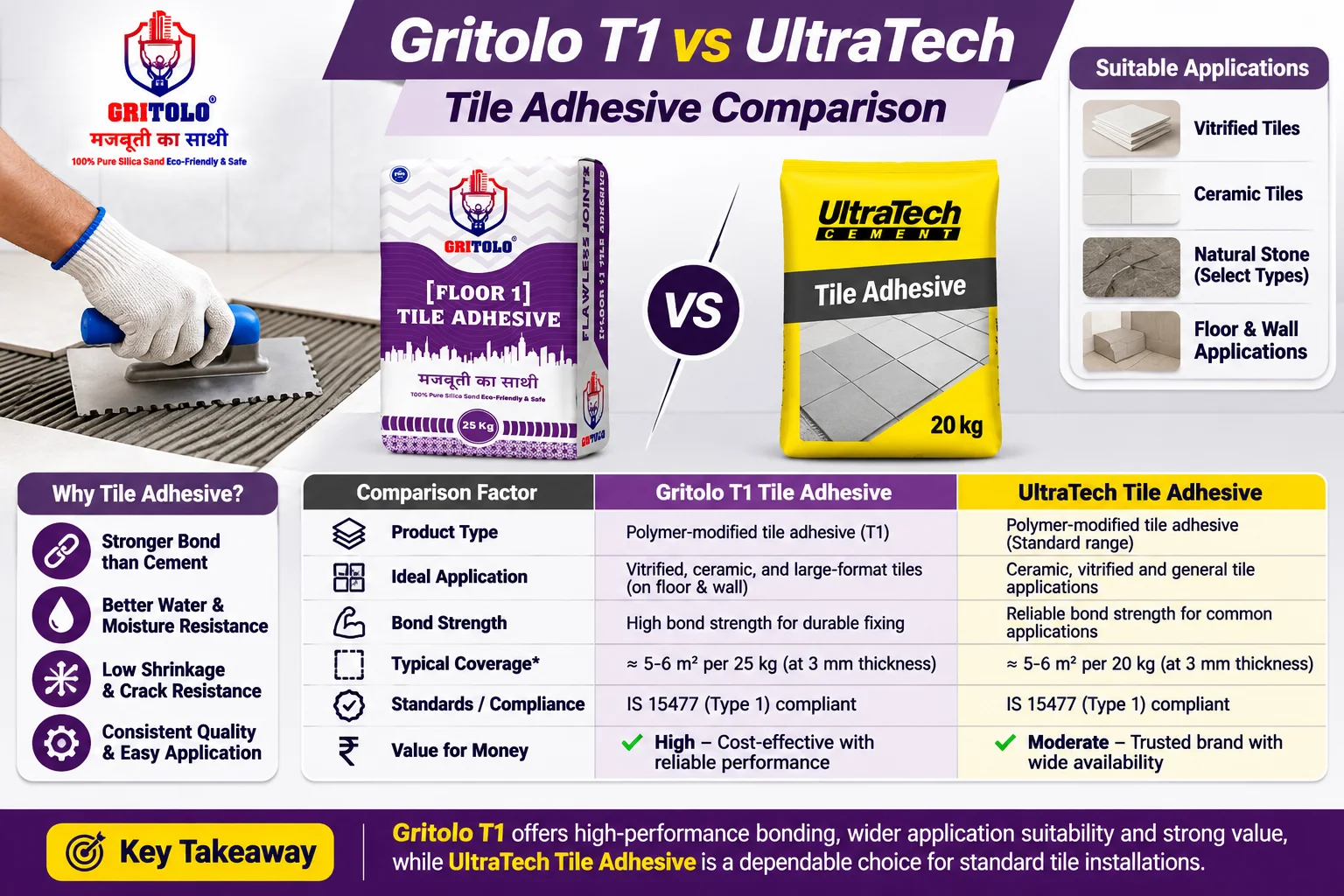
This guide compares Gritolo T1 vs UltraTech Tile Adhesive, focusing on Gritolo TA–C100 [T1] and UltraTech TileFixo CT. It explains their features, applications, differences, selection considerations and installation practices to help contractors, builders, architects, dealers and homeowners make an informed decision.
The comparison is based on the product information and technical documents available for the products discussed. Always confirm the latest manufacturer-issued Technical Data Sheet (TDS) before purchasing or specifying a product.
What Is T1 Tile Adhesive?
T1 tile adhesive refers to Type 1 tile adhesive under the Indian Standard IS 15477:2019. It is generally used for suitable ceramic tile installations on cementitious substrates, particularly interior walls and floors.
Traditional tile installation often uses a cement and sand mixture. However, a factory-manufactured tile adhesive offers a pre-formulated alternative. It generally contains cement, graded aggregates, polymers and other additives designed to provide consistent workability and bonding characteristics when mixed with the recommended quantity of water.
A Type 1 adhesive is intended for specific applications. It should not automatically be treated as suitable for every tile material, tile size or installation environment.
Key characteristics of T1 tile adhesive
- Cement-based formulation.
- Polymer modification, depending on the product.
- Suitable for specified ceramic tile applications.
- Designed for application over compatible cementitious substrates.
- Factory-controlled powder formulation.
- Requires mixing with a measured quantity of clean water.
- Applied using a suitable notched trowel.
- Does not normally require traditional water curing after installation, subject to the manufacturer’s instructions.
T1 adhesive is commonly considered for standard ceramic tiles in interior residential and commercial spaces. For vitrified tiles, large-format tiles, exterior applications or demanding wet areas, a higher classification may be required.
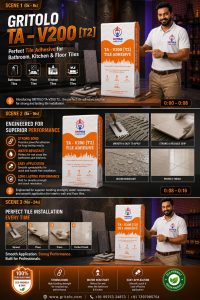
Introduction to Gritolo TA–C100 [T1] Tile Adhesive
Gritolo TA–C100 [T1] is a polymer-modified, cement-based tile adhesive developed for ceramic tiles and mosaics on interior walls and floors. It is designed for applications where a Type 1 adhesive is appropriate.
The product is intended for use on compatible cement mortar beds, cement plaster and brick masonry substrates, subject to proper surface preparation.
Main features of Gritolo T1
1. Polymer-modified formulation
Gritolo TA–C100 is a polymer-modified cement-based adhesive. Its formulation is designed to provide bonding and workability suitable for the applications specified by the manufacturer.
2. Suitable for ceramic tiles
The product is intended for ceramic, clay and cement tiles in recommended interior applications. Its suitability should be checked against tile dimensions, tile absorption and substrate conditions.
3. Interior wall and floor applications
Gritolo T1 can be considered for compatible interior ceramic tile installations, including selected residential and commercial flooring and small-format ceramic wall tiles.
4. Consistent mixing and workability
As a factory-prepared dry-mix adhesive, it helps reduce the need for on-site proportioning of separate cement and sand ingredients. The installer only needs to add the specified quantity of water and mix correctly.
5. Defined application and working time
The manufacturer’s published information gives an approximate open time of 15–20 minutes and a pot life of around two hours at 30°C. Actual working time can vary with temperature, humidity, wind and substrate absorption.
6. Coverage guidance
The published coverage depends on the adhesive-bed thickness and trowel notch. For example, the product page indicates approximately 45–50 sq. ft. per 20 kg bag at a 3–4 mm bed thickness under the stated conditions. Actual site coverage may differ.
Published technical information for Gritolo TA–C100 [T1]
| Parameter | Published information |
|---|---|
| Product | TA–C100 [T1] |
| Base | Cement-based, polymer-modified |
| Standard reference | IS 15477:2019 Type 1 |
| Recommended tile type | Ceramic, clay and cement tiles |
| Application | Interior floors and selected interior walls |
| Substrates | Cement mortar bed, cement plaster and brick masonry |
| Water-to-powder ratio | Approximately 20–25% by weight |
| Open time | Approximately 15–20 minutes |
| Pot life | Approximately 2 hours at 30°C |
| Tensile adhesion strength | Greater than 0.5 N/mm² at 28 days, as published |
| Light foot traffic | Approximately 24 hours |
| Shelf life | 12 months under dry storage conditions |
These are published product details, not a guarantee of the result on every site. Check the current product packaging and TDS before specifying the material.
Introduction to UltraTech TileFixo CT
UltraTech offers a range of tile adhesives under its TileFixo product range. These products are intended for different tile materials and applications, so it is important to select the correct product rather than treating all TileFixo adhesives as interchangeable.
For a Type 1 comparison, UltraTech TileFixo CT is the relevant product to examine. The available TileFixo CT technical document identifies it as Type 1T under IS 15477:2019 and describes its use for ceramic tile applications.
The available technical document also lists a water-to-powder ratio of approximately 24–26% by weight, a pot life of approximately 120 minutes at 30°C and an open time of approximately 15 minutes. These details should be checked against the latest official UltraTech TDS before publication or purchase.
Main features of UltraTech TileFixo CT
1. Designed for ceramic tile applications
TileFixo CT is positioned for ceramic tile fixing. The exact suitability for floors, walls, tile dimensions and substrates should be confirmed from the current product documentation.
2. Cement-based adhesive
The available product document describes a cement-based adhesive formulation. Such products are supplied as dry powder and mixed with water at the recommended ratio.
3. Defined working time
The available technical document specifies an approximate 15-minute open time. Site conditions can affect how long the adhesive remains suitable for tile placement.
4. Factory-prepared material
A pre-formulated adhesive helps reduce the need for manually proportioning cement and sand at the site. Correct water measurement and mixing remain essential.
5. Application-specific product selection
UltraTech’s TileFixo range includes products for ceramic tiles, vitrified tiles, stones and other specialised applications. A product designed for ceramic tiles should not be assumed suitable for all these materials.
Published information for UltraTech TileFixo CT
| Parameter | Available technical information |
|---|---|
| Product | TileFixo CT |
| Classification | Type 1T under IS 15477:2019 |
| Recommended application | Ceramic tile fixing |
| Water-to-powder ratio | Approximately 24–26% by weight |
| Pot life | Approximately 120 minutes at 30°C |
| Open time | Approximately 15 minutes |
| Adjustable time | Approximately 20 minutes |
| Usage after application | Approximately 24 hours, as stated in the available document |
| Coverage | Document indicates approximately 7.4 m² per 20 kg bag at 3 mm under laboratory conditions |
The figures above are from an available technical document and should not replace the latest manufacturer-issued TDS. Confirm the current version with UltraTech or its authorised distributor before relying on these values.
Gritolo T1 vs UltraTech Tile Adhesive: Feature Comparison
When comparing Gritolo TA–C100 [T1] and UltraTech TileFixo CT, the most useful approach is to compare their published technical information and intended applications.
| Comparison point | Gritolo TA–C100 [T1] | UltraTech TileFixo CT |
|---|---|---|
| Product category | Cement-based, polymer-modified adhesive | Cement-based tile adhesive |
| Classification stated in available information | Type 1 | Type 1T |
| Primary application | Ceramic tiles and mosaics | Ceramic tile applications |
| Interior flooring | Yes, for specified tiles and substrates | Confirm current TDS |
| Interior walls | Small-format ceramic tiles, up to the product’s stated limit | Confirm current TDS |
| Water-to-powder ratio | Approx. 20–25% | Approx. 24–26% |
| Open time | Approx. 15–20 minutes | Approx. 15 minutes |
| Pot life | Approx. 2 hours at 30°C | Approx. 120 minutes at 30°C |
| Published coverage | Varies with bed thickness and notch size | Approx. 7.4 m² per 20 kg at 3 mm in the available document |
| Substrate | Compatible cementitious substrates | Follow current manufacturer’s substrate guidance |
| Main selection factor | Ceramic tile and interior application suitability | Ceramic tile and application suitability |
What does this comparison tell us?
Both products are positioned for Type 1 ceramic tile applications in the available product information. Their published working times are broadly similar, although the exact figures and test conditions differ.
The water ratios and coverage figures should not be treated as direct indicators of product quality. Different formulations, aggregate grading, application thickness, trowel size and test conditions can influence these values.
A fair comparison should also consider current TDS documents, packaging, batch information, product availability, technical support and the installer’s experience.
No single figure in this table establishes that one product is universally better than the other.
Applications of Gritolo T1 Tile Adhesive
Gritolo TA–C100 [T1] is intended for specified ceramic tile applications. Selecting it for the correct project conditions is important for achieving a satisfactory installation.
Interior floor tiling
Gritolo T1 can be considered for ceramic tile flooring in suitable interior spaces such as:
- Bedrooms.
- Living rooms.
- Internal corridors.
- Residential utility areas.
- Selected office interiors.
- Other suitable indoor spaces.
The substrate should be stable, clean, properly cured and sufficiently level. The tile type and size must remain within the product’s recommended application range.
Interior wall tiling
The product information identifies small-format ceramic wall tiles, up to approximately 300 × 300 mm, for suitable interior applications.
Examples include selected kitchen wall areas, internal utility walls and other interior surfaces where ceramic tiles are appropriate.
For vertical installations, use the correct application technique and ensure that the adhesive is suitable for the tile weight and substrate.
Mosaic tile installation
Gritolo T1 is also described for mosaic applications. However, mosaic materials can vary in backing, size and composition. Confirm compatibility with the product supplier before installation, particularly when the mosaic has a mesh backing or a special surface finish.
Residential construction
For residential construction, T1 adhesive may be considered where the project uses standard ceramic tiles in appropriate interior locations.
The product should be selected according to the actual tile specification rather than simply because it is being used in a house or apartment.
Applications of UltraTech TileFixo CT
UltraTech TileFixo CT is the relevant product in the available information for a Type 1 ceramic tile comparison.
Its use should follow the current product instructions and the substrate and tile limitations specified by the manufacturer.
Potential project areas for a suitable ceramic tile adhesive include:
- Residential ceramic flooring.
- Internal ceramic wall tiling.
- Selected kitchen and utility areas.
- Suitable interior commercial spaces.
- Renovation work where the substrate is compatible with the product.
Before installation, verify whether the selected TileFixo CT variant is approved for the exact floor or wall application. Do not assume that a product’s general tile-fixing description covers every substrate or installation condition.
Important distinction: TileFixo CT vs TileFixo VT
UltraTech’s TileFixo range includes different products. The available September 2024 TileFixo VT document identifies that product as Type 2T and lists applications including vitrified tiles, stones, glass mosaics, tile-on-tile and selected exterior floor work.
This is different from the Type 1T comparison with TileFixo CT. Therefore, a contractor choosing an adhesive for vitrified tiles should investigate the appropriate product grade rather than selecting CT simply because it is part of the same brand range.
Which Is Better for Ceramic Tiles: Gritolo T1 or UltraTech TileFixo CT?
There is no responsible way to declare one product the winner for every project without comparing current, equivalent test reports and site conditions.
Both products are positioned for ceramic tile applications in the available documents. The final selection should be based on the following considerations.
Product classification
First, check the classification on the product packaging and TDS. Gritolo TA–C100 is published as Type 1, while the available TileFixo CT document identifies Type 1T.
Confirm the exact applicable classification and standard reference in the latest documents before making a purchase.
Tile type and size
The adhesive must be suitable for the material and dimensions of the tile.
For example, a standard ceramic tile may be suitable for a Type 1 product, while a large-format vitrified tile may require a different classification and formulation.
Substrate compatibility
Check whether the adhesive is approved for the surface on which it will be applied. Cement plaster, cement screed, concrete and other substrates may have different preparation requirements.
Do not use an adhesive on painted, weak, dusty, flexible or otherwise unsuitable surfaces without following the manufacturer’s approved preparation method.
Open time and working conditions
Open time is the period during which the spread adhesive can still form an adequate bond with the tile under specified test conditions.
It is not a guaranteed site working time. High temperatures, wind and absorbent surfaces can shorten the usable period.
Compare the published open-time information, but also consider the conditions in which the installer will work.
Coverage and material planning
Coverage is affected by:
- Tile dimensions.
- Trowel notch size.
- Adhesive-bed thickness.
- Substrate flatness.
- Tile-back profile.
- Installer technique.
- Material wastage.
Do not choose a product only because one coverage figure appears higher. Check whether the figures use the same bag size, bed thickness, trowel and test conditions.
Availability and technical support
Consider the availability of fresh stock, product documentation, dealer support and technical guidance in your project location.
The most appropriate product is one that matches the project requirements and can be applied correctly with reliable supply and support.
How to Select the Right T1 Tile Adhesive
Selecting tile adhesive should be a technical decision. Follow these steps before finalising the product.
Step 1: Identify the tile material
Determine whether the tile is ceramic, vitrified, porcelain, natural stone, glass mosaic or another material.
Do not assume that all tile adhesives are suitable for all tile types.
Step 2: Check tile dimensions
Small-format ceramic tiles and large-format slabs do not necessarily require the same adhesive classification.
Check the manufacturer’s stated maximum tile size and recommended applications.
Step 3: Identify the installation location
Is the project indoors or outdoors? Is it a floor or wall? Will the surface experience frequent moisture, temperature changes or heavy use?
The location can influence the required adhesive classification.
Step 4: Examine the substrate
Check whether the substrate is cement plaster, concrete, screed or another material.
It should be stable, clean, properly cured and sufficiently level. Remove dust, oil, loose particles, curing compounds and other bond-inhibiting substances as required.
Step 5: Read the TDS
Review the manufacturer’s technical data for:
- Classification.
- Water-to-powder ratio.
- Open time.
- Pot life.
- Bed thickness.
- Adhesion performance.
- Recommended tile types.
- Suitable substrates.
- Coverage guidance.
- Storage and shelf life.
Step 6: Compare the complete project cost
The purchase price per bag is only one part of the cost. Consider coverage at the required thickness, wastage, labour, surface preparation and the possibility of rework.
Step 7: Consult the technical team
If the project includes unusual tiles, difficult substrates, exterior exposure, tile-on-tile installation or large-format materials, ask the manufacturer for a written product recommendation.
Correct Method of Applying T1 Tile Adhesive
Even a suitable adhesive can fail if the application process is incorrect. Proper preparation and installation are essential.
Step 1: Prepare the surface
Ensure the substrate is stable, clean and adequately cured. Remove dust, grease, oil, loose material and other contaminants.
Correct major unevenness before tile installation. Tile adhesive should not be used as a substitute for a suitable levelling or repair system unless the product instructions specifically allow it.
Step 2: Measure clean water
Use the water quantity recommended in the product’s current TDS. Measure water accurately for every batch.
Adding excessive water can affect the adhesive’s consistency and performance.
Step 3: Mix the adhesive
Gradually add the powder to clean water while mixing with a suitable mechanical mixer. Mix until a smooth, lump-free consistency is obtained.
Follow the manufacturer’s instructions for any resting or maturation time and remixing.
Step 4: Apply with a notched trowel
Spread the adhesive onto a manageable area of the prepared substrate. Use the appropriate notched trowel according to tile dimensions and surface conditions.
Comb the adhesive in consistent, parallel ridges.
Step 5: Place the tiles
Position the tile within the product’s specified open time. Press and move it slightly across the adhesive ridges to achieve proper contact.
Periodically remove a freshly placed tile to inspect the adhesive transfer and coverage. Adjust the application technique if coverage is inadequate.
Step 6: Maintain joint spacing
Use appropriate spacers to maintain consistent tile joints. Remove excess adhesive from the joints before it hardens.
Step 7: Allow the installation to set
Avoid disturbing the installed tiles during the initial setting period. Follow the product instructions for grouting, foot traffic and subsequent use.
Do not assume that every adhesive has the same setting or grouting time.
Common Mistakes to Avoid When Using Tile Adhesive
Choosing the wrong adhesive grade
Using a Type 1 adhesive for an application that requires a higher classification can result in inadequate performance.
Always match the adhesive to the tile and installation conditions.
Applying adhesive over a dusty surface
Dust and loose particles can interfere with bonding. Clean the substrate properly before application.
Adding too much water
Excess water can change the formulation’s intended consistency and affect performance. Always measure water according to the TDS.
Spreading too much adhesive at once
If the adhesive forms a surface skin before the tile is placed, the bond may be compromised.
Spread only the amount that the installer can cover within the actual working time.
Ignoring the trowel notch size
The correct trowel depends on tile dimensions, tile-back profile and substrate condition. An unsuitable notch may result in insufficient adhesive transfer.
Using adhesive to correct major floor unevenness
A tile adhesive is not automatically a floor-levelling compound. Correct major substrate variations with an appropriate levelling material before tiling.
Ignoring product storage
Store bags in a dry place, protected from moisture and direct exposure. Do not use material that has become hardened or lumpy inside an unopened bag.
Assuming all products from a brand have the same application
A manufacturer may offer several adhesive grades. Always check the exact product name and classification on the bag.
Gritolo T1 vs UltraTech Tile Adhesive: Price and Coverage Considerations
Price is an important factor in construction material selection, but the lowest price per bag does not always mean the lowest installation cost.
When comparing Gritolo TA–C100 and UltraTech TileFixo CT, collect the following information from authorised suppliers:
- Current price per bag.
- Bag weight.
- Recommended water ratio.
- Coverage at the required bed thickness.
- Recommended trowel notch.
- Delivery charges.
- Availability of fresh stock.
- Technical support and product documentation.
How to calculate approximate adhesive quantity
Use the following basic calculation:
Number of bags = Total tiling area ÷ Actual coverage per bag
For example, if a project has 1,000 sq. ft. of floor area and the verified coverage is 45 sq. ft. per bag:
1,000 ÷ 45 = 22.22 bags.
The theoretical requirement is approximately 23 bags before allowing for wastage or site-specific variations.
This is only an example calculation. Use the actual coverage for the selected adhesive, tile and bed thickness. Add a reasonable allowance based on the project conditions and installer advice.
Why Technical Data Sheets Matter
A Technical Data Sheet is one of the most important documents when selecting construction chemicals and tile adhesives.
It helps contractors, engineers, architects and purchasers understand how a product is intended to be used.
A proper TDS should provide information such as:
- Product description.
- Classification and applicable standards.
- Recommended applications.
- Suitable substrates.
- Mixing instructions.
- Open time and pot life.
- Adhesion performance.
- Application thickness.
- Coverage guidance.
- Storage and shelf life.
- Safety and handling information.
When comparing two products, use their latest manufacturer-issued documents. Do not compare figures from different test methods or conditions as if they were directly equivalent.
For larger projects, request relevant test reports and written technical recommendations where necessary.
Why Consider Gritolo TA–C100 [T1] for Your Project?
Gritolo TA–C100 [T1] is an option for projects requiring a Type 1 ceramic tile adhesive within its stated application limits.
Some practical reasons to evaluate the product include:
- A defined product classification.
- A published application range for ceramic tiles.
- Technical information covering mixing and working time.
- Coverage guidance for different adhesive-bed thicknesses.
- A factory-prepared formulation.
- Product information available for review before purchase.
The right choice still depends on the project. Contractors and homeowners should confirm that the tile type, size, substrate and installation location match the manufacturer’s recommendations.
To explore the product, visit the Gritolo TA–C100 [T1] product page and review its current specifications.
Gritolo T1 vs UltraTech TileFixo CT
Gritolo TA–C100 [T1] and UltraTech TileFixo CT are relevant options to examine when a project requires a Type 1 ceramic tile adhesive.
Both should be assessed against the same project requirements rather than judged only by brand name. Review the current classification, application range, substrate compatibility, working time, coverage and technical documentation before selecting either product.
For a standard interior ceramic tile installation, a Type 1 product may be suitable when the tile and substrate fall within its stated limits.
For vitrified tiles, large-format tiles, demanding wet areas, exterior installations or tile-on-tile work, investigate a product with the appropriate higher classification and application approval. Do not select a Type 1 adhesive simply because it is more economical or readily available.
The best tile adhesive is the one whose verified technical performance and approved application match the requirements of the project.
Explore Gritolo’s tile adhesive range and consult the product technical information before finalising your selection.
Frequently Asked Questions (FAQs)
1. What is the difference between Gritolo T1 and UltraTech Tile Adhesive?
Gritolo TA–C100 [T1] and UltraTech TileFixo CT are products positioned for Type 1 ceramic tile applications in their available product information. Their published water ratios, working times and coverage details differ. The final selection should be based on current TDS information and project requirements.
2. Is Gritolo T1 suitable for ceramic tiles?
Yes. Gritolo TA–C100 [T1] is designed for specified ceramic tile applications on interior floors and selected interior walls. Check the manufacturer’s tile-size and substrate limitations before use.
3. Is UltraTech TileFixo CT a T1 tile adhesive?
The available TileFixo CT technical document identifies it as Type 1T under IS 15477:2019. Confirm the classification against the latest official product document before purchase.
4. Can Gritolo T1 be used for vitrified tiles?
Gritolo TA–C100 [T1] is not recommended for vitrified tiles according to its published product information. Select a suitable higher-grade adhesive, such as the relevant product in Gritolo’s T2 range, after checking its current TDS.
5. Can Type 1 tile adhesive be used on interior walls?
A Type 1 product may be suitable for specified interior wall applications when the tile size, weight, substrate and installation method are within the manufacturer’s recommendations.
6. How much area does one bag of Gritolo T1 cover?
The published product information indicates approximately 45–50 sq. ft. per 20 kg bag at a 3–4 mm bed thickness. Actual coverage varies with the trowel notch, substrate flatness, tile-back profile and application technique.
7. What is the open time of Gritolo T1?
The published open time for Gritolo TA–C100 [T1] is approximately 15–20 minutes. Temperature, humidity, wind and substrate absorption can affect the actual working period.
8. Can tile adhesive be applied directly over an existing tiled surface?
Only when the selected adhesive is specifically approved for tile-on-tile installation and the existing surface is properly assessed and prepared. Gritolo TA–C100 [T1] is not recommended for direct tile-on-tile use according to its published product information.
9. Is tile adhesive better than traditional cement mortar?
A suitable factory-prepared tile adhesive provides a controlled formulation and is designed for specified tile applications. Traditional cement mortar and modern tile adhesives have different uses. The correct choice depends on tile material, substrate, installation method and project specifications.
10. How do I choose between T1 and T2 tile adhesive?
T1 is generally intended for specified ceramic tile applications, while T2 is intended for applications requiring a higher classification and broader tile suitability as specified by the manufacturer. Check the tile type, size, location and current product TDS before choosing.
11. Does tile adhesive require water curing?
Many cement-based tile adhesives do not require traditional water curing after tile installation. However, follow the exact product instructions and site recommendations rather than assuming that every product has identical curing requirements.
12. Where can I find Gritolo T1 product details?
You can visit the Gritolo TA–C100 [T1] product page to review its published applications, technical information and coverage guidance. Contact the manufacturer or authorised supplier for the latest TDS and project-specific advice.
Conclusion
The comparison between Gritolo T1 and UltraTech TileFixo CT demonstrates why product classification and application suitability are important when selecting tile adhesive. Both products are intended for ceramic tile applications in the available Type 1 product information, but their technical details and coverage guidance should be checked carefully.
Before purchasing, verify the latest TDS, confirm that the product is suitable for the tile and substrate, and ensure that the installation team follows the correct mixing and application procedure.
A well-selected tile adhesive, combined with proper surface preparation and installation, supports a more reliable tiling system and helps reduce avoidable installation problems.