Understanding the Three Tile Adhesive Brands
Before comparing individual products, it is important to understand the brands and the product ranges they offer.
Gritolo Tile Adhesive
Gritolo Global India Private Limited offers a range of cement-based tile adhesives designed for different tile types and installation requirements.
Its published product range includes:
- TA – C100 [T1]: Designed for ceramic tiles and selected interior applications.
- TA – V200 [T2]: Designed for vitrified tiles and other applications specified by its technical documentation.
- TA – M300 [T3]: A higher-grade adhesive for applications requiring the performance specified for this product.
- TA – G400 [T4]: A higher-performance product intended for demanding applications within its approved scope.
The range gives contractors different product options rather than requiring one adhesive for every installation.
Gritolo’s product information references IS 15477:2019 for its adhesive classifications. Individual product specifications and application limitations should be checked before use.
Roff Tile Adhesive
Roff is a tile and stone fixing brand from Pidilite. It offers a portfolio of tile adhesives and related products for different installation conditions.
Its published adhesive range includes:
- Roff New Construction Adhesive.
- Roff Non-Skid Adhesive.
- Roff Vitrofix and Vitrofix Ultra.
- Roff Extrofix and Extrofix Ultra.
- Roff Master Fix.
- Roff Vertifix.
- Roff Yogafix.
These products address different requirements, including standard floor installations, vitrified tiles, exterior applications, vertical surfaces and selected difficult substrates.
The brand recommends choosing an adhesive according to the specific application and consulting the relevant technical data sheet.
MYK LATICRETE Tile Adhesive
MYK LATICRETE provides a broad range of tile adhesives for ceramic tiles, vitrified tiles, natural stones, large-format tiles and specialist installations.
Some of its published products include:
- LATICRETE 303.
- LATICRETE 305.
- LATICRETE 307.
- LATICRETE 313.
- LATICRETE 315 Plus.
- LATICRETE 325 High Flex.
- LATICRETE 335 Maxi.
- LATICRETE 345 Super Flex.
The products have different application scopes and technical classifications. For example, LATICRETE 313 is identified as a Type 2 adhesive under IS 15477:2019, while LATICRETE 325 High Flex is identified as Type 3.
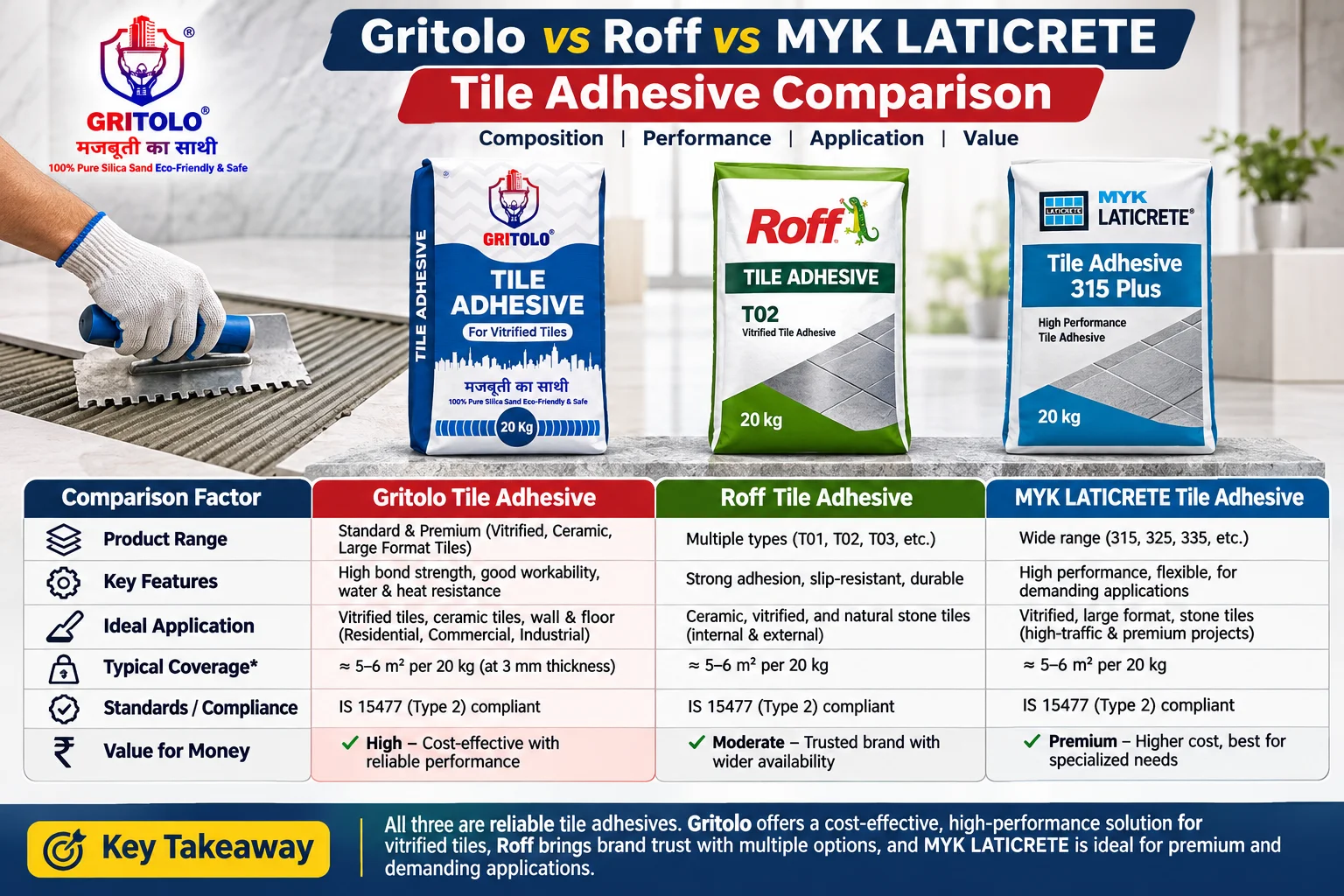
Gritolo vs Roff vs MYK LATICRETE: Product Range Comparison
A brand-level comparison is useful for understanding the choices available, but the actual product matters more than the brand name.
The following table gives an overview of selected product categories. It is not a declaration that similarly named or numbered products are technically identical.
| Brand | Example product | Published classification or positioning | General application |
|---|---|---|---|
| Gritolo | TA – C100 | T1 | Ceramic tiles and selected interior applications |
| Gritolo | TA – V200 | T2 | Vitrified tiles and other approved applications |
| Gritolo | TA – M300 | T3 | Applications requiring the product’s T3 performance |
| Gritolo | TA – G400 | T4 | More demanding applications within approved scope |
| Roff | New Construction Adhesive | Type 1 T in its published TDS | Standard new-construction tile fixing |
| Roff | Vitrofix / Vitrofix Ultra | Check the current product TDS | Vitrified tile applications |
| Roff | Extrofix / Extrofix Ultra | Check the current product TDS | Exterior tile and stone applications |
| MYK LATICRETE | LATICRETE 313 | Type 2 T | Small- to medium-format ceramic and vitrified tiles |
| MYK LATICRETE | LATICRETE 325 High Flex | Type 3 | Higher-performance tile and natural stone applications |
Gritolo’s product classifications and application descriptions are published on its website. Roff’s New Construction Adhesive TDS identifies Type 1 T, while MYK LATICRETE publishes Type 2 T for LATICRETE 313 and Type 3 for LATICRETE 325 High Flex.
Important comparison rule: A Gritolo T2 product should be compared with a Roff or MYK LATICRETE product that has a similar classification and application scope. Comparing a T1 product from one brand with a T3 or T4 product from another does not provide a fair technical comparison.
Gritolo Tile Adhesive vs Roff Tile Adhesive
Gritolo and Roff both offer cement-based tile adhesive products for construction and renovation work. However, the correct comparison depends on the product selected from each range.
Gritolo TA – C100 [T1] vs Roff New Construction Adhesive
Gritolo TA – C100 [T1] is designed for ceramic tiles and selected interior wall and floor applications. Roff New Construction Adhesive is also positioned for standard new-construction tile fixing, and its published technical data identifies it as Type 1 T.
This is a more relevant comparison than comparing Gritolo’s higher-grade products with Roff’s standard adhesive.
Gritolo TA – C100 [T1]
Its published product information includes:
- Polymer-modified, cement-based formulation.
- Interior ceramic tile applications.
- Use on specified cement mortar beds, cement plaster and brick masonry.
- Approximate open time of 15–20 minutes.
- Approximate pot life of two hours at 30°C.
- Reference to IS 15477:2019 Type 1.
The product page states that it is not recommended for vitrified tiles, large-format tiles or external cladding.
Roff New Construction Adhesive
Its published technical data sheet includes:
- Type 1 T classification.
- Approximate open time of 20 minutes.
- Approximate pot life of 120 minutes.
- Adhesive thickness of 3–12 mm.
- Tensile adhesion strength of at least 0.5 N/mm² under the stated EN 1348 test reference.
- Trafficable and grouting time of approximately 24 hours, as stated in the TDS.
Which should you choose?
For standard ceramic tile installation, both products may be considered if the tile, substrate and installation conditions match their respective technical documentation.
The final decision should be based on the full TDS, product availability, coverage, local technical support and project cost.
Gritolo TA – V200 [T2] vs Roff Vitrified Tile Adhesive Options
Vitrified tiles have a relatively dense and low-porosity body. They require an adhesive that is suitable for bonding to the tile’s back surface.
Gritolo TA – V200 [T2] is positioned for vitrified tile applications. Roff offers products such as Vitrofix and Vitrofix Ultra within its adhesive portfolio.
A fair comparison requires checking the latest Roff TDS for the exact Vitrofix product being considered.
Gritolo TA – V200 [T2]
Gritolo publishes the following information for TA – V200:
- Reference to IS 15477.
- Water-to-powder ratio of approximately 20–22% by weight.
- Open time and adjustability of approximately 20 minutes.
- Pot life of approximately two hours at 30°C.
- Tensile adhesion strength of 0.5 N/mm² as published.
- Adhesive layer thickness of 3–12 mm.
- Trafficable time of approximately 24 hours.
- Suitable applications include vitrified tiles and porcelain tiles within the product’s stated scope.
Roff Vitrofix range
Roff’s published product portfolio includes Vitrofix and Vitrofix Ultra for relevant tile and stone fixing requirements. The exact application limits, classification, coverage and performance values must be obtained from the current TDS of the selected product.
Which should you choose?
Consider Gritolo TA – V200 if its published TDS matches your tile format, substrate and installation environment.
Consider a Roff Vitrofix product if its current technical documentation matches those same requirements.
Compare the actual product classification, adhesion test results, coverage, open time and cost per installed square foot rather than relying on brand reputation alone.
Gritolo TA – M300 [T3] vs Roff Higher-Performance Adhesives
Some installations need more than a standard adhesive.
Examples include large-format tiles, selected exterior applications, tile-on-tile work and installations where movement or moisture exposure creates additional demands.
Gritolo TA – M300 [T3] is positioned within Gritolo’s higher-grade range. Roff offers products such as Extrofix, Extrofix Ultra and Yogafix for specific demanding applications.
These products should not automatically be treated as equivalent. Their classifications and intended applications need to be checked individually.
Selection considerations
- Is the product approved for the tile dimensions?
- Is it suitable for the substrate?
- Is it approved for the intended exterior or wet-area installation?
- Does it provide the required open time?
- Is its deformation or flexibility performance documented?
- Are movement joints and installation details properly specified?
The most appropriate product is the one that meets the actual application requirements.
Gritolo Tile Adhesive vs MYK LATICRETE
MYK LATICRETE offers a wide selection of tile adhesives with different classifications and application scopes. Comparing products at the same classification is the best way to evaluate them.
Gritolo TA – V200 [T2] vs MYK LATICRETE 313
This is a useful comparison for selected vitrified tile installations because both products are published as Type 2 T adhesives under IS 15477:2019.
Gritolo TA – V200 [T2]
Gritolo’s published specifications include:
| Parameter | Published value |
|---|---|
| Classification reference | IS 15477 |
| Water-to-powder ratio | Approx. 20–22% |
| Open time / adjustability | Approx. 20 minutes |
| Pot life | Approx. 2 hours at 30°C |
| Adhesive thickness | 3–12 mm |
| Tensile adhesion strength | 0.5 N/mm² as published |
| Trafficable time | Approx. 24 hours |
These figures are from Gritolo’s published product page and should be checked against the current approved TDS.
MYK LATICRETE 313
The official product page identifies LATICRETE 313 as:
- A single-component, polymer-based adhesive.
- Suitable for small- to medium-format ceramic and vitrified tiles and natural stones.
- Type 2 T under IS 15477:2019.
- C1TE under EN 12004 / ISO 13007.
- Suitable for specified interior floors and walls and exterior floors.
- Approximately 30 minutes of open time.
- Approximate coverage of 55–60 sq. ft. per 20 kg bag using a 6 × 6 mm square-notch trowel and a 3 mm bed, according to its published product information. <Cite refs={[“turn794292search1”]}/>
Comparison
| Parameter | Gritolo TA – V200 [T2] | MYK LATICRETE 313 |
|---|---|---|
| IS classification | Type 2 reference | Type 2 T |
| Tile suitability | Vitrified and other approved tiles | Small- to medium-format ceramic, vitrified and natural stone |
| Open time | Approx. 20 minutes | Approx. 30 minutes |
| Pack information | 40 kg published | 20 kg and 50 kg published |
| Coverage | Depends on application thickness and trowel | Approx. 55–60 sq. ft. per 20 kg at stated conditions |
| Substrate suitability | Refer to current Gritolo TDS | Published cement-based substrates and selected older tiled surfaces |
These values are manufacturer-published figures, not independent laboratory results. The coverage values are not directly comparable unless the trowel, bed thickness, tile dimensions and substrate conditions are identical.
Which should you choose?
Gritolo TA – V200 may be considered when its approved application range matches the project and the required pack size and supply arrangement are suitable.
MYK LATICRETE 313 may be considered when its published Type 2 T classification, longer stated open time or listed substrate suitability fits the installation.
The installer should review both TDS documents before deciding.
Gritolo TA – M300 [T3] vs MYK LATICRETE 325 High Flex
For projects requiring a higher adhesive classification, Gritolo TA – M300 [T3] can be considered alongside MYK LATICRETE 325 High Flex.
MYK LATICRETE identifies 325 High Flex as a Type 3 adhesive under IS 15477:2019. Its published product information also lists C2TE under EN 12004 / ISO 13007 and ANSI A118.4 ET. It is described for interior and exterior floor and wall installations and suitable tile and stone applications within its approved scope.
A comparison should include:
- Classification under the applicable standard.
- Adhesion performance.
- Open time and adjustability.
- Suitability for large-format tiles.
- Wet-area and exterior approvals.
- Substrate compatibility.
- Deformation performance, if required.
- Grouting and traffic times.
Do not assume that two products with a similar Type 3 classification have identical performance. Check the complete test results and application limitations.
When Should You Consider Higher-Grade Adhesives?
Higher-grade adhesives may be appropriate for demanding applications, but not every project needs one.
For example:
- A standard ceramic floor may require a suitable T1 product.
- A vitrified floor may require a suitable T2 product.
- A large-format or exterior installation may need a higher-performance product.
- A swimming pool or specialist stone installation may require a product with specific approvals and additional installation measures.
The selection should be driven by the project requirements rather than the assumption that a higher grade is always better.
Comparison by Project Application
The following table provides a practical way to shortlist products from the three brands.
| Project requirement | Gritolo option to investigate | Roff option to investigate | MYK LATICRETE option to investigate |
|---|---|---|---|
| Standard interior ceramic tiles | TA – C100 [T1] | New Construction Adhesive | LATICRETE 303 / 305 |
| Vitrified tiles | TA – V200 [T2] | Vitrofix / Vitrofix Ultra | LATICRETE 313 |
| Medium-format tile installations | TA – V200 [T2], subject to TDS | Suitable Vitrofix product | LATICRETE 313 |
| Higher-performance applications | TA – M300 [T3] | Extrofix / Extrofix Ultra / Yogafix, as applicable | LATICRETE 325 High Flex |
| Specialist demanding applications | TA – G400 [T4], subject to TDS | Suitable specialist Roff product | LATICRETE 335 / 345, as applicable |
This is a shortlist for investigation, not an installation approval. Product names, classifications and permitted uses must be confirmed from the latest official documents.
Important Factors to Compare Before Buying Tile Adhesive
Brand comparisons become more useful when buyers look beyond product names.
Tile Type
Identify whether you are installing ceramic, vitrified, porcelain, natural stone, glass mosaic or another tile type.
Different tile materials have different absorption and bonding characteristics.
Tile Size and Weight
A small ceramic tile and a large-format vitrified slab do not necessarily require the same adhesive.
Large-format tiles require suitable adhesive coverage, substrate flatness and installation methods.
Substrate Compatibility
Check whether the adhesive is approved for the actual substrate, such as cement plaster, concrete, mortar bed, existing tiles or a specialised board.
Do not assume that an adhesive suitable for concrete is automatically suitable for plywood, metal, gypsum or flexible substrates.
Interior and Exterior Use
Exterior installations experience temperature changes, moisture and other environmental stresses.
Select a product specifically approved for the required exposure conditions.
Open Time
Open time indicates how long the adhesive can remain exposed after application while still achieving the required bond under the test conditions.
This matters when working across larger surfaces or in warm and windy conditions.
A longer stated open time can be useful, but site conditions and correct application still matter.
Coverage per Bag
Coverage is affected by:
- Trowel notch size.
- Tile dimensions.
- Tile-back profile.
- Substrate flatness.
- Adhesive thickness.
- Back-buttering.
- Installer technique.
Compare coverage only when the stated conditions are similar.
Technical Classification
Check the relevant IS, EN or ANSI classification and the specific test results.
A product’s classification is more meaningful than a general marketing statement such as “premium” or “high strength.”
Price and Overall Project Cost
Do not compare only the price of one bag.
Calculate the estimated material cost for the actual installation area.
Estimated adhesive cost = Number of bags required × Price per bag
Then account for wastage, labour, substrate preparation and any additional installation materials.
A product with a higher price per bag may still be economical if it has suitable coverage and reduces installation difficulties. Conversely, a lower-priced product is not economical if it is unsuitable for the tile or substrate.
Which Tile Adhesive Brand Is Best for Your Project?
There is no single brand that is automatically the best for every installation. The correct decision depends on the product specification and project requirements.
Choose Gritolo when:
- Its T1, T2, T3 or T4 product range matches the project.
- You want to compare different adhesive grades within one product portfolio.
- The product’s technical data sheet confirms suitability for your tile and substrate.
- The required supply, coverage and technical support meet your project needs.
Choose Roff when:
- A specific Roff product matches the tile and installation conditions.
- You need a product from its New Construction, Vitrofix, Extrofix or another specialist range.
- Its published technical documentation meets your project requirements.
- Local availability and dealer support are suitable.
Choose MYK LATICRETE when:
- A specific LATICRETE product matches the required classification.
- Its listed substrate and tile applications suit the project.
- The documented open time, coverage and performance characteristics meet your needs.
- You need a product from its standard, high-flex or specialist adhesive range.
Our recommendation
For an objective decision, shortlist one product from each brand with a comparable classification and approved application. Compare their latest TDS documents, obtain samples if necessary and conduct a trial installation where appropriate.
This approach is more reliable than selecting a product solely because one brand has a longer product list or stronger marketing claims.
Common Mistakes When Comparing Tile Adhesive Brands
Mistake 1: Comparing Different Grades
Comparing a T1 product with a T3 product does not establish which brand offers better performance.
Solution: Compare products with similar classifications and intended applications.
Mistake 2: Looking Only at Price
A lower price per bag does not necessarily mean a lower installed cost.
Solution: Compare coverage, bag size, application thickness and estimated project consumption.
Mistake 3: Ignoring the Tile Manufacturer’s Instructions
Some tiles require specific adhesive systems or installation methods.
Solution: Check both tile and adhesive manufacturer recommendations.
Mistake 4: Assuming Every Adhesive Works Outdoors
Not every interior adhesive is suitable for exterior walls, exposed terraces or other weather-exposed locations.
Solution: Confirm the product’s exterior-use approval and the need for movement joints and waterproofing details.
Mistake 5: Ignoring the Substrate
An adhesive designed for cement-based surfaces may not be suitable for flexible boards or existing tiles.
Solution: Confirm substrate compatibility before purchase.
Mistake 6: Treating Coverage as a Fixed Number
Coverage changes with trowel size, substrate condition, tile back and adhesive thickness.
Solution: Use the manufacturer’s coverage information and conduct a site trial.
Mistake 7: Choosing a Higher Grade Without a Technical Reason
A higher grade may cost more without providing a necessary advantage for a simple installation.
Solution: Select the lowest classification that fully satisfies the project’s technical requirements.
Frequently Asked Questions
Q1. Which is better: Gritolo, Roff or MYK LATICRETE tile adhesive?
There is no universal winner. The best product depends on tile type, size, substrate, installation location and required performance. Compare equivalent classifications and current technical data sheets before deciding.
Q2. Is Gritolo tile adhesive suitable for vitrified tiles?
Gritolo identifies TA – V200 [T2] as a product option for vitrified tile applications. Confirm the tile dimensions, substrate and installation location against the latest product TDS.
Q3. Is Roff tile adhesive suitable for vitrified tiles?
Roff offers products such as Vitrofix and Vitrofix Ultra within its tile adhesive range. Check the current product documentation to identify the correct product for the tile format and application.
Q4. Which MYK LATICRETE adhesive is suitable for vitrified tiles?
MYK LATICRETE 313 is published as a Type 2 T adhesive suitable for small- to medium-format vitrified tiles. Other products may be more appropriate for larger or more demanding installations.
Q5. What is the difference between T1, T2, T3 and T4 tile adhesive?
These classifications identify different adhesive performance categories under the relevant Indian standard. The appropriate type depends on the tile, substrate and installation conditions. Always check the standard and product TDS rather than relying on the grade number alone.
Q6. Can I use T1 adhesive for vitrified tiles?
Do not assume that a T1 adhesive is suitable for vitrified tiles. Check the product’s approved tile applications. For example, Gritolo’s TA – C100 [T1] page specifically excludes vitrified tiles.
Q7. Which tile adhesive is suitable for large-format tiles?
Use a product whose current TDS specifically approves the tile dimensions, weight, substrate and installation location. Large-format tiles may require a higher-performance adhesive and back-buttering.
Q8. Is MYK LATICRETE 313 a T2 adhesive?
Yes. MYK LATICRETE’s official product page identifies LATICRETE 313 as Type 2 T under IS 15477:2019.
Q9. Is MYK LATICRETE 325 High Flex a T3 adhesive?
Yes. Its official product page identifies it as a Type 3 adhesive under IS 15477:2019. Check its current technical data sheet for the full application scope.
Q10. Does a higher tile adhesive grade always mean better quality?
No. A higher grade does not automatically make a product the best choice for every project. The adhesive must meet the specific installation requirements.
Q11. How can I compare the cost of different tile adhesives?
Compare the price per bag, pack size, actual site coverage, number of bags required and total installed material cost. Ensure the products are suitable for the same application before comparing costs.
Q12. Where can I find Gritolo tile adhesive product details?
Visit the Gritolo product catalogue to review the TA – C100 [T1], TA – V200 [T2], TA – M300 [T3] and TA – G400 [T4] products and their available technical information.
Make the Right Tile Adhesive Choice
Gritolo, Roff and MYK LATICRETE offer tile adhesive options for different construction and renovation requirements. Their product portfolios include solutions for standard ceramic tiles, vitrified tiles, large-format installations and more demanding applications.
However, comparing brands alone is not enough. Buyers should compare the exact product, classification, approved tile type, substrate compatibility, open time, coverage, technical performance and total project cost.
For standard ceramic installations, a suitable T1 product may be sufficient. For vitrified tiles, a suitable T2 product may be appropriate. Large-format tiles, exterior work and specialist installations may require a higher-performance adhesive with specific approvals.
Gritolo offers TA – C100 [T1], TA – V200 [T2], TA – M300 [T3] and TA – G400 [T4] as part of its tile adhesive range. Review the latest technical documentation to select the appropriate product for your project.
Planning a tile installation? Explore the Gritolo Tile Adhesive Range and compare the available products according to your tile, substrate and project requirements.
Choose the adhesive based on technical suitability—not just the brand name.