Block Jointing Mortar vs Traditional Cement Mortar: Cost, Coverage & Which to Use
Yes, block jointing mortar is genuinely cheaper than cement mortar — but only when you compare cost per square foot of finished wall, not price per bag. A 40 kg bag covers up to 240 sq ft at a 2–3 mm joint, against 12–18 mm joints and high wastage with site-mixed cement mortar, making jointing mortar roughly 10–15% cheaper overall.
Is block jointing mortar actually cheaper and better than cement mortar for AAC and concrete blocks? Yes — when you compare the true cost per square foot of wall rather than the price written on the bag. A bag of Gritolo Block Jointing Mortar costs more upfront than a bag of cement, but it replaces several bags of cement, a substantial quantity of sand, and most of the labour and wastage associated with traditional mortar mixing.
This guide breaks down the block jointing mortar price against traditional cement mortar in concrete terms — cost per bag, coverage area, joint thickness, labour time, and bond strength — so you can make a fully informed decision for your next AAC block or concrete block project, whether you are a contractor estimating a tender or a homeowner managing your own build.
What Is Block Jointing Mortar?
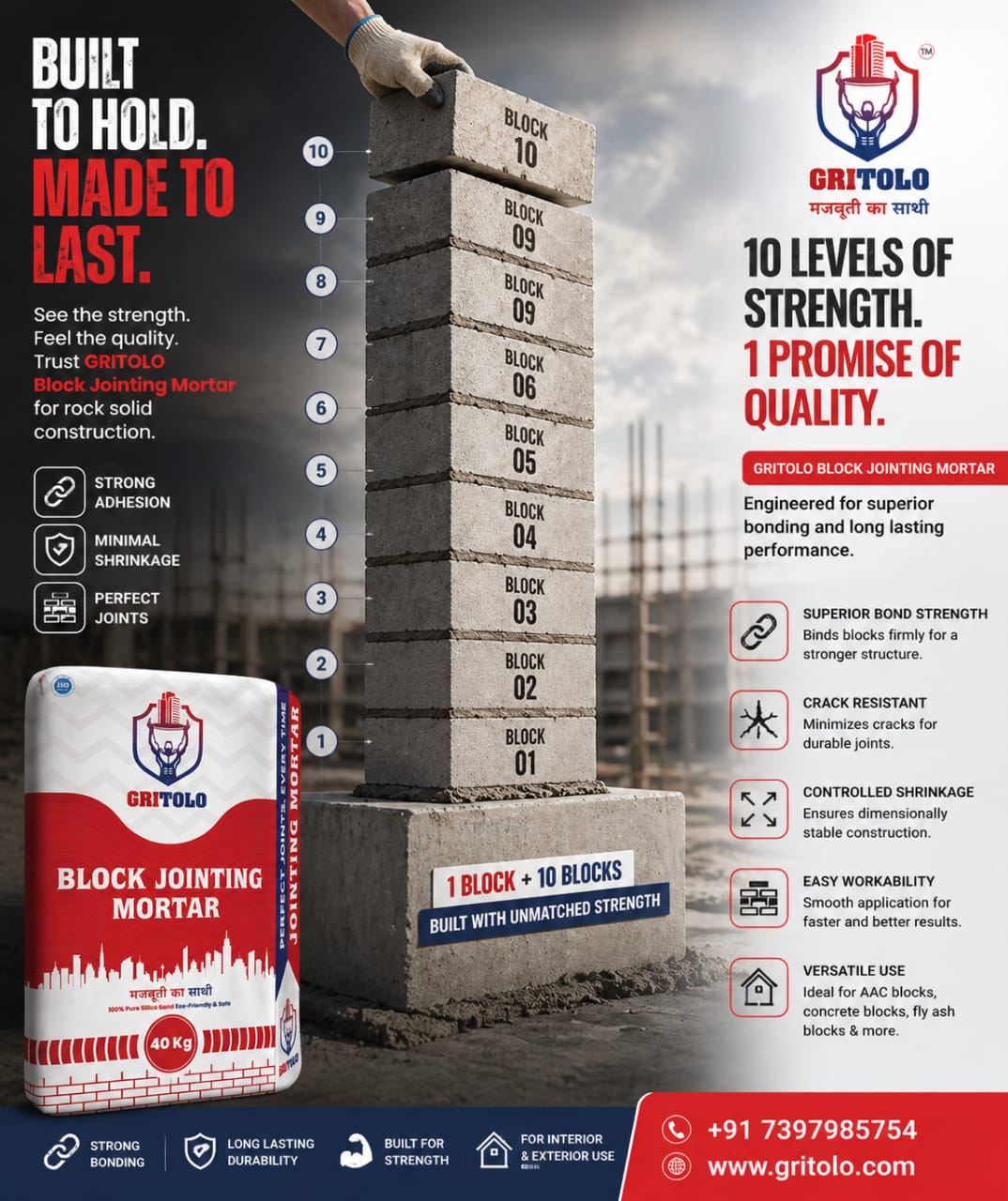
Block jointing mortar is a factory-blended, polymer-modified mortar designed specifically for bonding AAC blocks, fly ash bricks, and concrete blocks in thin-bed joints of 2–3 mm — a fraction of the 12–18 mm bed thickness used with traditional cement-sand mortar. Gritolo’s Block Jointing Mortar is formulated using high-grade cement, finely graded silica sand, and advanced polymers, and contains no fly ash or slag.
Unlike cement and sand mixed on site, block jointing mortar arrives pre-dosed and quality-controlled. You simply add water, mix for a few minutes, and apply with a notched trowel or bucket. There is no sieving, no manual ratio guesswork, and no variability from batch to batch or mason to mason.
Why AAC Blocks Specifically Need This Product
AAC blocks are precision-cut at the factory with tight dimensional tolerances, unlike traditional clay bricks. This precision is exactly what makes a 2-3mm joint possible — and necessary. Applying a thick 12-18mm cement-sand bed on AAC blocks wastes the precision the blocks were manufactured for, adds unnecessary dead load, and traps moisture that the dense AAC material struggles to release, weakening the bond over time.
Block Jointing Mortar vs Cement Mortar: The Full Comparison
Here is the parameter-by-parameter comparison that determines which mortar performs better for AAC and concrete block construction:
| Parameter | Block Jointing Mortar | Traditional Cement Mortar | Winner |
| Joint thickness | 2–3 mm | 12–18 mm | Jointing Mortar |
| Coverage per 40 kg bag | Up to 240 sq ft | N/A (multiple bags + sand needed) | Jointing Mortar |
| Material cost per sq ft | Lower (thin bed, less material) | Appears cheaper per bag, higher per sq ft | Jointing Mortar |
| Wastage | Minimal — factory-dosed | 20–30% from sieving, spillage, rebound | Jointing Mortar |
| Mixing time | 3–5 minutes, just add water | Sieving + manual mixing — 20–30 min | Jointing Mortar |
| Application speed | ~30% faster (notched trowel) | Slower — heavy trowel application | Jointing Mortar |
| Bond/tensile strength | Higher — polymer-modified | Lower — no polymer content | Jointing Mortar |
| Water curing required | Minimal to none | Several days of water curing | Jointing Mortar |
| Shrinkage cracking risk | Low — engineered to resist | Higher — variable sand/cement ratio | Jointing Mortar |
| Transport load (upper floors) | Reduced ~75% (compact bags) | Heavy — cement + sand bulk | Jointing Mortar |
| Skill dependency | Low — consistent factory mix | High — quality varies by mason | Jointing Mortar |
| Suitable for AAC blocks | Yes — purpose-built | Poor fit — designed for clay bricks | Jointing Mortar |
How Does the Price Per Bag Compare?
This is where most people get the comparison wrong — by stopping at the price tag. Here is the real picture
| Item | Block Jointing Mortar (40 kg bag) | Cement + Sand (equiv. coverage) |
| Market price range | ₹360 – ₹800 per bag (brand-dependent) | ₹200 – ₹300 per bag of cement (plus sand cost) |
| Coverage achieved | Up to 240 sq ft at 2–3 mm joint | Far less coverage per bag at 12–18 mm joint |
| Effective cost/sq ft | Lower once coverage is factored in | Higher once wastage, sand, and labour are added |
| Hidden costs | Minimal — almost nil wastage | Sieving labour, transport, rebound loss, water |
A 40 kg bag of branded block jointing mortar typically retails between ₹360 and ₹800 depending on the brand and region, while a bag of plain cement costs roughly ₹200–₹300 — but that cement bag still needs sand, water, labour for mixing, and only achieves a much thicker, heavier joint with significantly more material consumed per square foot of wall. Once coverage, wastage, and labour are factored in, block jointing mortar generally comes out 10–15% cheaper per square foot of completed wall — not more expensive, as the bag-price comparison alone suggests.
The Pricing Mistake to Avoid
Never compare block jointing mortar to cement mortar by bag price alone. You are not comparing like for like — one bag of jointing mortar replaces multiple bags of cement plus a substantial quantity of sand. Always calculate cost per square foot of finished wall before deciding.
How Much Block Jointing Mortar Do You Need?
Coverage depends directly on your target joint thickness. Use this table to estimate quantities accurately for tender pricing or material procurement:
| Joint Thickness | Coverage per 40 kg Bag | Water Required |
| 2 mm | 220 – 240 sq ft | 10 – 12 litres (~27–30% by weight) |
| 3 mm | 130 – 150 sq ft | 10 – 12 litres (~27–30% by weight) |
| 4–6 mm | 70 – 120 sq ft | 10 – 12 litres (~27–30% by weight) |
What Is the Mixing Ratio for Block Jointing Mortar?
Add approximately 10–12 litres of clean water to a 40 kg bag — roughly 27–30% water by weight — and mix using a slow-speed mechanical paddle mixer for 3–5 minutes until you achieve a smooth, lump-free, creamy consistency. Avoid over-watering, as excess water weakens bond strength and increases shrinkage. Always follow the specific Technical Data Sheet ratio for the exact product you are using, as formulations vary slightly between brands.
By comparison, traditional cement-sand mortar mixing involves sieving sand to remove stones and debris, manually proportioning cement and sand (commonly 1:4 or 1:6 by volume), and mixing by hand or with a drum mixer — a process that typically takes 20–30 minutes per batch and produces inconsistent results depending on the mason’s experience and attention to ratio accuracy.
Step-by-Step Application Process
Correct application technique is essential to realising the full coverage, strength, and durability benefits of block jointing mortar. Follow this sequence:
- Prepare the block surface. Remove dust, loose particles, and debris from the AAC block face. A clean surface ensures the polymer-modified mortar achieves full chemical and mechanical bond.
- Mix to the correct ratio. Add the mortar powder to clean water — not water to powder — and mix for 3–5 minutes to a smooth, creamy consistency using a mechanical paddle mixer.
- Respect the pot life. Mixed mortar typically remains workable for 1.5–2 hours. Mix only what your masons can apply within this window; never re-temper a stiffening batch by adding extra water.
- Apply with a notched trowel. Spread the mortar evenly along the bed face using a notched trowel sized to your target joint thickness — commonly a 2–4 mm notch depth for AAC block work.
- Place and align the block immediately. Position the next block within the mortar’s open time, then tap gently with a rubber mallet for full contact. Check alignment frequently with a spirit level and string line.
- Strike off excess mortar. Remove any mortar squeezed out beyond the joint line before it sets, keeping the wall face clean and ready for plastering.
- Allow correct setting time. Initial set typically occurs within 1.5–2 hours. Avoid loading the wall or fixing heavy fittings during this early period.
On-Site Tip from Gritolo’s Technical Team
Mix in small, manageable batches matched to your masons’ working pace, particularly in hot weather where pot life reduces. A smaller, fresher batch always outperforms a large batch that has begun to stiffen before it is fully used.
When NOT to Use Block Jointing Mortar
Block jointing mortar is purpose-built for thin-bed masonry applications, and it is important to recognise where it is not the right product:
- Traditional clay brick walls — these require thicker mortar beds (typically 10–15 mm) to accommodate dimensional variation in handmade or kiln-fired bricks, which jointing mortar is not formulated for.
- Gypsum plaster, fibre cement boards, drywall, plywood, or chipboard — block jointing mortar is not designed to bond to these substrates.
- Decorative laminates, resilient flooring, metal, or plastic surfaces.
- Flexible surfaces or areas prone to vibration, where the rigid bond cannot accommodate movement.
- Artificial stone, engineered composites, or metal tiles — these require specialised adhesives rather than block jointing mortar.
- Structural load-bearing joints requiring engineering-specified mortar grades beyond standard masonry bonding.
If your project involves any of these substrates or conditions, consult the relevant Gritolo product — such as Ready Mix Plaster for wall finishing or a tile adhesive for tiling work — rather than substituting block jointing mortar outside its intended use.
Local Insights: Block Jointing Mortar Use Across Pune and Maharashtra
Gritolo’s technical team works directly with contractors across Pune’s fast-growing residential corridors — Wakad, Hinjewadi, Undri, and Baner — where AAC block construction has become the standard for partition and external walls in new apartment developments. In these high-rise projects, the 75% reduction in transport load that block jointing mortar offers over bulk cement and sand is not a marketing claim; it is a measurable saving in labour hours spent carrying material up ten or fifteen floors, repeated across every unit on every level.
We also see a recurring pattern worth flagging: site teams sometimes default to cement-sand mortar out of habit on AAC block walls, simply because that is what masons have always used. The result is consistently thicker joints than necessary, higher material consumption, and — over time — a higher incidence of shrinkage cracking at joints compared to walls built with a purpose-formulated jointing mortar. Switching the specification at the tender stage, rather than mid-project, is the easiest way to capture the full cost and time benefit.
Frequently Asked Questions
Is block jointing mortar cheaper than cement mortar?
Per bag, cement appears cheaper at ₹200–300 versus ₹360–800 for jointing mortar. But cement mortar requires thicker 12–18 mm joints, multiple bags of sand, and has high wastage. Per square foot of finished wall, block jointing mortar typically works out 10–15% cheaper overall.
How much block jointing mortar do I need per square foot?
A 40 kg bag of block jointing mortar covers up to 240 sq ft at a 2 mm joint thickness, reducing to roughly 130–150 sq ft at 3 mm. Always calculate based on your target joint thickness for accurate quantity estimation.
What is the mixing ratio for block jointing mortar?
Add approximately 10–12 litres of clean water per 40 kg bag — around 27–30% by weight — then mix for 3–5 minutes using a mechanical paddle mixer until you achieve a smooth, lump-free, creamy consistency.
When should I NOT use block jointing mortar?
Avoid block jointing mortar on gypsum plaster, drywall, plywood, metal, plastic, flexible or vibrating surfaces, and artificial or engineered stone. It is also unsuitable for traditional clay brick walls, which need thicker mortar beds that jointing mortar is not designed for.
Does block jointing mortar need water curing like cement?
No. Block jointing mortar is self-curing and requires minimal to no additional water curing, unlike traditional cement mortar, which needs several days of water curing to reach design strength.
Internal Reference: Related Gritolo Products and Resources
- View full product page and Technical Data Sheet: Gritolo Block Jointing Mortar
- For wall finishing after block jointing, see: Ready Mix Plaster — Benefits, Application Guide & Price
- Full application guide: Block Jointing Mortar for AAC Blocks: Complete Application Guide for Contractors
- For tiling work after wall finishing, read: Which Tile Adhesive Grade Should You Use? T1, T2, T3, T4 Explained
- Browse Gritolo’s full construction materials range: Gritolo Shop
For bulk orders, technical data sheets, or site consultation: Contact the Gritolo Team | +91 7397985754
Gritolo Technical Team
The Gritolo Technical Team is based in Pune and works directly with contractors, masons, and developers across Maharashtra on AAC block construction. Gritolo Global India Pvt Ltd manufactures Block Jointing Mortar in-house, using high-grade cement, finely graded silica sand, and advanced polymers, and the cost and coverage figures in this article are drawn from our own product data sheets, real site applications, and current market pricing — not generic estimates. We regularly help builders compare true cost-per-square-foot rather than bag price alone, since this is where most procurement decisions go wrong.
Contact us: https://gritolo.com/contact | Phone: +91 7397985754