Block Jointing Mortar for AAC Blocks: Complete Application Guide for Contractors (2026)
Block jointing mortar for AAC blocks is a factory-mixed, polymer-modified cementitious adhesive applied in thin layers of 2–6 mm (ideally 2–3 mm) to bond Autoclaved Aerated Concrete blocks together. Unlike traditional cement-sand mortar, it requires only water, sets within 1.5–2 hours, needs no water curing, and delivers compressive strength of up to 36.9 MPa at 28 days. Correct application — clean surface, proper water-powder ratio, notched trowel, and consistent joint thickness — is what determines whether your AAC wall stays crack-free for decades.
AAC blocks have become the standard walling material across Indian residential and commercial construction, prized for their light weight, thermal insulation, and faster build speed. But ask any experienced site engineer and they will tell you: the block is only half the story. The mortar joining those blocks together determines whether your wall performs as designed or develops cracks, hollow joints, and alignment problems within a year or two.
This guide is written specifically for contractors, masons, and site supervisors who want a clear, practical understanding of block jointing mortar for AAC blocks — what it is, how thick the joint should be, how to mix and apply it correctly, and the mistakes that cause most on-site failures. We have based this on real application data, IS code references, and hands-on experience from Gritolo’s technical team working across Maharashtra construction sites.
What Is Block Jointing Mortar and Why AAC Blocks Need It
Block jointing mortar is a factory-premixed, polymer-modified cementitious compound formulated specifically for bonding Autoclaved Aerated Concrete (AAC) blocks, fly ash bricks, and concrete blocks. It is engineered to work in thin-bed applications — typically 2 mm to 6 mm — rather than the 15–20 mm thick beds used with traditional cement-sand mortar for red clay bricks.
AAC blocks present two challenges that ordinary mortar struggles with. First, their surface is smooth and factory-finished, offering very little of the mechanical interlock that rough-textured bricks provide. Second, AAC blocks are highly porous and absorb water rapidly — so a thick layer of conventional mortar loses its moisture to the block before the cement can hydrate properly, weakening the bond from the outset.
Block jointing mortar solves both problems. Its polymer content improves chemical adhesion to the smooth block surface, whilst its fine particle grading and water-retention properties allow it to cure correctly even in a thin layer, against a highly absorbent substrate.
Why This Matters on Site
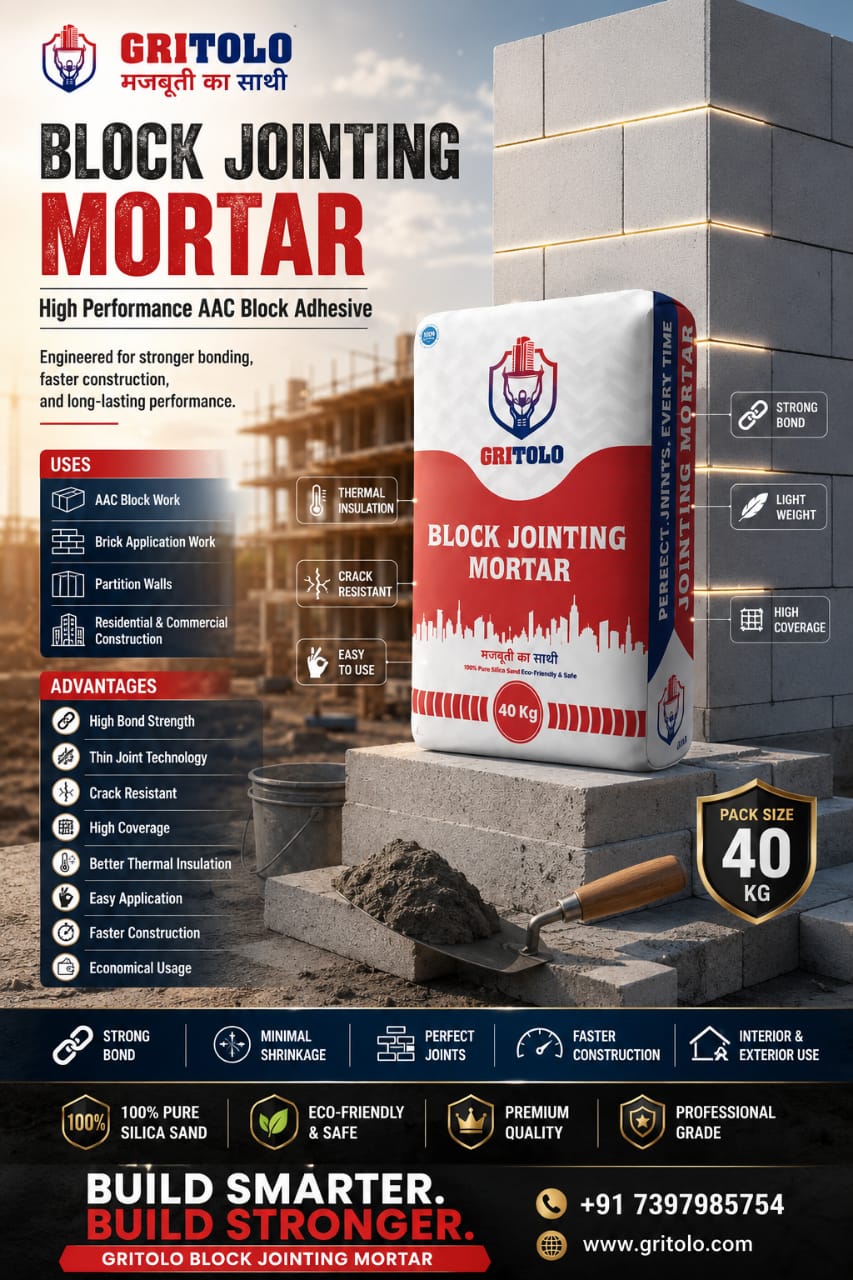
A 40 kg bag of Gritolo Block Jointing Mortar replaces several bags of cement and a significant quantity of sand for the same wall area — and at 2–3 mm joints, it covers up to 240 sq. ft. per bag. That is a direct reduction in material handling, transport to upper floors, and on-site wastage.
AAC Block Mortar Thickness: What Joint Thickness Should You Use?
This is one of the most frequently asked questions from site teams, and the answer depends on the dimensional accuracy of the blocks being used. AAC blocks are factory-cut and generally have tighter tolerances than red bricks, which is exactly why thin joints are possible — and recommended.
As a general rule for block jointing mortar AAC blocks application, follow this guidance:
- 2 mm joints — Ideal for precision-cut, factory-finished AAC blocks with minimal dimensional variation. Maximises coverage and minimises material cost per square foot.
- 3 mm joints — The most common thickness used on Indian sites; a safe, practical default for standard AAC block walls.
- 4 mm joints — Used where blocks show slightly more dimensional variation or where minor surface correction is needed.
- 6 mm joints — The upper limit; used only when blocks have larger tolerances or where a levelling course is required.
Gritolo’s Block Jointing Mortar is formulated to work reliably across this entire 2–6 mm range, but our technical recommendation for most AAC block walls is to target 2–3 mm wherever block quality allows it. Thinner joints mean better coverage per bag, lower material cost, and a stronger, more uniform wall.
| Joint Thickness | Coverage per 40 kg Bag | Typical Use Case |
| 2 mm | 220 – 240 sq. ft. | Factory-finished AAC blocks, precision masonry |
| 3 mm | 130 – 145 sq. ft. | Standard AAC block walls, most residential work |
| 4 mm | 110 – 120 sq. ft. | AAC blocks with minor dimensional variation |
| 6 mm | 70 – 75 sq. ft. | Levelling courses, blocks with larger tolerance |
Note: that coverage figures will vary slightly depending on block surface flatness, wastage during application, and trowel technique — but these figures from Gritolo’s own technical data sheet give a reliable planning baseline for site quantity estimation.
Step-by-Step Application Guide: How to Apply Block Jointing Mortar on AAC Blocks
Correct application technique is just as important as product quality. Follow this sequence for consistent, crack-free joints:
- Prepare the block surface. Remove all dust, loose particles, and debris from the AAC block surface. Block jointing mortar bonds chemically as well as mechanically, so a clean, slightly dampened surface (in hot or dry weather) improves adhesion significantly.
- Mix with the correct water-powder ratio. Gritolo Block Jointing Mortar requires a water-powder ratio of approximately 20%–22% by weight. Add the mortar powder to clean water — not the reverse — and mix using a slow-speed drill paddle or mechanical mixer until you achieve a smooth, lump-free, creamy consistency. Avoid over-watering, as this weakens bond strength and increases shrinkage.
- Respect the pot life. The mixed mortar has a pot life of approximately 1.5 hours at 30°C. Mix only the quantity you can apply within this window. Mortar that has begun to stiffen should never be reconstituted with extra water — discard it and mix a fresh batch.
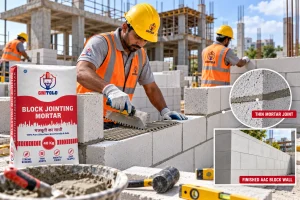
- Apply using a notched trowel. Spread the mortar evenly along the bed face of the block using a notched trowel appropriate for your target joint thickness (commonly 2–4 mm notch depth for AAC applications). This ensures a consistent, controlled layer rather than an uneven hand-applied smear.
- Place and align the block immediately. Position the next block within the open time of the mortar, then tap gently with a rubber mallet to achieve full contact and correct alignment. Use a spirit level and string line frequently to maintain plumb and level courses — AAC block walls rely heavily on accurate alignment since blocks are large-format and visible errors compound quickly.
- Strike off excess mortar. Remove any mortar that squeezes out beyond the joint line before it sets, keeping the wall face clean and ready for plastering or finishing.
- Allow correct setting time before loading. Initial set typically occurs within 1.5–2 hours; full strength development continues up to 27 days. Avoid loading the wall, fixing heavy fittings, or applying significant lateral pressure during the early setting period.
On-Site Tip from Gritolo’s Technical Team
Always batch-mix in small, manageable quantities matched to your masons’ working pace. On hot Maharashtra summer days, pot life can reduce noticeably — mix smaller batches more frequently rather than risking a large batch stiffening before use.
Technical Specifications of Gritolo Block Jointing Mortar
For contractors and consultants who need documented specification data for quality control, tender submissions, or technical approval, here are the key performance parameters:
| Property | Value |
| Bulk Density | 1300 – 1450 kg/m³ |
| Water–Powder Ratio | 20% – 22% by weight |
| Fresh Wet Density | 1300 – 1800 kg/m³ |
| Pot Life | 1.5 hours at 30°C |
| Flexural Strength | > 4.0 N/mm² @ 28 days |
| Compressive Strength | > 11–12 N/mm² @ 28 days (up to 36.9 MPa) |
| Split Tensile Strength | > 1.1 N/mm² |
| Layer Thickness | 2 mm to 6 mm |
| Water Curing | Not required |
| Setting Time | Initial: 1.5–2 hours | Final: 27 days |
| Finish | Smooth |
| Wastage | Almost nil |
These figures place Gritolo Block Jointing Mortar well within — and in several parameters above — the performance range expected of a premium thin-bed AAC block adhesive, with compressive strength reaching as high as 36.9 MPa at 28 days under standard test conditions.
Common Mistakes Contractors Make When Using Block Jointing Mortar
Even experienced masons accustomed to traditional brickwork can fall into habits that compromise AAC block jointing mortar performance. Here are the errors we see most often on Indian sites:
Mistake_1: Applying Joints That Are Too Thick
The single most common error is treating block jointing mortar like traditional cement-sand mortar and applying it in 12–15 mm beds. This defeats the product’s purpose entirely, increases material cost dramatically, and can actually weaken the bond since the product is engineered for thin-layer curing characteristics.
Mistake_2: Incorrect Water Dosing
Adding water by ‘feel’ rather than measuring the 20–22% water-powder ratio is a frequent source of inconsistent batches. Too much water reduces final strength and increases shrinkage cracking; too little produces a stiff, unworkable mix with poor coverage and weak adhesion.
Mistake_3: Ignoring Pot Life
Mixing a large batch in the morning and using it throughout the day — adding water periodically to keep it workable — destroys the polymer system’s intended performance. Always respect the 1.5-hour pot life and mix fresh batches.
Mistake_4: Skipping Surface Preparation
Laying mortar directly over dust-laden or loose-particle block surfaces significantly reduces bond strength. A quick brush-down before application takes seconds and meaningfully improves long-term joint integrity.
Mistake_5: Using It on Unsuitable Substrates
Block jointing mortar is not designed for every surface. It should not be applied directly to gypsum plaster, fibre cement boards, drywall, plywood, chipboard, decorative laminates, resilient flooring, metal, plastic, or flexible and vibration-prone surfaces. It is also not recommended for artificial stone, engineered composites, or metal tiles. Always confirm the substrate matches the product’s intended use before specifying it.
Block Jointing Mortar vs Traditional Cement-Sand Mortar: Why the Switch Matters
Many Indian contractors still default to site-mixed cement-sand mortar out of habit, even on AAC block projects. Understanding the practical differences helps explain why thin-bed jointing mortar has become the industry standard for AAC masonry:
- Joint thickness: 2–6 mm with jointing mortar versus 12–20 mm with traditional mortar — directly reducing material volume per wall.
- Water curing: Not required for block jointing mortar, whereas cement-sand mortar typically needs several days of water curing to achieve design strength.
- Logistics: A 40 kg bag replaces multiple cement bags and a substantial quantity of sand, cutting transport load to upper floors significantly — a meaningful saving on high-rise projects.
- Consistency: Factory-controlled mixing eliminates the variability inherent in on-site sand-cement ratios, which differ from mason to mason and batch to batch.
- Wastage: Pre-mixed, measured application produces almost nil wastage compared to the inconsistent quantities typical of hand-mixed mortar.
When contractors compare bag price to bag price, jointing mortar can appear costlier than cement and sand. But the realistic comparison is cost per square foot of finished wall — accounting for labour, water, transport, wastage, and rework. On that basis, block jointing mortar is frequently found to be more economical overall, not less.
Local Insights: AAC Block Construction Across Maharashtra
Gritolo’s technical team works directly with contractors and developers across Pune, Mumbai, and the wider Maharashtra region, and a few region-specific patterns are worth highlighting for anyone specifying block jointing mortar locally.
Pune’s High-Rise Residential Boom
In fast-growing corridors like Hinjewadi, Wakad, and Undri, AAC block walling has become near-universal for partition and external walls in new apartment developments. The high-rise nature of these projects makes material logistics a real cost driver — every bag that does not need to be hand-carried up ten or fifteen floors represents genuine labour savings, which is precisely where thin-bed jointing mortar earns its place over traditional mortar.
Monsoon Timing Considerations
Maharashtra’s monsoon season introduces particular challenges for masonry work — high ambient humidity can extend open time slightly, whilst the subsequent dry heat can shorten pot life. Site teams should adjust batch sizes seasonally: smaller, more frequent mixes during hot, dry months, and closer attention to surface dampness checks during humid periods, to maintain consistent bond quality year-round.
Commercial and Industrial Applications
Warehouses, IT parks, and industrial sheds across the Pune–Chakan–Talegaon industrial belt increasingly specify AAC block walling for its thermal insulation benefits, which directly reduces cooling loads. For these larger-scale projects, the documented technical performance data of a quality jointing mortar — compressive strength, flexural strength, and setting time — becomes essential for consultant approval and quality audits.
Long-Tail Questions Contractors Search Before Buying
Beyond the core technical questions, several specific, practical queries come up repeatedly from site teams and procurement managers. We address the most common ones here directly.
Q1. How much block jointing mortar do I need per square metre of AAC wall?
A1. At a 3 mm joint thickness, expect approximately 130–145 sq. ft. of wall coverage per 40 kg bag, which converts to roughly 12–13.5 sq. m per bag. Always calculate based on your specific target joint thickness using the coverage table above, and add a reasonable contingency for wastage and surface irregularity.
Q2. Can block jointing mortar be used for fly ash bricks as well as AAC blocks?
A2. Yes. Gritolo Block Jointing Mortar is formulated for AAC blocks, fly ash bricks, and concrete blocks alike, making it suitable for mixed-material projects without needing a separate product for each block type.
Q3. Does block jointing mortar need water curing after application?
A3. No. Unlike traditional cement-sand mortar, block jointing mortar does not require water curing. This is one of its principal time and labour advantages on site.
Q4. What tools are needed to apply block jointing mortar correctly?
A4. A notched trowel (for consistent layer thickness), a slow-speed mixing drill or paddle mixer, a rubber mallet for block alignment, a spirit level, and a string line for course alignment are the essential tools for correct application.
Internal Reference: Related Gritolo Products and Resources
Block jointing mortar is one part of a complete AAC block construction system. Depending on your project stage, these related Gritolo resources may also be useful:
- Block Jointing Mortar— Full product specification and technical data sheet. View Product
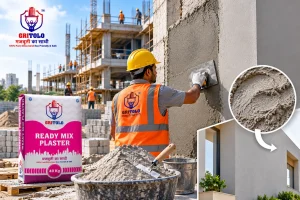
- Once block jointing is complete, walls typically require finishing with Ready Mix Plasterfor a smooth, durable surface — browse the full range on the Gritolo Shop.
- For tiling work after wall finishing, see our companion guide on tile adhesive grade selection (T1–T4)on the Gritolo Blog.
- Learn more about Gritolo’s manufacturing standards on the About Us
For bulk orders, technical data sheets, or site consultation, contact the Gritolo team directly.
Frequently Asked Questions
Q1. What is block jointing mortar used for in AAC block construction?
A1. Block jointing mortar is a thin-bed, polymer-modified cementitious adhesive used to bond AAC blocks together in masonry walls. It is applied in 2–6 mm layers, requires only water to mix, and provides high bond strength without the need for water curing.
Q2. What is the ideal joint thickness for AAC block mortar?
A2. The ideal AAC block mortar thickness is 2–3 mm for precision-cut blocks, which maximises coverage and minimises material cost. Joints up to 6 mm can be used where blocks have greater dimensional tolerance, though thinner joints generally produce stronger, more uniform walls.
Q3. How long does block jointing mortar take to set?
A3. Gritolo Block Jointing Mortar has an initial setting time of 1.5–2 hours and reaches final set at approximately 27 days, with compressive strength developing progressively from 12.1–14.5 MPa at 2 days to up to 36.9 MPa at 28 days.
Q4. Does AAC block jointing mortar need water curing?
A4. No, block jointing mortar does not require water curing, unlike traditional cement-sand mortar. This significantly reduces labour and time requirements on site.
Q5. How much does one bag of block jointing mortar cover?
A5. A 40 kg bag of Gritolo Block Jointing Mortar covers approximately 220–240 sq. ft. at a 2 mm joint thickness, or around 130–145 sq. ft. at a 3 mm joint thickness, depending on application technique and block surface flatness.
Q6. What is the correct water-powder ratio for block jointing mortar?
A6. The recommended water-powder ratio is approximately 20%–22% by weight. Adding water gradually whilst mixing to a smooth, lump-free, creamy consistency produces the best workability and bond strength.
Q7. Can block jointing mortar be used on surfaces other than AAC blocks?
A7. Yes, it is also suitable for fly ash bricks and concrete blocks. However, it should not be applied to gypsum plaster, drywall, plywood, metal, plastic, or other flexible and vibration-prone surfaces.
Gritolo Technical Team
The Gritolo Technical Team comprises construction materials specialists based in Pune with direct, hands-on experience supporting contractors on AAC block masonry across Maharashtra’s residential, commercial, and industrial projects. Gritolo Global India Pvt Ltd manufactures premium block jointing mortar, ready mix plaster, and tile adhesives, and the guidance in this article is drawn from the same technical data sheets and quality testing used in our own manufacturing process. Recommendations here reflect real on-site application experience, not just laboratory figures.
Contact us:https://gritolo.com/contact | Phone: +91 7397985754