Best Tile Adhesive for Vitrified Tiles: The Complete Buyer’s Guide for India (2026)
Quick Answer: The best tile adhesive for vitrified tiles is a white, polymer-modified flexible cementitious adhesive classified as C2TE or C2TES1 grade. Vitrified tiles are non-porous, so you must always use white adhesive and back-butter each tile. For large-format vitrified tiles (600mm and above), specify C2TE with extended open time. For bathroom walls, wet rooms, and swimming pools, add a waterproof-grade or epoxy adhesive. Gritolo’s TA–V200 and TA–G400 are purpose-formulated for vitrified tile applications across all Indian project types.
Vitrified tiles are India’s most popular flooring choice — and for good reason. They are hard, dense, low-maintenance, visually versatile, and available in formats from 300×300mm mosaics to 1200×2400mm large slabs. Walk into almost any new apartment, commercial building, or modern home in India and the floor under your feet is almost certainly vitrified.
But here is the thing most people get wrong: vitrified tiles are one of the most demanding tile types for adhesive selection. Their near-zero water absorption means standard adhesives simply do not bond reliably to their surface. Their large formats demand extended open time and full coverage. Their weight and thermal mass require flexible adhesives on floors. And their translucent characteristics mean grey adhesive can discolour light-coloured tiles from beneath.
Use the wrong adhesive — or the right adhesive but the wrong technique — and vitrified tiles will either delaminate within a year, show lippage (uneven tile edges), crack under thermal stress, or simply look wrong because of adhesive show-through. This guide gives you everything you need to get it right.
Why Vitrified Tiles Demand a Specialist Adhesive
To understand why vitrified tile adhesive is a specialist category, you need to understand what vitrification actually does to a tile. The word ‘vitrified’ comes from the Latin vitreum (glass). Vitrified tiles are fired at extremely high temperatures — 1,200°C to 1,400°C — causing the clay minerals and silica in the tile body to fuse together into a near-glass-like structure.
This process gives vitrified tiles their extraordinary hardness and scratch resistance. It also gives them a water absorption rate of less than 0.5% — compared to 10–15% for standard ceramic floor tiles. That near-zero absorption is the property that creates the adhesive challenge.
The Non-Porous Problem
Standard tile adhesives rely on two bonding mechanisms: chemical adhesion (the adhesive bonding to the tile’s material surface) and mechanical adhesion (the adhesive penetrating micro-pores and irregularities in the tile’s back face). Vitrified tiles, being essentially non-porous, provide far less opportunity for mechanical adhesion than ceramic tiles. This means the bond is almost entirely dependent on the adhesive’s chemical and contact adhesion properties.
The practical result: standard C1-grade cement adhesives, which are adequate for porous ceramic tiles, routinely fail on vitrified tiles. The bond strength is simply insufficient for the sustained load — particularly on floors where walking, furniture, and thermal cycling create constant mechanical stress on the adhesive bed.
Additional Characteristics That Affect Adhesive Choice
- Smooth back face: Many vitrified tiles have a smooth, glazed, or semi-polished back surface rather than the rough, textured back of ceramic tiles. This further reduces mechanical bond. Back-buttering — applying a thin skim of adhesive to the tile back — is mandatory for vitrified tiles.
- Large format and weight: Vitrified tiles are available in formats up to 1200×2400mm. A single tile at this size weighs 25–40kg. The adhesive must support this weight in a uniform bond without point-loading or void areas.
- Low thermal mass but high coefficient of expansion: Vitrified tiles expand and contract measurably with temperature changes. In India’s climate — where slab surface temperatures can reach 55–60°C in summer — this movement is significant. An inflexible adhesive will crack under this stress.
- Colour visibility: Lighter vitrified tiles — especially white, cream, beige, and light grey — are sufficiently translucent that grey adhesive is visible through the tile face, creating patchy, discoloured appearance that cannot be corrected without removing and relaying the tiles.
Understanding Tile Adhesive Classifications — What the Codes Mean
Tile adhesives are classified under EN 12004 (European standard) and equivalent BIS standards by a system of letters and numbers. Understanding this classification is the key to specifying correctly.
| Code | Meaning | Bond Strength | Non-Slip? | Best For |
| C1 | Standard cement adhesive | ≥0.5 N/mm² | No | Light ceramic, dry interior |
| C2 | Improved polymer-modified adhesive | ≥1.0 N/mm² | No | Vitrified floors & walls |
| C2T | C2 + non-slip (T = no slippage) | ≥1.0 N/mm² | Yes | Vitrified wall tiles |
| C2TE | C2T + extended open time | ≥1.0 N/mm² | Yes | Large-format vitrified tiles |
| C2TES1 | C2TE + Class S1 flexibility (2.5mm) | ≥1.0 N/mm² | Yes | External vitrified, wet areas |
| C2TES2 | C2TE + Class S2 flexibility (5.0mm) | ≥1.0 N/mm² | Yes | Pools, facades, underfloor heat |
| R2 | Reactive (epoxy) adhesive | ≥2.0 N/mm² | Yes | Pools, chemical environments |
For most vitrified tile installations in India — floors and walls, interior and exterior — C2TE is the minimum professional specification. The E (extended open time) suffix is essential for vitrified tiles because their non-porous surface means you need more time to position and press the tile before the adhesive skins over and loses bond. Never use C1-grade adhesive for vitrified tiles under any circumstances.
Types of Vitrified Tiles and Which Adhesive Each Needs
‘Vitrified tiles’ is an umbrella term covering several distinct product categories — each with different surface characteristics and adhesive requirements.
Full-Body Vitrified Tiles
Full-body vitrified tiles have a uniform colour and composition throughout their thickness — the tile body matches the surface colour. They are highly durable, resistant to chipping (chips are less visible), and are commonly used in high-traffic commercial and residential flooring. The back face is typically rough-textured, providing better adhesive key than other vitrified types.
- Adhesive specification: C2TE grade, grey or white depending on tile colour. Back-buttering recommended.
Soluble Salt / Double Charged Vitrified Tiles
Double charged vitrified tiles are manufactured by pressing two layers of different pigments together to create surface patterns that penetrate approximately 3–4mm into the tile body. They have a semi-polished surface and are extremely popular in Indian residential and commercial flooring at all price points.
The semi-polished surface is less porous than a full-body tile, making adhesive bond strength more critical. Additionally, the polish process creates a very smooth back face on some products.
- Adhesive specification: C2TE white grade for light-coloured tiles; grey acceptable for dark tiles. Back-buttering mandatory.
Nano / Super Polished Vitrified Tiles
Nano-polished vitrified tiles undergo an additional nano-coating process that fills micro-pores in the surface and creates an ultra-high gloss finish. The back face of these tiles is also typically very smooth. Both the surface and back face characteristics make adhesive bond the most critical consideration of any vitrified tile type.
- Adhesive specification: C2TE white grade mandatory — back-buttering is non-negotiable for nano-polished tiles. Coverage of 95–100% is required.
Nano-polished vitrified tiles have been the site of some of the most spectacular tile debonding failures in Indian construction — entire floors of polished tiles lifting within 2–3 years of installation because of incorrect adhesive type or poor coverage. The specification requirement is not a premium extra; it is essential for a bond that lasts.
Glazed Vitrified Tiles (GVT) and Polished Glazed Vitrified Tiles (PGVT)
GVT and PGVT tiles are vitrified tiles with an additional glaze layer applied to the surface, allowing far greater design flexibility — digital printing enables wood effects, marble effects, geometric patterns, and custom imagery. PGVT tiles are further polished to a high gloss after glazing.
These tiles have a vitrified tile base (non-porous) with an added glaze surface. The key consideration is that the glaze and vitrified body can have slightly different thermal expansion coefficients, making flexibility in the adhesive more important than for standard vitrified types.
- Adhesive specification: C2TE for standard sizes; C2TES1 for tiles 600mm and above. White adhesive for light-coloured and high-gloss tiles.
Large Format Vitrified Slabs (800mm+)
Large-format vitrified slabs — 800×800mm, 1200×600mm, 1200×1200mm, and 1200×2400mm — have become increasingly popular in premium Indian residential and commercial projects. They create seamless, grout-joint-free (or minimal grout joint) floors and walls that look spectacular but demand the most rigorous adhesive specification and application technique of any tile installation.
- Adhesive specification: C2TE minimum; C2TES1 or C2TES2 for external use, wet areas, and underfloor heating. White adhesive for all light-coloured slabs. Professional installation with laser level and large-format trowel (10–12mm notch) mandatory.
- Additional requirements: Movement joints every 3–4m and at all perimeter edges are mandatory. Failure to install movement joints on large-format vitrified floors is the most common cause of cracking and tenting.
Room-by-Room Guide: Best Adhesive for Vitrified Tiles by Location
Use this table as a quick reference for your specific project location.
| Location | Tile Type / Format | Recommended Grade | Colour & Notes |
| Living room floor | 600×600 to 800×800mm | C2TE | White if tile is light coloured; back-butter |
| Living room floor (slab) | 1200×600mm or larger | C2TES1 | White adhesive; 10–12mm notch trowel |
| Bedroom floor | 600×600mm standard | C2TE | Grey or white; back-butter |
| Kitchen floor | 600×600mm anti-skid | C2TE | Grey acceptable; water-resistant variant preferred |
| Bathroom floor | 300–600mm anti-skid vitrified | C2TES1 | White; waterproof membrane beneath |
| Bathroom wall | 300×600mm or 600×600mm | C2TES1 (non-slip + flex) | White; back-butter mandatory |
| Outdoor terrace / patio | 600×600mm outdoor grade | C2TES2 | Grey; movement joints every 3m; primer substrate |
| Swimming pool interior | 200–300mm vitrified mosaic | R2 (epoxy) or C2TES2 | White; see Gritolo Epoxy Pool Guide |
| External facade cladding | Large format vitrified panel | C2TES2 | Grey; mechanical fixings for heavy panels |
| Underfloor heating system | Any size vitrified | C2TES2 (minimum) | Flexibility essential; follow UFH system spec |
White Adhesive vs Grey Adhesive for Vitrified Tiles: Which Do You Need?
This is a question that is asked constantly — and the answer is straightforward once you understand the reason.
Vitrified tiles, despite their dense structure, have a degree of translucency — particularly lighter-coloured tiles and any tile with a polished, semi-polished, or glazed surface finish. When grey adhesive is used beneath these tiles, the grey colour is visible through the tile body, creating patches, colour variation, or an overall darkening of the tile colour. This effect is most pronounced with white, cream, beige, light grey, and pale marble-effect tiles.
When White Adhesive Is Mandatory
- White, cream, or beige vitrified tiles of any format
- Light grey or silver vitrified tiles
- Marble-effect or stone-effect vitrified tiles with white or cream ground colour
- All nano-polished vitrified tiles regardless of colour
- Glazed vitrified tiles (GVT / PGVT) in any light colour
- Any vitrified tile on bathroom walls where the tile is backlit or in a bright room
When Grey Adhesive Is Acceptable
- Dark grey, charcoal, or black vitrified tiles
- Dark brown or dark wood-effect vitrified tiles
- Full-body vitrified tiles with opaque dark colours
- Outdoor terrace tiles where the aesthetic is less critical
When in doubt, use white adhesive. The cost difference between white and grey adhesive is modest. The cost of relaying light-coloured vitrified tiles because of adhesive show-through is enormous — it means removing every tile, stripping the adhesive bed, and starting again.
Large-Format Vitrified Tiles: What Changes Above 600mm
Large-format vitrified tiles — anything 600mm or above in either dimension — require a different approach to adhesive selection, substrate preparation, and application technique compared to standard 300×300mm or 400×400mm tiles. Here is what changes.
Why the 600mm Threshold Matters
A 300×300mm vitrified tile covers 0.09m². A 1200×600mm tile covers 0.72m² — eight times the area. The larger the tile, the greater the chance that minor substrate imperfections, adhesive bed variations, or adhesive skinning before tile placement will create bond voids. Voids beneath large tiles concentrate stress, create hollow-sounding areas, and lead to cracking under load.
The extended open time (E) in C2TE adhesive is specifically engineered for this challenge. Standard C2T adhesive has an open time of 20–30 minutes. C2TE extends this to 30–50 minutes at 20°C — giving the installer time to properly position and press a large tile without the adhesive skinning over and losing bond strength before the tile is set.
The 95% Coverage Rule for Large-Format Tiles
For standard tiles (up to 400×400mm) in dry interior locations, 80% adhesive coverage is the accepted professional minimum. For large-format vitrified tiles (600mm and above), the minimum coverage required is 95% — and 100% is the target for wet areas and external applications.
Achieving 95%+ coverage on a large tile requires: the correct notch trowel size (10–12mm square notch); back-buttering of the tile; application of adhesive in one consistent direction (so ridges run parallel and collapse uniformly); and firm pressing with a rubber mallet across the entire tile surface, starting from the centre and working outward.
Substrate Flatness for Large-Format Vitrified Tiles
Substrate flatness tolerance for standard tiles is ±3mm over 2 metres. For large-format tiles (600mm+), this must be tightened to ±2mm over 2 metres, and for very large slabs (1200mm+), ±1.5mm is the professional standard. Exceeding these tolerances causes lippage — visible differences in height between adjacent tiles — that cannot be corrected after installation.
Movement Joints Are Non-Negotiable
On any installation using vitrified tiles 600mm or larger, movement joints (expansion joints filled with flexible silicone sealant rather than grout) must be installed at:
- All perimeter edges — where the tiled floor meets walls, door thresholds, and steps
- Changes in substrate material (e.g., concrete slab to screed)
- Intermediate positions at maximum 4m spacings in each direction for floor tiles
- At all structural joints in the substrate (construction joints, expansion joints)
Failure to install movement joints in large-format vitrified tile installations is the single most common cause of tenting (tiles lifting from the floor in a ridge) and cracking. This is a structural response to constrained thermal expansion — not an adhesive failure.
Step-by-Step Application Guide for Vitrified Tile Adhesive
Getting the application right is just as important as selecting the correct adhesive grade. Follow this professional process for vitrified tile installations that last decades.
Step 1 — Assess and Prepare the Substrate
- Check flatness: Use a 2-metre straight edge. For tiles up to 600mm, maximum deviation is 3mm. For larger tiles, tighten to 2mm. Use a suitable self-levelling compound to correct deviations before tiling.
- Check for structural soundness: Tap the substrate — any hollow areas indicate delaminated screed or concrete that must be repaired before tiling. Do not tile over a hollow substrate.
- Check substrate dryness: Concrete and screed must have reached equilibrium moisture content before tiling — typically 4–6 weeks for a 50mm screed. In-situ moisture meters should read below 75% relative humidity. Tiling over damp screeds causes adhesive failure.
- Clean the substrate: Remove all dust, oil, paint, and curing compounds. On smooth concrete, prime with a diluted polymer primer to improve adhesion.
Step 2 — Plan the Layout
- Dry-lay tiles: Before applying any adhesive, plan the tile layout on the floor to ensure visual balance — symmetrical cuts at room edges, tiles not narrower than half a tile at borders. Mark datum lines with a chalk line.
- Allow for movement joints: Mark movement joint positions on the substrate before starting. These will be maintained throughout the installation.
Step 3 — Mix the Adhesive
- Add powder to water: Always add adhesive powder to clean, cold water — not water to powder. Use the manufacturer’s specified water-to-powder ratio exactly. Extra water weakens the adhesive and extends drying time.
- Mix thoroughly: Use a slow-speed mechanical mixer (300–400 RPM) until the adhesive is smooth and completely lump-free. Allow to slake for 5 minutes, then remix briefly. The correct consistency should hold a peak when a trowel is lifted from the mix.
- Batch control: Mix only as much adhesive as you can use within the stated open time — typically 30–50 minutes for C2TE grade. In hot weather (above 30°C), reduce batch size or work in shaded areas.
Step 4 — Apply Adhesive to the Substrate
- Choose correct trowel: For vitrified tiles up to 400mm: 6–8mm square-notch trowel. For 600×600mm tiles: 8–10mm notch. For tiles 800mm and above: 10–12mm notch.
- Apply in ridged bed: Hold the notched trowel at 45–60 degrees to the substrate surface to create consistent, even ridges. Work a section of approximately 0.5–1m² at a time — no more.
- One-direction combing: Apply adhesive ridges in a single consistent direction across the working section. This ensures the ridges collapse uniformly when the tile is pressed, maximising coverage.
Step 5 — Back-Butter the Tile
- Apply thin skim to tile back: Using the flat side of the trowel, apply a thin, even skim of adhesive to the back face of the vitrified tile. This step is mandatory for vitrified tiles — it fills micro-surface irregularities and ensures contact adhesion on the non-porous tile back.
- Do not let back-butter skin: Place the back-buttered tile onto the adhesive bed immediately after back-buttering. If the back-butter has skinned over (lost its tack), discard it and re-apply.
Step 6 — Position and Press the Tile
- Place tile onto adhesive: Lower the tile onto the adhesive bed in one smooth motion, aligning carefully with your datum lines. Do not slide the tile into position — this pushes adhesive away from beneath the tile edges.
- Press firmly: Use a rubber mallet to tap the tile firmly into the adhesive, starting from the centre and working to the edges. This collapses the adhesive ridges and creates full contact across the tile back. For large-format tiles, walk across a beating board placed over the tile to ensure full pressure across the entire area.
- Check with level: Immediately check the tile is level and at the correct height relative to adjacent tiles using a spirit level and tile spacers. Correct while the adhesive is fresh — do not attempt to adjust after 10–15 minutes.
Step 7 — Check Coverage
Periodically remove a recently placed tile (within the first few minutes) to verify adhesive coverage. On the back of the tile and on the adhesive bed, you should see even adhesive transfer across 95%+ of the surface. If coverage is low, check trowel size, back-buttering technique, and working section size.
Step 8 — Allow to Set and Then Grout
- Set time: Allow C2TE adhesive a minimum of 24 hours at 20–25°C before grouting. In cooler conditions or thick adhesive beds, allow 48 hours. Test by pressing firmly on the tile — it must feel absolutely firm with no movement.
- Grout selection: For vitrified tiles with polished surfaces, use a non-abrasive fine-particle grout. Anti-stain or epoxy grout is recommended for kitchens and bathrooms where grout lines are difficult to clean.
Long-Tail Questions Answered: What People Actually Search
These are the real questions people type into Google when choosing tile adhesive for vitrified tiles. Here are direct, practical answers.
Which tile adhesive is best for large-format vitrified tiles?
For vitrified tiles 600mm and above, C2TE grade polymer-modified adhesive is the minimum specification — the E (extended open time) is essential for positioning large tiles before the adhesive skins. Use white adhesive for light-coloured tiles. For tiles on external surfaces or in wet areas, upgrade to C2TES1. For slabs above 800mm, use C2TES1 or C2TES2. Always back-butter and target 95%+ coverage. Gritolo TA–G400 is the professional recommendation for large-format vitrified floor and wall installations.
Can I use normal tile adhesive for vitrified tiles?
No. Standard C1-grade tile adhesive does not provide sufficient bond strength for non-porous vitrified tiles. The minimum correct specification is C2TE — polymer-modified with extended open time. Using standard adhesive for vitrified tiles will result in tiles that feel hollow when tapped within months of installation, and eventual tile delamination, particularly in areas subject to thermal cycling or foot traffic.
What is the best tile adhesive for vitrified tiles in bathrooms?
For bathroom vitrified tiles — both floors and walls — the correct specification is a white C2TES1 polymer-modified flexible adhesive with waterproof characteristics. Apply over a waterproofing membrane in the shower zone. Use a non-slip (T) adhesive on bathroom walls. Gritolo TA–V200 (C2T) is suitable for general bathroom tiling; TA–G400 (C2TES1) is recommended for shower enclosures and wet rooms with direct water exposure.
Do I need to back-butter vitrified tiles?
Yes — back-buttering vitrified tiles is mandatory, not optional. Vitrified tiles are non-porous with a smooth back face, meaning the adhesive has no micro-pore penetration to rely on for bonding. Back-buttering ensures the adhesive makes full contact with the tile’s back surface through both the adhesive bed and the thin skim on the tile. Without back-buttering, coverage is typically only 50–70%, which is insufficient for reliable bond strength on non-porous tiles.
What size trowel do I use for vitrified tile adhesive?
Trowel notch size depends on tile format: for tiles up to 400mm, use a 6–8mm square-notch trowel; for 600×600mm tiles, use an 8–10mm notch; for tiles 800mm and above, use a 10–12mm notch. Larger tiles require deeper adhesive beds to compensate for tile back-surface variation and substrate micro-unevenness. Always check coverage by lifting a tile — you should see even adhesive transfer on 95%+ of the back surface.
How long should vitrified tile adhesive dry before grouting?
Allow vitrified tile adhesive a minimum of 24 hours at 20–25°C before grouting. In cool or humid conditions, or for thick adhesive beds (over 10mm), allow 48–72 hours. Test readiness by pressing firmly on the tile — it must be completely rigid with zero movement. Grouting before adhesive has fully set risks displacing tiles, particularly on walls.
Why are my vitrified tiles hollow after fixing?
Hollow-sounding vitrified tiles after fixing are almost always caused by: insufficient adhesive coverage (less than 80%); failure to back-butter the non-porous tile back; using standard C1 adhesive that does not bond adequately to vitrified surfaces; or adhesive skinning before the tile was placed (working section too large or hot weather). If tiles are hollow, they must be removed and relaid — hollow tiles will crack under load and adhesive will continue to degrade over time.
What tile adhesive is best for vitrified tiles on an external terrace?
For external vitrified terrace tiles, specify C2TES2 grade — the S2 flexibility class (5mm deformation) is essential for external applications where the tile and substrate face the full temperature range of India’s climate. Apply with a 10–12mm notched trowel and target 100% coverage (back-butter mandatory). Install movement joints every 3–4m and at all perimeter edges. Use an outdoor-rated flexible grout or epoxy grout for the joints. Seal the grout annually in high-exposure locations.
Common Mistakes When Using Tile Adhesive for Vitrified Tiles
These are the installation errors that lead to vitrified tile failures — most are avoidable with correct knowledge.
| Mistake | What Goes Wrong | The Correct Approach |
| Using C1 adhesive | Bond fails on non-porous surface; tiles hollow within months | Always specify C2TE minimum for vitrified tiles |
| Skipping back-butter | Coverage drops below 70%; tiles hollow; long-term delamination | Back-butter every vitrified tile — it is mandatory, not optional |
| Using grey adhesive on light tiles | Grey shows through translucent tile; permanent discolouration | Use white adhesive for all light, cream, or pale-coloured vitrified tiles |
| Too large a working section | Adhesive skins before tile is placed; bond strength reduced to near zero | Work 0.5–1m² sections; use C2TE for extended open time in hot weather |
| Wrong trowel size | Insufficient adhesive bed; point loading; cracking under heavy load | Match trowel notch size to tile format — see trowel size guide above |
| No movement joints | Tiles tent (lift in ridges) or crack as thermal expansion is constrained | Install perimeter and intermediate movement joints on all installations |
| Tiling on damp screed | Moisture trapped under tile causes adhesive failure and tile lifting | Test moisture content; allow screed to dry fully; use suitable primer |
| Grouting too soon | Adhesive displaced; tiles move; joint alignment lost | Wait minimum 24h (48h in wet areas and cool conditions) before grouting |
Tile Adhesive for Vitrified Tiles: Cost Guide for India 2026
Understanding the cost structure for vitrified tile adhesive helps you budget accurately and evaluate products correctly. Here is an indicative cost guide for major Indian cities in 2026.
Note: Costs below are indicative and vary by city, project scale, and supplier. Always obtain current market pricing and compare on a per-square-metre installed basis, not just bag price.
| Adhesive Type | Bag Size & Price (approx) | Coverage (per bag) | Cost per m² |
| C2T standard (grey / white) | 20kg @ ₹450–600 | 4–5 m² at 6mm notch | ₹90–150 |
| C2TE polymer-modified (grey/white) | 20kg @ ₹600–800 | 4–5 m² at 8mm notch | ₹120–200 |
| C2TES1 white flexible | 20kg @ ₹750–1,000 | 3.5–4.5 m² at 10mm notch | ₹170–290 |
| C2TES2 highly flexible | 20kg @ ₹900–1,200 | 3–4 m² at 12mm notch | ₹225–400 |
| R2 Epoxy adhesive | Typically sold in 5–10kg kits @ ₹1,800–3,000 | 1.5–3 m² per kit | ₹600–2,000 |
The difference between C1 and C2TE adhesive is typically ₹50–100 per square metre of floor area. On a 100m² floor, that is ₹5,000–10,000. The cost of removing and relaying 100m² of vitrified tile due to adhesive failure — materials, labour, tile breakage, and disposal — is typically ₹80,000–200,000. The case for correct specification is straightforward.
Gritolo’s Tile Adhesive Range for Vitrified Tiles
At Gritolo Global India Private Limited, we manufacture a complete range of tile adhesives purpose-formulated for vitrified tiles across all application types. Our products are manufactured at our Pune facility under rigorous quality management systems — automated batching, precise polymer dosing, and batch testing for bond strength and open time ensure consistent performance on every project.
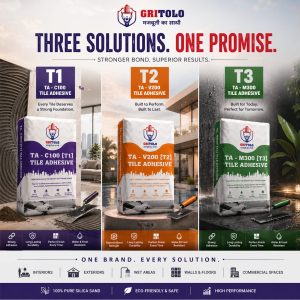
| Gritolo Product | Classification | Best Application | Colour | Vitrified Use |
| TA–C100 | C1 | Light ceramic, dry interior only | Grey | Not recommended |
| TA–V200 | C2T | Bathroom, kitchen, feature walls | White & Grey | ✓ Standard vitrified tiles |
| TA–M300 | C2TE | Large format floors, walls, LVT | White & Grey | ✓✓ Best for 600mm+ tiles |
| TA–G400 | C2TES1 | Wet rooms, external, pools | White & Grey | ✓✓ Premium wet & external |
| TA–E500 | R2 (Epoxy) | Swimming pools, chemical environments | White | ✓✓ Pool & specialist use |
For standard vitrified tiles up to 600mm, Gritolo TA–M300 is the professional recommendation. For large-format slabs (800mm+) and wet area applications, upgrade to TA–G400 C2TES1. For glass mosaic tile adhesive requirements on the same project, see our dedicated guide: Glass Mosaic Tile Adhesive — The Complete Guide. For cladding applications, see: Vertical Wall Cladding Adhesive .
Explore Gritolo’s full tile adhesive range: Visit gritolo.com/shop or call our technical team on +91 7397985754 for product selection and project specification support.
Related Guides on the Gritolo Blog
These related technical guides from Gritolo will help with your full project specification:
- Glass Mosaic Tile Adhesive: The Complete Guide 2026
- Vertical Wall Cladding Adhesive: Complete Guide 2026
- Water-Resistant Ready Mix Plaster: Complete Technical Guide 2026
- External Wall Plastering Solutions: Complete Guide 2026
- Browse Gritolo’s full product range
Frequently Asked Questions (FAQ)
These answers are structured for Google’s FAQ schema. Add them using the FAQ block in Rank Math or Yoast SEO for rich result eligibility.
Q1. What is the best tile adhesive for vitrified tiles in India?
The best tile adhesive for vitrified tiles in India is a white, polymer-modified C2TE-grade cementitious adhesive with extended open time. For tiles 600mm and above, the C2TE specification is essential. For bathroom walls, wet areas, and external applications, upgrade to C2TES1 or C2TES2. Gritolo TA–M300 (C2TE) and TA–G400 (C2TES1) are purpose-formulated for vitrified tile applications.
Q2. Can I use standard tile adhesive for vitrified tiles?
No. Standard C1-grade tile adhesive does not provide sufficient bond strength for non-porous vitrified tiles. Vitrified tiles require a minimum of C2TE-grade polymer-modified adhesive. Using standard adhesive results in poor coverage and hollow tiles that will delaminate under load and thermal cycling.
Q3. Why do I need to back-butter vitrified tiles?
Vitrified tiles are non-porous with a smooth back surface. Adhesive cannot penetrate the tile back for mechanical bond, so the entire bond relies on contact adhesion. Back-buttering — applying a thin skim of adhesive to the tile back before placing it onto the adhesive bed — ensures full contact and raises coverage from 50–70% to 95%+, which is the minimum for reliable long-term bond on non-porous tiles.
Q4. Should I use white or grey adhesive for vitrified tiles?
Use white adhesive for all white, cream, beige, light grey, marble-effect, and polished vitrified tiles. Light-coloured vitrified tiles are translucent enough for grey adhesive to show through and discolour the tile permanently. Grey adhesive is only acceptable for dark-coloured vitrified tiles (dark grey, charcoal, black, dark brown).
Q5. What tile adhesive do I need for large-format vitrified tiles (600mm+)?
For vitrified tiles 600mm and above, specify C2TE grade (extended open time) minimum. The extended open time is essential for positioning large tiles before the adhesive skins over. For external use, wet areas, and underfloor heating, upgrade to C2TES1 or C2TES2. Use a 10–12mm notch trowel, back-butter every tile, and target 95%+ coverage.
Q6. How long does vitrified tile adhesive take to set before grouting?
Vitrified tile adhesive requires a minimum of 24 hours at 20–25°C before grouting — 48 hours in cool, humid, or wet conditions, or for thick adhesive beds. Test by pressing firmly on the tile: it must be completely rigid with zero movement before grouting proceeds. Grouting too soon can displace tiles, particularly on vertical wall applications.
Q7. Do vitrified tiles on external terraces need a special adhesive?
Yes. External vitrified terrace tiles require C2TES2-grade flexible adhesive — the S2 flexibility class (5mm deformation) is essential for external surfaces where tiles and substrate face India’s full temperature range. Movement joints every 3–4m and at perimeter edges are mandatory. Use outdoor-rated flexible or epoxy grout for the joints.
Q8. Where can I buy Gritolo tile adhesive for vitrified tiles?
Gritolo’s tile adhesive range for vitrified tiles is available through our authorised distributor network across India and directly via gritolo.com/shop. For bulk project supply, technical specifications, or specification support, contact our team on +91 7397985754 or visit gritolo.com/contact.
Specify Right — Your Vitrified Tiles Deserve It
Vitrified tiles are beautiful, durable, and low-maintenance when correctly installed. The key word is correctly. Everything in this guide points to a simple principle: vitrified tiles are non-porous and demand an adhesive that compensates for this — through polymer modification, extended open time, back-buttering, and full coverage.
The investment in correct adhesive specification — C2TE instead of C1, white instead of grey, S1 flexibility for wet areas — is measured in hundreds of rupees per project. The cost of getting it wrong is measured in tens of thousands. The mathematics are simple, and the right choice is always the correct specification from the start.
At Gritolo Global India Private Limited, our tile adhesive range is designed around the actual demands of vitrified tile installation in India — non-porous surfaces, large formats, diverse climates, and the full range of project types from premium residential to industrial. Every product is manufactured with precision, tested rigorously, and supported by technical expertise that is genuinely available for your project.
Ready to order or need a specification recommendation? Visit gritolo.com/shop or call our technical team on +91 7397985754. We will help you choose the right adhesive for your vitrified tile project — every time.
About the Author
The Gritolo Editorial Team comprises civil engineers, construction materials technologists, and experienced tile installation specialists based at our Pune headquarters. Our team develops, tests, and provides field support for Gritolo’s full range of tile adhesives — including C2TE and C2TES1 formulations designed specifically for vitrified tile applications across India’s diverse construction environments.
Our guidance on vitrified tile adhesive reflects years of direct involvement in specification, quality testing, and application support across hundreds of Indian projects — from premium large-format vitrified floors in Mumbai and Bengaluru to bathroom and pool installations in coastal Kerala and Gujarat. We understand that vitrified tiles are unforgiving of adhesive shortcuts, and our products and advice are designed to ensure you never have to discover that the hard way.