Construction Material Comparison: Types, Uses & Key Differences
Choosing the right material is one of the most important decisions in a construction project. From foundations and masonry to plastering, tiling, waterproofing and flooring, different construction materials are designed to perform different functions.
However, construction material selection can become confusing when several products appear to serve similar purposes.
Should you use ready mix plaster or traditional cement-sand plaster?
Is tile adhesive or cement mortar more appropriate for tile installation?
When should you consider block jointing mortar instead of conventional masonry mortar?
What is the difference between floor hardener and an ordinary concrete floor?
These questions are common among homeowners, contractors, architects, engineers and construction professionals.
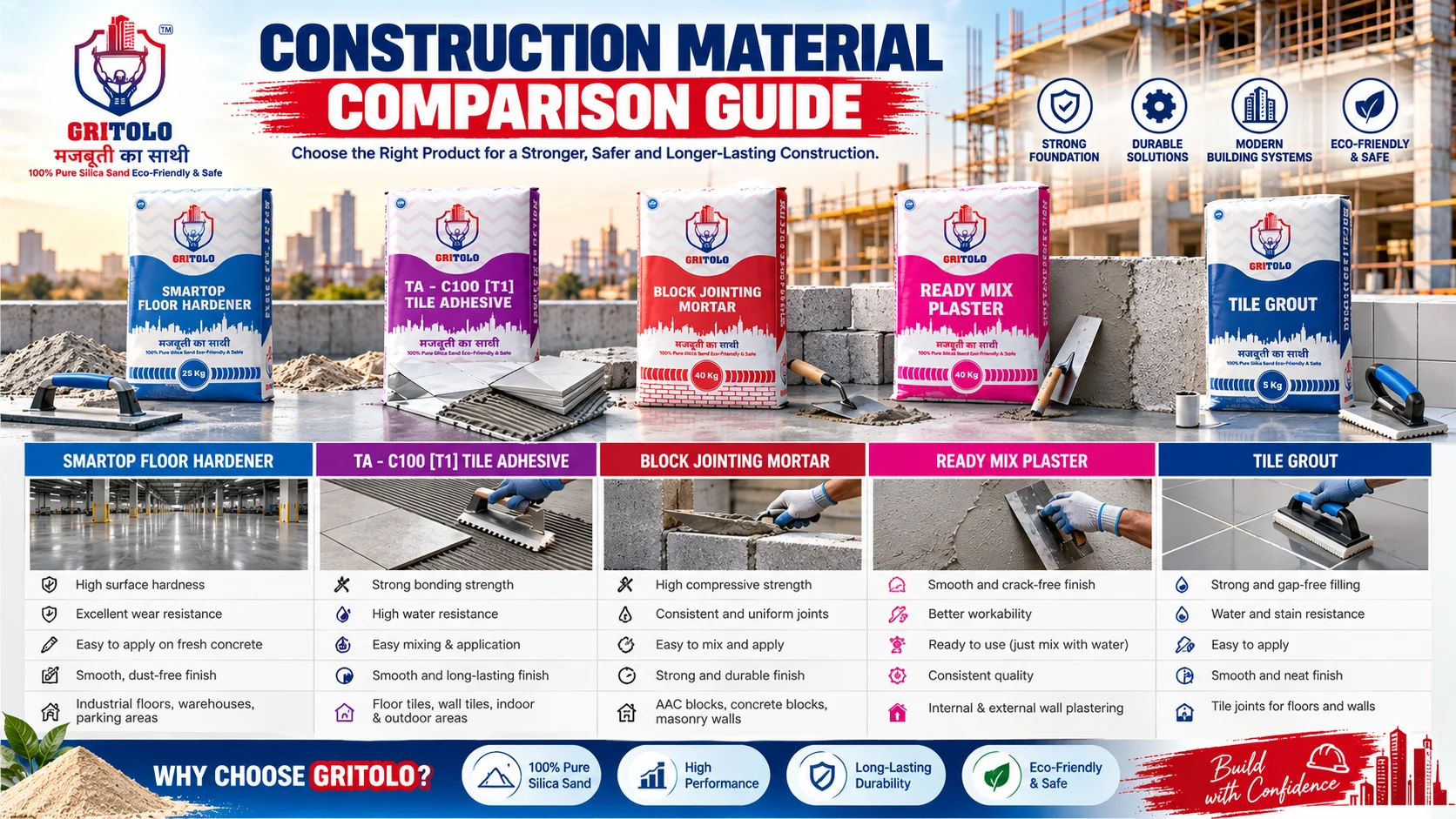
This Construction Material Comparison guide explains the key differences between commonly used materials and highlights the factors that should be considered before making a selection.
The objective is not to declare one material universally better than another. Instead, the right construction material depends on the application, substrate, environmental conditions, technical requirements, installation method and project specifications.
What Is Construction Material Comparison?
Construction material comparison is the process of evaluating different materials according to their intended application and relevant performance characteristics.
A useful comparison may consider:
- Purpose
- Composition
- Application
- Substrate compatibility
- Installation method
- Thickness
- Workability
- Labour requirements
- Material consumption
- Durability considerations
- Environmental exposure
- Maintenance
- Cost
- Technical specifications
For example, comparing tile adhesive with cement mortar only makes sense when considering their role in tile installation.
Similarly, comparing ready mix plaster with traditional plaster requires an understanding of how each material is prepared and applied.
Therefore, construction material comparison should focus on fitness for purpose, rather than simply asking which product is “best.”
Why Compare Construction Materials?
Different materials can have different characteristics even when they are used in related applications.
A proper comparison can help project teams:
Understand material differences
It clarifies what each material is designed to do.
Select suitable products
Materials can be evaluated according to the actual requirements of a project.
Improve planning
Knowing application requirements helps with estimating labour, material quantities and installation time.
Control costs
Total project cost includes more than the purchase price.
Reduce application problems
Selecting a compatible material can reduce the risk of inappropriate installation.
Improve decision-making
Technical specifications can be compared before procurement.
Construction Material Comparison: Key Factors
Before comparing individual products, consider the following factors.
1. Application
The first question should always be:
What is the material intended to do?
A material designed for masonry should not automatically be used for tile installation simply because both contain cementitious components.
2. Substrate
The substrate is the surface receiving the material.
It may be:
- Concrete
- Brick
- AAC block
- Cement plaster
- Screed
- Masonry
- Existing flooring
Material compatibility with the substrate is essential.
3. Environmental Conditions
Consider whether the material will be exposed to:
- Rain
- Water
- Humidity
- Heat
- Sunlight
- Chemicals
- Heavy traffic
- Abrasion
A product designed for an indoor application may have different requirements from one intended for exterior exposure.
4. Installation Method
Some products require:
- Site mixing
- Mechanical mixing
- Trowel application
- Spraying
- Dry-shake application
- Multiple coats
- Specific curing procedures
Installation method should be included in any meaningful comparison.
5. Total Cost
Material purchase price is only one component of construction cost.
A broader calculation can include:
Total installed cost = Material + Labour + Wastage + Tools + Application + Maintenance
This is particularly important when comparing traditional and specialized construction materials.
Ready Mix Plaster vs Traditional Cement-Sand Plaster
One of the most relevant comparisons in modern wall finishing is ready mix plaster vs traditional cement-sand plaster.
Traditional Cement-Sand Plaster
Traditional plaster generally involves mixing cementitious material, sand and water at the construction site according to the required formulation.
Typical characteristics
- Site-based preparation
- Individual material measurement
- Sand handling
- On-site mixing
- Conventional application methods
The quality of the final plaster depends on material quality, proportioning, mixing, substrate preparation and workmanship.
Ready Mix Plaster
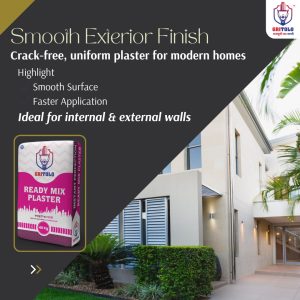
Ready mix plaster is a factory-produced plastering material designed for specified wall-finishing applications.
Typical characteristics
- Factory-controlled formulation
- Pre-prepared dry material
- Simplified site preparation
- Product-specific application instructions
- Controlled material composition
The exact benefits depend on the particular product.
Comparison
| Factor | Traditional Cement-Sand Plaster | Ready Mix Plaster |
|---|---|---|
| Preparation | Generally on site | Factory-prepared |
| Material measurement | Required on site | Product controlled |
| Sand handling | Required | Product dependent |
| Mixing | Site-based | According to product instructions |
| Consistency | Can depend on site batching | Designed for controlled formulation |
| Application | Conventional plastering | Product-specific |
| Selection | General-purpose approach | Application-specific |
Neither system should automatically be considered suitable for every project. The choice should depend on specifications, substrate, workmanship, availability and project requirements.
Tile Adhesive vs Cement Mortar
Tile installation is another area where material selection matters.
Cement Mortar
Traditional cement mortar has historically been used in various masonry and tile-related applications.
Its performance depends on:
- Material proportions
- Mixing
- Water quantity
- Substrate
- Tile characteristics
- Workmanship
Tile Adhesive
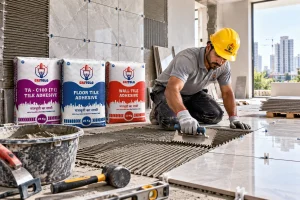
Tile adhesive is specifically formulated for bonding suitable tiles to compatible substrates.
Its selection can depend on:
- Tile material
- Tile dimensions
- Substrate
- Wall or floor application
- Indoor or outdoor use
- Moisture exposure
- Service conditions
Comparison
| Factor | Cement Mortar | Tile Adhesive |
|---|---|---|
| Primary role | General masonry/construction applications | Tile installation |
| Formulation | Typically cement, sand and water | Specialized adhesive formulation |
| Application | Depends on system | Product-specific |
| Thickness | System dependent | Product dependent |
| Tile compatibility | Depends on method | Depends on adhesive classification |
| Installation control | Can depend heavily on site mixing | Factory-controlled product |
| Selection | General construction practice | Application-specific |
Tile adhesive should be selected according to the tile, substrate and installation requirements.
How to Choose Tile Adhesive
When comparing tile adhesives, evaluate:
Tile type
Ceramic, porcelain and other tiles can have different installation requirements.
Tile size
Large-format tiles can require different installation practices from smaller tiles.
Substrate
The substrate must be compatible with the adhesive.
Location
Wall and floor installations can have different requirements.
Exposure
Wet areas and exterior applications may require specific adhesive characteristics.
Product classification
The appropriate adhesive classification should be selected according to the installation conditions and applicable product requirements.
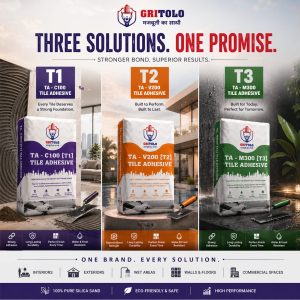
Gritolo’s product range includes:
- TA-C100 [T1] Tile Adhesive
- TA-V200 [T2] Tile Adhesive
- TA-M300 [T3] Tile Adhesive
- TA-G400 [T4] Tile Adhesive
The correct grade should be selected based on the product’s technical specifications and the project requirements.
Block Jointing Mortar vs Traditional Cement Mortar
Block jointing mortar and conventional cement mortar can both be associated with masonry construction, but they are not necessarily interchangeable.
Traditional Cement Mortar
Conventional mortar can be prepared at the construction site using cementitious material, sand and water.
Its performance can depend heavily on:
- Proportioning
- Material quality
- Mixing
- Water quantity
- Workmanship
Block Jointing Mortar
Block jointing mortar is designed for suitable masonry block systems.
It can be particularly relevant where controlled jointing is part of the masonry installation method.
Comparison
| Factor | Traditional Cement Mortar | Block Jointing Mortar |
|---|---|---|
| Preparation | Generally site mixed | Factory-produced product |
| Application | Conventional masonry | Suitable block systems |
| Joint thickness | System dependent | Product/system dependent |
| Material consistency | Depends on site batching | Controlled formulation |
| Application method | Traditional | Product-specific |
| Suitable blocks | Depends on mortar design | Depends on product specification |
The correct choice depends on the masonry unit and system being constructed.
Block Jointing Mortar Application Considerations
Before selecting block jointing mortar, check:
- Block type
- Block dimensions
- Surface condition
- Recommended joint thickness
- Mixing procedure
- Working time
- Weather conditions
- Subsequent finishing requirements
Correct alignment of masonry units remains important regardless of which mortar system is used.
Floor Hardener vs Ordinary Concrete Floor
Floor hardener and concrete are not directly equivalent products.
Concrete forms the basic flooring or structural material, while a floor hardener can be incorporated into an appropriate concrete floor system to improve surface characteristics.
Concrete Floor
Concrete can provide:
- Structural support
- Load-bearing capacity
- Base flooring
- Durable surface when correctly designed and constructed
Its performance depends on the mix design, placement, compaction, curing and other construction factors.
Floor Hardener
Floor hardener is used as part of appropriate flooring systems where improved surface characteristics may be required.
Applications can include:
- Warehouses
- Factories
- Workshops
- Industrial facilities
- Commercial areas
Comparison
| Factor | Ordinary Concrete Floor | Concrete Floor with Floor Hardener |
|---|---|---|
| Primary function | Base/structural flooring | Flooring with enhanced surface treatment |
| Material | Concrete system | Concrete + suitable floor hardener |
| Surface performance | Depends on concrete and finishing | Depends on complete flooring system |
| Application | Concrete placement and finishing | Hardener integrated at specified stage |
| Typical use | General flooring | Areas requiring additional surface performance |
Floor hardener does not replace appropriate concrete design.
Waterproof Plaster vs Normal Plaster
Moisture exposure is another important factor in material selection.
Normal Plaster
Conventional plaster is primarily used to create a suitable wall surface and finish.
Its suitability depends on:
- Substrate
- Exposure
- Application
- Product formulation
- Surface preparation
Waterproof or Water-Resistant Plaster Systems
Water-resistant plaster products are designed for suitable applications where improved resistance to moisture is required.
Comparison
| Factor | Normal Plaster | Waterproof/Water-Resistant Plaster System |
|---|---|---|
| Primary purpose | Wall finishing | Wall finishing with moisture-related requirements |
| Moisture consideration | Depends on system | Specifically considered in product/system design |
| Application | Product dependent | Product dependent |
| Exterior use | Depends on product | Depends on product and exposure |
| Waterproofing role | Not necessarily designed as waterproofing | Depends on product; should not automatically replace a complete waterproofing system |
A waterproof plaster product should not automatically be described as a substitute for a complete waterproofing system.
Water management also depends on drainage, joints, detailing, substrate condition and other building components.
Dry-Mix Construction Materials vs Site-Mixed Materials
Another useful comparison is between factory-produced dry-mix products and materials mixed entirely at the construction site.
Site-Mixed Materials
Site mixing can provide flexibility but requires:
- Material measurement
- Sand handling
- Storage
- Water measurement
- Mixing
- Labour
- Quality control
Consistency can depend on site practices.
Dry-Mix Materials
Factory-produced dry-mix materials are manufactured to a defined formulation.
They can simplify certain aspects of:
- Storage
- Material handling
- Mixing
- Batch consistency
- Application
However, correct water measurement and application remain important.
Construction Material Comparison by Application
Instead of comparing materials only by name, compare them according to their intended application.
| Application | Materials to Consider |
|---|---|
| Wall plastering | Traditional plaster, Ready Mix Plaster |
| Tile installation | Tile Adhesive, suitable mortar systems |
| Block masonry | Block Jointing Mortar, suitable conventional mortar |
| Industrial flooring | Concrete, Floor Hardener systems |
| Moisture protection | Waterproofing systems, suitable water-resistant materials |
| General masonry | Cement-based mortar, specialized mortars |
| Wall finishing | Plastering and finishing systems |
This approach helps avoid inappropriate material substitution.
How to Compare Construction Materials Before Buying
Use a structured evaluation process.
1. Define the application
Write down exactly where the material will be used.
2. Identify the substrate
Determine what surface or material the product will be applied to.
3. Identify environmental exposure
Consider water, weather, traffic, chemicals and temperature.
4. Check technical specifications
Review the manufacturer’s product documentation.
5. Compare application methods
Determine:
- Mixing
- Tools
- Thickness
- Working time
- Curing
- Drying
6. Compare material consumption
Don’t compare only the price per bag.
Consider the actual quantity required for the project.
7. Consider labour
Application complexity can influence total installed cost.
8. Check availability
Material availability can affect project scheduling.
9. Consider maintenance
Think about the expected service environment and future maintenance requirements.
10. Consult professionals for critical applications
For structural or technically demanding applications, the project engineer or other qualified professional should determine the appropriate material specification.
Material Cost vs Total Installed Cost
One of the most common mistakes in construction material comparison is comparing only the purchase price.
For example:
Product A = ₹500 per bag
Product B = ₹600 per bag
It would be incorrect to conclude that Product A is automatically cheaper.
The actual project cost can involve:
Material price + consumption + labour + wastage + equipment + transportation + maintenance
Therefore, compare materials based on the cost of completing the application, not just the price printed on the package.
Actual costs vary according to location, product, project scale, labour rates and market conditions.
Quality vs Performance in Construction Materials
Quality and performance are related but should not be treated as identical.
A material may be manufactured consistently but still be unsuitable for a particular application.
For example:
- A suitable tile adhesive must match the tile and substrate.
- A suitable plaster must match the wall application.
- A floor hardener must be compatible with the flooring system.
- A block jointing mortar must be suitable for the masonry units.
Therefore, material suitability is as important as material quality.
Common Mistakes in Construction Material Comparison
Comparing products without considering application
A material should be compared with alternatives intended for the same or closely related purpose.
Choosing the cheapest product
Price alone doesn’t establish suitability.
Ignoring technical documentation
Manufacturer data should be reviewed before making a technical decision.
Comparing different grades as if they were identical
Different product grades can have different intended uses.
Ignoring substrate compatibility
A product’s suitability depends partly on what it is being applied to.
Ignoring environmental conditions
Interior and exterior applications can have different requirements.
Assuming more material means better performance
Excess thickness or quantity is not automatically beneficial.
Ignoring workmanship
Installation quality can significantly influence the final result.
Construction Material Comparison Checklist
Before selecting a construction material, ask:
Application
- What will the material be used for?
- Is the product specifically designed for this application?
Substrate
- What surface will receive the material?
- Is the substrate compatible?
Environment
- Is the material exposed to water?
- Is it indoors or outdoors?
- Will it experience heavy traffic?
Installation
- What mixing method is required?
- What tools are needed?
- What thickness should be applied?
- What is the working time?
Cost
- What is the consumption rate?
- What labour is required?
- What is the total installed cost?
Quality
- Does the product meet the relevant specification?
- Is technical documentation available?
- Is the product being stored correctly?
Maintenance
- What maintenance will the finished system require?
- What conditions will it experience?
How Gritolo Helps With Construction Material Selection
GRITOLO GLOBAL INDIA PRIVATE LIMITED provides construction-material solutions for residential, commercial and industrial applications.
Its product portfolio includes solutions associated with:
- Ready mix plaster
- Tile adhesives
- Block jointing mortar
- Floor hardeners
- Construction materials
- Wall and floor finishing
Gritolo’s tile adhesive range includes TA-C100 [T1], TA-V200 [T2], TA-M300 [T3] and TA-G400 [T4], while Smartop Floor Hardener is positioned for suitable flooring applications.
Rather than selecting a product solely based on price, customers should consider the specific application, substrate, environmental conditions and product documentation.
For project-specific technical decisions, qualified construction professionals should be consulted where appropriate.
Frequently Asked Questions
What is construction material comparison?
Construction material comparison is the evaluation of different building materials based on factors such as application, substrate compatibility, installation method, performance requirements, consumption, cost and maintenance.
Which construction material is best?
There is no single construction material that is best for every application. The appropriate material depends on the project, substrate, environmental conditions, technical requirements and installation method.
What is the difference between ready mix plaster and cement-sand plaster?
Traditional cement-sand plaster is generally prepared at the construction site, while ready mix plaster is a factory-produced plastering material formulated for specified applications.
Is tile adhesive better than cement mortar?
Tile adhesive and cement mortar have different characteristics and applications. The appropriate choice depends on the tile, substrate, installation conditions and project requirements.
What is the difference between block jointing mortar and cement mortar?
Block jointing mortar is a specialized product designed for suitable block masonry systems, while conventional cement mortar is commonly prepared for general masonry applications. The correct selection depends on the masonry system.
Is floor hardener the same as concrete?
No. Concrete forms the base material of a concrete floor, while floor hardener is a material used in suitable flooring systems to improve surface characteristics.
What should I compare when buying construction materials?
Compare intended application, substrate compatibility, technical specifications, material consumption, installation method, labour requirements, environmental exposure, availability and total installed cost.
How can I compare construction material costs?
Compare total installed cost rather than only purchase price. Consider material consumption, labour, wastage, tools, transportation and maintenance.
Why is substrate compatibility important?
A construction material needs to bond or interact correctly with the surface on which it is applied. An incompatible or poorly prepared substrate can affect the final result.
Should I choose construction materials based only on price?
No. Price is one consideration. Suitability, technical performance, application requirements, consumption, workmanship and long-term maintenance should also be evaluated.
Are modern construction materials always better than traditional materials?
Not necessarily. Modern specialized materials can offer application-specific characteristics, while traditional materials remain suitable for many applications. The appropriate choice depends on project requirements.
Can one construction material replace another?
Only when the alternative is technically suitable for the same application and meets the relevant project requirements. Materials should not be substituted solely because they appear similar.
Conclusion
A meaningful Construction Material Comparison should go beyond product price or marketing claims.
The right material depends on the purpose, substrate, environmental exposure, application method, technical requirements, material consumption, workmanship and total project cost.
Ready mix plaster and traditional cement-sand plaster have different preparation approaches. Tile adhesive and cement mortar have different application characteristics. Block jointing mortar is designed for suitable masonry systems, while floor hardener is part of appropriate concrete flooring systems. Waterproof plaster and conventional plaster also have different considerations when moisture exposure is involved.
The most effective approach is therefore to compare materials according to fitness for purpose.
Before purchasing any construction material, review its technical documentation, confirm substrate compatibility, understand the application procedure and evaluate the total installed cost.
For modern residential, commercial and industrial projects, selecting the appropriate construction material can help support efficient installation and the desired finished result.
GRITOLO GLOBAL INDIA PRIVATE LIMITED provides construction-material solutions including ready mix plaster, tile adhesives, block jointing mortar and floor finishing products.
Explore the Gritolo product range or contact the Gritolo team for product-specific information and application requirements.