Ready mix plaster has become an increasingly important construction material for modern wall-finishing applications. Unlike traditional plastering methods that generally require individual materials to be measured and mixed at the construction site, ready mix plaster is manufactured as a controlled formulation for specific applications.
For contractors, builders, architects and homeowners, the main attraction is often convenience and consistency. However, choosing the right plaster involves more than simply replacing conventional cement-sand plaster with a premixed product.
The substrate, application thickness, environmental conditions, surface preparation, mixing procedure, workmanship and curing or drying requirements all influence the final result.
This Complete Guide to Ready Mix Plaster explains what ready mix plaster is, how it works, where it can be used, its advantages and limitations, how to prepare a surface, how the material is generally applied, how it compares with traditional plaster and what to consider before selecting a product.
What Is Ready Mix Plaster?
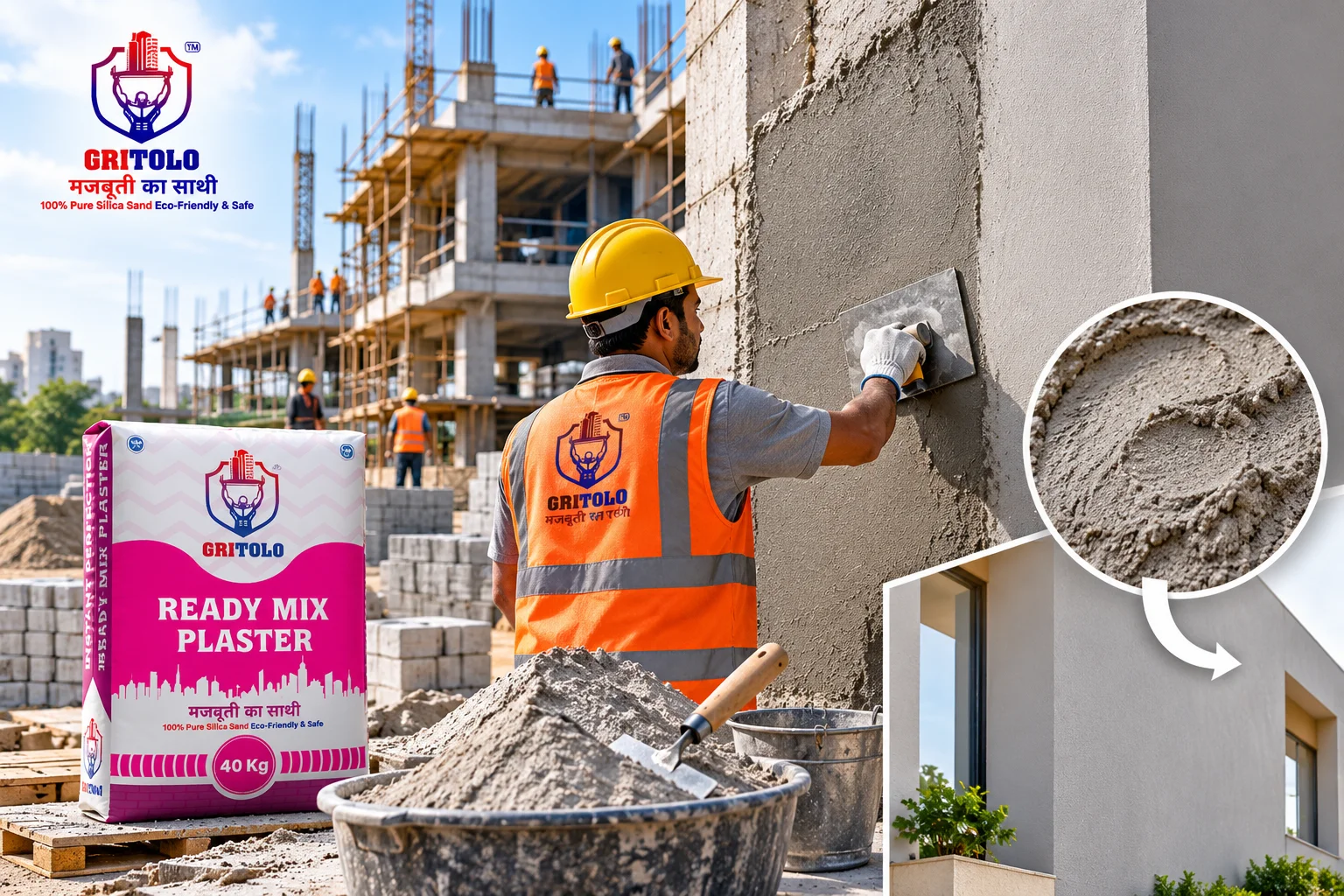
Ready mix plaster is a factory-manufactured plastering material designed for specified wall and surface-finishing applications.
It is generally supplied as a dry, pre-formulated material that is mixed with a specified quantity of water before application.
Depending on the product formulation, ready mix plaster may contain cementitious binders, graded aggregates, mineral components and performance-enhancing additives.
The exact composition varies between manufacturers and products.
Unlike traditional plastering, where cement, sand and other materials may be proportioned at the construction site, a ready mix product is manufactured according to a defined formulation.
This can help simplify material handling and mixing at the project site.
However, ready mix plaster is not automatically suitable for every wall or every environment. The product should always be selected according to its technical specifications and intended application.
How Does Ready Mix Plaster Work?
The basic concept is straightforward.
A dry plaster product is mixed with water according to the manufacturer’s instructions. The resulting material is applied to a suitable substrate and finished to achieve the required surface.
The general process is:
Manufacturing → Storage → Surface Preparation → Mixing → Application → Leveling → Finishing → Curing/Drying
The final performance depends on every stage.
For example, even a properly manufactured plaster may perform poorly if:
- The substrate is contaminated.
- Excess water is added.
- The application thickness is incorrect.
- The product is applied outside its recommended conditions.
- The material is not finished properly.
- Curing or drying requirements are ignored.
Therefore, ready mix plaster should be considered a complete application system rather than simply a bag of material.
Main Types of Ready Mix Plaster
Ready mix plaster products can differ depending on their intended application.
Cement-Based Ready Mix Plaster
Cement-based ready mix plaster is commonly associated with masonry and concrete wall applications.
It may be suitable for:
- Interior walls
- Exterior walls
- Brickwork
- Blockwork
- Concrete surfaces
The exact application depends on the product specification.
Interior Ready Mix Plaster
Interior plaster products are intended for suitable indoor wall and ceiling applications.
They may be selected where a consistent surface is required before:
- Painting
- Decorative finishing
- Wall covering
- Other interior treatments
Exterior Ready Mix Plaster
Exterior applications can expose plaster to:
- Rain
- Sunlight
- Temperature changes
- Humidity
- Wind
Therefore, the plaster system should be specifically suitable for the intended exterior exposure.
Not every interior plaster product should be used on exterior walls.
Specialized Plaster Products
Some manufacturers also develop products for specific substrates or performance requirements.
These may be designed around:
- Particular masonry units
- Concrete surfaces
- Thin or controlled application
- Water resistance
- Improved workability
- Specific finishing requirements
Always review the product’s technical documentation before selecting a specialized plaster.
Ready Mix Plaster vs Traditional Cement-Sand Plaster
One of the most common questions is whether ready mix plaster is better than traditional plaster.
The answer depends on the project.
Traditional cement-sand plaster generally involves preparing the plaster mixture at the construction site.
Ready mix plaster is factory-produced and supplied as a controlled formulation.
| Factor | Traditional Cement-Sand Plaster | Ready Mix Plaster |
|---|---|---|
| Material preparation | Generally at site | Factory-prepared |
| Sand handling | Usually required | Product dependent |
| Proportioning | Site controlled | Factory controlled |
| Mixing | Site mixing | Water added according to product instructions |
| Consistency | Depends on batching/workmanship | Designed for formulation consistency |
| Storage | Separate materials may be required | Packaged product |
| Application | Conventional plastering | Product-specific method |
| Quality control | Depends on site practices | Manufacturing + site application |
| Suitability | Depends on mix and application | Depends on product specification |
This comparison does not mean ready mix plaster is automatically superior in every situation.
The correct choice depends on project requirements, availability, labour practices, substrate and product specifications.
Benefits of Ready Mix Plaster
1. Controlled Formulation
One of the main characteristics of factory-produced plaster is controlled manufacturing.
Materials can be proportioned according to a defined formulation before they reach the construction site.
This can reduce some of the variability associated with manual proportioning.
2. Simplified Site Mixing
Ready mix plaster generally requires adding a specified amount of water rather than separately measuring multiple dry ingredients.
This can simplify site operations.
3. Easier Material Handling
Instead of storing separate quantities of cement and sand for plaster preparation, a packaged dry-mix product can simplify certain aspects of material management.
4. Consistency
Factory-controlled production can help maintain consistency between batches when the product is manufactured and stored correctly.
However, site mixing and application still need to follow the manufacturer’s instructions.
5. Potentially Reduced Material Wastage
Controlled packaging and application can help manage material quantities.
Actual wastage depends on:
- Worker practices
- Surface condition
- Application thickness
- Storage
- Handling
- Project design
Therefore, wastage reduction should not be assumed automatically.
6. Convenient for Modern Construction
Ready mix plaster can be useful for projects where predictable material preparation and organized site operations are important.
It can be particularly convenient when multiple areas need consistent plastering.
Where Is Ready Mix Plaster Used?
Ready mix plaster can be used in several construction environments, depending on the product.
Residential Buildings
Applications can include:
- Houses
- Apartments
- Villas
- Residential developments
It may be used on suitable interior and exterior masonry surfaces.
Commercial Buildings
Commercial applications may include:
- Offices
- Retail buildings
- Hotels
- Educational buildings
- Institutional facilities
Industrial Buildings
Some suitable products can be used for:
- Factories
- Warehouses
- Industrial facilities
- Utility buildings
The product must be compatible with the specific substrate and environmental conditions.
Ready Mix Plaster for Interior Walls
Interior walls generally have different exposure conditions from exterior walls.
When selecting ready mix plaster for interiors, consider:
- Substrate
- Desired finish
- Application thickness
- Surface flatness
- Paint or finishing system
- Drying conditions
The plaster should create a suitable surface for the subsequent finishing system.
Before painting, the wall should be allowed to reach the condition specified by the plaster and paint manufacturers.
Ready Mix Plaster for Exterior Walls
Exterior walls can experience more demanding environmental conditions.
They may be exposed to:
- Rain
- Solar radiation
- Temperature fluctuations
- Wind
- Humidity
Therefore, exterior ready mix plaster should be specifically selected for exterior use where required.
Important considerations include:
- Substrate preparation
- Application thickness
- Detailing
- Cracks and joints
- Water exposure
- Curing
- Finishing
For exterior walls where moisture is a concern, plaster should be considered as part of the broader wall and waterproofing system rather than as the only moisture-control measure.
How to Prepare a Wall for Ready Mix Plaster
Surface preparation is one of the most important stages.
Step 1: Inspect the Surface
Check for:
- Cracks
- Loose material
- Dust
- Oil
- Grease
- Efflorescence
- Uneven areas
- Weak surfaces
Step 2: Clean the Surface
Remove dust, loose particles and other contaminants.
The surface must be suitable for receiving the plaster.
Step 3: Repair Defects
Major cracks, holes or weak areas should be addressed before plaster application.
Step 4: Check Absorption
Highly absorbent substrates may require a specific preparation procedure depending on the product.
Follow the manufacturer’s recommendations.
Step 5: Check Alignment
Identify areas that require additional attention before plastering.
Correcting significant substrate problems before application can help reduce unnecessary plaster consumption.
Ready Mix Plaster Application Process
The exact process varies by product, but a general application sequence is as follows.
Step 1: Read the Technical Instructions
Before mixing, check:
- Water requirement
- Application thickness
- Mixing time
- Working time
- Suitable substrate
- Coverage
- Drying/curing requirements
Step 2: Measure Water
Use the manufacturer’s specified water quantity.
Avoid estimating water by eye.
Step 3: Add the Plaster
Add the dry ready mix plaster according to the manufacturer’s mixing instructions.
Step 4: Mix Thoroughly
Use appropriate mechanical or manual mixing equipment.
The mixture should achieve the recommended consistency.
Step 5: Allow Resting Time if Required
Some products may require a specified resting period before remixing.
Follow the product documentation.
Step 6: Apply the Plaster
Apply the material to the prepared substrate using suitable plastering tools.
Maintain the recommended thickness.
Step 7: Level the Surface
Use appropriate tools to achieve the required flatness and alignment.
Step 8: Finish the Surface
The finishing technique depends on the desired texture and subsequent coating.
Step 9: Cure or Dry
Follow the manufacturer’s instructions regarding curing, drying and protection.
What Thickness Should Ready Mix Plaster Be?
There is no single universal thickness for every ready mix plaster product.
The appropriate thickness depends on:
- Product formulation
- Substrate
- Wall condition
- Application
- Number of coats
- Manufacturer’s instructions
Applying excessive thickness in one layer may create problems such as cracking, shrinkage or extended drying.
Applying insufficient material may result in incomplete coverage or inadequate surface correction.
Therefore, the manufacturer’s recommended application thickness should always take priority.
Tools Used for Ready Mix Plaster Application
Typical tools can include:
- Mixing bucket
- Mechanical mixer
- Trowel
- Plastering trowel
- Straight edge
- Float
- Level
- Measuring equipment
- Protective equipment
The exact tools depend on the application and product.
For large projects, specialized plastering equipment may also be considered where compatible with the product.
Ready Mix Plaster Coverage
Coverage depends on multiple factors.
These include:
- Application thickness
- Surface roughness
- Substrate condition
- Product density
- Application technique
- Material wastage
Therefore, a manufacturer-provided coverage figure should be considered a product-specific guideline rather than a universal value.
Before purchasing material, estimate the wall area and expected application thickness, then use the product’s stated coverage or consumption information.
Factors Affecting Ready Mix Plaster Performance
Surface condition
A weak or contaminated substrate can affect the finished result.
Water quantity
Incorrect water addition can affect consistency and performance.
Application thickness
Thickness should remain within the recommended range.
Weather
Heat, rain, wind and humidity can affect application.
Mixing
Poor mixing can result in inconsistent material.
Workmanship
Application technique directly influences surface quality.
Curing and drying
Insufficient or incorrect curing/drying can affect the final surface.
Common Ready Mix Plaster Application Mistakes
1. Applying plaster over a dirty wall
Dust and contamination can interfere with bonding.
2. Adding excessive water
More water does not automatically make plaster easier or better.
3. Applying excessive thickness
Large thickness variations can create uneven drying and other problems.
4. Ignoring substrate defects
Plaster should not be used simply to hide major structural or substrate problems.
5. Mixing too much material
Prepare an amount that can be used within the product’s working time.
6. Using expired or improperly stored material
Moisture and unsuitable storage conditions can affect dry construction products.
7. Ignoring environmental conditions
Very hot, windy or wet conditions may require specific precautions.
8. Painting too early
The plaster must reach the condition required by the plaster and coating system before subsequent finishing.
Ready Mix Plaster Storage Guide
Proper storage helps maintain product quality.
General storage principles include:
- Keep bags dry.
- Protect them from rain and moisture.
- Store them off the ground where appropriate.
- Keep packaging intact.
- Follow the manufacturer’s recommended storage conditions.
- Use material within the specified shelf life.
- Avoid storing products in conditions outside their recommendations.
Do not use material that has visibly deteriorated or become contaminated.
Ready Mix Plaster Quality Checklist
Before using a product, check:
Product
- Correct product selected
- Packaging intact
- Batch information available
- Within shelf life
- Suitable for the application
Surface
- Clean
- Sound
- Stable
- Free from contaminants
- Properly prepared
Mixing
- Correct water quantity
- Correct mixing method
- Correct mixing time
- Suitable equipment
Application
- Correct thickness
- Correct tools
- Proper working time
- Suitable weather conditions
Finishing
- Surface level
- Desired finish achieved
- Appropriate curing/drying
- Protected from premature damage
Ready Mix Plaster for Different Construction Projects
Residential Projects
For residential projects, the key priorities may include:
- Smooth finishing
- Application efficiency
- Consistency
- Compatibility with paint
- Material availability
Commercial Projects
Commercial projects may require:
- Consistent wall finishes
- Large-area application
- Organized material supply
- Labour efficiency
- Project scheduling
Industrial Projects
Industrial buildings may have more demanding requirements based on:
- Substrate
- Environment
- Mechanical conditions
- Moisture
- Subsequent coatings
The selected plaster should be appropriate for the particular application.
Is Ready Mix Plaster Environmentally Friendly?
The environmental performance of a construction material depends on several factors.
These can include:
- Manufacturing process
- Material composition
- Packaging
- Transportation
- Waste
- Durability
- Service life
- Maintenance requirements
It would therefore be inaccurate to describe every ready mix plaster as automatically “eco-friendly.”
However, controlled material production and efficient material use can potentially contribute to reduced wastage in suitable applications.
Sustainability should be evaluated using product-specific and project-specific information.
Ready Mix Plaster Cost
The cost of ready mix plaster can vary significantly depending on:
- Product formulation
- Brand
- Location
- Packaging
- Transportation
- Application thickness
- Coverage
- Labour
- Project scale
Material price alone does not represent the complete plastering cost.
A useful project-level calculation is:
Total plastering cost = Material + Labour + Transportation + Wastage + Surface Preparation + Finishing
For accurate budgeting, use the manufacturer’s current product consumption data and local market rates.
How to Choose the Right Ready Mix Plaster
Before purchasing, ask the following questions.
1. Where will it be used?
Interior or exterior?
2. What is the substrate?
Brick, block, AAC block or concrete?
3. What thickness is required?
Check the product’s recommended range.
4. What finish is required?
Smooth, textured or another specified finish?
5. What environmental exposure exists?
Is the wall exposed to rain, humidity or heat?
6. What are the application requirements?
Check mixing, working time and finishing instructions.
7. What is the total cost?
Compare consumption and labour rather than only bag price.
8. Is technical documentation available?
A reputable product should have appropriate technical information.
Ready Mix Plaster and Gritolo
GRITOLO GLOBAL INDIA PRIVATE LIMITED provides construction materials designed for modern residential, commercial and industrial construction applications.
Gritolo’s product portfolio includes:
- Ready mix plaster solutions
- Tile adhesives
- Block jointing mortar
- Floor hardeners
- Construction materials for wall and floor applications
The objective is to provide construction professionals with materials that can support efficient and consistent construction practices when properly selected and applied.
For any specific Gritolo ready mix plaster product, customers should review the applicable technical documentation for:
- Recommended substrate
- Mixing procedure
- Water requirement
- Application thickness
- Coverage
- Working time
- Drying/curing
- Storage
- Limitations
This product-specific information should always take priority over general information in an online article.
Frequently Asked Questions
What is ready mix plaster?
Ready mix plaster is a factory-manufactured plastering material supplied in a prepared formulation for specified wall and surface-finishing applications. It is generally mixed with a specified amount of water before application.
Is ready mix plaster better than traditional plaster?
Not necessarily in every situation. Ready mix plaster offers a controlled factory-produced formulation, while traditional plaster can provide a familiar site-mixed approach. The appropriate choice depends on the application, substrate, workmanship, project requirements and product specifications.
Can ready mix plaster be used on exterior walls?
Some ready mix plaster products are designed for suitable exterior applications. Always confirm that the specific product is suitable for the intended exterior substrate and environmental exposure.
Can ready mix plaster be used on interior walls?
Yes, suitable ready mix plaster products can be used for interior wall applications. The product should be selected according to the substrate and desired finish.
How is ready mix plaster mixed?
Ready mix plaster is generally mixed with a specified quantity of clean water according to the manufacturer’s instructions. The exact mixing method and duration depend on the product.
How thick should ready mix plaster be?
There is no universal thickness. The appropriate thickness depends on the product, substrate and application. Follow the manufacturer’s technical recommendations.
How much ready mix plaster is required per square foot?
Consumption depends on application thickness, surface roughness, product characteristics and wastage. Use the manufacturer’s coverage or consumption data to calculate the required quantity.
Does ready mix plaster require curing?
Curing or drying requirements depend on the product formulation and application. Follow the specific manufacturer’s instructions.
Can ready mix plaster be painted?
A suitable ready mix plaster surface can generally receive subsequent finishing such as paint after the plaster has reached the required condition. Follow both plaster and paint manufacturer recommendations.
What is the difference between ready mix plaster and ready mix mortar?
Ready mix plaster is formulated specifically for plastering and wall-finishing applications, while ready mix mortar can refer to products designed for masonry, bedding, repair or other construction applications.
How should ready mix plaster be stored?
Ready mix plaster should generally be protected from moisture and stored according to the manufacturer’s specified conditions. Packaging should remain intact and material should be used within its stated shelf life.
Can ready mix plaster prevent all wall cracks?
No construction plaster can automatically eliminate all cracking. Cracking can result from substrate movement, structural movement, shrinkage, improper application, environmental conditions and other factors. The correct cause should be identified before selecting a remedial material.
Conclusion
Ready mix plaster is an important modern construction material for suitable wall-finishing applications. Its factory-controlled formulation can simplify material preparation and provide a more controlled approach to plastering compared with manually proportioned site mixes.
However, choosing the right product is only the beginning.
The final result depends on substrate preparation, correct mixing, appropriate thickness, application technique, environmental conditions, finishing and curing or drying.
For residential, commercial and industrial projects, the best approach is to select a ready mix plaster based on the actual application rather than choosing solely on price or general marketing claims.
Before purchasing, confirm the substrate, interior or exterior use, application thickness, coverage, technical specifications, storage conditions and installation procedure.
GRITOLO GLOBAL INDIA PRIVATE LIMITED provides construction-material solutions including ready mix plaster, tile adhesives, block jointing mortar and floor finishing products.
For product-specific requirements, review the relevant Gritolo product documentation or contact the Gritolo team before beginning your project.