Tile installation is an important part of modern construction and interior finishing. The quality of a tiled surface depends not only on the tile itself but also on the substrate, installation method, workmanship and bonding material used underneath the tile.
Tile adhesive is a specialized construction material designed to bond suitable tiles to compatible substrates. Compared with traditional tile-setting approaches, modern tile adhesives are formulated for specific installation requirements and can provide a more controlled method of tile installation when properly selected and applied.
But choosing a tile adhesive is not as simple as selecting the cheapest bag or the product with the highest advertised strength.
The right adhesive depends on several factors, including:
- Tile type
- Tile size
- Tile weight
- Substrate
- Wall or floor application
- Interior or exterior location
- Moisture exposure
- Temperature
- Expected traffic
- Installation method
- Product classification
This Tile Adhesive: Types, Uses & Selection Guide explains what tile adhesive is, the major types, common applications, selection factors, preparation, application, differences from cement mortar and common installation mistakes.
What Is Tile Adhesive?
Tile adhesive is a construction material formulated to bond tiles to a suitable substrate.
Depending on the product, tile adhesive may be supplied as a dry powder that is mixed with water or as another type of ready-to-use formulation.
Cementitious tile adhesives commonly contain cementitious binders, graded aggregates and chemical additives designed to provide specific workability and bonding characteristics.
The exact formulation varies by manufacturer and product.
Tile adhesive can be used for suitable:
- Ceramic tiles
- Porcelain tiles
- Wall tiles
- Floor tiles
- Interior tiles
- Exterior tiles
- Other compatible tile systems
However, not every tile adhesive is suitable for every tile or surface.
Product selection should always follow the manufacturer’s technical specifications and applicable installation requirements.
Why Is Tile Adhesive Important?
Tiles are exposed to different stresses during their service life.
These can include:
- Foot traffic
- Temperature changes
- Moisture
- Cleaning
- Mechanical movement
- Substrate movement
- Tile weight
The bonding layer therefore needs to be appropriate for the installation.
A suitable tile adhesive can help provide:
Proper bonding
The adhesive creates a bond between the tile and compatible substrate.
Installation control
Modern adhesives provide defined application procedures.
Compatibility
Different adhesive formulations can be designed for different tile and substrate combinations.
Consistent application
Factory-produced products can provide controlled formulation when properly manufactured and mixed.
Efficient installation
Depending on the product, tile adhesive can support organized and efficient installation practices.
Types of Tile Adhesive
Tile adhesives can be categorized in several ways depending on their formulation, performance characteristics and intended application.
For practical selection, the most important consideration is not simply the product name but the technical classification and suitability for the actual installation.
1. Standard Cement-Based Tile Adhesive
Cement-based tile adhesives are widely used for suitable tile installations.
They are generally supplied as a dry powder and mixed with water before application.
Typical applications can include:
- Ceramic wall tiles
- Floor tiles
- Interior applications
- Suitable masonry or concrete substrates
The exact suitability depends on the adhesive specification.
2. Enhanced Tile Adhesive
Enhanced formulations may be developed to provide characteristics appropriate for more demanding applications.
Depending on the product, these may include improved:
- Adhesion
- Workability
- Water resistance
- Open time
- Flexibility
- Application performance
However, these characteristics should be confirmed from the product’s technical documentation rather than assumed from the product name.
3. Flexible Tile Adhesive
Flexible adhesives are designed for applications where some degree of movement may need to be accommodated.
Potential applications can include substrates subject to thermal movement or other service conditions.
The appropriate flexibility classification depends on the installation.
4. Large-Format Tile Adhesive
Large-format tiles require careful attention to:
- Substrate flatness
- Adhesive selection
- Coverage
- Installation technique
- Tile handling
A suitable adhesive may be required depending on the tile and substrate.
Large tiles can also require techniques such as appropriate troweling and back-buttering where recommended.
5. Exterior Tile Adhesive
Exterior tile installations can experience:
- Rain
- Sunlight
- Temperature changes
- Moisture
- Thermal movement
Therefore, the adhesive should be specifically suitable for the intended exterior application.
An adhesive designed only for an interior application should not automatically be used outdoors.
6. Tile Adhesive for Wet Areas
Bathrooms, kitchens, balconies and other wet areas can have additional moisture-related requirements.
The adhesive should be selected according to the tile, substrate and overall installation system.
It is important to understand that tile adhesive itself should not automatically be considered a complete waterproofing system.
Waterproofing behind or beneath a tiled surface may be a separate requirement depending on the project.
Understanding Tile Adhesive Classification
Tile adhesive products may be identified using classifications that describe their performance or formulation.
In India and other markets, relevant standards and classifications should be checked for the specific product and application.
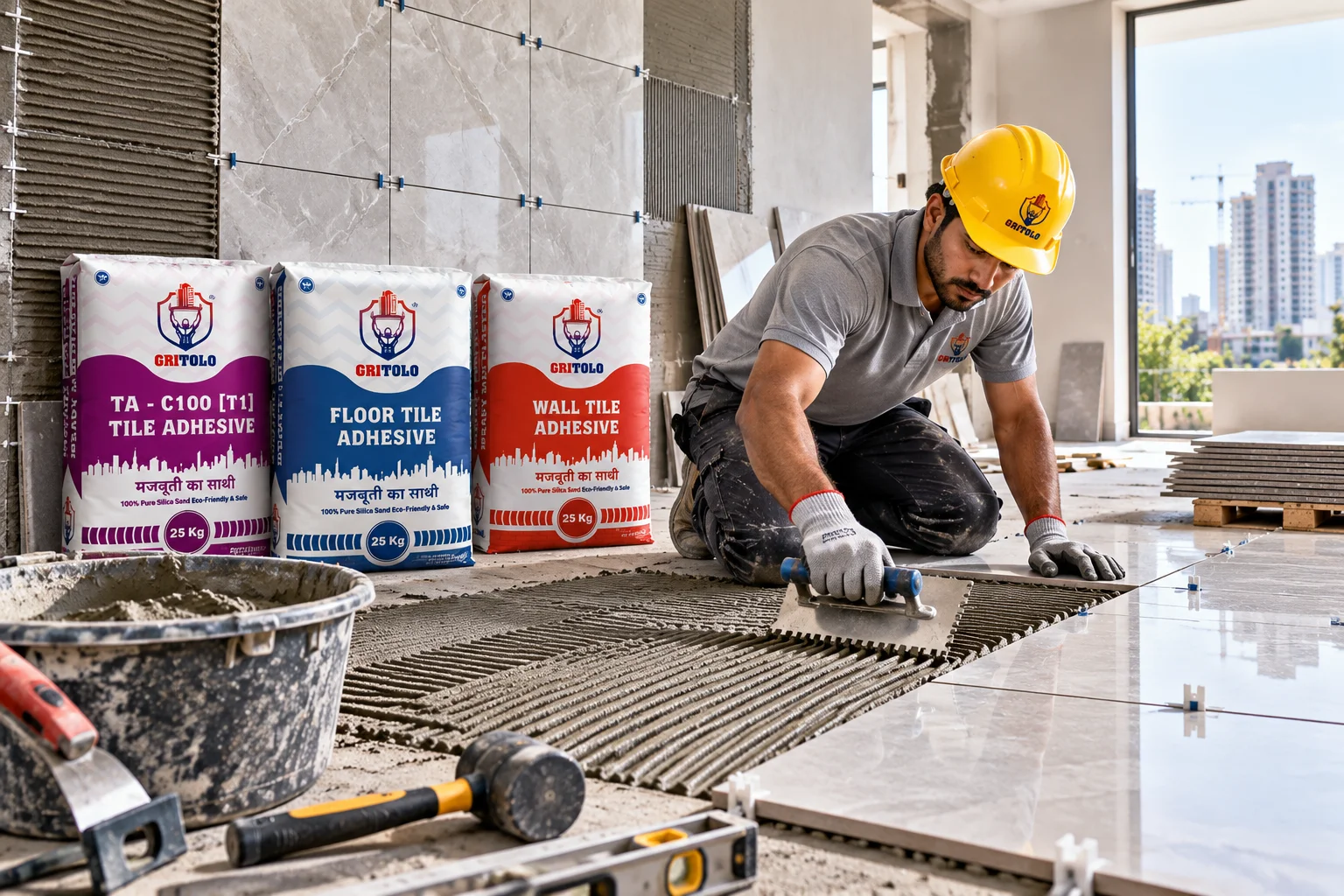
For Gritolo’s product portfolio, the range includes:
- TA-C100 [T1] Tile Adhesive
- TA-V200 [T2] Tile Adhesive
- TA-M300 [T3] Tile Adhesive
- TA-G400 [T4] Tile Adhesive
The specific meaning, performance requirements and application suitability of each product should be verified against Gritolo’s current technical documentation.
Customers should not choose a grade simply because its number is higher. The correct product is the one whose technical characteristics match the installation requirements.
Tile Adhesive Uses
Tile adhesive can be used for several suitable applications.
Wall Tile Installation
Wall tiles are commonly installed in:
- Bathrooms
- Kitchens
- Residential interiors
- Commercial spaces
- Offices
- Hotels
- Retail environments
The adhesive must be appropriate for the tile and substrate.
Floor Tile Installation
Floor tiles experience mechanical loading and foot traffic.
Selection should therefore consider:
- Tile type
- Tile dimensions
- Substrate
- Expected traffic
- Interior or exterior exposure
Ceramic Tile Installation
Ceramic tiles are commonly used on walls and floors.
A suitable tile adhesive can provide the required bond when correctly selected and applied.
Porcelain Tile Installation
Porcelain tiles can have different installation characteristics from conventional ceramic tiles.
The adhesive should therefore be selected according to the tile manufacturer’s requirements and the substrate.
Commercial Tile Installation
Commercial spaces can have higher foot traffic and different maintenance requirements.
Examples include:
- Shopping areas
- Restaurants
- Hotels
- Offices
- Showrooms
- Institutional buildings
The adhesive and tile system should be selected according to the expected service conditions.
Tile Adhesive for Wall Tiles
Wall tile installations require careful attention to the tile weight and substrate.
Before installation, check:
- Wall condition
- Tile size
- Tile weight
- Adhesive classification
- Open time
- Working time
- Environmental conditions
The substrate should be stable, clean and suitable for tiling.
The adhesive should then be mixed and applied according to the product instructions.
Tile Adhesive for Floor Tiles
Floor installations require consideration of:
- Traffic
- Tile dimensions
- Substrate flatness
- Moisture
- Adhesive compatibility
- Installation technique
Large or heavy tiles may require a product and installation method specifically suited to those conditions.
Tile Adhesive for Exterior Tiles
Exterior applications are more exposed to weather conditions.
Before selecting an adhesive, consider:
- Rain
- Temperature changes
- Sunlight
- Moisture
- Thermal movement
- Substrate type
Use a product specifically approved for the intended exterior application.
Tile Adhesive vs Cement Mortar
One of the most frequently asked questions is:
Should I use tile adhesive or cement mortar?
The answer depends on the specific installation.
Cement Mortar
Traditional cement mortar has been used for many construction applications, including certain tile installation practices.
Its properties depend on:
- Cement
- Sand
- Water
- Proportioning
- Mixing
- Workmanship
Tile Adhesive
Tile adhesive is formulated specifically for tile bonding applications.
It provides a controlled product formulation designed around tile installation requirements.
Comparison
| Factor | Cement Mortar | Tile Adhesive |
|---|---|---|
| Primary use | General construction/masonry applications and some traditional tile methods | Tile installation |
| Formulation | Generally site mixed | Factory-formulated product |
| Material control | Depends on site proportioning | Controlled manufacturing |
| Application | Method dependent | Product-specific |
| Thickness | System dependent | Product dependent |
| Tile compatibility | Depends on system | Depends on adhesive classification |
| Selection | Traditional approach | Application-specific |
The correct choice should be based on the actual tile installation system.
How to Choose the Right Tile Adhesive
This is the most important part of tile adhesive selection.
1. Identify the Tile
First determine the tile material.
Examples include:
- Ceramic
- Porcelain
- Natural stone
- Other specialized tiles
Not every adhesive is suitable for every material.
2. Check Tile Size
Tile size can influence adhesive selection and installation technique.
Large-format tiles require careful attention to:
- Substrate flatness
- Adhesive coverage
- Trowel selection
- Installation technique
3. Check the Substrate
Common substrates include:
- Concrete
- Cement screed
- Cement plaster
- Masonry
- Gypsum-based surfaces
- Existing tile surfaces
The adhesive should be compatible with the substrate.
4. Determine Wall or Floor Application
Wall and floor applications can have different requirements.
Floor installations may experience higher mechanical loading and traffic.
5. Check Interior or Exterior Location
Indoor and outdoor installations can have very different environmental exposure.
Exterior applications need products suitable for the expected weather conditions.
6. Consider Moisture Exposure
For:
- Bathrooms
- Kitchens
- Balconies
- Wet rooms
- Exterior surfaces
consider the overall moisture-management system.
7. Consider Expected Traffic
A residential bedroom floor has different service conditions from a shopping centre or industrial facility.
Choose the adhesive system according to the expected service conditions.
Tile Adhesive Application Guide
Correct installation is essential for achieving the intended performance.
Step 1: Prepare the Substrate
The substrate should be:
- Clean
- Stable
- Sound
- Free from dust
- Free from grease
- Free from loose material
- Appropriately flat
Major substrate defects should be corrected before tiling.
Step 2: Measure Water
If the adhesive is a powder product, measure the recommended quantity of water.
Avoid adding water by estimation.
Step 3: Mix the Adhesive
Add the powder according to the manufacturer’s instructions.
Mix until a consistent material is obtained.
Step 4: Allow Maturation if Required
Some products may require a resting period before remixing.
Follow the product instructions.
Step 5: Apply the Adhesive
Use the recommended notched trowel or application tool.
The adhesive should be spread evenly over the substrate.
Step 6: Create the Correct Trowel Pattern
The trowel should be held at the recommended angle to create consistent adhesive ridges.
Step 7: Place the Tile
Press the tile into the adhesive while the product is within its specified open time.
Adjust the tile as required.
Step 8: Check Coverage
For demanding applications and larger tiles, adequate adhesive coverage is particularly important.
Follow the applicable installation requirements.
Step 9: Maintain Tile Joints
Use appropriate spacers or installation systems to maintain the required joint width.
Step 10: Allow Setting
Do not expose the installation to premature traffic or load.
Follow the adhesive manufacturer’s setting requirements.
What Is Open Time?
Open time refers to the period during which an applied adhesive remains suitable for receiving the tile under specified conditions.
Open time can be affected by:
- Temperature
- Humidity
- Air movement
- Substrate absorption
- Adhesive thickness
- Product formulation
If adhesive is left exposed beyond its usable period, the surface can begin to dry and the bond may be affected.
Therefore, installers should work within the product’s specified open time.
What Is Pot Life?
Pot life refers to the period after mixing during which the prepared adhesive remains usable under specified conditions.
Once mixed, the adhesive should be used within the manufacturer’s recommended time.
Do not automatically restore an aging mixture by adding additional water.
Follow the product instructions regarding re-mixing and working time.
Common Tile Adhesive Application Mistakes
1. Applying adhesive over a dirty substrate
Dust and contamination can interfere with bonding.
2. Using too much water
Excess water can alter the intended formulation.
3. Mixing without measuring
Inconsistent water quantities can produce inconsistent results.
4. Applying too much adhesive
Excess thickness does not automatically improve performance.
5. Applying too little adhesive
Insufficient coverage can leave voids beneath the tile.
6. Ignoring open time
Tiles should be installed while the adhesive remains suitable for bonding.
7. Using the wrong trowel
Trowel size and configuration should match the tile and application.
8. Ignoring substrate flatness
Large tiles are particularly sensitive to uneven substrates.
9. Walking on newly installed tiles too soon
Premature traffic can disturb tile positioning and bonding.
10. Using an indoor adhesive outdoors
Always verify the intended application.
Tile Adhesive Coverage and Consumption
There is no single universal coverage rate for all tile adhesives.
Consumption depends on:
- Tile size
- Substrate flatness
- Trowel size
- Adhesive thickness
- Installation technique
- Back-buttering
- Surface condition
For example, a larger tile may require a different adhesive application approach than a small wall tile.
The manufacturer’s published coverage or consumption data should therefore be used for quantity estimation.
Tile Adhesive and Large-Format Tiles
Large-format tiles require careful installation.
Important considerations include:
Substrate flatness
The substrate should meet the required flatness for the tile system.
Adhesive coverage
Adequate coverage is important.
Trowel selection
A suitable trowel should be selected according to the tile and product requirements.
Back-buttering
Depending on the tile and installation system, back-buttering may be recommended.
Handling
Large tiles may require more than one installer to safely position them.
Tile Adhesive for Bathrooms and Wet Areas
Bathrooms and wet areas require more than simply choosing an adhesive.
Consider the complete system:
Substrate → Waterproofing → Adhesive → Tile → Grout → Joints
Tile adhesive provides bonding, but it should not automatically be treated as the sole waterproofing layer.
Waterproofing requirements should be determined according to the building design and applicable system specifications.
Tile Adhesive for Exterior Applications
Exterior tiling can be exposed to:
- Rain
- Heat
- UV exposure
- Temperature changes
- Moisture
- Substrate movement
The adhesive should therefore be specifically suitable for the intended exterior environment.
Other details such as expansion joints, movement joints and substrate preparation can also influence the performance of an exterior tile installation.
How to Store Tile Adhesive
Correct storage helps protect the product before installation.
For dry powder products:
- Keep bags dry.
- Protect from rain and moisture.
- Store according to manufacturer’s requirements.
- Keep packaging intact.
- Avoid direct contact with wet surfaces.
- Use within the recommended shelf life.
Moisture contamination can affect cement-based powder products.
Tile Adhesive Quality Checklist
Before starting installation, check:
Product
- Correct adhesive selected
- Suitable for tile type
- Suitable for substrate
- Suitable for application
- Packaging intact
- Within shelf life
Substrate
- Clean
- Stable
- Sound
- Suitable
- Adequately flat
Mixing
- Correct water quantity
- Correct mixing procedure
- Appropriate mixing equipment
- Correct working time
Application
- Correct trowel
- Appropriate adhesive thickness
- Adequate coverage
- Open time observed
- Tile properly positioned
Finishing
- Correct joint width
- Excess adhesive removed
- Tiles aligned
- Setting time observed
- Premature traffic avoided
How Gritolo Supports Tile Installation
GRITOLO GLOBAL INDIA PRIVATE LIMITED provides construction-material solutions for residential, commercial and industrial projects.
Gritolo’s tile adhesive portfolio includes:
TA-C100 [T1] Tile Adhesive
A tile adhesive product within Gritolo’s T1 range.
TA-V200 [T2] Tile Adhesive
A T2-range product within the Gritolo tile adhesive portfolio.
TA-M300 [T3] Tile Adhesive
A T3-range tile adhesive solution.
TA-G400 [T4] Tile Adhesive
A T4-range product within the Gritolo tile adhesive portfolio.
The appropriate product should be selected based on its current technical specifications, tile type, substrate, application environment and project requirements.
Do not select a product solely because its grade or product number appears higher.
How Much Tile Adhesive Do You Need?
Tile adhesive quantity depends on the installation.
A simple estimation process is:
Required material = Tile area × Product consumption rate
However, actual consumption can be affected by:
- Substrate condition
- Trowel size
- Tile size
- Tile back profile
- Adhesive thickness
- Application technique
- Wastage
For accurate project estimation, use the consumption rate provided for the specific Gritolo product and installation method.
Tile Adhesive Cost Factors
Tile adhesive pricing varies depending on:
- Product grade
- Packaging
- Location
- Transportation
- Quantity
- Application
- Project scale
But material price should not be the only comparison factor.
Consider:
Total tile installation cost = Adhesive + Tiles + Labour + Surface Preparation + Grouting + Wastage + Related Materials
A technically suitable adhesive may provide better project economics than choosing a product solely because its bag price is lower.
Benefits of Using the Right Tile Adhesive
Selecting a suitable adhesive can help support:
Better compatibility
The adhesive can be selected according to the tile and substrate.
More controlled installation
The product has defined mixing and application instructions.
Appropriate bonding
A correctly selected and installed adhesive can provide the intended bond.
Better project planning
Consumption and application requirements can be estimated more systematically.
Consistent material preparation
Factory-manufactured adhesives provide a controlled formulation when properly handled and mixed.
When Should You Not Choose a Tile Adhesive?
Tile adhesive should not be selected blindly.
Reconsider the product choice when:
- The substrate is unsuitable.
- The product is not designed for the tile.
- The environment exceeds the product’s intended conditions.
- The product is outside its shelf life.
- The installation requires a different specialized system.
- The technical documentation does not support the intended application.
For technically demanding installations, consult the project engineer, architect or relevant qualified professional.
Frequently Asked Questions About Tile Adhesive
What is tile adhesive?
Tile adhesive is a specialized construction material used to bond suitable tiles to compatible substrates. Different adhesive products are designed for different tile types, substrates and installation conditions.
Which tile adhesive is best?
There is no single best tile adhesive for every project. The correct product depends on the tile, substrate, tile size, location, moisture exposure, traffic and other installation requirements.
Is tile adhesive better than cement mortar?
Tile adhesive is specifically formulated for tile bonding, while conventional cement mortar has broader traditional construction uses. The appropriate choice depends on the particular installation system.
Can tile adhesive be used for floor tiles?
Yes, suitable tile adhesives can be used for floor tiles. The product should be selected according to tile type, size, substrate and expected traffic.
Can tile adhesive be used for wall tiles?
Yes, suitable tile adhesives can be used for wall tiles. Tile weight, substrate and application environment should be considered.
Can tile adhesive be used outdoors?
Some tile adhesives are designed for exterior applications. Always confirm the product’s technical documentation before using an adhesive outdoors.
Can tile adhesive be used in bathrooms?
Suitable tile adhesive can be used for bathroom tile installation, but the complete system may also require appropriate waterproofing beneath the tiles.
How thick should tile adhesive be?
There is no universal thickness. Application thickness depends on the product, substrate, tile and installation method. Follow the manufacturer’s recommendations.
How much tile adhesive is required per square metre?
Consumption varies according to the adhesive, trowel size, tile dimensions, substrate condition and application technique. Use the manufacturer’s consumption data for accurate estimation.
How long does tile adhesive take to set?
Setting time varies by product and environmental conditions. Follow the specific manufacturer’s technical documentation rather than relying on a universal time.
Can tile adhesive be applied directly over old tiles?
Some specialized products may allow installation over existing tiles, but the old surface must be stable, clean and compatible. The adhesive manufacturer must specifically permit the application.
Why is substrate preparation important for tile installation?
A clean, stable and suitable substrate provides the foundation for the adhesive and tile system. Dust, weak material, contamination or excessive unevenness can affect installation quality.
What is open time in tile adhesive?
Open time is the specified period during which the applied adhesive remains suitable for receiving tiles under defined conditions.
Conclusion
Tile adhesive is an important component of modern tile installation. However, choosing the right product requires more than comparing bag prices or selecting a product based only on its name.
The correct adhesive depends on the tile, tile size, substrate, wall or floor application, indoor or outdoor location, moisture exposure, traffic and installation requirements.
Proper surface preparation, accurate mixing, appropriate trowel selection, adequate coverage, correct working time and proper setting are equally important.
Gritolo offers a range of tile adhesive products, including TA-C100 [T1], TA-V200 [T2], TA-M300 [T3] and TA-G400 [T4]. Customers should select the appropriate product based on the current technical documentation and actual project requirements.
For residential, commercial and industrial tile installations, the best approach is to treat the adhesive as part of a complete tile installation system rather than as an isolated product.
GRITOLO GLOBAL INDIA PRIVATE LIMITED provides construction-material solutions for modern building requirements, including tile adhesives, ready mix plaster, block jointing mortar and floor finishing products.
For product-specific information, review the relevant technical documentation or contact the Gritolo team before starting your tile installation project.