Imagine you are standing at a construction site. On one side, a team of workers is manually sieving sand, mixing cement, adding water, and preparing plaster batch after batch — inconsistent in color, texture, and ratio. On the other side, a single worker opens a bag of ready mix plaster, adds water, mixes it, and applies a perfectly smooth, consistent coat on the wall in half the time.
This is not a futuristic vision. This is happening right now on thousands of construction sites across India. The shift from traditional plaster to ready mix plaster is one of the most significant changes in the Indian construction industry in recent decades.
But is ready mix plaster really better? Is it worth the investment? How does it compare in cost, quality, and performance?
In this comprehensive guide, we will break down every aspect of ready mix plaster vs traditional plaster to help you make an informed decision for your next project.
What is Traditional Plaster?
Traditional plaster (also called site-mixed plaster or conventional plaster) is a mixture of cement, sand, and water that is manually prepared at the construction site. It has been the standard wall finishing method in India for over a century.
Composition:
- Cement (OPC 43 or OPC 53 grade)
- River Sand or M-Sand (sieved to remove impurities)
- Water
- Ratio: Typically 1:4 to 1:6 (cement to sand) depending on the application
Application Process:
- Sand is sieved and cleaned
- Cement and sand are mixed manually or with a drum mixer
- Water is added to achieve desired consistency
- Applied on walls in 2-3 coats (base coat + finish coat)
- Curing with water for 7-14 days
What is Ready Mix Plaster?
Ready mix plaster is a factory-manufactured, pre-blended dry mixture of cement, graded sand, polymers, and special additives. It arrives at the construction site in sealed bags, requires only the addition of water, and is ready for application.
Composition:
- Portland Cement (precisely measured)
- Graded Sand/Fillers (quality-controlled)
- Polymers (for adhesion and flexibility)
- Cellulose Ethers (for water retention)
- Mineral Additives (for workability and finish)
Application Process:
- Open the bag and pour into a mixing container
- Add specified quantity of water
- Mix with mechanical mixer for 3-5 minutes
- Apply on the wall with standard plastering tools
- Minimal curing required (self-curing properties in premium grades)
Head-to-Head Comparison: Ready Mix Plaster vs Traditional Plaster
1. Quality and Consistency
| Parameter | Ready Mix Plaster | Traditional Plaster |
| Mix Consistency | Factory-controlled, batch-to-batch identical | Varies with worker skill and site conditions |
| Surface Finish | Smooth, uniform, professional | Depends on mason skill; often uneven |
| Color Consistency | Uniform throughout | Patchy; varies with sand quality |
| Crack Resistance | High (polymer-modified) | Medium to Low |
| Shrinkage | Minimal | Higher (inconsistent water content) |
Winner: Ready Mix Plaster
The biggest advantage of ready mix plaster is consistency. Since it is manufactured in a controlled factory environment, every bag produces the same quality. Traditional plaster quality depends entirely on the skill of the mason, the quality of locally sourced sand, and the accuracy of manual mixing — all of which vary significantly.
2. Application Speed and Labor
| Parameter | Ready Mix Plaster | Traditional Plaster |
| Site Preparation | Minimal (open bag, add water) | Extensive (sand sieving, proportioning) |
| Mixing Time | 3-5 minutes | 15-30 minutes per batch |
| Application Speed | 30-40% faster | Standard |
| Labor Required | Fewer workers | More workers (sieving, mixing, carrying) |
| Skill Requirement | Moderate | High |
| Number of Coats | Usually single coat (8-15mm) | 2-3 coats required |
| Curing Duration | 3-7 days (some grades self-cure) | 10-14 days minimum |
Winner: Ready Mix Plaster
Ready mix plaster can reduce plastering time by 30-40% and requires fewer laborers on site. This translates directly to faster project completion and lower labor costs — a critical advantage in India where skilled mason availability is becoming a challenge.
3. Cost Comparison
This is where the debate gets interesting. Let us break down the true cost of both options.
Traditional Plaster Cost Breakdown (Per Square Meter):
| Component | Cost (Approx.) |
| Cement (OPC 53) | ₹8-12 |
| Sand (River/M-Sand) | ₹5-8 |
| Water | ₹0.50-1 |
| Labor (mixing + application) | ₹15-25 |
| Sand Sieving Labor | ₹2-4 |
| Material Wastage (15-20%) | ₹3-5 |
| Curing Cost (water + labor for 14 days) | ₹3-5 |
Ready Mix Plaster Cost Breakdown (Per Square Meter):
| Component | Cost (Approx.) |
| Ready Mix Plaster Material | ₹30-45 |
| Water | ₹0.50 |
| Labor (application only) | ₹10-15 |
| Material Wastage (3-5%) | ₹1-2 |
| Curing Cost (minimal) | ₹1-2 |
| Total | ₹42-65 per sq m |
Total Cost of Ownership:
| Factor | Ready Mix Plaster | Traditional Plaster |
| Direct Material Cost | Higher | Lower |
| Labor Cost | Lower (fewer workers, faster) | Higher (more workers, slower) |
| Wastage Cost | Lower (3-5%) | Higher (15-20%) |
| Time Cost (Faster completion) | Saves 30-40% time | Standard timeline |
| Rework/Repair Cost | Minimal | Significant (cracks, unevenness) |
| Curing Cost | Minimal | Significant (14 days of water curing) |
| Long-term Maintenance | Lower (crack-resistant) | Higher (hairline cracks, patching) |
| Overall Lifecycle Cost | Lower ✅ | Higher |
Winner: Ready Mix Plaster (when considering total lifecycle cost)
While the initial material cost of ready mix plaster is higher, the total project cost is often comparable or even lower when you factor in reduced labor, minimal wastage, faster completion, and lower maintenance costs.
4. Durability and Performance
| Parameter | Ready Mix Plaster | Traditional Plaster |
| Compressive Strength | 3-7 N/mm² (controlled) | 2-5 N/mm² (variable) |
| Bond Strength to Wall | High (polymer-enhanced) | Moderate |
| Crack Resistance | Excellent | Poor to Moderate |
| Water Absorption | Low | Moderate to High |
| Weather Resistance | Excellent | Moderate |
| Mold/Fungal Resistance | Available in specialty grades | Not available |
| Expected Lifespan | 25-50 years | 10-25 years |
Winner: Ready Mix Plaster
5. Sustainability and Environmental Impact
| Factor | Ready Mix Plaster | Traditional Plaster |
| Sand Consumption | Optimized (factory-graded) | Excessive (uncontrolled) |
| Cement Consumption | Precise (factory-measured) | Over-used (manual mixing) |
| Water Consumption | 60-70% less curing water | Heavy water usage for curing |
| Material Wastage | 3-5% | 15-20% |
| Carbon Footprint | Lower per unit area | Higher per unit area |
| Sand Mining Impact | Reduced | Contributes to river sand depletion |
Winner: Ready Mix Plaster
With India facing a severe sand shortage crisis and increasing environmental regulations on river sand mining, ready mix plaster offers a more sustainable alternative that reduces sand consumption and material wastage significantly.
When Should You Choose Traditional Plaster?
Despite ready mix plaster’s advantages, traditional plaster still has its place:
- Very small repair jobs where ordering ready mix bags is not economical
- Remote rural areas where ready mix plaster is not easily available
- Ultra-budget projects where material cost is the only consideration
- Heritage restoration projects requiring traditional materials
- When high-quality sand is locally available at very low cost
When Should You Choose Ready Mix Plaster?
Ready mix plaster is the better choice for:
- Residential buildings (apartments, villas, independent houses)
- Commercial projects (offices, malls, hotels)
- Industrial buildings (warehouses, factories)
- High-rise construction (consistent quality at all floor levels)
- Projects with tight timelines (30-40% faster completion)
- Areas with sand scarcity or poor sand quality
- Green building projects targeting sustainability certifications
- Any project where quality consistency and long-term durability are priorities
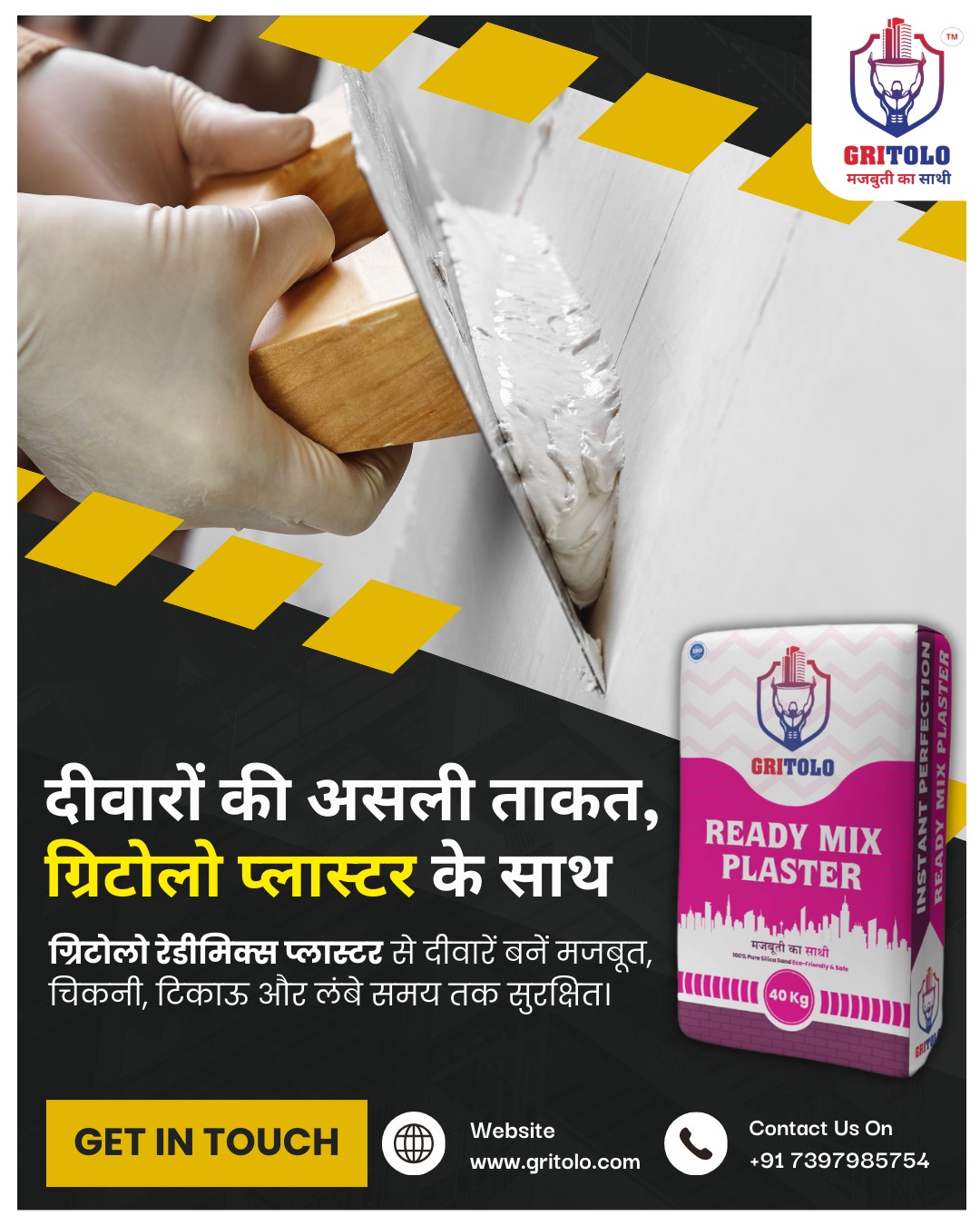
Gritolo Ready Mix Plaster – Engineered for Indian Walls
At Gritolo Global India Pvt Ltd, we manufacture premium ready mix plaster that is specifically formulated for India’s diverse climate conditions.
Why Choose Gritolo Ready Mix Plaster?
- Factory-controlled quality — Every bag delivers identical performance
- Polymer-modified formula — Superior crack resistance and bond strength
- Low water requirement — Saves water during mixing and curing
- Single coat application — Reduces plastering time by 30-40%
- Suitable for all substrates — Brick, block, concrete, AAC
- Eco-friendly — Reduced sand and water consumption
- Technical support — On-site guidance for perfect application
Explore our full product range →
How to Apply Ready Mix Plaster – Professional Guide
Materials Needed:
- Gritolo Ready Mix Plaster bags
- Clean water
- Mechanical mixer (drill with paddle)
- Plastering trowel (flat trowel)
- Spirit level
- Plumb bob
- Spray bottle for curing
Application Steps:
Step_1: Surface Preparation
- Remove all loose particles, dust, oil, and debris from the wall surface
- Wet the surface evenly with water (damp, not soaking)
- Ensure the surface is free from cracks wider than 3mm (repair first if needed)
- For smooth concrete surfaces, apply a bonding agent or scratch coat first
Step_2: Setting Guide Lines
- Fix vertical and horizontal guide lines using plumb bob and spirit level
- Install guide dots or strips at 1.5-2 meter intervals for consistent thickness
- Maintain a minimum plaster thickness of 8mm and maximum of 15mm in a single coat
Step_3: Mixing
- Add 5-6 liters of water per 25 kg bag (follow specific product instructions)
- Add powder to water (not water to powder)
- Mix using a mechanical mixer for 3-5 minutes until lump-free
- Allow 5 minutes rest time, then remix for 1 minute
- Use mixed material within 60-90 minutes (pot life)
Step_4: Application
- Apply the mixed plaster using a flat trowel or plastering machine
- Work from bottom to top
- Level the surface using an aluminum straight edge or darby
- Achieve the desired thickness in one coat wherever possible
Step_5: Finishing
- After initial setting (30-60 minutes), finish the surface with a sponge float for a smooth texture
- For textured finishes, use appropriate finishing tools
Step_6: Curing
- Light water spray curing for 3-5 days is usually sufficient
- Avoid heavy water curing (unlike traditional plaster)
- Protect from direct sunlight and strong winds during initial 24 hours
Ready Mix Plaster – Market Trends in India 2025
The Indian ready mix plaster market is experiencing rapid growth driven by several factors:
- Urbanization — India’s urban population is expected to reach 600 million by 2031
- Housing demand — Pradhan Mantri Awas Yojana targeting “Housing for All”
- Skilled labor shortage — India faces a 30-40% shortage of skilled masons
- Sand scarcity — NGT restrictions on river sand mining
- Quality awareness — Builders and homeowners demanding better finishes
- Green building mandates — IGBC and GRIHA pushing sustainable materials
Industry reports suggest the Indian ready mix plaster market is growing at 15-20% CAGR and is expected to reach significant market value by 2028.
Frequently Asked Questions (FAQ)
Q1: Is ready mix plaster more expensive than traditional plaster?
A1: The material cost of ready mix plaster is higher, but the total project cost (including labor, wastage, time, and curing) is often comparable or lower. When you factor in reduced maintenance costs over the building’s lifetime, ready mix plaster offers better value for money.
Q2: Can ready mix plaster be used on AAC blocks?
A2: Yes, ready mix plaster is ideal for AAC blocks. In fact, it is often the recommended plastering method for AAC block walls because of its superior bond strength and flexibility, which prevents cracks at block joints.
Q3: How thick should ready mix plaster be applied?
A3: Ready mix plaster is typically applied at 8-15 mm thickness in a single coat. For traditional plaster, 12-20 mm in two coats is standard. This means ready mix plaster uses less material overall.
Q4: Does ready mix plaster crack?
A4: High-quality ready mix plaster like Gritolo’s polymer-modified plaster has excellent crack resistance due to polymer additives. Cracks are far less common compared to traditional plaster, provided the application follows manufacturer guidelines.
Q5: How long does ready mix plaster last?
A5: Premium ready mix plaster can last 25-50 years or more with proper application. Traditional plaster typically shows signs of deterioration (hairline cracks, peeling) within 10-15 years.
Q6: Can I paint directly on ready mix plaster?
A6: Yes, after proper curing (typically 7-14 days), you can apply primer and paint directly on ready mix plaster. The smooth, consistent surface of ready mix plaster actually requires less primer and paint compared to traditional plaster.
Q7: Is ready mix plaster eco-friendly?
A7: Yes, ready mix plaster is more environmentally friendly than traditional plaster. It uses less sand (reducing mining impact), less water (during mixing and curing), and produces less material wastage (3-5% vs 15-20%).
Q8: Where can I buy Gritolo Ready Mix Plaster?
A8: You can contact Gritolo Global India Pvt Ltd directly at +91 7397985754 for pricing, bulk orders, and dealer inquiries. We supply across India.
The Future of Plastering in India is Ready Mix
The evidence is clear — ready mix plaster outperforms traditional plaster in quality, consistency, speed, durability, and sustainability. While the initial material cost is slightly higher, the total lifecycle benefits make it the smarter investment for any construction project.
As India’s construction industry modernizes, ready mix plaster is not just an alternative — it is becoming the new standard. Forward-thinking builders, contractors, and homeowners are already making the switch, and the results speak for themselves — smoother walls, fewer cracks, faster projects, and happier clients.
At Gritolo, we are proud to be at the forefront of this transformation, providing high-quality ready mix plaster that meets the highest standards of performance and sustainability.
Ready to upgrade your plastering? Contact us today for samples, pricing, and technical support.