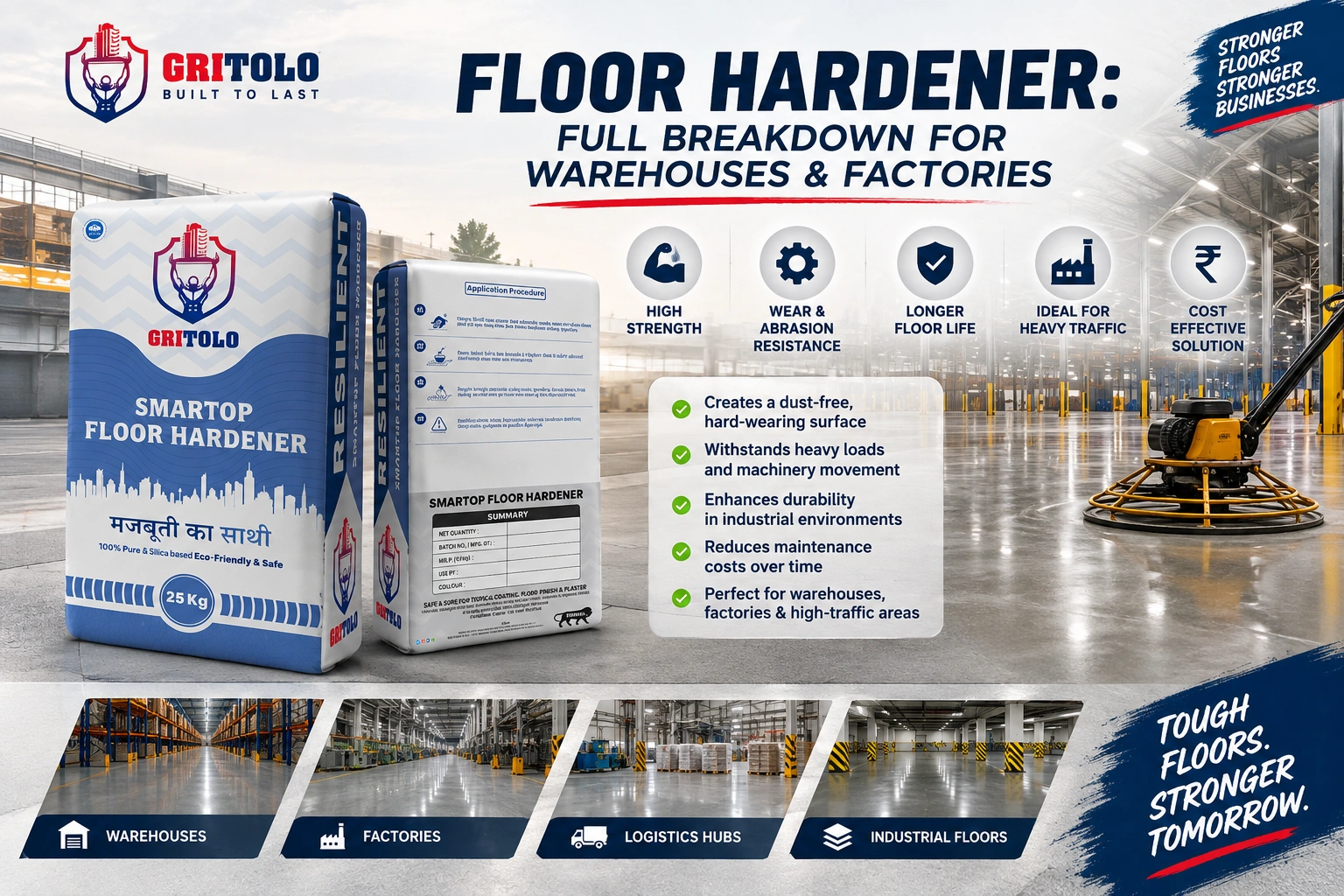
Floor Hardener Cost Per Sq Meter: Full Breakdown for Warehouses & Factories
Floor hardener cost isn’t a single number — it’s the sum of three separate line items: material (which scales directly with dosage rate and hardener type), labour (finishing crew and equipment time), and site-specific factors like floor area and finishing complexity, and together these typically land in a moderate-to-wide per-sq-m range depending on whether you’re specifying a standard mineral hardener for a warehouse or a high-performance metallic hardener for a heavy manufacturing floor. Getting an accurate budget means pricing each of these components separately rather than relying on a single generic per-sq-m figure, since dosage rate alone can swing total cost by 50% or more between a light-duty and heavy-duty specification.
This breakdown walks through exactly what drives floor hardener cost, how material and labour typically split, what changes the price up or down, and how to compare that cost against the long-term expense of an under-specified floor that fails early.
What Determines Floor Hardener Cost
Four variables drive the bulk of the cost difference between one floor hardener project and another:
1. Dosage rate (kg per sq m). This is the single biggest cost driver. Light-duty floors need less material per square metre than heavy industrial floors expected to handle constant forklift and machinery traffic, and material cost scales roughly linearly with dosage.
2. Hardener type (mineral vs metallic). Standard non-metallic (mineral) hardener, using quartz or emery aggregate, costs meaningfully less per kg than metallic hardener, which uses iron or steel aggregate for higher abrasion and impact resistance. Metallic hardener is only specified where extreme-duty performance genuinely justifies the added cost.
3. Floor area and project scale. Larger projects typically achieve better per-sq-m pricing on both material (bulk purchasing) and labour (fixed mobilization costs spread across more area), while very small floor areas often carry a cost premium since crew mobilization and equipment setup costs don’t scale down proportionally.
4. Finishing complexity and site conditions. Floors requiring decorative colour, tighter tolerance finishing, unusual shapes, extensive edge work, or site access constraints (multi-storey, limited crane/material access) all add labour time and therefore cost, independent of the hardener material itself.
Material Cost Breakdown
Material cost is driven directly by dosage rate multiplied by the hardener’s per-kg price, which varies by type:
| Hardener Type | Typical Dosage Range | Relative Material Cost per kg |
|---|---|---|
| Non-metallic (mineral) — light duty | 3-4 kg per sq m | Lower |
| Non-metallic (mineral) — standard warehouse/forklift traffic | 4-6 kg per sq m | Lower-Moderate |
| Non-metallic (mineral) — heavy-duty industrial | 6-8 kg per sq m | Moderate |
| Metallic — extreme-duty (steel mills, high-impact zones) | 8-10+ kg per sq m | Significantly higher |
| Coloured/decorative mineral hardener | 4-6 kg per sq m | Moderate (pigment premium) |
Because dosage and per-kg cost both increase together for heavier-duty specifications, total material cost for a heavy-duty mineral floor can easily run 60-100% higher than a light-duty floor of the same area, and metallic hardener projects can cost several times more in material alone compared to standard mineral hardener — which is why matching hardener type to actual traffic load matters as much for budget control as it does for performance.
Always confirm current per-kg or per-bag pricing directly with your supplier, since raw material costs (particularly for metallic aggregate) can fluctuate with commodity pricing more than cement-based products typically do.
Labour and Equipment Cost Breakdown
Labour is often underestimated in floor hardener budgeting, and on smaller projects it can rival or exceed material cost.
Finishing crew. Floor hardener application requires a skilled crew experienced in timing the dry-shake passes correctly against the concrete’s setting stage — this isn’t unskilled labour, and crew day-rates reflect that. A typical crew includes power-float/trowel operators, spreaders for hardener broadcasting, and edge-finishing labour for areas the machines can’t reach.
Equipment costs. Power floats and power trowels are either owned by the contractor (amortized cost) or rented for the project. For large floor areas, multiple machines running simultaneously are often needed to keep pace with the concrete’s narrow workable timing window, which increases equipment cost proportionally with floor size and pour rate.
Mobilization cost. Crew and equipment mobilization to site is often a semi-fixed cost — it doesn’t scale down much for a small floor area, which is exactly why small projects (under roughly 200-300 sq m) frequently see a higher effective per-sq-m rate than large warehouse-scale pours.
Pour scheduling and crew size. Larger continuous pours need proportionally larger crews to apply, float, and trowel the hardener within the concrete’s workable window before it sets too far to finish properly — this is a coordination cost as much as a straightforward labour-hours cost, since getting crew sizing wrong (too small a crew for a large pour) risks a rushed, lower-quality finish across part of the floor.
General estimate range. Skilled labour and equipment time for floor hardener finishing typically represents a substantial share of total project cost — on many mid-sized projects, labour and equipment can approach or match material cost, and can exceed it on smaller floor areas where mobilization costs aren’t spread across much square footage.
Full Cost Breakdown by Project Type
Putting material, labour, and equipment together, here’s how total cost typically splits by project type (as a planning framework — always confirm actual figures with suppliers and contractors for your specific project):
| Project Type | Dosage | Cost Driver Mix | Relative Total Cost |
|---|---|---|---|
| Small workshop / light-duty floor (under 300 sq m) | 3-4 kg/sq m | Labour-heavy (mobilization not spread out) | Higher per-sq-m rate despite lower dosage |
| Standard warehouse (500-2,000 sq m) | 4-6 kg/sq m | Balanced material/labour split | Moderate, most cost-efficient range |
| Large distribution centre (2,000+ sq m) | 4-6 kg/sq m | Material-heavy, labour cost spread thin | Lower per-sq-m rate due to scale efficiency |
| Heavy manufacturing floor | 6-8 kg/sq m | Material-heavy (higher dosage) | Higher due to dosage, moderated by scale if large |
| Extreme-duty (metallic hardener) | 8-10+ kg/sq m | Material-dominant (metallic aggregate premium) | Highest overall |
What Increases Floor Hardener Cost
- Specifying metallic hardener where mineral hardener would suffice — a common overspend when traffic load is overestimated at the specification stage
- Small, fragmented floor areas with multiple separate pours rather than one continuous large pour, which multiplies mobilization costs
- Tight or unusual site access that slows material and equipment movement, extending labour time
- Decorative/coloured finishes requiring additional material and finishing care
- Rush timelines that require overtime crew rates or additional crews to meet an accelerated schedule
- Remote project locations with higher crew and material transport costs
What Reduces Floor Hardener Cost
- Larger, continuous pour areas that spread mobilization and equipment costs across more square footage
- Accurate traffic-load assessment upfront, avoiding over-specification of a heavier-duty hardener than the floor actually needs
- Advance scheduling that avoids rush/overtime labour rates
- Standard mineral hardener in a natural finish, where decorative options aren’t a project requirement
- Bulk material purchasing for multi-building or phased projects, where supplier pricing often improves with volume
Cost vs. the Price of Getting It Wrong
The floor hardener line item on a budget is easy to view as a cost to minimize, but it’s worth weighing against the cost of floor failure. A plain, unhardened industrial concrete floor — or one where hardener was applied at too low a dosage for the actual traffic load — typically shows visible dusting, pitting, and surface wear within 1-3 years under sustained heavy use.
Repairing or resurfacing a failed industrial floor (grinding, patching, epoxy overlay, or in severe cases replacement) generally costs significantly more than the incremental cost of specifying the correct hardener dosage and type upfront — and that’s before accounting for the operational disruption of taking a working floor out of service for repair.
This is the argument for treating floor hardener dosage as a specification decision tied to actual traffic load, rather than a line item to trim during value engineering — the cheapest hardener spec on paper is rarely the cheapest floor over its actual service life.
Sample Cost Scenarios
These scenarios illustrate how the cost components combine — treat them as a framework for building your own estimate, not fixed pricing, since actual figures depend on current material rates, your region, and your specific contractor’s day rates.
Scenario A — Small workshop, light traffic, 250 sq m: Lower dosage (3-4 kg/sq m) keeps material cost modest, but mobilization and crew setup costs are spread across a small area, pushing the effective per-sq-m rate higher than a larger project would see. Total project cost is dominated by labour/equipment mobilization relative to material.
Scenario B — Mid-size warehouse, forklift traffic, 1,500 sq m: Standard dosage (4-6 kg/sq m) with a full crew running efficiently across a continuous pour. This size typically achieves the best cost efficiency — large enough to spread mobilization costs, not so large that scheduling and crew-sizing complexity adds risk.
Scenario C — Heavy manufacturing floor, constant machinery traffic, 3,000 sq m: Higher dosage (6-8 kg/sq m) increases material cost meaningfully, but the large continuous area still achieves reasonable labour efficiency. Total cost is higher than Scenario B primarily due to the dosage increase, not a labour cost increase.
Scenario D — Extreme-duty zone within a larger facility, metallic hardener, 200 sq m section: Small area combined with metallic hardener’s premium material cost produces the highest per-sq-m rate of any scenario here — justified only where the specific zone genuinely faces extreme impact or abrasion loads that mineral hardener wouldn’t withstand.
Regional Cost Variation Across India
Floor hardener project costs vary meaningfully by region, driven by both material transport distance and local labour rates:
Metro industrial hubs (Pune, Mumbai, Chennai, Bengaluru, NCR) typically have better access to experienced flooring contractors and established supply chains, which can offset otherwise higher urban labour rates through efficiency and competition among suppliers.
Tier-2 industrial belts may see lower labour rates but sometimes face higher material transport costs if the nearest hardener supplier or distributor is further away, and fewer specialized flooring contractors to choose from, which can reduce competitive pricing pressure.
Projects near major manufacturing clusters (auto component hubs, industrial parks) often benefit from contractors and suppliers who have deep experience with large-scale industrial flooring specifically, which tends to improve both pricing competitiveness and execution quality.
How to Get an Accurate Quote
Generic per-sq-m estimates are useful for early budgeting, but an accurate quote requires sharing specific project details with suppliers and contractors:
- Total floor area and pour sequencing (single continuous pour vs multiple phases)
- Expected traffic type and load (foot traffic, forklift class, machinery type, point-loads from racking or equipment)
- Site access conditions (ground floor vs upper floor, material handling constraints)
- Timeline and any schedule constraints that might require overtime or accelerated crew sizing
- Finish requirements (standard grey, coloured, specific surface tolerance)
Sharing these details upfront with both your hardener supplier and flooring contractor produces a far more accurate quote than working from a generic per-sq-m benchmark, since the scenarios above show how much these variables can shift total cost.
Comparing Floor Hardener Cost to Other Flooring Solutions
Floor hardener is one of several options for durable industrial flooring, and it’s worth seeing where it sits cost-wise relative to alternatives, since some projects genuinely need a different solution.
Plain concrete with no hardener — the lowest upfront cost, but the least durable option for any floor with sustained heavy traffic. Plain concrete floors under industrial use typically need resurfacing or an overlay system within a few years, at which point the “savings” from skipping hardener are usually erased by the resurfacing cost, plus the operational disruption of taking the floor out of service.
Dry-shake floor hardener (mineral or metallic) — moderate additional cost over plain concrete, applied during the original pour, giving strong abrasion and impact resistance for the floor’s working life without needing a separate topping system. This is generally the most cost-efficient durability upgrade for new industrial floor construction.
Epoxy or polyurethane floor coatings — applied as a separate system over cured concrete (with or without a hardener beneath it), these add chemical resistance and a smoother, often more aesthetic finish, but typically cost considerably more than dry-shake hardener alone and usually need periodic recoating, adding a recurring maintenance cost that hardener doesn’t carry to the same degree.
Full floor resurfacing/overlay systems — used to rehabilitate an existing failed or worn floor rather than as a new-construction option, these are generally the most expensive route, which is exactly why specifying adequate hardener at the time of original construction is the more cost-effective long-term decision.
For new industrial floor construction, dry-shake floor hardener remains the standard cost-effective specification, with epoxy or polyurethane systems reserved for facilities with specific chemical-resistance or hygiene requirements that hardener alone doesn’t address (food processing, pharmaceutical manufacturing, and similar regulated environments).
Budgeting Tips for Project Planning
A few practical habits help keep floor hardener costs predictable rather than surprising at invoice time:
- Get quotes based on actual traffic-load assessment, not a generic “industrial floor” description — a warehouse handling light pallet trucks and a facility running heavy forklifts constantly have meaningfully different dosage needs and therefore different costs.
- Ask suppliers for a dosage recommendation in writing, tied to the specific traffic class described, so the quote and the actual site requirement stay aligned through the project.
- Build in a contingency for weather-related scheduling risk, particularly for monsoon-season pours, since a rained-out or rescheduled pour can add remobilization costs that a tight budget won’t have accounted for.
- Request itemized quotes (material, labour, equipment separately) rather than a single lump-sum figure, which makes it easier to compare quotes across contractors and spot where cost differences are actually coming from.
- Factor in the cost of not hardening a floor properly as an explicit line item in the decision, even if only as a rough comparison, since it reframes the hardener cost as risk mitigation rather than a pure expense.
Frequently Asked Questions
What is the average cost of floor hardener per square meter in India? Cost varies significantly by dosage rate and hardener type — light-duty mineral hardener applications cost less than heavy-duty specifications, and metallic hardener for extreme-duty zones costs substantially more than standard mineral hardener, so it’s best to get a project-specific quote rather than rely on a single average figure.
Why does floor hardener cost more for small floor areas? Crew mobilization and equipment setup costs are largely fixed regardless of floor size, so on small projects these costs are spread across less square footage, resulting in a higher effective per-sq-m rate compared to larger, more efficient pours.
Is metallic floor hardener worth the extra cost? It’s worth it specifically for extreme-duty environments with heavy impact or point-loading, such as steel mills or constant heavy machinery traffic, but it’s an unnecessary expense for standard warehouse or light industrial floors where mineral hardener performs adequately.
Does floor hardener cost include labour, or just material? Material and labour are typically priced separately, and labour/equipment costs can represent a substantial share of total project cost, particularly on smaller floor areas where mobilization costs aren’t spread across much square footage.
How can I reduce floor hardener project costs without compromising durability? Accurately assess actual traffic load to avoid over-specifying a heavier-duty hardener than needed, plan large continuous pours rather than fragmented small sections, and schedule in advance to avoid rush or overtime labour rates.
What happens if I choose a lower dosage rate to save money? Under-dosing relative to actual traffic load typically leads to premature dusting, pitting, and surface wear within 1-3 years, and the cost of repairing or resurfacing a failed floor generally exceeds the amount saved by under-specifying the hardener upfront.
How do I get an accurate floor hardener cost estimate for my project? Share specific project details — floor area, expected traffic type and load, site access conditions, timeline, and finish requirements — with your supplier and contractor, since generic per-sq-m figures don’t account for the project-specific factors that most affect total cost.
Final Thoughts
Floor hardener cost is best understood as three components — material, labour, and site-specific factors — rather than a single number, and the biggest budgeting mistake is either over-specifying a heavier-duty hardener than the traffic load requires, or under-specifying to save upfront cost and paying far more in premature floor repairs later. Getting an accurate quote means sharing real project specifics with your supplier rather than working from a generic benchmark.
If you’re budgeting for an upcoming industrial flooring project and want a dosage recommendation and cost estimate for Smartop Floor Hardener based on your actual floor area and traffic load, get in touch with our team for a project-specific quote.