Block Jointing Mortar vs Traditional Brickwork Mortar: Cost, Speed & Strength Compared
Block jointing mortar and traditional cement mortar both bond masonry units together, but they solve the problem in very different ways. Block jointing mortar is a factory-engineered, thin-bed adhesive mortar built specifically for AAC blocks, concrete blocks, and fly ash blocks. Builders apply it in a thin 2–4mm layer. Traditional cement mortar, by contrast, is a site-mixed cement-sand blend that masons apply in a much thicker 10–12mm bed — a method that evolved for conventional clay bricks, not modern block masonry.
Joint thickness and material engineering drive this difference, not simply “old method vs new method.” That gap cascades into measurable differences in cost, construction speed, wall strength, and long-term durability. This guide compares the two methods directly, so you can make a specification decision based on numbers rather than habit.
What Is Block Jointing Mortar?
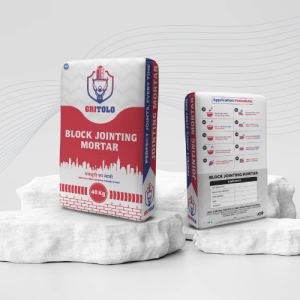
Block jointing mortar is a pre-blended, factory-manufactured mortar built specifically for laying AAC (Autoclaved Aerated Concrete) blocks, concrete blocks, and similar modern masonry units. Masons apply it in a thin bed — typically 2–3mm — using a notched trowel, a technique closer to tile adhesive application than conventional brick-mortar spreading.
Manufacturers formulate it with polymers, fine graded sand, and cement. This combination gives strong initial bond strength, good workability in a thin layer, and controlled water retention, so the mortar doesn’t dry out before the mason positions and levels the block.
What Is Traditional Brickwork Mortar?
Traditional mortar is a site-mixed blend of cement and sand — commonly in a 1:4 or 1:6 ratio, depending on the project specification — that masons mix with water on-site. They apply it in a thicker bed, usually 10–12mm, to accommodate the dimensional variation typical of conventional clay bricks, which are less uniform in size than factory-made blocks.
Indian construction has relied on this method for generations. It evolved alongside clay brick masonry, where a thicker mortar bed compensated for irregular brick dimensions and helped masons achieve a level, plumb wall.
Why the Comparison Matters Now
The construction material landscape has shifted meaningfully over the last decade. AAC blocks, fly ash blocks, and concrete blocks now dominate a large share of Indian residential and commercial construction, thanks to their lighter weight, better thermal insulation, and faster wall-raising speed compared to clay brick. Yet a significant share of contractors and builders still lay these modern blocks with traditional cement mortar out of habit, which undermines many of the advantages the blocks themselves offer.
Pairing modern blocks with traditional thick-bed mortar doesn’t just produce a suboptimal result — it actively works against the properties that made switching to blocks worthwhile in the first place, as the sections below explain.
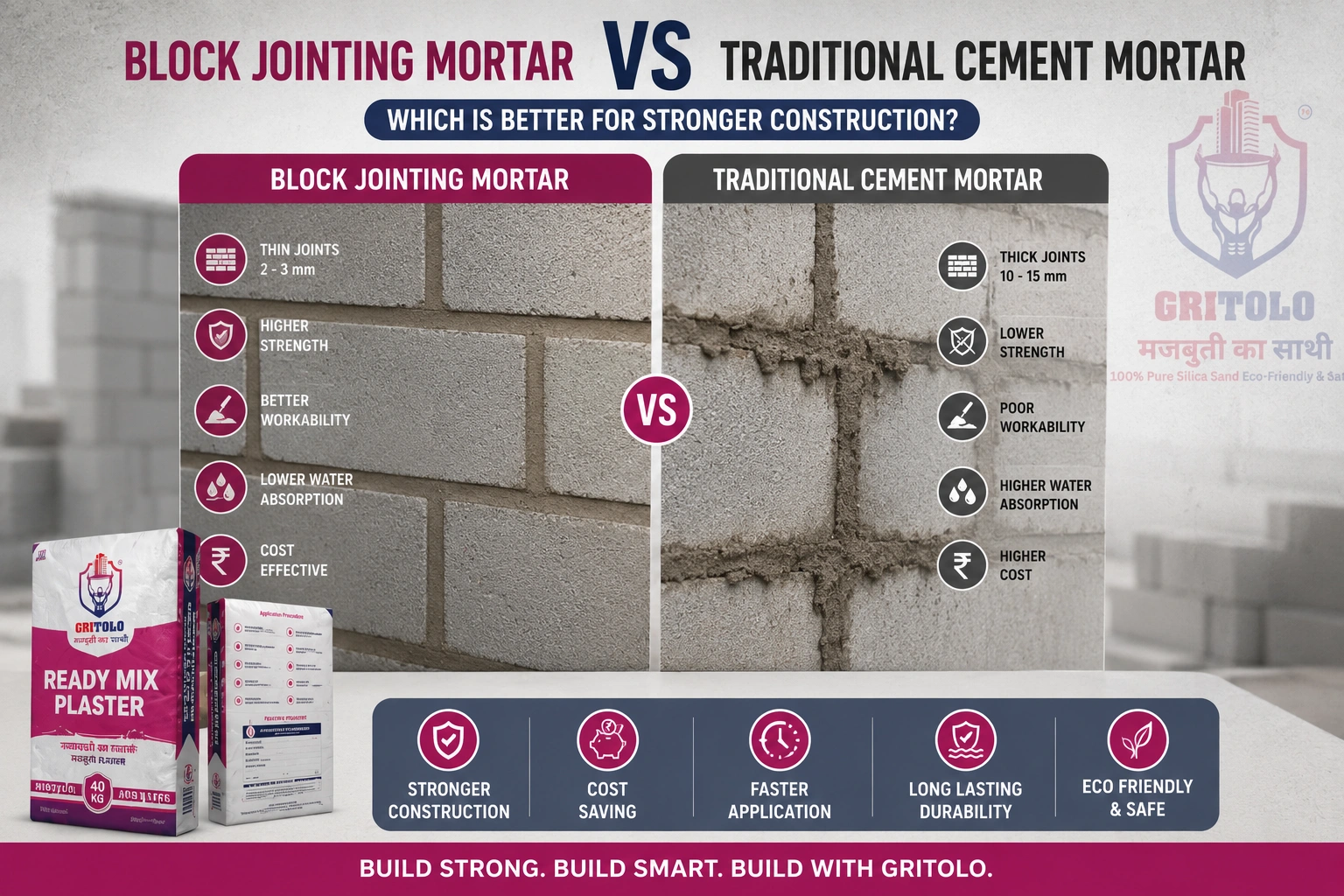
Block Jointing Mortar vs Traditional Mortar: Full Comparison Table
| Factor | Block Jointing Mortar | Traditional Cement Mortar |
|---|---|---|
| Joint thickness | 2–4mm | 10–12mm |
| Application method | Notched trowel, thin-bed technique | Manual spreading with trowel, thick bed |
| Material consumption | Significantly lower (thin joint = less material per sq. ft.) | Higher — thick joints consume substantially more mortar volume |
| Mixing | Factory pre-blended, just add water | Site-mixed cement + sand + water; quality depends on the mason’s ratio consistency |
| Wall raising speed | Faster — thin joints cure quickly, less material handling | Slower — thicker joints require more mixing and application time |
| Compressive strength | Generally higher and more consistent (controlled factory formulation) | Variable — depends heavily on site mixing accuracy and sand quality |
| Thermal performance | Preserves the block’s insulation properties (thin joint = minimal thermal bridging) | Thick mortar joints create thermal bridges that reduce the wall’s overall insulation value |
| Wall finish flatness | More uniform, easier plastering finish | More variable; may need a thicker plaster coat to correct unevenness |
| Water/cement ratio control | Factory-controlled, consistent batch to batch | Depends on manual dosing at the mixing point — prone to inconsistency |
| Cost per bag/unit | Higher upfront material cost | Lower upfront material cost |
| Total wall cost (material + labour) | Often comparable or lower, once material savings and labour speed are factored in | Appears cheaper on paper, but labour and material volume can offset the lower per-bag price |
| Best suited for | AAC blocks, concrete blocks, fly ash blocks | Traditional clay brick masonry |
Cost Breakdown: Where the Real Numbers Land
Most comparisons oversimplify this part. Comparing “cost per bag” alone misleads, because the joint thickness difference changes how much material a wall actually consumes per square foot — and that’s where the real cost comparison should focus.
Material Cost Per Square Foot
Block jointing mortar goes on at roughly a quarter of the thickness of traditional mortar, so actual material consumption per square foot drops dramatically — even though the per-bag price of jointing mortar typically runs higher than an equivalent bag of cement for site mixing. In practice, many contractors find the higher per-bag cost gets offset, partially or fully, by the sheer reduction in volume needed to cover the same wall area.
Labour Cost
Thin-bed application with a notched trowel generally moves faster per square foot than mixing, spreading, and leveling a thick traditional mortar bed. Labour often represents the single largest line item in a masonry budget, so this speed advantage matters most on large projects. Faster wall-raising also compresses the overall project timeline, which carries its own indirect cost benefit through faster handover and reduced site overhead duration.
Wastage
Site-mixed traditional mortar tends to generate wastage from over-mixing, inconsistent batching, and leftover material that can’t be reused once it starts setting. Pre-blended jointing mortar, mixed in smaller controlled batches as needed, typically produces less waste.
Plastering Cost Impact
Block jointing mortar produces a flatter, more consistent wall surface, so the plaster coat that follows can often go on at the manufacturer’s standard thickness without extra correction layers. Traditional mortar walls carry more surface irregularity and sometimes need a thicker plaster coat to reach a flat, paint-ready finish — an indirect cost that’s easy to miss when comparing mortar prices alone.
Net Effect
Once you account for material volume, labour speed, wastage, and downstream plastering cost together, block jointing mortar for AAC or concrete block construction frequently comes out cost-comparable to, or even cheaper than, traditional mortar on a full-wall-system basis, despite its higher sticker price per bag. The “traditional mortar is cheaper” assumption usually only holds up when you compare bag price alone and ignore everything downstream of that number.
Speed of Construction: A Direct Comparison
Construction speed ranks among the most common reasons contractors switch to block jointing mortar, and the reasons trace back to the method itself, not just a marketing claim.
Thinner joints mean masons place and level less material per course of blocks, which directly cuts the time spent per square foot of wall. Factory pre-blended mortar also removes on-site mixing time and mixing-ratio decisions — steps that can otherwise introduce delays, especially with less experienced labour.
AAC and concrete blocks typically come in larger sizes than clay bricks, so a wall needs fewer units to cover the same area. Combine that with a thinner, faster-applied joint, and the compounding effect on wall-raising speed becomes significant compared to traditional clay-brick-and-mortar construction. Many block jointing mortar formulations also set faster per joint, letting masons move to the next course sooner rather than waiting for a thick mortar bed to gain enough initial strength to support the added weight.
For time-sensitive projects — particularly builder-driven residential and commercial developments where timelines directly affect financing and handover costs — this speed advantage often decides the specification before cost even enters the conversation.
Strength and Structural Performance
Compressive strength: Manufacturers formulate block jointing mortars to a controlled strength specification, so they generally achieve consistent compressive strength that meets or exceeds what site-mixed mortar typically delivers. Site-mixed mortar’s strength can vary significantly, since it depends on the mason’s cement-sand ratio and water dosing on any given day.
Bond strength: The polymer content in block jointing mortar generally improves adhesion to the block surface compared to plain cement-sand mortar. This matters directly for a wall’s resistance to lateral loads and its overall structural integrity as a composite system.
Crack resistance: Thinner, more consistent joints combined with better bond strength generally produce fewer joint-line cracks over time. Thick traditional mortar joints, by contrast, remain more prone to shrinkage cracking as the larger mortar volume cures and dries.
Consistency across a project: This might be the most underrated strength advantage. Traditional mortar’s performance only matches its least careful mixing batch on a given day, while block jointing mortar’s factory-controlled formulation keeps every batch performing to the same specification — a real advantage on larger projects with multiple mason teams working simultaneously.
Thermal and Energy Efficiency Considerations
Cost comparisons often overlook this factor, but it matters increasingly as energy-efficient construction becomes a priority. Builders choose AAC blocks largely for their thermal insulation properties, yet a thick traditional mortar joint — made of plain cement and sand — carries considerably higher thermal conductivity than the block material itself. Every thick mortar joint effectively becomes a small thermal bridge, letting heat pass through the wall far more readily at that point than through the block itself.
Block jointing mortar’s thin 2–3mm joint minimizes this thermal bridging effect and preserves a much higher percentage of the wall’s designed insulation performance. Projects that choose AAC blocks specifically for their energy-efficiency benefits undercut that very reason when they pair those blocks with traditional thick-bed mortar. In that context, block jointing mortar becomes less of an optional upgrade and more of a functional requirement to actually realize the block’s rated thermal performance.
When Traditional Mortar Still Makes Sense
Block jointing mortar isn’t the better choice in every scenario. Traditional mortar remains appropriate, and sometimes necessary, in these cases:
- Conventional clay brick masonry, where brick dimensional variation requires a thicker bed to achieve a level, plumb wall
- Repair and patch work on existing traditional brick structures, where matching the existing mortar type and joint thickness is often more practical than introducing a different system
- Very small-scale or budget-constrained projects, where the upfront per-bag cost difference outweighs the downstream labour and material efficiency gains that show up at larger scale
- Regions with limited access to block jointing mortar suppliers, where site-mixed mortar remains the only readily available and reliably sourced option
Correct Application Practices for Block Jointing Mortar
Even a well-formulated block jointing mortar underperforms when a crew applies it incorrectly, and the technique differs meaningfully from traditional mortar application.
Surface Preparation and Mixing
Blocks need a clean, dust-free surface, lightly dampened if the manufacturer’s data sheet recommends it — excessive dry dust on the block surface can weaken the thin-bed bond. Because the mortar goes on in such a thin layer, mixing water content needs to follow the manufacturer’s ratio closely. Too much water thins the mix and reduces bond strength; too little makes a consistent thin spread difficult to achieve.
Trowel Technique and Timing
A notched trowel, typically with a specific tooth size the manufacturer recommends, spreads the mortar in a controlled, uniform thin layer across the block face — a different technique from the free-hand spreading used with thick traditional mortar. Block jointing mortar also has a limited open working time before it begins to set. Masons need to place and adjust each block within that window, which demands more attention to pacing than traditional mortar’s more forgiving thicker bed allows.
Alignment and Joint Details
Because the joint runs so thin, the dimensional accuracy of the blocks themselves matters more than it does with traditional mortar. Using a quality block with consistent dimensions helps masons achieve a plumb, level wall with this method. Vertical joints between blocks also use jointing mortar — though some tongue-and-groove block systems skip mortar at the vertical joint entirely, so always check the specific manufacturer’s system requirements, since this varies by product.
Training a mason team specifically on thin-bed technique, even briefly, meaningfully improves the finished result compared to applying block jointing mortar with traditional thick-bed instincts and habits.
Sustainability and Material Efficiency
Block jointing mortar offers a material efficiency advantage worth considering for projects with sustainability targets or green building certification goals, beyond its cost and speed benefits.
Lower Embodied Carbon
Because builders apply it in such a thin layer, the total volume of cement-based material a wall consumes per square foot drops substantially compared to traditional mortar. Cement production carries a significant carbon footprint, so material-efficient construction methods become a meaningful lever for reducing a project’s overall embodied carbon.
Less Waste on Site
Reduced wastage adds a second factor. Traditional site-mixed mortar that goes unused within its working time often ends up discarded, while pre-blended jointing mortar — typically mixed in smaller batches as needed — tends to generate less waste over the course of a project. Builders pursuing IGBC, GRIHA, or similar green building ratings can document the use of factory-engineered, material-efficient mortar systems toward material-efficiency and resource-conservation credit categories, depending on the specific rating framework in use.
How to Choose the Right Option for Your Project
- Match the mortar to the masonry unit. Block jointing mortar suits AAC, concrete, or fly ash block construction best. Clay brick construction still calls for traditional mortar.
- Evaluate the full-wall-system cost, not just per-bag price. Ask your supplier or contractor for a comparison based on cost per square foot of finished wall, including labour, not just material cost per bag.
- Consider project timeline pressure. When construction speed materially affects your project economics — interest carrying costs, handover deadlines — the labour-speed advantage of block jointing mortar often tips the decision even before cost parity enters the picture.
- Check the technical data sheet. Look for stated compressive strength, bond strength, and coverage-per-bag figures from the manufacturer, and confirm the product suits your specific block type.
- Factor in downstream plastering costs. A flatter wall surface from block jointing mortar can reduce plastering material and labour costs, so ask your contractor to account for this when comparing total project cost between the two methods.
Frequently Asked Questions
Is block jointing mortar more expensive than traditional cement mortar? The per-bag price generally runs higher, but because masons apply it in a much thinner joint, actual material consumption per square foot of wall drops significantly — so the total material cost for a wall often comes out comparable to, or sometimes lower than, traditional mortar once you account for volume.
Can block jointing mortar be used with clay bricks? Manufacturers engineer it specifically for AAC, concrete, and fly ash blocks, not conventional clay bricks. Clay brick’s greater dimensional variation generally needs the thicker bed that traditional mortar provides to achieve a level wall.
Does block jointing mortar actually make construction faster? Yes. Thinner joints, faster application with a notched trowel, and the absence of on-site mixing time combine to meaningfully cut wall-raising time compared to traditional thick-bed mortar, particularly on larger projects.
Is block jointing mortar stronger than traditional cement mortar? Manufacturers formulate block jointing mortar to a controlled strength specification, so it generally achieves more consistent compressive and bond strength than site-mixed traditional mortar, where strength can vary based on mixing accuracy.
Does the mortar type affect a wall’s insulation performance? Yes, more than most people expect. Thick traditional mortar joints create thermal bridging that reduces a wall’s overall insulation performance, while the thin joint of block jointing mortar helps preserve more of the block’s rated thermal insulation value.
How much mortar do I need for block jointing compared to traditional mortar? Block jointing mortar goes on at roughly a quarter of the thickness of traditional mortar, so a wall needs substantially less material per square foot — though exact coverage depends on the specific product’s technical data sheet and the block size in use.
Can I mix block jointing mortar on-site myself, or does it need to be purchased pre-blended? Manufacturers sell block jointing mortar as a factory pre-blended dry mix that only needs water added on-site. You can’t formulate it yourself from raw cement and sand, and that factory control is precisely what gives it a consistency advantage over traditional site-mixed mortar.
Final Thoughts
The choice between block jointing mortar and traditional cement mortar isn’t really “old vs new” — it comes down to matching the mortar system to the masonry unit and the project’s real priorities. For AAC, concrete, or fly ash block construction, block jointing mortar generally outperforms traditional mortar on speed, consistency, and thermal performance. Once you calculate the full wall-system cost rather than just the per-bag price, it often wins on cost as well.
Traditional mortar still holds its place, particularly for conventional clay brick construction and small-scale or repair work. But pairing modern block masonry with traditional thick-bed mortar undercuts many of the reasons a project chose those blocks in the first place.
If you’re specifying materials for an upcoming project and want a technical data sheet or a project-specific cost comparison for block jointing mortar, get in touch with the Gritolo team for guidance suited to your block type and project scale.