Block masonry is widely used in residential, commercial and industrial construction. As modern building projects increasingly use manufactured masonry units such as AAC blocks and concrete blocks, the materials used to join those blocks have also evolved.
Block jointing mortar is a specialized construction material designed for suitable masonry block applications. It is commonly supplied as a factory-prepared dry mix that is mixed with water before application.
Compared with conventional site-mixed mortar, thin-bed block jointing systems can provide a more controlled approach to joining compatible blocks. However, the correct product, joint thickness and application method depend on the block type, mortar formulation and project requirements.
This Block Jointing Mortar: Complete Guide explains what block jointing mortar is, where it is used, its advantages, how to select it, how to prepare the blocks, how the mortar is generally mixed and applied, and what common mistakes should be avoided.
For actual construction, the manufacturer’s current technical documentation, approved drawings and applicable standards should always take priority over general online guidance.
What Is Block Jointing Mortar?
Block jointing mortar is a specially formulated mortar used to join compatible masonry blocks during wall construction.
Unlike conventional mortar that may be prepared by mixing cement, sand and water on site, many block jointing mortar products are manufactured as pre-formulated dry mixes.
The dry material is generally mixed with a specified quantity of clean water before application.
Depending on the product, a formulation may contain:
- Cementitious binders
- Graded aggregates
- Mineral components
- Polymer or other performance additives
The exact formulation differs between manufacturers.
Block jointing mortar is commonly associated with masonry systems using:
- AAC blocks
- Concrete blocks
- Lightweight blocks
- Certain fly-ash or manufactured masonry units
However, compatibility must always be confirmed before use.
BIS identifies IS 2185 Part 3 for autoclaved cellular aerated concrete blocks and IS 6041:1985 for construction of AAC block masonry. BIS also lists IS 2250:1981 for preparation and use of masonry mortars. Bureau of Indian Standards
Why Is Block Jointing Mortar Important?
The mortar joint is an important part of masonry construction.
A suitable jointing material can help create:
- Proper connection between blocks
- Controlled joint geometry
- Consistent masonry work
- Appropriate bonding
- Efficient installation
- Better alignment when used with correct workmanship
The final quality of the wall does not depend on mortar alone.
It also depends on:
- Block quality
- Block dimensions
- Surface condition
- Masonry alignment
- Joint thickness
- Mixing
- Workmanship
- Curing or setting conditions
- Structural detailing
Therefore, block jointing mortar should be considered as one part of a complete masonry system.
Block Jointing Mortar vs Conventional Cement Mortar
One of the most common questions is:
What is the difference between block jointing mortar and conventional cement mortar?
Traditional cement mortar is generally prepared on site using cementitious material, sand and water in proportions appropriate for the application.
Block jointing mortar is typically a factory-prepared product formulated for specified block masonry applications.
| Factor | Conventional Cement Mortar | Block Jointing Mortar |
|---|---|---|
| Preparation | Generally site mixed | Factory-prepared |
| Ingredients | Individually measured | Pre-formulated |
| Water addition | Site controlled | Product specified |
| Application | Conventional masonry | Suitable block systems |
| Joint thickness | System dependent | Product/system dependent |
| Consistency | Depends on site batching | Controlled formulation |
| Application tools | Conventional masonry tools | Product-specific tools |
| Selection | Based on masonry requirements | Based on block and product compatibility |
A thin-bed jointing mortar should not be considered a universal replacement for every conventional mortar application.
What Are the Main Types of Block Jointing Mortar?
The correct classification depends on the product and intended masonry system.
1. AAC Block Jointing Mortar
AAC block jointing mortar is formulated for suitable autoclaved aerated concrete masonry applications.
AAC blocks are manufactured with controlled dimensions, which can make thin-joint masonry systems practical when compatible products and workmanship are used.
BIS identifies AAC blocks under IS 2185 Part 3 and provides a dedicated code of practice for AAC block masonry under IS 6041:1985. Bureau of Indian Standards
2. Concrete Block Jointing Mortar
Certain products may be suitable for concrete masonry blocks.
However, the block and mortar should be compatible.
Always verify:
- Block type
- Surface characteristics
- Product specification
- Recommended joint thickness
- Application method
3. Lightweight Block Jointing Mortar
Some lightweight masonry units may require specialized jointing materials.
The material should be selected according to the block manufacturer’s requirements and the mortar manufacturer’s recommendations.
4. Thin-Bed Jointing Mortar
Thin-bed mortar is designed to create controlled joints between compatible masonry units.
The actual thickness should not be assumed from generic online recommendations. Follow the specific product technical data and masonry-system requirements.
For example, published AAC installation guidance from manufacturers commonly describes thin-bed mortar as a specialized premixed product, while conventional mortar uses substantially thicker joints. Magicrete
Where Is Block Jointing Mortar Used?
Block jointing mortar may be used in various masonry applications.
Residential Construction
Potential applications include:
- Houses
- Apartments
- Villas
- Residential developments
- Partition walls
Commercial Construction
Applications can include:
- Offices
- Shops
- Hotels
- Schools
- Hospitals
- Commercial buildings
Industrial Construction
Suitable products may also be used for:
- Warehouses
- Factories
- Industrial buildings
- Utility structures
The exact suitability depends on the masonry design and product specifications.
Block Jointing Mortar for AAC Blocks
AAC blocks are one of the most common applications associated with thin-bed block jointing mortar.
AAC blocks are lightweight cellular concrete masonry units.
Because manufactured AAC blocks can have controlled dimensions, a suitable thin-bed mortar system can be used to create controlled joints.
However, the blocks still need to be correctly:
- Stored
- Handled
- Aligned
- Cut
- Positioned
- Joined
A jointing mortar cannot compensate for severely damaged blocks or poor masonry workmanship.
Benefits of Block Jointing Mortar
1. Factory-Controlled Formulation
A factory-manufactured product is prepared according to a defined formulation.
This can reduce some of the variability associated with manual site batching.
2. Simplified Site Preparation
Many products require only the addition of a specified quantity of water.
This can simplify material preparation.
3. Controlled Jointing
Suitable thin-bed systems are designed to create controlled joints.
This can support more consistent masonry construction when properly applied.
4. Reduced Site Material Handling
Instead of separately storing and measuring cement and sand, a packaged jointing product can simplify material logistics.
5. Consistent Material Properties
Factory production can provide greater formulation consistency between batches when the product is correctly manufactured and stored.
6. Potentially Lower Material Consumption
Thin-joint systems can use less mortar by volume than conventional thick-joint systems in appropriate applications.
Actual consumption depends on:
- Block dimensions
- Joint thickness
- Wall area
- Surface condition
- Application technique
- Product density
- Wastage
Therefore, quantity should be calculated using the manufacturer’s consumption data.
How to Choose Block Jointing Mortar
Selecting the correct product is essential.
1. Identify the Block Type
Determine whether you are using:
- AAC blocks
- Concrete blocks
- Lightweight blocks
- Other manufactured masonry units
2. Check Compatibility
The mortar should be approved or specified for the particular block system.
3. Check Joint Thickness
Follow the manufacturer’s specified application thickness.
Do not choose a product based only on a generic “thin-bed” label.
4. Review Technical Specifications
Check:
- Bonding characteristics
- Compressive strength where relevant
- Adhesion characteristics
- Working time
- Coverage
- Mixing instructions
- Storage requirements
5. Consider Environmental Conditions
Consider whether the wall will be exposed to:
- Rain
- Humidity
- Heat
- Temperature changes
- Interior or exterior conditions
6. Consider the Complete Wall System
Masonry is more than blocks and mortar.
Also consider:
- Structural connections
- Reinforcement
- Lintels
- Movement joints
- Openings
- Plastering
- Waterproofing
- Finishing
These should follow the project design and applicable standards.
Block Jointing Mortar Application Guide
The following is a general process. Always follow the specific product instructions.
Step 1: Inspect the Blocks
Check blocks for:
- Cracks
- Damage
- Excessive dust
- Contamination
- Dimensional problems
Damaged or unsuitable blocks should be dealt with according to the project requirements.
Step 2: Prepare the Work Area
Ensure:
- Blocks are readily available
- Mortar mixing equipment is clean
- Water is available
- Tools are ready
- The wall line has been established
Step 3: Prepare the First Course
The first course of masonry is particularly important because it establishes the alignment for the wall above.
The base should be appropriately levelled according to the project design.
The initial leveling procedure may differ from subsequent thin-bed joints.
Step 4: Prepare the Mortar
Measure the manufacturer’s recommended quantity of clean water.
Add the dry powder according to the product instructions.
Mix using suitable equipment until a consistent mortar is obtained.
Step 5: Allow Maturation if Required
Some products may require a specified resting period after initial mixing.
Follow the product’s technical documentation.
Step 6: Remix
Where required, remix before application.
Do not add additional water unless specifically permitted by the manufacturer.
Step 7: Apply the Mortar
Use the recommended tool.
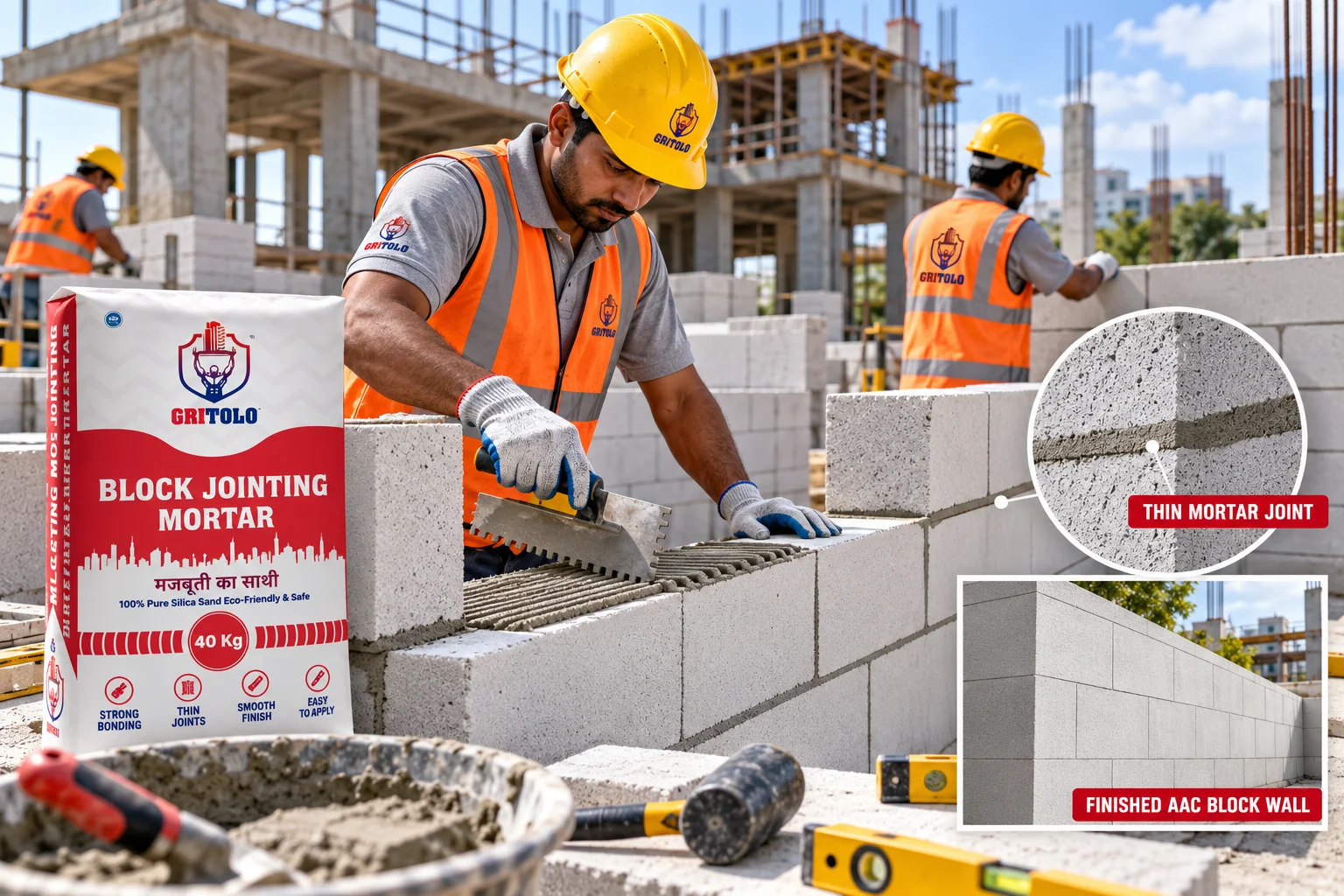
A notched trowel is commonly used for suitable thin-bed systems, but the correct tool and configuration depend on the product.
Published AAC installation guidance also describes notched-trowel application for thin-bed mortar systems. Magicrete
Step 8: Place the Block
Position the block carefully onto the mortar.
Check:
- Level
- Alignment
- Verticality
- Joint consistency
Step 9: Adjust the Block
Make adjustments within the product’s specified working period.
Avoid unnecessary disturbance after the mortar begins setting.
Step 10: Continue the Wall
Repeat the process while maintaining:
- Horizontal alignment
- Vertical alignment
- Required bond pattern
- Openings
- Structural details
What Is the Ideal Joint Thickness?
There is no single universal joint thickness for every block jointing mortar.
The correct thickness depends on:
- Block type
- Mortar type
- Product formulation
- Masonry system
- Manufacturer instructions
- Applicable project specification
Thin-bed products are often designed for much thinner joints than conventional cement-sand mortar, but the exact value should come from the approved product documentation.
This distinction is important because using a generic thickness from another manufacturer’s product can result in incorrect application.
How Much Block Jointing Mortar Is Required?
Consumption depends on:
- Block dimensions
- Wall thickness
- Joint thickness
- Wall area
- Block alignment
- Surface condition
- Mortar density
- Application technique
- Wastage
A basic estimation concept is:
Mortar quantity = Wall area × Product consumption rate
But for accurate estimation, use the specific product’s published consumption rate.
Do not estimate material requirement solely from the bag weight.
Block Jointing Mortar Mixing Procedure
A general mixing procedure is:
1. Use clean water
Use water suitable for the manufacturer’s requirements.
2. Measure accurately
Use the specified water-to-powder ratio.
3. Add powder gradually
Follow the manufacturer’s recommended sequence.
4. Mix thoroughly
Use suitable mixing equipment.
5. Achieve uniform consistency
The mortar should be consistent and free from dry lumps.
6. Observe working time
Use the prepared mortar within the specified working period.
Exact water quantities should always come from the product’s current technical data sheet rather than from a generic article.
Block Surface Preparation
Surface preparation can influence the performance of the joint.
Before applying mortar:
- Remove loose dust.
- Remove contamination.
- Check block condition.
- Follow product-specific wetting or dampening instructions.
- Ensure the block surface is suitable.
Different AAC block systems provide different guidance about moisture conditioning. Therefore, don’t assume that every AAC block should be soaked in water or every block should remain completely dry.
For example, published AAC guidance varies in its wording around surface moisture, reinforcing why the product and masonry-system instructions should be followed. Magicrete
Block Alignment and Leveling
Mortar alone cannot correct major masonry alignment problems.
During installation, continuously check:
- Horizontal level
- Vertical plumb
- Wall straightness
- Corner alignment
- Opening dimensions
- Course height
Use suitable:
- Spirit levels
- Mason’s line
- Measuring equipment
- Straight edges
- Other masonry tools
Correcting small deviations during construction is generally easier than correcting the completed wall.
Block Jointing Mortar for Internal Walls
Internal partition walls may have different requirements from exterior walls.
Consider:
- Wall thickness
- Block type
- Partition design
- Door openings
- Service penetrations
- Finishing system
- Acoustic requirements
The mortar should be compatible with the block and specified masonry system.
Block Jointing Mortar for External Walls
Exterior walls experience greater environmental exposure.
Consider:
- Rain
- Wind
- Solar heating
- Temperature variation
- Moisture
- External plastering
- Waterproofing details
The mortar should be suitable for the specified exterior masonry system.
External wall performance also depends on detailing and finishing, not simply the jointing mortar.
Block Jointing Mortar vs Cement-Sand Mortar
A more detailed comparison can help when deciding between systems.
| Factor | Block Jointing Mortar | Cement-Sand Mortar |
|---|---|---|
| Manufacturing | Factory formulated | Often site mixed |
| Material measurement | Product controlled | Cement/sand proportioning required |
| Jointing | Often designed for controlled joints | Generally thicker conventional joints |
| Application | Product-specific | Conventional masonry technique |
| Storage | Packaged dry mix | Separate cement/sand storage |
| Consistency | Factory controlled | Depends on site batching |
| Best use | Compatible manufactured blocks | Broad masonry applications |
| Water addition | Manufacturer specified | Site controlled |
| Tools | Product dependent | Conventional masonry tools |
The comparison should not be interpreted as saying that one system is universally better.
The correct system depends on the wall design, block type, specifications and project conditions.
Common Block Jointing Mortar Application Mistakes
1. Using the wrong mortar
Not every jointing mortar is suitable for every block.
2. Applying on contaminated blocks
Dust or contamination can affect bonding.
3. Incorrect water quantity
Too much or too little water can change the material’s intended properties.
4. Applying inconsistent thickness
Uneven joints can affect masonry alignment and material consumption.
5. Ignoring block alignment
Mortar should not be used to hide significant masonry errors.
6. Re-tempering incorrectly
Do not add water to partially set mortar unless the manufacturer specifically allows it.
7. Using expired material
Check shelf life and packaging condition.
8. Poor storage
Dry powder products should be protected from moisture.
9. Ignoring weather
Extreme environmental conditions can influence application.
10. Starting plastering too soon
Allow the masonry system to reach the condition required before subsequent finishing work.
Storage of Block Jointing Mortar
Proper storage is important for dry construction products.
Generally:
- Keep bags dry.
- Protect from rain.
- Store off wet surfaces as appropriate.
- Keep packaging sealed/intact.
- Follow the manufacturer’s storage conditions.
- Rotate stock according to shelf life.
- Avoid using moisture-damaged material.
Moisture contamination can cause premature setting or hardening in cement-based dry products.
Block Jointing Mortar Quality Checklist
Before installation
- Correct block type confirmed
- Correct mortar selected
- Product within shelf life
- Packaging intact
- Technical documentation reviewed
Surface preparation
- Blocks inspected
- Dust removed
- Contamination removed
- Surface condition checked
- Moisture preparation followed
Mixing
- Correct water measured
- Correct powder quantity
- Suitable mixing equipment
- Recommended mixing time
- Working time observed
Application
- Correct tool
- Correct joint thickness
- Blocks properly aligned
- Level checked
- Plumb checked
Completion
- Wall inspected
- Joints checked
- Openings verified
- Required curing/setting followed
- Subsequent finishing delayed until appropriate
Block Jointing Mortar and Construction Efficiency
Modern construction places increasing emphasis on controlled material usage and site efficiency.
Factory-produced block jointing mortar can simplify some site processes because the dry formulation is prepared before delivery.
Potential operational advantages include:
- Reduced individual material measurement
- Simplified storage
- Controlled mixing
- Consistent formulation
- Organized application
- Potentially reduced mortar volume in suitable thin-joint systems
Actual productivity depends heavily on:
- Worker skill
- Block quality
- Site organization
- Wall geometry
- Material availability
- Application method
Therefore, productivity improvements should be measured under actual project conditions.
Block Jointing Mortar and Sustainability
Construction material sustainability involves more than product labeling.
Factors to consider include:
- Material consumption
- Packaging
- Transportation
- Manufacturing
- Waste
- Durability
- Service life
- Maintenance
Thin-joint masonry can potentially reduce mortar consumption compared with conventional thick joints where the system is appropriately designed and installed.
However, sustainability claims should be based on actual product and project data rather than generalized assumptions.
Block Jointing Mortar Cost
The price of block jointing mortar varies according to:
- Product formulation
- Brand
- Packaging
- Location
- Transportation
- Quantity
- Project size
But bag price is not the same as installed cost.
Consider:
Total masonry jointing cost = Material + Consumption + Labour + Wastage + Transportation + Application
A product with a higher price per bag may have a different consumption rate from a conventional mortar system.
Therefore, compare systems based on the total cost of completing the masonry work.
How to Calculate Block Jointing Mortar Requirements
A practical project calculation should use:
- Total wall area.
- Block dimensions.
- Number of joints.
- Joint thickness.
- Product consumption rate.
- Expected wastage.
For example:
Estimated quantity = Wall area × Manufacturer’s consumption rate
Then add an appropriate project allowance based on actual site conditions.
Do not use a generic bag-per-square-metre figure without confirming the specific product and block dimensions.
Block Jointing Mortar and Plastering
Block jointing mortar is used to join masonry blocks.
It should not automatically be treated as a substitute for:
- Wall plaster
- Rendering material
- Waterproofing
- Structural reinforcement
- Surface finishing
After masonry construction, the wall may require a suitable finishing system depending on the project.
This can include:
- Ready mix plaster
- Conventional plaster
- Render
- Tile installation
- Paint system
- Waterproofing system
The compatibility between the masonry surface and subsequent finish should be considered.
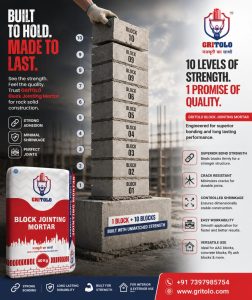
Block Jointing Mortar and Gritolo
GRITOLO GLOBAL INDIA PRIVATE LIMITED provides construction-material solutions for modern residential, commercial and industrial construction.
Its construction-material portfolio includes solutions associated with:
- Block jointing mortar
- Ready mix plaster
- Tile adhesives
- Floor hardeners
- Construction materials
- Wall and floor finishing
Gritolo’s approach focuses on application-oriented construction materials designed to support modern building requirements.
For a specific block jointing mortar product, customers should review the applicable product documentation for:
- Compatible blocks
- Mixing instructions
- Water requirement
- Application thickness
- Coverage
- Working time
- Storage
- Curing or setting
- Limitations
The exact product specification should always be confirmed before project use.
Frequently Asked Questions
What is block jointing mortar?
Block jointing mortar is a specialized mortar used to join compatible masonry blocks. It is commonly supplied as a factory-prepared dry mix that is mixed with water before application.
What is block jointing mortar used for?
It is used for suitable block masonry applications, including certain AAC, concrete and lightweight block systems. The product must be compatible with the specific block.
Is block jointing mortar the same as cement mortar?
No. Conventional cement mortar is often prepared on site from cementitious material, sand and water, while block jointing mortar is typically a factory-formulated product designed for specified block masonry applications.
Can block jointing mortar be used for AAC blocks?
Suitable block jointing mortar products can be used for AAC block masonry. The mortar must be specifically compatible with the AAC block and masonry system.
What is thin-bed mortar?
Thin-bed mortar is a jointing material designed to create controlled, relatively thin joints between suitable masonry units. The exact joint thickness depends on the product and masonry system.
How thick should block jointing mortar be?
There is no universal thickness for every product. Follow the manufacturer’s technical documentation and the approved masonry-system requirements.
How is block jointing mortar mixed?
Most dry-mix products are mixed with a specified quantity of clean water. The exact water quantity, mixing time and working procedure must come from the product’s technical instructions.
Can block jointing mortar replace plaster?
No. Block jointing mortar is intended for joining masonry units. Plaster is a separate wall-finishing material.
Can block jointing mortar be used outdoors?
Some products may be suitable for exterior masonry applications. Check the product documentation before using it on an external wall.
How much block jointing mortar is required per square metre?
Consumption varies according to block dimensions, joint thickness, wall area, application method and product formulation. Use the manufacturer’s stated consumption rate for estimation.
How should block jointing mortar be stored?
Dry block jointing mortar should generally be kept dry, protected from moisture and stored according to the manufacturer’s instructions.
Is block jointing mortar better than cement mortar?
Neither should be considered universally better. Block jointing mortar can be advantageous for suitable manufactured block systems, while conventional mortar remains appropriate for many masonry applications. Selection should be based on the project requirements.
Can damaged AAC blocks be installed using more mortar?
Adding extra mortar should not be used as a substitute for proper block selection and masonry workmanship. Damaged or unsuitable blocks should be addressed according to the project requirements.
Conclusion
Block jointing mortar is an important construction material for suitable modern masonry systems, particularly where manufactured blocks are used.
Its main purpose is to create controlled joints between compatible masonry units. Compared with conventional site-mixed mortar, factory-prepared jointing products can simplify material preparation and provide a more controlled formulation.
However, successful masonry depends on much more than the mortar.
The block type, substrate condition, joint thickness, mixing procedure, application technique, alignment, workmanship, structural detailing and environmental conditions all influence the finished wall.
For AAC and other manufactured block systems, the product should always be selected according to the block manufacturer’s requirements, the mortar manufacturer’s technical documentation, project drawings and applicable standards.
Gritolo provides construction-material solutions including block jointing mortar, ready mix plaster, tile adhesives and floor hardeners for modern construction applications.
Before starting a project, review the relevant product documentation and consult the responsible engineer or qualified construction professional where required.