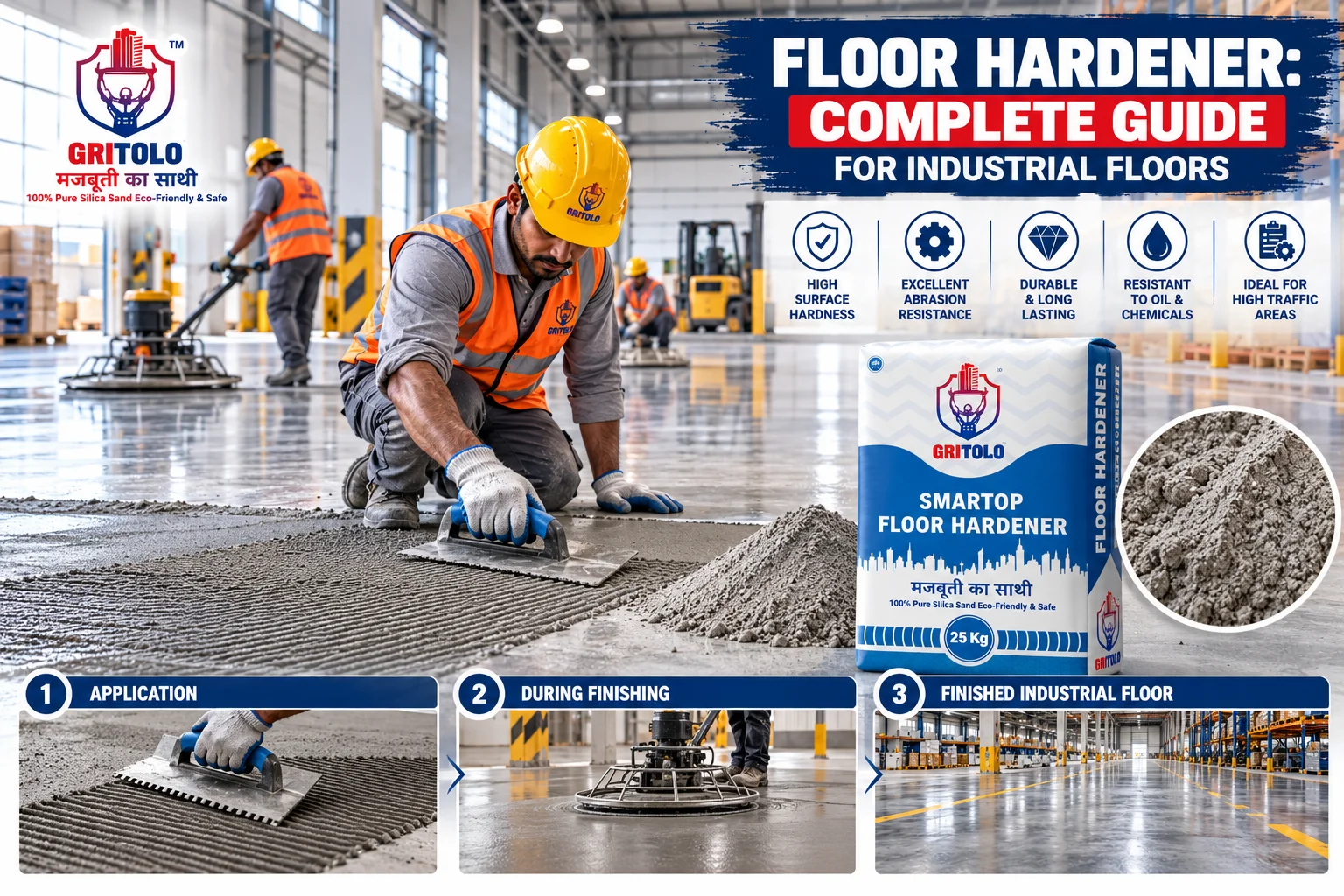
Industrial floors face demanding conditions every day. Forklifts move continuously across warehouse surfaces, manufacturing equipment creates repeated mechanical loads, workers and vehicles generate abrasion, and production environments can expose floors to dust, impact, moisture and other stresses.
A conventional concrete floor may provide a strong base, but the surface can still require additional protection and wear resistance depending on how the facility is used. This is where a floor hardener can become an important part of an industrial flooring system.
A floor hardener is a specially formulated material used to improve the surface performance of concrete flooring. Depending on the product and application method, floor hardeners can help improve abrasion resistance, surface durability, dust control and resistance to everyday mechanical wear.
For warehouses, factories, workshops, manufacturing plants, logistics facilities and other commercial or industrial spaces, choosing the right floor hardener is not simply about selecting the hardest material available. The correct solution depends on traffic, loading conditions, concrete quality, construction method, finishing requirements and the expected service environment.
This complete guide explains what floor hardener is, how it works, where it is used, its benefits, types, application process, consumption considerations, maintenance requirements and how to choose the right solution for an industrial floor.
What Is Floor Hardener?
A floor hardener is a cementitious or specially formulated flooring material designed to improve the surface characteristics of a concrete floor.
Floor hardeners can contain combinations of cementitious binders, hard mineral or synthetic aggregates, pigments and performance-enhancing additives. The formulation varies according to the intended application and performance requirements.
One common method is the dry-shake floor hardener system. In this approach, the dry material is distributed over freshly placed concrete at the appropriate stage of setting and then mechanically or manually worked into the concrete surface.
The objective is to create a dense and wear-resistant surface that can withstand the type of traffic and abrasion expected in the facility.
Floor hardener should not be considered a replacement for properly designed structural concrete. Instead, it is generally part of the overall flooring system, with the concrete slab providing the structural base and the hardener improving the surface layer.
Why Is Floor Hardener Important for Industrial Floors?
Industrial floors are exposed to considerably more demanding conditions than many residential floors.
Consider a warehouse where forklifts repeatedly travel through the same aisles. Every movement creates rolling and abrasive forces on the floor. In a manufacturing facility, machinery, material handling equipment and production activities can create additional mechanical stresses.
Without an appropriate surface treatment, concrete floors may experience problems such as:
- Surface abrasion
- Dust generation
- Surface wear
- Minor surface deterioration
- Reduced appearance
- Difficult cleaning
- Damage caused by repeated traffic
- Localized wear in high-traffic zones
A suitable floor hardener can improve the surface performance of the floor and help create a more durable working environment.
However, the hardener cannot compensate for poor concrete design, inadequate substrate preparation, improper finishing or unsuitable curing. The complete flooring system must be designed and installed correctly.
How Does a Floor Hardener Work?
A floor hardener works by creating a harder and more wear-resistant surface layer on concrete.
In a typical dry-shake application, the hardener is distributed over fresh concrete when the surface has reached the appropriate stage for application. The material uses available moisture from the concrete and is then incorporated into the surface through floating or trowelling.
Once properly finished and cured, the treated surface can provide improved resistance to abrasion compared with an untreated concrete surface.
The exact mechanism and performance depend on:
- Hardener formulation
- Aggregate type
- Cementitious binder
- Application rate
- Concrete mix
- Surface moisture
- Application timing
- Finishing technique
- Curing
- Traffic conditions
- Maintenance
This is why following the manufacturer’s technical data sheet is essential.
Types of Floor Hardeners
Floor hardeners can be classified in several ways depending on their composition and application method.
1. Dry-Shake Floor Hardener
Dry-shake hardeners are applied to fresh concrete.
The dry material is distributed over the concrete surface and incorporated during the finishing process.
This method is commonly considered for:
- Warehouses
- Factories
- Workshops
- Manufacturing facilities
- Logistics centres
- Parking areas
- Industrial corridors
- Commercial floors
The application timing is critical because the hardener needs suitable moisture and concrete consistency to become properly integrated into the surface.
2. Mineral Aggregate Floor Hardener
Mineral-based hardeners use hard aggregates to improve the wear resistance of the surface.
Depending on the formulation, aggregate types may include selected mineral materials designed for specific performance requirements.
The appropriate material depends on the expected abrasion and traffic level.
3. Metallic Floor Hardener
Metallic hardeners use metallic aggregates or components to provide very high surface wear resistance in suitable applications.
They may be considered for particularly demanding industrial environments.
However, metallic systems are not appropriate for every project. Selection should consider the operating environment, moisture conditions, corrosion considerations, equipment requirements and manufacturer’s recommendations.
4. Non-Metallic Floor Hardener
Non-metallic hardeners use mineral aggregates and cementitious binders rather than metallic aggregate.
They can be suitable for many general industrial and commercial applications where improved abrasion resistance is required without using metallic aggregate.
5. Liquid-Applied Hardener or Densifier
Liquid-applied products are different from conventional dry-shake hardeners.
They are generally applied to an existing or newly finished concrete surface to densify and improve surface performance.
Therefore, when selecting a floor hardener, first determine whether the project requires:
Fresh-concrete dry-shake treatment or surface-applied treatment for existing concrete.
These are different applications and should not be treated as interchangeable.
Where Is Floor Hardener Used?
Floor hardeners are suitable for many areas where concrete surfaces experience regular traffic or mechanical wear.
Industrial Factories
Factory floors may experience:
- Forklift movement
- Pallet movement
- Machinery loads
- Material handling
- Repeated cleaning
- Heavy pedestrian traffic
A properly selected floor hardener can help create a durable surface for these operating conditions.
Warehouses
Warehouses are among the most common environments where floor performance is important.
Typical requirements include:
- Abrasion resistance
- Smooth movement of forklifts
- Reduced dusting
- Easy cleaning
- Long-term surface durability
- Good visual appearance
Manufacturing Plants
Manufacturing facilities may require flooring that can withstand continuous traffic and mechanical activity.
The correct flooring specification should consider the particular production process rather than simply choosing a generic floor hardener.
Workshops
Automotive, engineering and fabrication workshops can experience significant mechanical wear.
Floor hardener can be considered where concrete floors need improved surface resistance.
Logistics Facilities
Distribution centres and logistics facilities often experience continuous movement of pallet trucks, forklifts and other material-handling equipment.
Floor quality can directly influence operational efficiency and maintenance requirements.
Commercial Areas
Floor hardeners can also be considered for certain commercial and service areas where concrete flooring requires improved surface performance.
Major Benefits of Floor Hardener
1. Improved Abrasion Resistance
One of the primary reasons to use a floor hardener is to improve resistance to surface abrasion.
This is particularly important where forklifts, pallet trucks, carts and other equipment operate continuously.
2. Better Surface Durability
A properly installed hardener can create a more durable wearing surface compared with ordinary untreated concrete.
3. Reduced Surface Dusting
Concrete surfaces can generate dust when the near-surface material is weak or poorly finished.
A suitable hardener system can help reduce surface dusting when correctly applied.
4. Improved Maintenance
A dense, properly finished concrete surface can be easier to clean and maintain.
This is valuable in factories, warehouses and production environments where regular cleaning is necessary.
5. Longer-Lasting Surface Performance
By improving resistance to everyday wear, floor hardeners can contribute to better surface service life.
Actual durability depends on concrete quality, traffic, application quality, maintenance and operating conditions.
6. Improved Appearance
Floor hardeners can provide a more uniform and finished appearance.
Some products are also available in different colours for aesthetic or zoning purposes.
7. Better Suitability for Industrial Traffic
Industrial floors are exposed to different traffic categories.
A floor hardener can be selected according to the expected level of pedestrian, wheeled or mechanical traffic.
Floor Hardener vs Ordinary Concrete Floor
A conventional concrete floor provides the structural foundation of the flooring system.
A floor hardener, on the other hand, is used to improve surface characteristics.
| Factor | Ordinary Concrete Floor | Concrete Floor with Hardener |
|---|---|---|
| Structural base | Yes | Yes |
| Surface protection | Basic | Improved |
| Abrasion resistance | Depends on concrete | Generally improved |
| Dust control | Depends on finish | Can be improved |
| Industrial traffic | Depends on specification | Better suited when correctly specified |
| Surface durability | Depends on concrete | Enhanced surface performance |
| Maintenance | Project dependent | Can be easier when properly finished |
The important point is that floor hardener does not make poorly designed concrete automatically suitable for heavy industrial loading.
How to Choose the Right Floor Hardener
Selecting the correct floor hardener requires understanding the actual operating environment.
1. Identify the Traffic
Ask:
- Will the floor have pedestrian traffic?
- Will forklifts operate?
- What type of wheels are being used?
- How frequently will vehicles travel?
- Are there defined high-traffic lanes?
Traffic is one of the most important factors in product selection.
2. Determine the Abrasion Level
A warehouse with occasional pallet movement has different requirements from a manufacturing facility with continuous forklift traffic.
The hardener should match the expected abrasion.
3. Understand the Concrete Specification
The hardener works with the concrete substrate.
Consider:
- Concrete strength
- Mix design
- Slump
- Water content
- Surface condition
- Finishing method
- Curing method
The concrete must be suitable for the flooring system.
4. Consider the Application Method
Determine whether the project will use:
- Manual application
- Mechanical spreader
- Power trowel
- Laser screed
- Other approved equipment
Large industrial projects may benefit from mechanized application for better consistency.
5. Consider the Environment
Evaluate whether the floor is exposed to:
- Moisture
- Chemicals
- Oils
- Temperature changes
- Outdoor weather
- Continuous cleaning
- Heavy mechanical traffic
If chemical resistance is required, a specialized coating or flooring system may be necessary rather than relying solely on a conventional hardener.
Floor Hardener Application Process
Correct application is essential for performance.
The following is a general process. The exact procedure must always follow the selected product’s technical data sheet and project specification.
Step 1: Prepare the Concrete
The concrete slab should be properly designed, placed, levelled and compacted.
The surface must be suitable for receiving the floor hardener.
Step 2: Monitor Surface Condition
Timing is critical.
The concrete should reach the appropriate stage where the hardener can be incorporated effectively.
Do not apply the product simply because a fixed number of minutes has passed. Weather, concrete mix, slab thickness and site conditions can change the timing.
Step 3: Control Bleed Water
Surface bleed water must be handled according to the product’s application instructions.
The surface should not have uncontrolled standing water when the hardener is applied.
Step 4: Apply the Floor Hardener
The required quantity is distributed uniformly over the concrete.
For larger projects, mechanical spreaders may be used to improve consistency.
Step 5: First Incorporation
The first portion of material is incorporated into the concrete using the specified finishing equipment.
Uniform application is important to prevent variations in surface performance and appearance.
Step 6: Second Application
Many dry-shake systems are applied in multiple stages.
The remaining quantity is distributed and incorporated according to the manufacturer’s instructions.
Step 7: Final Finishing
Power trowels or appropriate hand tools are used to compact and finish the surface.
The objective is to achieve the specified surface texture, flatness and finish.
Step 8: Curing
Proper curing is critical.
The completed floor should be cured according to the selected product and project requirements.
Step 9: Protect the Floor
The finished floor should be protected from premature traffic, contamination and damage until it reaches the required condition for use.
Floor Hardener Consumption
Floor hardener consumption is normally expressed in kilograms per square metre.
However, there is no single consumption rate that is correct for every project.
Consumption depends on:
- Product type
- Aggregate type
- Required performance
- Traffic level
- Application method
- Concrete condition
- Surface finish
- Project specification
For example, manufacturer guidance for dry-shake systems may specify different application rates for light, medium and heavy traffic. Some technical guidance gives examples ranging from approximately 3 kg/m² for lighter applications to 5–7 kg/m² for heavier abrasion environments, but these figures are product-specific and should not be treated as universal.
Basic Quantity Calculation
A simple planning formula is:
Required Quantity = Floor Area × Recommended Consumption Rate
For example:
If:
- Floor area = 1,000 m²
- Recommended consumption = 5 kg/m²
Then:
1,000 × 5 = 5,000 kg
Therefore, the theoretical material requirement would be approximately 5,000 kg before considering project-specific ordering and wastage.
Always use the manufacturer’s recommended consumption for the selected product.
What Thickness Does Floor Hardener Provide?
The thickness of the finished hardener layer is not universal.
It depends on the material, application rate, aggregate density and installation method.
Some dry-shake manufacturer guidance indicates a finished dry-shake layer around 2–3 mm, but this is not a universal specification for every floor hardener.
Therefore, never specify floor-hardener thickness solely from a generic article.
Use:
- Product technical data sheet
- Project specification
- Manufacturer recommendation
- Flooring contractor’s installation procedure
Common Floor Hardener Application Mistakes
Applying at the Wrong Time
Timing is one of the most critical factors.
Applying too early or too late can negatively affect incorporation and final surface quality.
Uneven Distribution
Uneven spreading can create inconsistent colour, texture and performance.
Adding Water to the Surface
Water should not be added to the surface simply to make finishing easier.
Certain manufacturer instructions specifically prohibit adding water after dry-shake material has been applied.
Using an Unsuitable Concrete Mix
The concrete must be compatible with the flooring system.
Poor-quality concrete cannot be transformed into a high-performance industrial floor simply by applying more hardener.
Poor Finishing
Insufficient or excessive trowelling can affect the final surface.
The finishing sequence must be coordinated with the setting behaviour of the concrete and hardener.
Inadequate Curing
Improper curing can reduce the performance and appearance of the completed floor.
Ignoring Joints
Industrial concrete floors require appropriate joint planning.
Movement joints, construction joints, saw-cut joints and other details should be considered during floor design.
Using the Wrong Product
A general-purpose hardener may not be appropriate for every industrial environment.
Selection should be based on actual traffic and operating conditions.
Floor Hardener for Warehouses
Warehouse flooring needs to support both storage and movement.
Forklifts may travel repeatedly through specific aisles, creating concentrated traffic patterns.
Important warehouse floor considerations include:
- Forklift traffic
- Wheel type
- Load intensity
- Surface abrasion
- Flatness requirements
- Joint performance
- Dust control
- Cleaning
- Maintenance
- Rack layout
Floor hardener can improve the wearing surface, but warehouse flooring should be considered as a complete system.
Floor Hardener for Factories
Factory floors may face more complex conditions.
Depending on the industry, floors may encounter:
- Machinery
- Heavy equipment
- Material handling
- Production waste
- Oil
- Water
- Chemicals
- Heat
- Repeated cleaning
If the environment includes aggressive chemicals or specialized hygiene requirements, a resinous coating or another specialized flooring system may be more appropriate.
The right choice should always be based on actual service conditions.
Floor Hardener for Garages and Parking Areas
Floor hardeners can also be considered for selected garages, parking structures and vehicle areas.
However, outdoor exposure introduces additional considerations such as:
- Weather
- Rain
- Drainage
- Freeze-thaw conditions where applicable
- UV exposure
- Oil contamination
- Vehicle traffic
The selected product should be specifically suitable for the intended environment.
Maintenance of Industrial Floors
Even a high-quality industrial floor requires maintenance.
Recommended practices include:
Regular Cleaning
Remove dust, dirt and debris regularly.
Immediate Spill Management
Oil, chemicals and other potentially damaging materials should be cleaned according to the facility’s maintenance procedures.
Inspect High-Traffic Areas
Regularly inspect:
- Forklift routes
- Doorways
- Loading areas
- Production zones
- Joints
- Expansion areas
Repair Damage Early
Small defects should be evaluated and repaired before they become larger maintenance problems.
Use Appropriate Cleaning Equipment
Industrial floors can be maintained using suitable mechanical cleaning equipment, provided the cleaning method is compatible with the floor system.
Floor Hardener vs Floor Coating
These two solutions are often confused.
A floor hardener is typically integrated with concrete or used to improve the concrete surface.
A floor coating is generally a separate protective layer applied over the substrate.
| Feature | Floor Hardener | Floor Coating |
|---|---|---|
| Relationship with concrete | Integrated surface treatment | Separate coating layer |
| Common application | Fresh concrete for dry-shake systems | Usually cured concrete |
| Abrasion resistance | Can be improved | Depends on coating |
| Chemical resistance | Product dependent | Often available in specialized systems |
| Colour options | Available for some systems | Generally extensive |
| Repair | Surface-specific | Coating-specific |
| Typical selection | Heavy-wear concrete surfaces | Specialized protection and appearance |
The correct solution depends on project requirements.
How to Calculate Floor Hardener Quantity
To estimate material quantity:
Floor Area × Manufacturer’s Recommended Consumption = Base Quantity
For example:
A factory has a floor area of 2,500 m².
The selected product recommends 5 kg/m² for the specified application.
Therefore:
2,500 × 5 = 12,500 kg
The final procurement quantity should account for the manufacturer’s packaging, application method, project conditions and reasonable wastage.
Do not increase consumption simply because a higher quantity sounds like it will produce a stronger floor.
More material does not automatically mean better performance.
Quality Checklist Before Floor Hardener Application
Before starting the installation, verify:
- Concrete specification is approved
- Floor levels are established
- Reinforcement is correctly installed
- Joints are planned
- Concrete delivery is coordinated
- Surface condition is suitable
- Weather conditions are acceptable
- Product is stored correctly
- Product batch information is recorded
- Required application rate is known
- Finishing equipment is available
- Experienced workers are assigned
- Curing procedure is ready
- Finished floor protection is planned
Good coordination between the concrete contractor, flooring contractor and project team is essential.
Sustainability Considerations
Industrial flooring decisions should consider the complete lifecycle of the floor.
A durable surface may reduce the frequency of major repairs and replacement when correctly designed and maintained.
Sustainability considerations can include:
- Product service life
- Material efficiency
- Local sourcing
- Reduced maintenance
- Cleaning requirements
- Waste management
- Repairability
- Long-term operational performance
The most sustainable flooring solution is not necessarily the cheapest product. It is the solution that provides the required performance over its intended service life with appropriate material and maintenance requirements.
How to Select a Floor Hardener Manufacturer
When evaluating a floor hardener supplier, consider more than product price.
Check:
Technical Documentation
The manufacturer should provide clear technical information covering application, consumption, storage and limitations.
Product Consistency
Factory-controlled manufacturing can help provide consistent product characteristics.
Application Support
Industrial projects benefit from technical guidance during installation.
Project Experience
Look for experience with comparable flooring applications.
Product Suitability
The product should match the actual industrial environment.
After-Sales Support
Technical support can be valuable when dealing with large or complex flooring projects.
Smartop Floor Hardener by Gritolo
GRITOLO GLOBAL INDIA PRIVATE LIMITED provides construction material solutions for modern building and industrial requirements.
Gritolo’s product portfolio includes Smartop Floor Hardener, alongside solutions such as ready mix plaster, tile adhesive and block jointing mortar.
For an industrial flooring project, product selection should be based on the required traffic, abrasion conditions, concrete specification, application method and project requirements.
Before purchasing or applying a floor hardener, project teams should review the applicable technical documentation and confirm suitability for the intended application.
Frequently Asked Questions About Floor Hardener
What is floor hardener?
Floor hardener is a specially formulated material used to improve the surface performance of concrete floors, particularly resistance to abrasion and everyday mechanical wear.
What is an industrial floor hardener?
An industrial floor hardener is a floor-hardening solution selected for environments such as factories, warehouses, workshops and logistics facilities where concrete floors experience regular traffic and abrasion.
Is floor hardener applied to fresh concrete?
Many dry-shake floor hardeners are applied to fresh concrete and incorporated during the concrete finishing process. Other hardening products are designed for existing or cured concrete.
How much floor hardener is required per square metre?
The required quantity depends on the product and project conditions. The manufacturer’s technical data sheet should be used to determine the correct application rate.
Is floor hardener the same as concrete?
No. Concrete forms the structural base of the floor, while a floor hardener is generally used to improve the surface performance of the concrete.
Can floor hardener be used in warehouses?
Yes, floor hardeners can be suitable for warehouse flooring where improved abrasion resistance and surface durability are required. Product selection should consider forklift traffic, loading and operating conditions.
Can floor hardener be used in factories?
Yes. Floor hardeners are commonly considered for factory environments, but the product should be selected according to traffic, abrasion, chemical exposure, machinery and other operating conditions.
Does floor hardener make concrete waterproof?
A floor hardener should not automatically be described as a waterproofing system. Some systems can reduce surface permeability, but waterproofing requirements should be addressed using an appropriate waterproofing or flooring system.
Can floor hardener be applied to old concrete?
It depends on the product. Dry-shake hardeners are generally designed for fresh concrete, while some liquid-applied hardeners or densifiers are designed for existing concrete.
Is floor hardener suitable for forklift traffic?
A suitable floor hardener can be used in forklift areas, provided the complete concrete flooring system is designed for the expected traffic, loads and abrasion.
Is more floor hardener always better?
No. Applying more material than specified does not automatically improve performance. Application rate should be based on the product’s technical requirements and project conditions.
How long does a floor hardener last?
There is no universal lifespan. Service life depends on concrete quality, traffic, loading, installation, curing, maintenance and environmental conditions.
What is the difference between floor hardener and floor coating?
A floor hardener generally improves or forms part of the concrete wearing surface, while a floor coating creates a separate protective layer over the substrate.
Conclusion
A floor hardener can be an important component of a durable industrial concrete flooring system.
Factories, warehouses, workshops and logistics facilities often require floors that can withstand repeated traffic, abrasion and mechanical use. A correctly selected and professionally installed floor hardener can improve surface durability, abrasion resistance and overall floor performance.
However, successful industrial flooring depends on more than the hardener itself.
Concrete quality, slab design, surface preparation, application timing, application rate, finishing, curing, joints, maintenance and operating conditions all contribute to the final result.
The best approach is therefore to select the floor hardener according to the actual requirements of the facility rather than choosing a product based only on price or a generic performance claim.
For projects requiring a suitable construction material solution, GRITOLO GLOBAL INDIA PRIVATE LIMITED offers products including Smartop Floor Hardener along with ready mix plaster, tile adhesive and block jointing mortar solutions.
Before installation, always review the manufacturer’s technical documentation and confirm that the selected product is appropriate for the specific industrial flooring application.