Best Tile Adhesive in India 2026 – Types, Uses & Complete Buying Guide
Have you ever walked into a beautifully tiled home or commercial space and wondered what keeps those tiles perfectly in place for years? The answer lies not in the tiles themselves, but in what goes behind them — tile adhesive.
Gone are the days when cement-sand mortar was the only option for tile installation. Today, tile adhesive has revolutionized the Indian construction industry by offering superior bond strength, water resistance, and long-lasting performance that traditional methods simply cannot match.
But with dozens of brands and grades available in the market, choosing the best tile adhesive in India can feel overwhelming. Whether you are a contractor, builder, architect, or homeowner, this comprehensive guide will help you understand everything about tile adhesive — from types and grades to application methods and cost comparison.
What is Tile Adhesive?
Tile adhesive is a specially formulated cement-based or polymer-modified bonding material used to fix tiles on walls, floors, and other surfaces. Unlike traditional cement-sand mortar, tile adhesive provides a thinner, stronger, and more consistent bond that prevents tiles from falling, cracking, or developing hollow spots over time.
Tile adhesives are manufactured as ready-mix dry powder that only requires the addition of water before application. This makes them significantly easier and faster to use compared to conventional methods.
Key Components of Tile Adhesive:
- Portland Cement — Base binding agent
- Graded Sand/Fillers — For body and workability
- Polymers (Redispersible Powders) — For flexibility and bond strength
- Cellulose Ethers — For water retention and open time
- Other Additives — For specific performance properties
Why is Tile Adhesive Better Than Cement Mortar?
Before diving into the best tile adhesive options, let us understand why tile adhesive has become the preferred choice over traditional cement-sand mortar.
| Parameter | Tile Adhesive | Cement-Sand Mortar |
|---|---|---|
| Bond Strength | 0.5 – 2.5 N/mm² (depending on grade) | 0.2 – 0.5 N/mm² |
| Application Thickness | 3-6 mm | 10-20 mm |
| Curing Time | 24 hours | 7-14 days |
| Water Resistance | High (polymer-modified grades) | Low |
| Material Wastage | Less than 5% | 15-25% |
| Coverage Per Bag | 40-60 sq ft (20 kg bag) | 8-12 sq ft (equivalent) |
| Tile Hollowness Risk | Very Low | High |
| Large Format Tile Suitability | Excellent | Poor |
| Skill Requirement | Moderate | High |
| Cost Efficiency | Higher initial cost, lower overall cost | Lower initial cost, higher overall cost |
As you can see, tile adhesive outperforms cement mortar in virtually every parameter that matters for modern construction.
Types of Tile Adhesive Available in India
Tile adhesives in India are classified based on IS 15477:2019 (Indian Standard) and international standards. Understanding these classifications is crucial for selecting the right product for your project.
1. Classification by Grade (IS Standard)
| Grade | Type | Bond Strength | Best For |
|---|---|---|---|
| T1 | Cementitious Adhesive (Basic) | ≥ 0.5 N/mm² | Small ceramic tiles, interior walls |
| T2 | Cementitious Adhesive (Standard) | ≥ 1.0 N/mm² | Vitrified tiles, interior floors & walls |
| T3 | Cementitious Adhesive (High Performance) | ≥ 1.5 N/mm² | Large format tiles, heavy stones, exteriors |
| T4 | Cementitious Adhesive (Extra High Performance) | ≥ 2.0 N/mm² | Very large format tiles, swimming pools, facades |
2. Classification by Application
- Wall Tile Adhesive — Formulated with anti-sag properties to prevent tile slippage on vertical surfaces
- Floor Tile Adhesive — Designed for horizontal applications with high compressive strength
- Universal Tile Adhesive — Suitable for both wall and floor applications
3. Classification by Special Properties
- Waterproof Tile Adhesive — For bathrooms, kitchens, swimming pools
- Heat Resistant Tile Adhesive — For areas near fireplaces, industrial zones
- Flexible Tile Adhesive — For surfaces with vibration or thermal movement
- Rapid Setting Tile Adhesive — For quick-turnaround projects
How to Choose the Best Tile Adhesive for Your Project
Selecting the right tile adhesive depends on several factors. Here is a systematic approach to help you make the best choice:
Factor_1: Tile Type and Size
| Tile Type | Recommended Adhesive Grade |
|---|---|
| Ceramic Tiles (up to 30×30 cm) | T1 or T2 |
| Vitrified Tiles (up to 60×60 cm) | T2 or T3 |
| Large Format Tiles (60×120 cm or larger) | T3 or T4 |
| Natural Stone (Marble, Granite) | T3 or T4 |
| Porcelain Tiles | T2, T3 or T4 |
| Glass Mosaic Tiles | T3 or T4 (white adhesive) |
Factor_2: Application Surface
| Surface | Recommended Adhesive |
|---|---|
| Plastered Walls | T1 or T2 |
| Concrete Floors | T2 or T3 |
| Existing Tile Surface (Tile-on-Tile) | T3 or T4 |
| AAC Blocks | T2 or T3 |
| Plywood/Wooden Surface | T4 (flexible type) |
| Exterior Facades | T3 or T4 |
Factor_3: Location and Environment
| Location | Key Requirement | Recommended |
|---|---|---|
| Interior Dry Areas | Basic adhesion | T1 or T2 |
| Bathrooms/Wet Areas | Water resistance | T2 or T3 (waterproof) |
| Kitchen Backsplash | Heat + moisture resistance | T2 or T3 |
| Swimming Pools | Full waterproofing | T4 |
| Exterior Walls | Weather resistance | T3 or T4 |
| High Traffic Floors | High bond + compressive strength | T3 or T4 |
Factor_4: Budget Considerations
| Grade | Approximate Price Range (per 20 kg bag) | Coverage |
|---|---|---|
| T1 | ₹200 – ₹350 | 45-60 sq ft |
| T2 | ₹350 – ₹550 | 40-55 sq ft |
| T3 | ₹550 – ₹800 | 35-50 sq ft |
| T4 | ₹800 – ₹1250+ | 30-45 sq ft |
Note: Prices vary by brand, region, and quantity. Contact Gritolo for current pricing.
Gritolo Tile Adhesive Range – Engineered for Indian Construction
At Gritolo Global India Pvt Ltd, we manufacture a complete range of tile adhesives designed specifically for Indian construction conditions — from humid coastal climates to extreme heat.
Our Tile Adhesive Products:
1. TA – C100 [T1] Tile Adhesive
- Grade: T1 (Basic)
- Best For: Small ceramic tiles on interior walls
- Key Features: Economical, easy mixing, good open time
- View Product →
2. TA – V200 [T2] Tile Adhesive
- Grade: T2 (Standard)
- Best For: Vitrified tiles on walls and floors
- Key Features: Strong bond, water resistant, versatile
- View Product →
3. TA – M300 [T3] Tile Adhesive
- Grade: T3 (High Performance)
- Best For: Large format tiles, natural stone, exteriors
- Key Features: High bond strength, anti-sag, weather resistant
- View Product →
4. TA – G400 [T4] Tile Adhesive
- Grade: T4 (Extra High Performance)
- Best For: Very large tiles, swimming pools, facades, tile-on-tile
- Key Features: Maximum bond strength, full waterproofing, flexibility
- View Product →
5. Application-Specific Adhesives
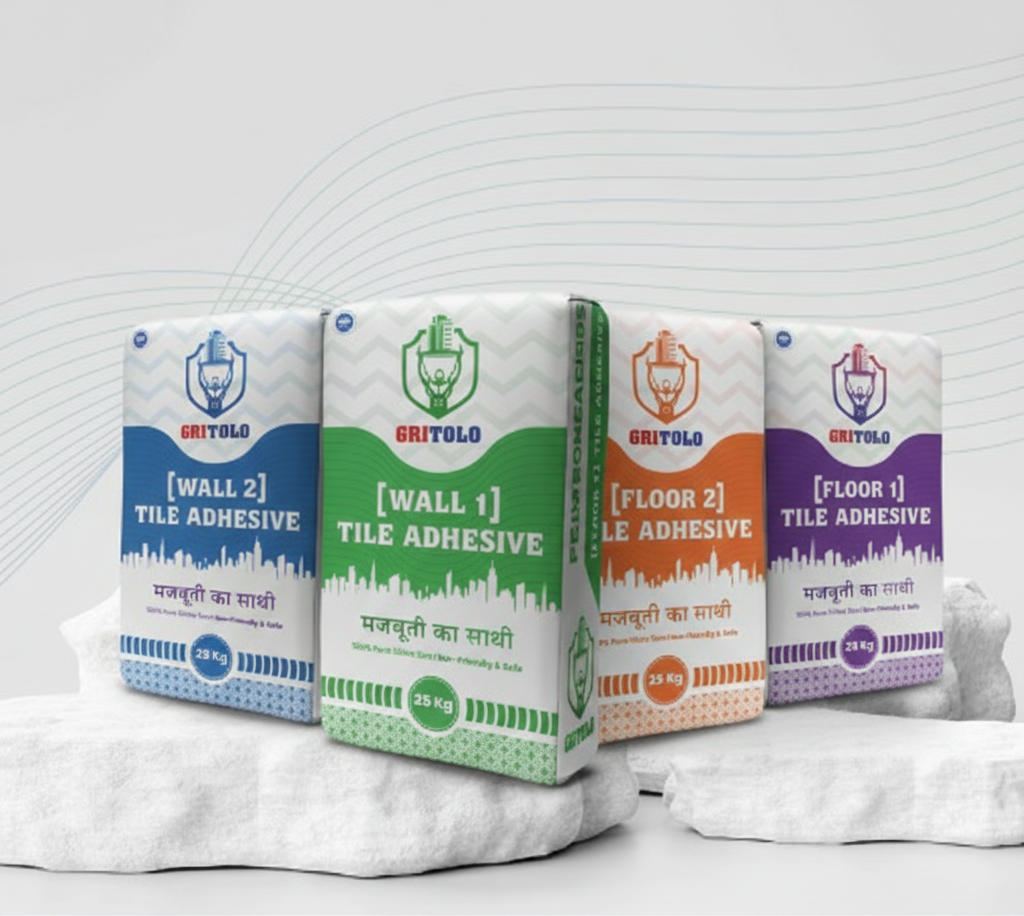
- Tile Adhesive Wall 1 & Wall 2 — Specially formulated for vertical applications
- Tile Adhesive Floor 1 & Floor 2 — Engineered for horizontal, high-traffic surfaces
How to Apply Tile Adhesive – Step-by-Step Guide
Proper application is just as important as choosing the right adhesive. Follow these steps for perfect tile installation:
Step_1: Surface Preparation
- Ensure the surface is clean, dry, and free from dust, oil, and loose particles
- The surface should be level and structurally sound
- For new plaster, allow at least 14 days of curing before tiling
- Dampen the surface slightly before application (not soaking wet)
Step_2: Mixing the Adhesive
- Pour clean water into a clean bucket (approximately 6-7 liters per 20 kg bag, or as per product instructions)
- Gradually add the adhesive powder while mixing
- Use a mechanical stirrer or drill with paddle attachment for consistent mixing
- Mix until you achieve a lump-free, creamy consistency
- Let the mixture rest for 5 minutes (slaking time) and remix briefly
Step_3: Application
- Apply the mixed adhesive on the surface using a notched trowel
- Use the appropriate notch size based on tile size:
- 6mm notch — tiles up to 30×30 cm
- 8mm notch — tiles 30×60 cm
- 10-12mm notch — tiles 60×60 cm and larger
- Spread adhesive in one direction to create even ridges
- For large format tiles, apply adhesive on both the surface and the back of the tile (back-buttering)
Step_4: Tile Placement
- Place tiles within the open time of the adhesive (typically 15-20 minutes)
- Press firmly and twist slightly to ensure full contact
- Use tile spacers for consistent joint width
- Check alignment with a spirit level
Step_5: Grouting
- Allow 24 hours for the adhesive to cure before grouting
- Apply grout using a rubber float, pressing into joints at a diagonal angle
- Clean excess grout with a damp sponge within 15-20 minutes
Common Mistakes to Avoid When Using Tile Adhesive
Even the best tile adhesive can fail if not applied correctly. Here are the most common mistakes and how to avoid them:
| Mistake | Consequence | How to Avoid |
|---|---|---|
| Using expired adhesive | Weak bond, tile failure | Check manufacturing date; use within 6-12 months |
| Incorrect water ratio | Too thin or too thick mixture | Follow manufacturer’s mixing instructions precisely |
| Applying on dusty surface | Adhesive won’t bond to surface | Clean and prepare surface thoroughly |
| Exceeding open time | Tiles won’t stick; skinning occurs | Apply tiles within specified open time |
| Not back-buttering large tiles | Hollow spots under tiles | Always back-butter tiles larger than 60×60 cm |
| Using wrong grade | Bond failure, tile cracking | Match adhesive grade to tile type and application |
| Applying too thick or too thin | Uneven bond, tile displacement | Maintain recommended 3-6 mm thickness |
| Grouting too early | Disturbs adhesive cure | Wait minimum 24 hours before grouting |
Tile Adhesive vs White Cement vs Epoxy Adhesive – Which One Should You Use?
| Feature | Tile Adhesive (Cement-Based) | White Cement + Fevicol | Epoxy Adhesive |
|---|---|---|---|
| Bond Strength | High (0.5-2.5 N/mm²) | Low-Medium | Very High (>3 N/mm²) |
| Water Resistance | Good to Excellent | Poor | Excellent |
| Cost | Moderate | Low | Very High |
| Ease of Application | Easy | Easy | Complex (2-component) |
| Best For | Most applications | Small repairs only | Chemical-resistant areas, laboratories |
| Flexibility | Good (polymer types) | Rigid | Semi-flexible |
| Industry Recommendation | ✅ Preferred | ❌ Not recommended for new work | ✅ For specialty applications |
Verdict: For most residential and commercial tile installations in India, cement-based tile adhesive (T1-T4) is the best and most cost-effective choice.
Frequently Asked Questions (FAQ)
Q1: Which tile adhesive is best for bathroom walls in India?
A: For bathroom walls, a T2 or T3 grade tile adhesive with waterproof properties is recommended. Products like Gritolo TA-V200 (T2) or TA-M300 (T3) provide excellent water resistance and strong adhesion for wet areas.
Q2: Can I use tile adhesive on painted walls?
A: It is not recommended to apply tile adhesive directly on painted walls. The paint must be completely removed, and the surface should be roughened before applying tile adhesive for proper bonding.
Q3: How much area does 20 kg of tile adhesive cover?
A: A 20 kg bag of tile adhesive typically covers 40-60 square feet depending on the tile size, adhesive grade, and notched trowel size used.
Q4: Is tile adhesive waterproof?
A: Standard tile adhesive (T1) offers basic moisture resistance. For waterproof applications like bathrooms and swimming pools, use T3 or T4 grade tile adhesive with polymer modification.
Q5: What is the shelf life of tile adhesive?
A: Most tile adhesives have a shelf life of 6-12 months from the date of manufacture when stored in a cool, dry place away from moisture.
Q6: Can tile adhesive be used for natural stone installation?
A: Yes, T3 or T4 grade tile adhesive is suitable for natural stone like marble and granite. However, use white-colored adhesive for light-colored stones to prevent staining.
Q7: How long does tile adhesive take to dry?
A: Tile adhesive typically takes 24 hours to achieve initial set and 7-14 days for full cure. Avoid heavy traffic on floor tiles for at least 48-72 hours.
Q8: What is the difference between T1 and T4 tile adhesive?
A: T1 is a basic grade suitable for small ceramic tiles in dry, interior areas. T4 is the highest performance grade with maximum bond strength, suitable for large format tiles, swimming pools, and exterior facades.
Choosing the Best Tile Adhesive in India
The Indian construction industry is rapidly evolving, and choosing the best tile adhesive is no longer a luxury — it is a necessity. Whether you are working on a residential bathroom, a commercial mall, or an industrial facility, the right tile adhesive ensures that your tiles stay beautiful, strong, and secure for decades.
When choosing tile adhesive, remember to consider the tile type, surface, location, and budget. For most applications, a T2 grade adhesive offers the best balance of performance and cost. For demanding applications, T3 and T4 grades provide the extra strength and durability you need.
At Gritolo Global India Pvt Ltd, we are committed to manufacturing high-quality, affordable tile adhesives that meet the diverse needs of Indian construction. Our products are engineered for Indian conditions and backed by technical support to ensure perfect results on every project.
Ready to find the perfect tile adhesive for your project? Contact Gritolo today or call us at +91 7397985754 for expert guidance and competitive pricing.