Cement Plaster vs Ready Mix Plaster: What’s the Real Difference?
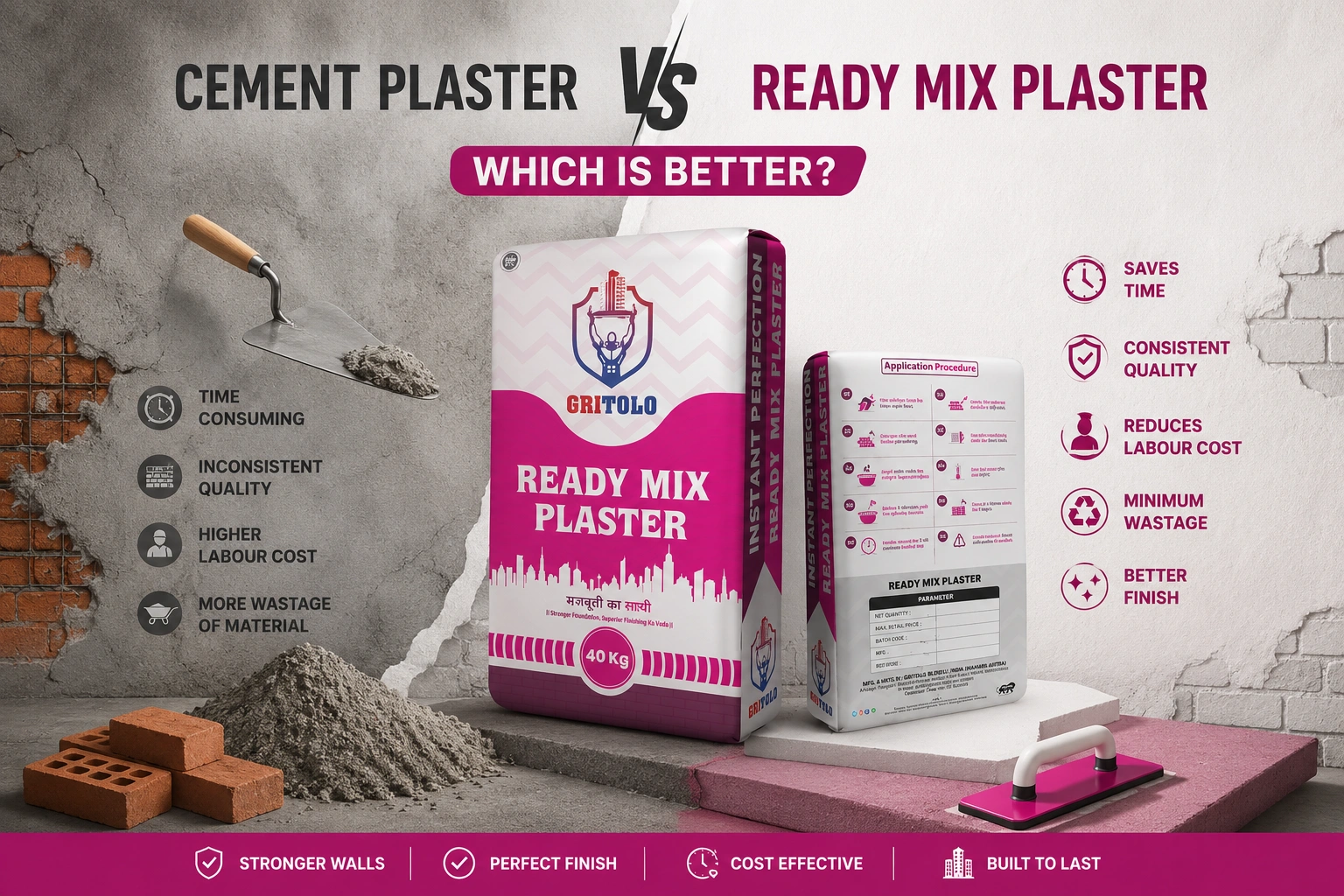
The core difference is consistency, not the basic ingredients — traditional cement plaster is mixed manually on-site from cement, sand, and water in proportions the mason judges by eye, while ready mix plaster is factory-proportioned, quality-tested, and pre-blended, so every bag delivers the same strength, workability, and finish regardless of who’s mixing it or which site it’s used on. Both ultimately produce a cement-based wall coating, but that difference in how the mix is controlled shows up directly in crack resistance, finish quality, water demand, and how long the wall lasts before it needs repair.
This comparison breaks down cost, quality, application speed, durability, and environmental factors side by side, so you can decide which one actually fits your project — whether you’re a contractor pricing a job or a homeowner reviewing a quote that lists one or the other.
What Is Traditional Cement Plaster?
Traditional cement plaster is the conventional method used across Indian construction for decades: cement and sand are brought to site separately, and a mason or labour team mixes them in a specified ratio (commonly 1:4 or 1:6, cement to sand, depending on the coat and application) with water added by estimation, then applies the wet mix to the wall by hand using trowels and floats.
It’s the default method most contractors and masons are already trained on, which is part of why it remains widely used — no new equipment, no new technique, and materials are available at almost any local hardware or building material shop.
What Is Ready Mix Plaster?
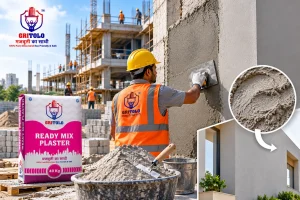
Ready mix plaster is a pre-blended, factory-manufactured product — cement, graded sand (or fine aggregate), and performance additives are proportioned and mixed under controlled conditions at a manufacturing facility, then packed into bags. On-site, the only step is adding a specified quantity of water and mixing (usually with a mechanical mixer or drill-paddle) before application.
Because the dry components are pre-graded and pre-proportioned at the factory, ready mix plaster removes the biggest source of variability in traditional plastering: manual, by-eye site mixing. Products like Gritolo’s Ready Mix Plaster also typically include additives for improved workability, water retention, and — depending on the specific product line — waterproofing performance that a plain site-mixed cement-sand mix doesn’t have unless a separate waterproofing compound is added manually.
Side-by-Side Comparison
| Factor | Traditional Cement Plaster | Ready Mix Plaster |
|---|---|---|
| Consistency | Varies by mason, batch, and site conditions | Factory-controlled, consistent bag to bag |
| Material cost | Generally lower per bag/kg for raw cement and sand | Moderately higher per kg, reflects processing and additives |
| Labour cost | Often higher — more time spent mixing and correcting inconsistent batches | Typically lower — faster mixing, less rework |
| Application speed | Slower — manual proportioning and mixing takes time | Faster — pre-blended, ready to mix and apply |
| Crack resistance | Depends heavily on mixing accuracy and curing discipline | Generally better, due to consistent proportioning and additives |
| Water demand control | Hard to standardize; over-watering is common | Specified water ratio printed on the bag, easier to control |
| Waterproofing | Requires separate additive, dosed manually | Often built in (product-dependent) |
| Site storage/wastage | Requires storing loose sand and cement separately; more wastage | Compact bagged storage; less material wastage |
| Finish quality | Can vary noticeably across a large wall area | More uniform finish across the full project |
| Sand availability dependency | High — quality depends on local sand source | Lower — sand is graded and controlled at the factory |
| Best suited for | Small jobs, budget-tight projects, experienced supervised crews | Larger projects, quality-critical facades, time-constrained schedules |
Cost Comparison: What You’re Actually Paying For
On a pure per-bag or per-kg basis, traditional cement plaster materials (raw cement plus sand) are usually cheaper than ready mix plaster. But comparing raw material cost alone misses most of the real cost picture.
Traditional cement plaster’s hidden costs:
- Labour time spent measuring and mixing batches repeatedly through the day
- Rework cost when inconsistent mixing produces patches that crack or fail early
- Material wastage from over-ordering sand/cement or discarding poorly mixed batches
- Transport and storage of bulk sand, which adds site logistics cost and space requirements
- Sand quality variability — poor local sand can force higher cement dosing to compensate, increasing cost unpredictably
Ready mix plaster’s cost profile:
- Higher per-bag material price, but predictable — no surprise cost increases from sand quality issues
- Lower labour hours per square metre, since mixing is faster and more foolproof
- Less wastage, since bags are used as needed without large bulk sand piles degrading or being wasted
- Fewer callback/rework costs from cracking or inconsistent finish
For small residential jobs with a single experienced, closely supervised mason, traditional plaster can still work out cheaper overall. For larger projects — where consistency across many masons and many wall sections matters, or where schedule delays are costly — ready mix plaster often ends up cost-competitive or even cheaper on a total-project basis, once labour efficiency and reduced rework are factored in.
Quality and Durability: Where the Real Difference Shows Up
This is where ready mix plaster’s advantage is most consistent, and it comes down to a simple fact: cement plaster performance is only as good as the least careful batch mixed on-site.
Consistency of mix ratio. A mason mixing by eye or shovel-count will produce some variation from batch to batch, even with good intentions. Small variations in cement content affect strength, shrinkage behaviour, and crack resistance — and these variations compound across a large wall area mixed by different labourers across different days.
Sand quality and grading. Traditional plaster’s quality is highly dependent on the local sand source. Poorly graded, silty, or contaminated sand (a common issue with river sand sourcing in many regions) weakens the plaster and increases shrinkage cracking risk. Ready mix plaster uses factory-controlled, properly graded fine aggregate, removing this variable entirely.
Water-cement ratio control. Over-watering is one of the most common site mistakes with traditional plaster — it makes the mix easier to apply in the short term but significantly weakens the cured plaster and increases shrinkage cracking. Ready mix plaster bags specify an exact water ratio, and because the dry mix is factory-proportioned, deviating from that ratio has a more predictable (and self-evident) effect, making it easier for site supervisors to enforce correct mixing.
Crack resistance. Because of the above factors, ready mix plaster generally shows fewer hairline and shrinkage cracks across a project, particularly on larger wall areas where consistency across multiple mixing batches becomes harder to maintain with traditional methods.
Additive-driven performance. Many ready mix plaster products include additives for improved water retention (reducing the risk of the substrate pulling moisture out too fast, which weakens hydration) and, in waterproof-grade products, integral water-resistance — properties a plain traditional cement-sand mix simply doesn’t have unless something extra is manually added.
None of this means traditional plaster is inherently low-quality — a well-supervised crew using good-quality sand and disciplined mixing practices can produce excellent traditional plaster. The difference is that ready mix plaster achieves that same quality level consistently, without depending on having an unusually careful crew on every single job.
Application Speed and Labour Considerations
Ready mix plaster generally applies faster for a few concrete reasons:
- No separate sand sourcing, storage, or screening step — the graded aggregate is already in the bag
- Faster mixing — mechanical mixing of a pre-blended dry mix with a specified water ratio takes less time and guesswork than proportioning cement and sand from separate stockpiles
- Less troubleshooting mid-application — masons spend less time correcting overly wet or dry batches
- Standardized workability — every batch behaves the same way under the trowel, which speeds up the actual application motion since there’s no adjustment period per batch
For time-sensitive projects — commercial handover deadlines, projects with tight labour scheduling, or large facade areas that need to be completed within a specific weather window — this speed advantage can be significant, sometimes cutting plastering time by a meaningful margin compared to fully manual site-mixed methods.
Traditional plaster can still be applied quickly by an experienced crew that has worked together consistently, but that consistency itself is harder to guarantee across a large labour force or a project spanning many weeks.
Environmental and Site Logistics Factors
Material wastage. Bulk sand and cement stockpiles on-site are exposed to weather, contamination, and over-ordering losses. Bagged ready mix plaster is used as needed, with far less material sitting exposed and wasted.
Sand extraction concerns. River sand sourcing has well-documented environmental concerns in parts of India (riverbed degradation, regulatory restrictions in some states). Ready mix plaster manufacturers generally source aggregate through more controlled supply chains, though it’s worth checking a specific manufacturer’s sourcing practices if this is a priority for a project.
Site space and cleanliness. Bulk sand and loose cement require storage space and tend to create dust and mess on-site. Bagged ready mix plaster is more compact and easier to manage on constrained urban sites, which is increasingly relevant for infill construction in dense Indian cities.
Transport efficiency. Ready mix plaster’s factory blending means fewer separate material deliveries (no separate sand truck and cement truck), which can simplify site logistics, particularly for projects with limited access or storage area.
When Traditional Cement Plaster Still Makes Sense
Ready mix plaster isn’t automatically the right choice for every project. Traditional cement plaster remains a reasonable, often cheaper option when:
- The project is small-scale, and a single experienced, closely supervised mason is doing the mixing and application personally
- Budget is the dominant constraint and the project can tolerate some finish variability
- Good-quality, well-graded local sand is readily and reliably available
- The site has an established, disciplined workflow with a crew that has a strong track record on similar jobs
When Ready Mix Plaster Is the Better Choice
Ready mix plaster tends to be the stronger choice when:
- The project is large enough that consistency across multiple masons and mixing batches becomes hard to guarantee manually
- Schedule matters — faster application and fewer rework delays translate directly into cost and time savings
- The wall will face significant weather exposure (exterior facades, monsoon-heavy regions) where crack resistance and water performance matter more
- Local sand quality is inconsistent or of questionable grading
- The project needs specific performance properties — waterproofing, extra workability, or a particular finish — that are difficult to achieve reliably with a manual site mix
Regional Considerations Across India
The right choice can shift slightly depending on where a project is located, since regional material availability and climate both play into the comparison.
Cities with strained or regulated sand supply (Chennai, parts of Kerala, several districts with sand-mining restrictions) often see traditional plaster costs rise and quality become less predictable, since masons may end up working with whatever sand is locally available rather than a consistently graded source. In these regions, ready mix plaster’s factory-controlled aggregate becomes a more reliable option, since it sidesteps local sand-sourcing volatility entirely.
High-rainfall and coastal regions (Mumbai, the Konkan belt, coastal Karnataka and Kerala) put more stress on plaster’s crack resistance and water performance, which tends to favour ready mix plaster — particularly waterproof-grade formulations — over traditional plaster unless a separate waterproofing compound is carefully dosed on-site.
Tier-2 and tier-3 towns with strong local masonry traditions often still favour traditional cement plaster, partly due to cost sensitivity and partly because experienced local masons have a long track record with the method. Ready mix plaster is gaining ground here too, mainly on larger commercial and builder-driven residential projects where consistency across a bigger crew matters more.
Pune and similar fast-growing urban markets increasingly see ready mix plaster specified by default on builder-driven projects, since developers value predictable finish quality and faster handover timelines over the marginal raw material cost savings of traditional plaster.
How to Choose Based on Project Type
A quick way to frame the decision by project category:
Independent house, single mason, tight budget — traditional cement plaster is often still the practical choice, provided the mason is experienced and local sand quality is reliable. Ask to see the mason’s previous work before committing.
Multi-storey residential building with several plastering crews working in parallel — ready mix plaster reduces the risk of visible finish inconsistency between different sections of the building, which becomes a real aesthetic and quality-control concern once multiple crews are involved.
Commercial or industrial facility with a fixed handover date — ready mix plaster’s faster application and reduced rework risk directly protects the project schedule, which often outweighs the higher material cost.
Exterior facade in a high-rainfall or coastal zone — waterproof-grade ready mix plaster is generally the safer long-term choice, given the crack-resistance and water-performance advantages discussed above.
Renovation or repair work on an existing structure — either option can work, but ready mix plaster’s consistency is particularly useful when patching or blending new plaster into existing wall sections, where colour and texture matching matters.
How to Verify Ready Mix Plaster Quality Before Buying
Not all products labelled “ready mix plaster” deliver the same consistency advantage, so a few checks help before committing to a supplier:
- Ask for the technical data sheet, which should specify recommended thickness, coverage per bag, water ratio, and curing requirements — vague packaging without these figures is a warning sign.
- Check the manufacturing and quality control process — reputable manufacturers can explain how batch consistency is maintained, which is the entire value proposition of choosing ready mix over traditional plaster in the first place.
- Confirm additive content, especially if waterproofing or extra workability is part of why you’re choosing ready mix plaster over the traditional method — a plain ready mix product without additives offers consistency but not necessarily extra performance.
- Request a small trial batch on a sample wall section before committing to a full project, to confirm workability and finish match expectations under your site’s specific conditions.
Common Misconceptions
“Ready mix plaster is just cement plaster with a higher price tag.” Not quite — the value isn’t just convenience, it’s the consistency and additive performance that comes from factory control, which directly affects long-term crack resistance and durability, not just application speed.
“Traditional plaster is always cheaper.” Only true when comparing raw material cost in isolation. Once labour hours, rework, and wastage are factored in, the total cost gap narrows substantially, and can even reverse on larger projects.
“Ready mix plaster doesn’t need skilled labour.” It still requires correct mixing ratios, proper application technique, and adequate curing — it reduces variability, but it doesn’t eliminate the need for competent application and curing practice.
Frequently Asked Questions
Is ready mix plaster more expensive than traditional cement plaster? The raw material cost per bag is usually higher for ready mix plaster, but once labour time, rework, and material wastage are factored in, the total project cost gap is often much smaller, and can favour ready mix plaster on larger projects.
Is ready mix plaster stronger than traditional cement plaster? Ready mix plaster generally offers more consistent strength and crack resistance because it’s factory-proportioned and quality-controlled, whereas traditional plaster’s strength depends heavily on the accuracy of on-site mixing and the quality of locally sourced sand.
Can ready mix plaster be used for exterior walls? Yes, ready mix plaster is commonly used for exterior walls, and waterproof-grade versions specifically address the added water exposure that exterior surfaces face, particularly in high-rainfall regions of India.
Does ready mix plaster require different application tools than traditional plaster? No, application uses the same basic tools — trowels, floats, and a mixer — the main difference is that the dry components are pre-blended, so mixing is faster and more consistent, without needing separate sand and cement measuring on-site.
Which is better for small residential projects, cement plaster or ready mix plaster? For very small projects with an experienced, closely supervised mason and reliable local sand quality, traditional cement plaster can still be a cost-effective choice, though ready mix plaster offers more predictable results even at a small scale.
Does ready mix plaster crack less than traditional cement plaster? Generally yes, since consistent proportioning, controlled water ratios, and quality-tested aggregate reduce the shrinkage and mixing-related variability that cause most hairline cracking in traditional plaster.
How much water is needed to mix ready mix plaster? The exact water-to-powder ratio is specified on the product packaging and should be followed precisely, since both over-watering and under-watering reduce the plaster’s strength and finish quality, even with a factory-controlled dry mix.
Final Thoughts
Cement plaster and ready mix plaster aren’t fundamentally different materials — they’re different approaches to controlling quality. Traditional plaster puts that control in the hands of whoever is mixing on-site that day; ready mix plaster moves it into the factory, where it can be measured, tested, and repeated reliably. For small, well-supervised jobs, traditional plaster remains a viable, budget-conscious option. For larger projects, exterior applications, or anywhere consistency and durability matter more than the lowest raw material cost, ready mix plaster is generally the stronger long-term choice.
If you’re comparing options for an upcoming project and want a cost estimate or technical data sheet for Gritolo’s Ready Mix Plaster, get in touch with our team for project-specific guidance.