Waterproof Plaster for Exterior Walls in India: Complete Guide (2026)
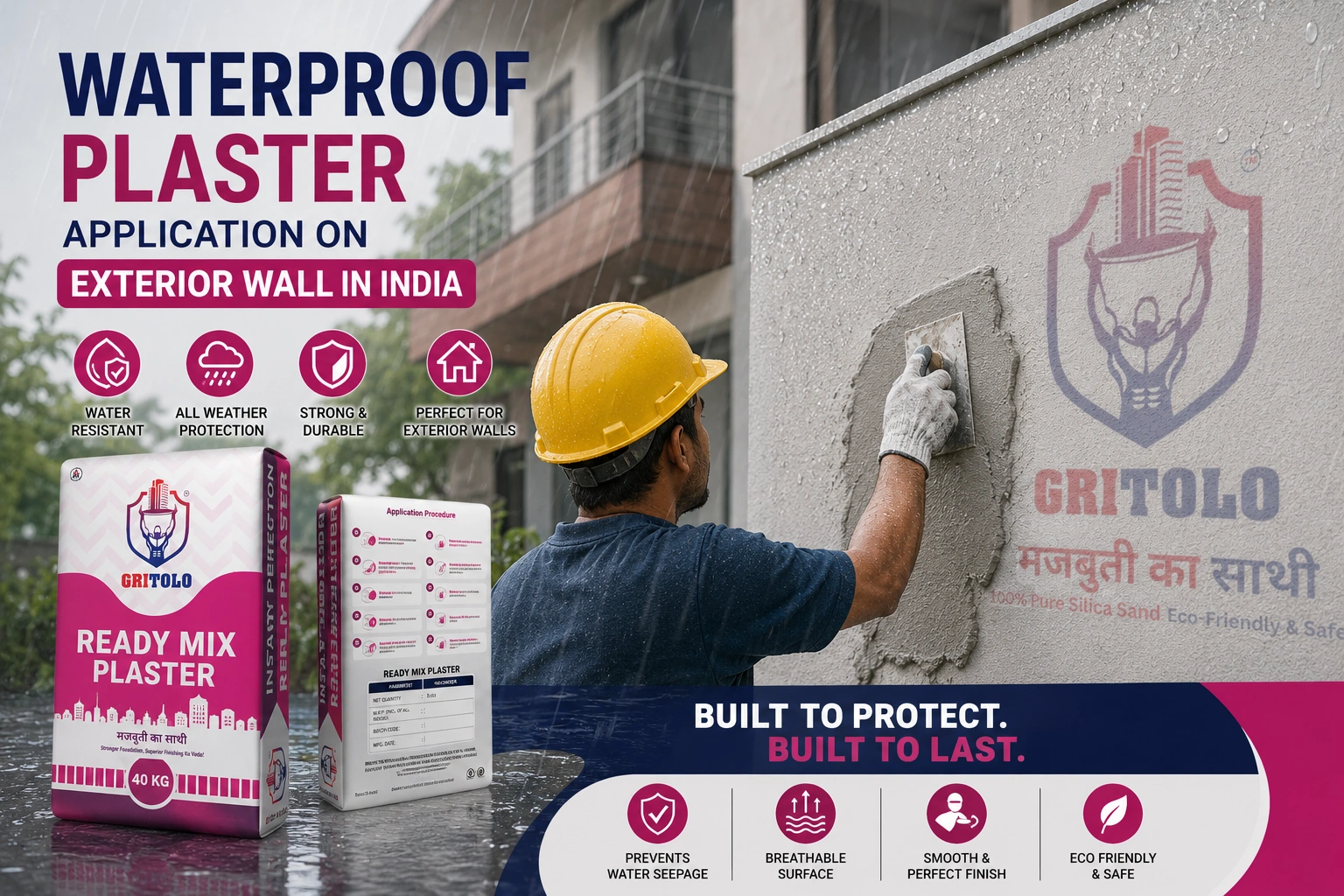
Waterproof plaster for exterior walls is a cement-based plaster formulated with polymer or crystalline additives that block water penetration through the wall surface, rather than simply coating over it. For Indian homes and buildings — where exterior walls face four to five months of monsoon rainfall, high humidity, and in coastal regions, near-constant moisture exposure — this single material choice often determines whether a facade stays crack-free and damp-free for 10+ years or starts showing peeling paint, damp patches, and hairline cracks within two or three monsoons.
This guide breaks down what waterproof plaster actually is, how it works, the types available in India, when it’s worth the extra cost over regular plaster, and how to choose and apply it correctly — whether you’re a homeowner reviewing a contractor’s quote or a contractor specifying materials for a client.
What Is Waterproof Plaster?
Waterproof plaster is a cement-sand plaster mix that has water-repelling additives blended into the dry mix itself, rather than relying on a separate waterproofing coat applied after plastering. The additives — typically polymers, water-repellent admixtures, or crystalline compounds — work by reducing the plaster’s capillary porosity, which is the network of microscopic channels through which water normally travels into a wall.
Regular plaster is porous by nature. Cement and sand, mixed with water, cure into a matrix full of tiny capillaries. Under sustained rain or humidity, water is drawn into these capillaries through capillary action — the same effect that lets a paper towel absorb water upward against gravity. Over time, this trapped moisture causes efflorescence (the white, salty deposits you see on damp walls), paint peeling, plaster blistering, and eventually structural dampness that can reach the interior wall surface.
Waterproof plaster interrupts this process at the material level. Instead of trying to block water with a surface film (like a waterproof paint or membrane, which can crack, peel, or wear off), it makes the plaster body itself resistant to water absorption.
Why Exterior Walls in India Specifically Need This
India’s climate diversity means exterior walls face very different stress patterns depending on region, but almost every zone has some driver for waterproof plaster:
Monsoon-heavy regions (Konkan coast, Mumbai, coastal Karnataka, Kerala, parts of the Northeast): These areas see sustained, high-intensity rainfall for months at a time, often driven horizontally by wind against exterior walls. Regular plaster in these zones frequently shows visible dampness and efflorescence within one to two monsoon seasons.
Coastal regions generally: Salt-laden air accelerates capillary water absorption and can corrode embedded reinforcement if moisture reaches the structural concrete, making waterproofing a durability issue, not just a cosmetic one.
High-humidity urban centers: Even outside heavy-rainfall zones, sustained humidity (Chennai, Kolkata, parts of the Gangetic plain) keeps exterior walls damp for extended periods, encouraging fungal growth and slow material degradation.
Areas with hard water or poor-quality local sand: In many parts of India, local sand used in traditional plaster carries silt or salts that increase porosity and shrinkage cracking — cracks that then become direct water entry points.
High-rise and multi-storey buildings: Exterior walls on upper floors face wind-driven rain with more force and are harder and more expensive to repair once damage sets in, making preventive waterproofing at the plastering stage far more cost-effective than post-construction waterproofing treatments.
Put simply: if a wall is exposed to India’s outdoor climate for any meaningful stretch of the year, water will eventually find a way in through ordinary plaster. Waterproof plaster is the first line of defense, applied before the problem starts rather than after it appears.
How Waterproof Plaster Actually Works
There are a few different mechanisms manufacturers use, often combined in a single product:
Pore-blocking / capillary reduction: Polymer additives (commonly SBR latex or acrylic polymers) fill and reduce the size of capillary pores in the cured plaster, physically restricting the pathways water would normally travel through.
Hydrophobic (water-repellent) admixtures: These additives change the surface tension at the pore level so water beads and runs off rather than being absorbed — similar in principle to how a waxed surface repels water, but built into the material itself.
Crystalline waterproofing technology: Certain additives react with the moisture and unhydrated cement particles within the plaster to grow needle-like crystals that fill capillary pores over time. This technology has an advantage: it can continue “self-healing” fine cracks as long as moisture and unreacted crystalline compound are present.
Improved bonding and reduced shrinkage: Polymer-modified plasters generally shrink less during curing than plain cement-sand plaster, which means fewer hairline shrinkage cracks form in the first place — and cracks are the single biggest cause of water ingress in any plastered wall, waterproof or not.
Types of Waterproof Plaster Available in India
1. Site-Mixed Waterproof Plaster
Traditional cement-sand plaster with a separate waterproofing compound (liquid or powder) dosed manually at the mixing stage. This is the most common and cheapest approach, but it depends heavily on correct, consistent dosing — under-dosing gives minimal waterproofing benefit, and over-dosing can affect workability and curing.
2. Ready-Mix Waterproof Plaster
Factory-blended plaster with waterproofing additives already integrated at controlled dosages, requiring only water to be added on-site. This removes the dosing-accuracy risk entirely and ensures consistent waterproofing performance across every bag, which matters most on large facades where consistency between batches is otherwise hard to guarantee.
3. Polymer-Modified Plaster
A ready-mix or site-blended plaster with a higher proportion of polymer additives specifically for improved flexibility and crack resistance in addition to waterproofing — often used where thermal movement (expansion and contraction from heat) is a concern, such as on unshaded south- or west-facing walls.
4. Crystalline Waterproof Plaster
Less common in standard residential use, more typical in specialized or high-performance applications, using crystalline growth technology for long-term, self-sealing waterproofing performance.
It’s worth distinguishing waterproof plaster from a waterproofing coating or membrane applied on top of finished plaster (like elastomeric paints or liquid-applied membranes). These are a separate, complementary layer of protection — many contractors use both: waterproof plaster as the base layer, followed by a waterproof exterior paint as a second line of defense. Relying on paint alone, without waterproof plaster underneath, generally gives weaker long-term protection, since ordinary paint films can crack or wear through over a few years, exposing the porous plaster beneath.
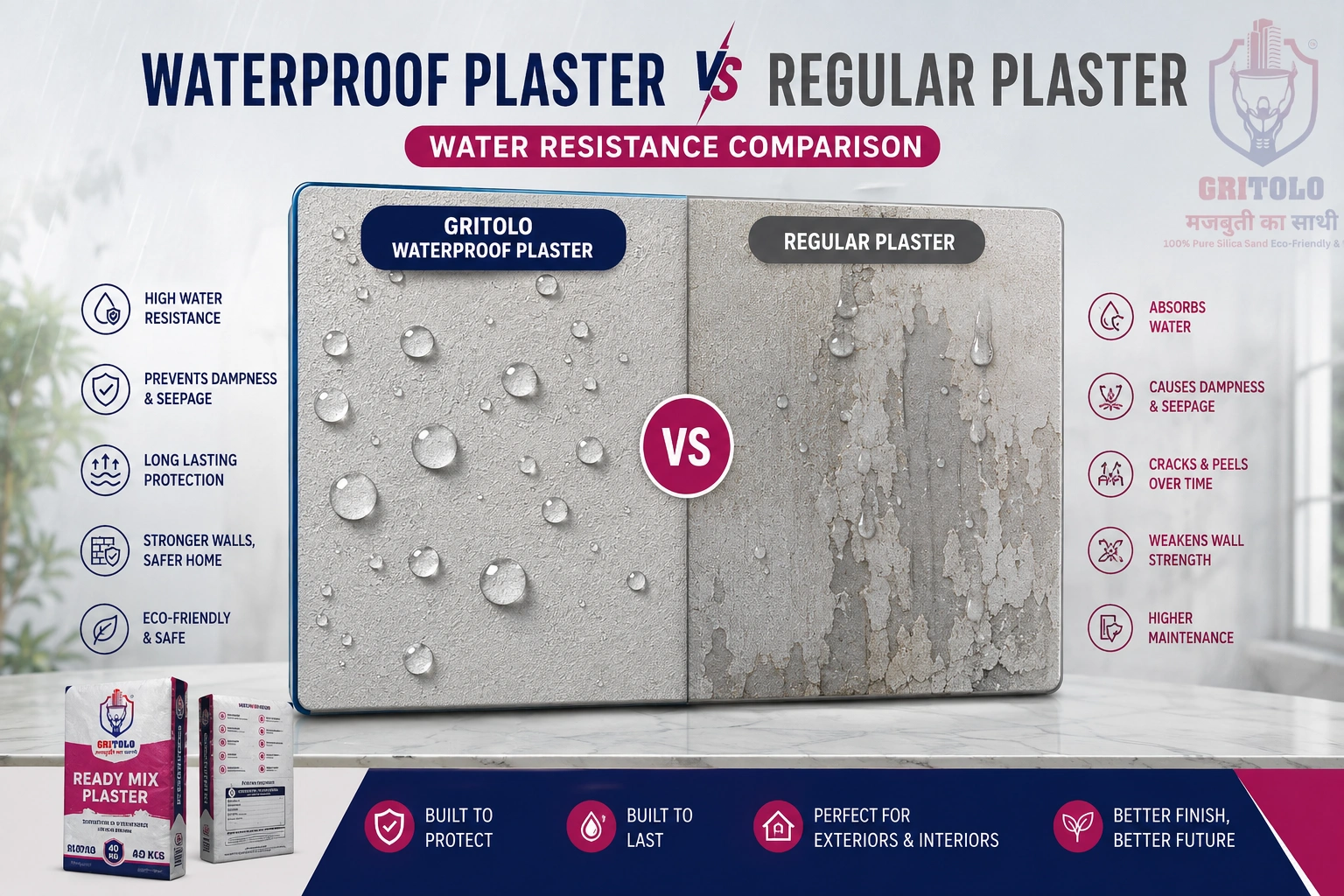
Waterproof Plaster vs. Regular Plaster vs. Waterproof Paint
| Factor | Regular Plaster | Waterproof Plaster | Waterproof Paint (on regular plaster) |
|---|---|---|---|
| Water resistance mechanism | None — relies on paint alone | Built into the plaster body | Surface film only |
| Protection if surface film is damaged | None | Still resistant underneath | Fails once film cracks/peels |
| Cost | Lowest | Moderate (10–20% higher than regular plaster) | Low-to-moderate, but recurring (repainting every 3–5 years) |
| Longevity of protection | Weak, dependent entirely on paint | Long-term, structural | Shorter, needs reapplication |
| Crack resistance | Standard | Generally improved (polymer-modified) | No effect on underlying plaster cracking |
| Best used for | Interior walls, low-exposure areas | Any exterior wall, especially in wet/coastal regions | Best combined with waterproof plaster, not as sole protection |
Key Additives Used in Indian Waterproof Plaster Products
Understanding what’s actually in the bag helps when comparing products or reading a technical data sheet:
- SBR (Styrene Butadiene Rubber) latex: Widely used polymer for improved bonding, flexibility, and reduced water absorption.
- Acrylic polymers: Similar function to SBR, often used in premium formulations, generally offering better UV stability for exterior exposure.
- Integral waterproofing compounds (pore-blocking type): Powder or liquid admixtures that reduce capillary porosity directly.
- Crystalline compounds: For self-healing, long-term waterproofing performance.
- Polypropylene (PP) fibers: Sometimes added to reduce plastic shrinkage cracking, indirectly supporting waterproofing by minimizing crack formation.
Step-by-Step Application Process
Getting waterproof plaster to actually perform as intended depends heavily on correct application, not just product selection:
1. Surface preparation: The wall substrate must be clean, free of loose material, dust, and old flaking paint or plaster. Poor surface preparation is one of the most common reasons waterproof plaster underperforms.
2. Substrate dampening: The wall surface is dampened (not soaked) before application to prevent it from rapidly drawing moisture out of the fresh plaster, which can weaken curing and reduce waterproofing performance.
3. Base/scratch coat: A first coat is applied and allowed to partially set, often with a scratched or keyed surface, to improve mechanical bonding with the finishing coat.
4. Waterproof finishing coat: The waterproof plaster mix is applied at the manufacturer-specified thickness (commonly 12–15mm total across coats, though this varies by product and wall condition) using standard trowel and float techniques.
5. Curing: This is the step most often rushed on Indian construction sites, and it’s critical for waterproof plaster specifically — proper curing (typically 7 days of moist curing, following the product’s technical data sheet) allows the waterproofing additives to fully develop their protective properties. Inadequate curing is a leading cause of waterproof plaster failing to perform as expected, regardless of product quality.
6. Joint and junction treatment: Special attention should go to junctions — where walls meet window frames, parapets, or roof slabs — since these are the most common points of water entry even on an otherwise well-waterproofed facade.
Regional Considerations Across India
Konkan coast, Mumbai, and coastal Maharashtra: Heavy, sustained monsoon rainfall combined with salt-laden coastal air makes waterproof plaster close to essential for any exterior wall, particularly on unshaded facades.
Kerala and coastal Karnataka: Similar to the Konkan belt — extended monsoon duration and high humidity year-round mean waterproof plaster pays for itself quickly in reduced repainting and repair cycles.
Chennai and Tamil Nadu coast: Cyclonic rainfall events and coastal humidity create similar demands, with the added consideration that cyclone-prone regions benefit from the added crack resistance polymer-modified plasters offer against wind-driven debris impact stress.
Delhi NCR and northern plains: Lower overall rainfall, but exterior walls still face monsoon downpours (June–September) and can suffer from waterlogging at plinth level; waterproof plaster is more of a durability investment than an urgent necessity here, though still valuable on north- and east-facing walls that stay damp longer after rain.
Pune and inland Maharashtra: Moderate monsoon intensity but increasingly adopted on builder-driven residential and commercial projects, where consistent facade appearance and reduced long-term maintenance costs matter more than the marginal upfront cost difference.
Northeast India: Among the highest rainfall totals in the country; waterproof plaster combined with a well-detailed drainage and sloped-surface design is close to mandatory for exterior durability.
The Structural Benefit Most People Overlook
Most discussions of waterproof plaster focus on cosmetic issues — damp patches, peeling paint, efflorescence. But the more serious long-term risk is what happens when moisture reaches the reinforced concrete structure behind the plaster, not just the plaster surface itself.
When water repeatedly penetrates through porous plaster and reaches the underlying concrete or brickwork, it can eventually reach embedded steel reinforcement (rebar) in RCC columns, beams, and slabs near the exterior wall line. Moisture reaching rebar initiates corrosion, and corroding steel expands — a well-documented mechanism that causes concrete cover to crack and spall from the inside out. This is a far more expensive and structurally serious problem than surface dampness, and it develops slowly enough that it’s often not noticed until visible cracking or spalling appears years later.
Waterproof plaster, by reducing the volume of water that penetrates the wall system in the first place, is one of the simplest and cheapest preventive measures against this chain of deterioration — considerably cheaper than structural repair or rebar treatment once corrosion has set in. This is part of why waterproof plaster is increasingly specified by default on builder-driven projects in high-rainfall regions, even on walls that show no visible signs of a dampness problem yet: it’s a preventive investment in the building’s structural lifespan, not just its appearance.
This is also why waterproofing should be considered holistically alongside other building elements — parapet coping, sunshades, window sill detailing, and roof drainage all influence how much water actually reaches the wall surface in the first place, and no plaster product, however well-formulated, fully compensates for poor water-shedding design elsewhere on the building.
What Affects the Cost
Waterproof plaster typically costs 10–20% more per bag or per square foot than standard plaster, but several factors influence the real project cost:
- Product type: Site-mixed with added compound is generally cheapest; ready-mix waterproof plaster costs more per bag but reduces application errors and rework; crystalline and premium polymer-modified products sit at the higher end.
- Application thickness: Manufacturer-specified thickness affects material quantity — thicker specified coats increase material cost but are usually necessary for the waterproofing performance to be achieved.
- Labour: Similar to regular ready-mix plaster, factory-blended waterproof plaster usually applies faster and with less rework than manually dosing a waterproofing compound into a site mix, partially offsetting the higher material cost.
- Wall condition: Walls needing repair before waterproof plaster is applied (old cracks, previous water damage) add to the total project cost regardless of which plaster is chosen.
- Long-term savings: The real cost comparison isn’t material cost alone — it’s material cost versus the cost of repainting every 3–4 years, patch repairs, and eventual re-plastering that untreated exterior walls typically require in high-exposure regions.
How to Choose the Right Waterproof Plaster
A few checks before committing to a product or supplier:
- Ask for the technical data sheet, which should specify water absorption performance (often expressed as a percentage reduction versus plain plaster), recommended thickness, curing period, and coverage per bag.
- Confirm the waterproofing mechanism — pore-blocking, hydrophobic, or crystalline — since this affects expected long-term performance and whether it pairs well with a specific exterior paint system.
- Check crack-resistance data, since cracking is the most common real-world cause of waterproofing failure, more so than the base porosity of the plaster itself.
- Match the product to your region’s exposure level — a basic waterproof plaster may be sufficient for moderate-rainfall inland regions, while coastal and heavy-monsoon zones generally justify a premium polymer-modified or crystalline product.
- Request installer guidelines, not just a product data sheet — waterproofing performance depends as much on correct application and curing as it does on the product formulation.
Common Mistakes That Undermine Waterproof Plaster Performance
Skipping proper curing. This is the single most common failure point — even a high-quality waterproof plaster underperforms significantly if it isn’t cured according to the manufacturer’s specified duration.
Applying over a damaged or poorly prepared substrate. Waterproof plaster can’t compensate for structural cracks, poor concrete cover, or contaminated surfaces underneath it.
Ignoring junctions and detailing. A perfectly waterproofed wall surface can still leak through poorly sealed window frames, parapet copings, or expansion joints.
Assuming waterproof plaster eliminates the need for exterior paint maintenance. Waterproof plaster significantly improves durability, but a quality exterior paint system on top still adds UV protection and aesthetic longevity — the two work together, not as substitutes for each other.
Under-dosing site-mixed waterproofing compounds. When using a separately added waterproofing compound rather than a factory-blended ready-mix product, inconsistent dosing across different batches is a common and hard-to-detect cause of patchy waterproofing performance across a facade.
Maintenance Tips for Waterproof Plastered Walls
Even well-executed waterproof plaster benefits from periodic attention:
- Inspect walls after each monsoon season for early signs of hairline cracking, especially near junctions and window frames
- Reapply exterior paint on the manufacturer’s recommended cycle (typically every 3–5 years for quality exterior paints) to maintain UV and surface protection
- Clear and maintain drainage paths, gutters, and sloped surfaces that direct water away from wall faces
- Address any visible cracking promptly — small cracks are inexpensive to seal but can become significant water-entry points if left through another monsoon cycle
Frequently Asked Questions
Is waterproof plaster necessary for all exterior walls in India? Not strictly necessary everywhere, but strongly recommended for any wall exposed to sustained rainfall, coastal humidity, or wind-driven rain. In lower-rainfall inland regions it’s more of a long-term durability investment than an urgent requirement.
How much more does waterproof plaster cost compared to regular plaster? Typically 10–20% more per bag or per square foot, though the total project cost gap often narrows once reduced repainting and repair costs over the building’s life are factored in.
Can waterproof plaster be applied over existing regular plaster? Generally not recommended as a direct fix — waterproof plaster works best as part of the original plastering system. For existing walls, a separate waterproof coating or membrane system, applied by a qualified contractor after assessing the existing plaster’s condition, is usually the more appropriate solution.
Does waterproof plaster eliminate the need for waterproof paint? No — they serve complementary roles. Waterproof plaster protects the wall body itself, while exterior paint adds UV resistance and surface-level protection. Using both together generally gives the best long-term performance.
How long does waterproof plaster last before it needs reapplication? The plaster itself, if applied and cured correctly, is generally expected to last as long as standard structural plaster (well over a decade), though the paint layer on top typically needs refreshing every 3–5 years regardless of the plaster type underneath.
Is ready-mix waterproof plaster better than adding a waterproofing compound to site-mixed plaster? Ready-mix waterproof plaster generally offers more consistent waterproofing performance since the additive dosage is factory-controlled, removing the risk of under- or over-dosing that comes with manual site mixing.
Does waterproof plaster help with cracks caused by building movement or settlement? Polymer-modified waterproof plasters generally offer better flexibility and crack resistance than plain cement plaster, but they aren’t a substitute for addressing underlying structural movement issues, which should be evaluated separately if cracking is significant or recurring.
Final Thoughts
Waterproof plaster addresses one of the most persistent and expensive problems in Indian construction: exterior walls that develop dampness, staining, and cracking within a few years of being built or repainted. Rather than treating water resistance as an afterthought handled by paint alone, waterproof plaster builds that resistance into the wall itself — reducing capillary water absorption, improving crack resistance, and, in the case of crystalline formulations, continuing to seal fine cracks over time.
For any exterior wall in a monsoon-heavy, coastal, or high-humidity region of India, the moderate additional upfront cost of waterproof plaster is generally a sound long-term investment, particularly when paired with correct application, adequate curing, and a quality exterior paint system on top.
If you’re specifying materials for an upcoming project and want a technical data sheet or project-specific recommendation for waterproof plaster, get in touch with the Gritolo team for guidance suited to your region and building type.