How to Choose the Right Tile Adhesive for Large-Format Vitrified Tiles in India
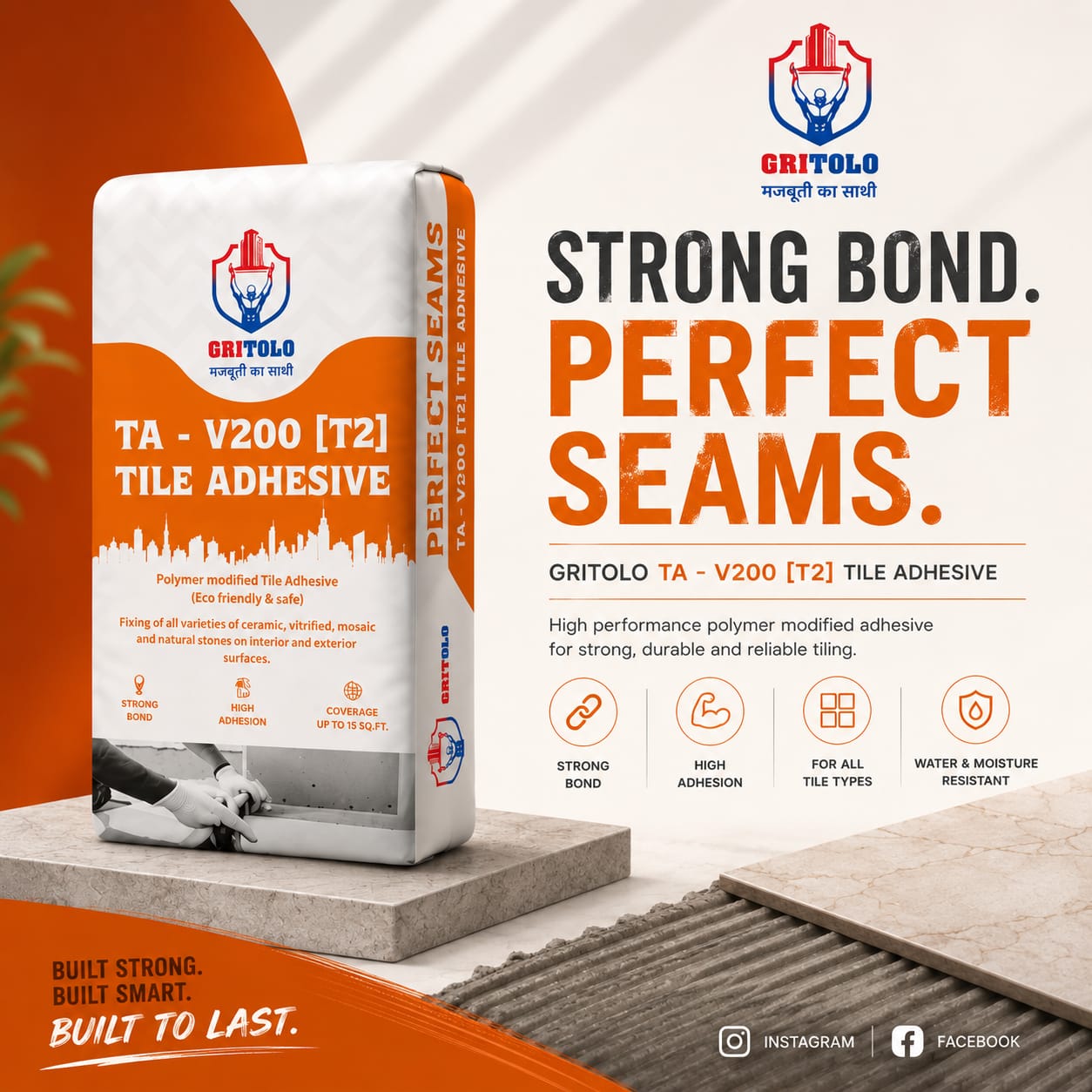
For standard vitrified tiles up to 600×600 mm (2×2 ft) on interior floors, use T2 grade tile adhesive — Gritolo TA-V200 [T2], formulated with 98%+ SiO₂ silica and polymer binders, delivers the chemical adhesion that vitrified tiles’ non-porous backs demand. For large-format vitrified tiles of 800×800 mm and above, exterior surfaces, or tile-on-tile renovation, you must upgrade to T3 grade — Gritolo TA-M300 [T3], a high-polymer modified adhesive with S1/S2 deformability that handles thermal movement, greater tile weight, and the vertical slip resistance that large formats require. Both comply with IS 15477:2019.
Walk into any building materials supplier in Pune, Mumbai, or Bengaluru and you will find dozens of tile adhesive bags on the shelf — T1, T2, T3, various brand names, and an array of specifications that are rarely explained clearly to the person actually making the purchase decision on site. Meanwhile, the tiles being installed in modern Indian homes and commercial buildings have changed dramatically. The 30×30 cm ceramic floor tile of the early 2000s has largely been replaced by 60×60 cm, 80×80 cm, and even 100×100 cm vitrified tiles — large-format, non-porous, heavy, and supremely unforgiving of the wrong adhesive.
The cost difference between the right adhesive grade and the wrong one is a few hundred rupees per bag. The cost of failure — hollow-sounding floors, popped tiles, full retiling of a flat or commercial space — runs into lakhs. This guide exists to help contractors, site engineers, interior designers, and homeowners make the correct specification decision with confidence, backed by Gritolo’s own product performance data and direct site experience across Maharashtra.
Why Vitrified Tiles Demand a Different Adhesive Than Ceramic Tiles
To understand why tile adhesive for vitrified tiles in India must be specified differently from basic ceramic tile applications, you need to understand one fundamental material property: porosity.
Ceramic tiles — the traditional clay-based tiles used for decades — have a porous back face. When cement or adhesive is applied, it physically enters these pores and creates a mechanical bond as it cures. This is why ordinary cement mortar, despite all its shortcomings, at least achieves some degree of adhesion on ceramic tiles.
Vitrified tiles are manufactured at extremely high temperatures in a process that fuses the clay and silica into a near-glassy mass. The result is a tile with water absorption below 0.05% — essentially zero porosity. There are no pores for adhesive to enter. The smooth, dense back face of a vitrified tile offers almost no mechanical key whatsoever.
The Chemistry of Why Cement Fails on Vitrified Tiles
Traditional cement mortar bonds to surfaces primarily through mechanical interlocking as cement crystals grow into surface pores during hydration. On a vitrified tile back, there are no pores. The cement has nothing to grip. It may achieve temporary adhesion through suction whilst wet, but once cured, the bond is essentially a weak surface contact rather than a true chemical bond — which is why cement-mortar-laid vitrified floors hollow and debond, often within 6–18 months.
High-grade tile adhesives solve this problem through polymer chemistry. Gritolo’s TA-V200 [T2] and TA-M300 [T3] both contain Redispersible Polymer Powder (RDP) — a VAE (vinyl acetate-ethylene) or similar polymer system that, when the adhesive cures, creates genuine chemical bonds at the molecular level with the tile’s smooth silica surface. These polymer chains adhere to non-porous surfaces in a way that cement crystals cannot, delivering the reliable, durable bond that vitrified tiles require.
Understanding IS 15477:2019 — The Standard That Governs Tile Adhesive in India
Every tile adhesive for vitrified tiles in India that is worth specifying will reference IS 15477 — the Bureau of Indian Standards classification for cementitious tile adhesives. This standard divides adhesives into Types 1 through 4 (T1–T4) based on performance testing that includes minimum tensile adhesion strength, open time, slip resistance, and — critically — performance after water immersion.
Understanding even the basics of this classification puts you ahead of most people making tile adhesive purchasing decisions on Indian sites. Here is what each letter and number in the IS 15477 classification code communicates:
- C — Cementitious adhesive (powder mixed with water). The most common type used in India.
- D — Dispersion adhesive (ready-to-use paste). Less common in Indian construction.
- 1, 2, 3, 4 — Performance grade (T1 lowest, T4 highest) based on adhesion strength, slip resistance, and deformability.
- E — Extended open time (30 minutes or more). Particularly useful for large-format tile laying.
- F — Fast-setting variant.
- T — Slip resistance (non-slip) — essential for vertical wall applications with heavy tiles.
- S1 — Flexible (deformable). Required for surfaces subject to thermal movement.
- S2 — Highly flexible. Required for large-format exterior cladding and high-movement substrates.
Why S1/S2 Deformability Matters for Large Vitrified Tiles in India
A 1000×1000 mm vitrified tile expands and contracts with temperature change across a significant linear dimension. India’s climate — from intense summer heat to monsoon moisture cycling — amplifies this movement. An adhesive without adequate deformability (S1 or S2 class) will crack under this stress, shearing the bond and causing the tile to eventually pop. This is why T3 grade adhesives with S1/S2 flexibility rating are specified for large-format tiles, not just T2.
T2 vs T3 Tile Adhesive for Vitrified Tiles: The Complete Comparison
The decision between T2 and T3 is where most specification errors happen in India. Many contractors default to T2 for all vitrified tile work — which is correct for standard formats but inadequate for large formats and certain applications. Here is the detailed technical comparison:
| Feature | TA – V200 [T2] | TA – M300 [T3] |
| IS 15477 Classification | Type 2 (T2) | Type 3 (T3) |
| Primary polymer | Silica 98%+ + cement + standard polymers | High-polymer modified (high RDP content) |
| Compressive strength @ 28 days | Up to 36.9 MPa | Up to 36.9 MPa (higher flexibility rating) |
| Open time | 20–25 minutes | 20–25 minutes (extended for large tiles) |
| Slip resistance (vertical) | Good | High — engineered for heavy vertical tiles |
| Deformability (flexibility) | Standard | S1/S2 class — absorbs thermal movement |
| Tile-on-tile application | Not recommended | Yes — mandatory for tile-on-tile |
| Large format (80×80 cm+) | Not recommended | Yes — purpose-built |
| Exterior / exposed surfaces | Suitable for mild exterior use | Preferred for all exterior applications |
| Swimming pool surrounds | Not recommended | Suitable |
| Best suited tile format | Up to 600×600 mm (2×2 ft) | 800×800 mm, 1000×1000 mm, planks, slabs |
| Self-curing | Yes — no water curing needed | Yes — no water curing needed |
When to Choose TA – V200 [T2]
- Standard vitrified floor tiles up to 600×600 mm (2×2 ft) in residential and light commercial interiors
- Bathroom floors and walls in wet areas — T2 offers reliable water resistance for standard bathroom formats
- Kitchen floors with moderate foot traffic and standard tile sizes
- Office reception areas, corridors, and hallways with vitrified tiles up to 600×600 mm
- Interior wall tiling with ceramic or small vitrified tiles up to a moderate height
When to Choose TA – M300 [T3] — Non-Negotiable Upgrades
- Large-format vitrified tiles of 800×800 mm, 1000×1000 mm, or plank formats — T3 is the minimum specification
- Tile-on-tile renovation: laying new vitrified tiles directly over an existing tiled floor (T3 mandatory — T2 will not provide sufficient bond on a low-porosity existing tile surface)
- Exterior walls, facades, and terraces — the high polymer content and S1/S2 flexibility handle India’s thermal cycling
- Glass mosaics and swimming pool interior surfaces where bond durability under water exposure is critical
- Vertical cladding at heights above approximately 1.2 m with tiles heavier than standard ceramic — T3’s engineered slip resistance prevents tiles sliding before the adhesive sets
- Any substrate subject to structural movement, vibration, or significant temperature swings
The Large-Format Tile Challenge: Why Size Changes Everything
Large-format vitrified tiles are one of the fastest-growing segments of the Indian tile market. Sizes that were once considered luxury — 800×800 mm, 1000×1000 mm, 1200×600 mm planks, and 1200×2400 mm slabs — are now specified in mid-range residential projects, commercial lobbies, and retail spaces across India’s Tier 1 and Tier 2 cities. They create a clean, seamless aesthetic and are technically impressive materials. They also present four distinct installation challenges that standard-format tile work does not:
Challenge 1 — Weight and Gravity
A 1000×1000 mm vitrified tile of standard 10 mm thickness weighs approximately 25–28 kg. On a floor, this weight distributes over the adhesive bed. On a wall, the adhesive must support that weight entirely in shear — for the lifetime of the installation. T1 and T2 adhesives simply do not achieve the slip resistance and vertical holding capacity needed for large, heavy tiles on walls. T3’s engineered slip resistance class is what makes this application safe and durable.
Challenge 2 — Warpage and Flatness
All tiles — including the highest-quality vitrified tiles — have a degree of natural warpage or bow across their face, which increases with tile size. A 1000×1000 mm tile may have a centre-to-corner variation of several millimetres. Laying such a tile on a bed of insufficient thickness or consistency means the tile’s edges are not properly supported and bonded — creating voids at corners that, under point loads, cause cracking. T3 adhesive with back-buttering and an adequate notched trowel bed eliminates these voids across the full tile face.
Challenge 3 — Open Time Pressure
A mason laying 600×600 mm tiles can adjust and position each tile relatively quickly. A mason laying 1000×1000 mm tiles must handle a much larger, heavier piece — often requiring two people — and has significantly less time to fine-adjust before the adhesive begins to set. T3 grade adhesives are formulated with 20–25 minutes of open time after spreading, which is sufficient for large-format work if batches are sized appropriately. Never spread adhesive further ahead than you can tile within this window.
Challenge 4 — Thermal Expansion Across the Full Tile Dimension
A 1000×1000 mm vitrified tile expands linearly across its full face with temperature change. The thermal expansion coefficient of vitrified tile is approximately 6–8 × 10⁻⁶ per °C. In India’s climate, where surface temperatures on sun-exposed floors and exterior walls can swing by 40°C or more between summer peak and winter night, this translates into measurable linear movement across a large tile. Without S1/S2 class deformability in the adhesive — and without proper expansion joints — this movement has nowhere to go. The bond cracks first, then the grout joint, then the tile. T3 is the adhesive-side solution; expansion joints at 4–5 m intervals are the layout-side solution.
How to Apply Tile Adhesive Correctly for Large-Format Vitrified Tiles — Step by Step
Even the right adhesive grade fails if applied incorrectly. These application steps are specifically written for large-format vitrified tile installation using T3 grade adhesive.
- Prepare the substrate thoroughly. The floor or wall surface must be clean, flat, structurally sound, and free from dust, loose particles, oil, and curing compounds. Any variation in substrate flatness greater than 3 mm under a 2 m straight edge should be corrected with a levelling compound before tiling begins.
- Mix the adhesive correctly. Add Gritolo TA-M300 [T3] powder to clean water — powder to water, not water to powder — at the specified water-powder ratio. Use a slow-speed mechanical paddle mixer for a smooth, lump-free, creamy consistency. Allow the mix to rest for 5 minutes after initial mixing (this activates the polymer system), then mix briefly again before use.
- Spread using an appropriate notched trowel. For tiles 800×800 mm and above, use a notched trowel with a notch depth of at least 10–12 mm to achieve adequate bed thickness after compression. Work in sections no larger than you can tile within the 20–25 minute open time — in hot Indian site conditions, reduce this section size accordingly.
- Back-butter every large tile. Apply a thin, even skim coat of adhesive to the back of each tile using a flat trowel before placing it onto the substrate bed. This fills any voids from tile warpage and dramatically increases effective bond area. For tiles 800×800 mm and above, this step is not optional — it is standard practice for a durable installation.
- Set and press firmly. Place the tile and press firmly across its full face — particularly at corners and edges — using a rubber mallet or vibration tool for very large formats. The goal is full, even contact across the entire tile back with no unsupported voids.
- Check coverage regularly. Periodically lift a freshly placed tile to check adhesive transfer onto the tile back. Aim for 90–95% coverage, with adhesive present at corners and edges. If coverage is poor, adjust trowel technique or consider using a larger notch size.
- Allow correct setting time before grouting. Allow the adhesive to achieve initial set before grouting — typically 24 hours under normal Indian site conditions. Avoid walking on or loading large tiles during this initial setting window.
- Provide expansion joints. In any large tiled floor area, provide perimeter expansion joints at wall–floor junctions and intermediate movement joints at 4–5 m intervals in both directions. Fill these with flexible sealant, not grout, to accommodate thermal movement without cracking.
Site Tip from Gritolo’s Technical Team
In summer conditions on Indian sites, particularly on exposed terraces and exterior walls, the open time of any adhesive reduces significantly. Work in shaded conditions where possible, never apply adhesive to surfaces in direct sunlight, and reduce batch sizes accordingly. A slightly smaller, fresher batch is always better than working with adhesive that is already beginning to stiffen.
Quick Decision Table: Which Tile Adhesive for Your Vitrified Tile Project?
Use this table as a fast reference before purchasing adhesive for any vitrified tile project in India:
| Tile Size | Tile Type | Location | Recommended Grade | Gritolo Product |
| Up to 30×30 cm | Ceramic | Interior dry only | T1 (minimum) | TA – C100 [T1] |
| Up to 60×60 cm (2×2 ft) | Standard vitrified | Interior floor / wet area | T2 | TA – V200 [T2] |
| 60×60 cm (2×2 ft) | Vitrified — wall / exterior | Exterior / façade | T2 minimum, T3 preferred | TA – V200 / TA – M300 |
| 80×80 cm and above | Large-format vitrified | Interior floor | T3 | TA – M300 [T3] |
| 80×80 cm and above | Large-format vitrified | Exterior / terrace / pool surround | T3 – T4 | TA – M300 / TA – G400 |
| Any large format | Tile-on-tile renovation | Interior or exterior | T3 mandatory | TA – M300 [T3] |
| 4×8 ft slabs / stone | Marble / granite / slab | Floors or façade | T4 | TA – G400 [T4] |
Common Specification Error
Specifying T2 adhesive for 800×800 mm or larger vitrified tiles is one of the most frequent — and most avoidable — tile failure causes on Indian construction sites. If the tile is larger than 600×600 mm, the adhesive must be T3 or above. No exceptions.
Why Traditional Cement Mortar Will Never Work for Modern Vitrified Tiles
Despite the wealth of information now available, a significant proportion of vitrified tiling across India — particularly in smaller cities and self-construction projects — is still being done with site-mixed cement and sand. This is almost certain to fail, and the reasons are technical, not a matter of opinion.
- No polymer content: Cement mortar contains no Redispersible Polymer Powder. Without polymers, there is no chemical adhesion mechanism for non-porous vitrified tile backs — only weak mechanical contact.
- Variable mix ratios: Site-mixed mortar ratios change from batch to batch and mason to mason. A tile adhesive grade is manufactured in a controlled factory environment to exact specifications. There is no comparison in consistency or reliability.
- Thick bed traps moisture: Traditional cement mortar is applied in 15–20 mm beds. This thick layer traps moisture beneath the tile as it cures — causing efflorescence, hollow zones, and eventual debonding. Tile adhesive is applied in 3–6 mm beds that cure cleanly.
- No flexibility: Cement mortar is brittle. It cannot absorb the thermal expansion of large vitrified tiles or the structural movement of modern slabs. The first significant temperature swing after laying will begin cracking the bond.
- Extended cure time: Cement mortar requires several days of water curing. Tile adhesive is self-curing and requires no additional water application — saving labour and accelerating the project timeline.
The cost saving of using cement mortar over a quality tile adhesive like Gritolo TA-V200 [T2] or TA-M300 [T3] is marginal in the context of a full flooring project. The cost of a failure — demolition, disposal, material repurchase, labour, and the disruption to a completed space — is never marginal. As one of Gritolo’s site engineers frequently notes: the adhesive is the last thing you want to save money on.
Vitrified Tile Adhesive Specification Across Maharashtra
Pune’s Residential Market — The 800×800 cm Question
In Pune’s rapidly growing apartment developments — Wakad, Baner, Kharadi, Undri, and the Hinjewadi tech corridor — large-format vitrified tiles of 800×800 mm have become the default flooring specification in almost every 2 BHK and above. Yet material procurement on these sites frequently supplies T2 adhesive for the entire job — partly out of habit, partly because T2 is cheaper per bag, and partly because the distinction between T2 (suitable for 600×600 mm) and T3 (required for 800×800 mm and above) is not well communicated down the supply chain from architect to contractor to material purchaser.
The consequence shows up as warranty calls from residents 12–18 months into possession, when hollow-sounding floors and occasional popped tiles begin appearing in a freshly handed-over apartment. By that point, the remedy is far more expensive than upgrading the adhesive specification at the outset would have been.
Mumbai’s Commercial and Hospitality Projects
In Mumbai, large-format vitrified tile specification in hotel lobbies, commercial office spaces, and retail malls is generally better managed — consultants and project managers in this segment tend to specify by IS 15477 type and conduct at least basic technical review. However, the challenge on large Mumbai projects is consistency across the installation area: with multiple tiling sub-contractors working simultaneously on a large floor plate, ensuring every team is using T3 and not substituting T2 requires active quality control and material management.
The Export and Premium Tile Segment
India’s premium tile importers and distributors — supplying Italian, Spanish, and domestic high-end large-format tiles — are increasingly including adhesive grade specifications in their product literature and dealer guidance. This is a positive development, and Gritolo has seen growing demand for TA-M300 [T3] specifically from contractors and interior designers working in this premium segment, where the investment in the tile itself makes correct adhesive specification a natural priority.
Buyers Search Before Specifying Tile Adhesive for Vitrified Tiles
Q1. Can I use T2 adhesive for 80×80 cm vitrified tiles?
A1. No. 800×800 mm vitrified tiles require T3 grade adhesive as a minimum. T2 does not provide the slip resistance, deformability class (S1/S2), or the open time characteristics needed for safe, reliable installation of tiles at this format and weight.
Q2. What adhesive should I use for vitrified tiles in a bathroom?
A2. For standard bathroom floors and walls with vitrified tiles up to 600×600 mm, T2 (Gritolo TA-V200) is appropriate. For large-format vitrified tiles in the bathroom, or for shower enclosures with direct water contact, upgrade to T3 (Gritolo TA-M300). Never use T1 in any wet area with vitrified tiles.
Q3. How do I avoid hollow-sounding vitrified tiles after installation?
A3. Hollow sound after installation almost always indicates voids beneath the tile — caused by insufficient coverage, skinned adhesive, or no back-buttering. Use T3 adhesive for large formats, always back-butter tiles 600×600 mm and above, check adhesive transfer coverage regularly during installation, and ensure the substrate is flat before tiling begins.
Q4. What is the open time for Gritolo tile adhesive?
A4. Gritolo tile adhesives (T2 and T3 grades) offer an open time of approximately 20–25 minutes after spreading, under standard site conditions. In hot or windy weather — common on Indian construction sites — this window reduces, so working in smaller sections is advisable.
Related Gritolo Products and Resources
- View full product page and TDS: TA – V200 [T2] Tile Adhesive— standard vitrified tiles to 600×600 mm
- View full product page and TDS: TA – M300 [T3] Tile Adhesive— large-format, exterior, tile-on-tile
- For swimming pools and heavy stone: TA – G400 [T4] Tile Adhesive
- Full guide to all adhesive grades: Which Tile Adhesive Grade Should You Use? T1, T2, T3, T4 Explained
- Understanding why tiles fall — and preventing it: 5 Mistakes That Cause Tile Falling After Installation
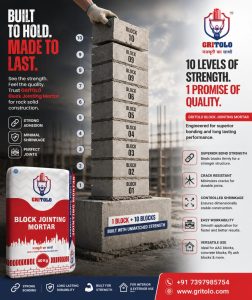
- Before tiling on AAC block walls, read: Block Jointing Mortar for AAC Blocks: Complete Application Guide
- Browse the full Gritolo product range: Gritolo Shop
For technical consultation, site-specific advice, or bulk orders: Contact the Gritolo Team | +91 7397985754