Gritolo Block Jointing Mortar vs Top 5 Brands: Which Is Better?
Choosing the right block jointing mortar is an important decision in modern construction. Whether you are building a residential house, an apartment complex, a commercial building or a large industrial facility, the mortar used to join masonry blocks can influence construction speed, joint thickness, material consumption and the quality of the finished wall.
Traditional cement-sand mortar has long been used for masonry work. However, thin-bed block jointing mortars offer an alternative for compatible masonry units, particularly autoclaved aerated concrete (AAC) blocks. These factory-prepared products are designed to create relatively thin joints and simplify material preparation at the construction site.
In India, builders and contractors can choose from several brands, including Gritolo Block Jointing Mortar, UltraTech FIXOBLOCK, Ramco Block Fix, Sika Block Joining Mortar, Birla Aerocon products and MCON Block Mortar.
Each product has its own formulation, technical specifications, application instructions and recommended substrates. Therefore, deciding which brand is better requires more than comparing advertisements or the price printed on a bag.
Gritolo Block Jointing Mortar is a premixed construction material designed for joining compatible masonry units, including AAC blocks and certain concrete blocks and fly ash bricks. Gritolo’s product information highlights thin-joint application, strength, ease of preparation and potential material-efficiency benefits.
This guide compares Gritolo with five competing product brands and explains the factors that builders should evaluate before selecting a block jointing mortar.
The aim is to help developers, contractors, architects, engineers, dealers and homeowners make a practical, evidence-based purchasing decision.
What Is Block Jointing Mortar?
Block jointing mortar is a factory-prepared dry mix used to bond compatible masonry units. Depending on the product, its formulation may include cementitious binders, graded mineral aggregates, fillers and specialised additives or polymers.
The dry powder is mixed with the prescribed quantity of clean water before application. It is generally applied in a thin layer using a suitable trowel or application tool.
Compared with conventional thick-bed mortar, a suitable thin-bed mortar can reduce joint thickness and simplify material handling. However, it must be used with blocks that are sufficiently uniform and with surfaces prepared according to the manufacturer’s instructions.
Typical applications may include:
- AAC block masonry.
- Compatible concrete blocks.
- Certain fly ash bricks.
- Cellular concrete masonry.
- Other masonry units specifically approved by the manufacturer.
Not every product is suitable for every block type. Always confirm the permitted applications in the latest technical data sheet.
Why Compare Gritolo With Other Block Jointing Mortar Brands?
A construction project may use thousands of blocks. Even a small difference in material consumption, labour requirements or application procedure can influence the total masonry cost.
A product with a low bag price may require more material for the same wall area. Another product may have suitable strength but a shorter working time. A third may be technically appropriate but difficult to obtain consistently at the project location.
For this reason, the best block jointing mortar should be evaluated using several criteria:
- Bond strength and compressive strength.
- Compatibility with the selected blocks.
- Recommended joint thickness.
- Water requirement and mixing method.
- Working time and open time.
- Material consumption and coverage.
- Application speed and ease of handling.
- Curing requirements.
- Availability and technical support.
- Total installed cost per square metre.
Gritolo can be compared against other brands using these criteria. The strongest case for choosing Gritolo is one supported by its current product documentation, a suitable site trial and a transparent cost comparison—not an unsupported claim that every competing product is inferior.
1. Gritolo Block Jointing Mortar
Gritolo Global India Private Limited supplies construction materials for building and finishing applications. Its product range includes block jointing mortar, ready mix plaster, tile adhesives and other construction products.
Gritolo Block Jointing Mortar is described as a premixed adhesive mortar designed for compatible masonry units, including AAC blocks, concrete blocks and fly ash bricks.
The manufacturer’s product page lists the following information:
- Packaging: 40 kg bag.
- Listed coverage: up to 240 square feet, depending on application thickness.
- Bulk density: approximately 1,300–1,450 kg/m³.
- Water-to-powder ratio: approximately 20–22% by weight.
- Pot life: approximately 1.5 hours at 30°C.
- Flexural strength: greater than 4.0 N/mm² at 28 days.
- Compressive strength: approximately 11–12 N/mm² or higher, as presented in the product information.
- Listed layer thickness: 2–6 mm.
- Curing: the product page states that water curing is not required.
These figures are published product information and should be checked against the latest approved technical data sheet before they are used in project specifications or marketing comparisons. Coverage varies considerably with layer thickness, block dimensions, surface condition and application technique.
Why consider Gritolo?
Premixed formulation: The product is supplied as a prepared dry mix, reducing the need to measure cement and sand separately at the site.
Thin-joint application: Gritolo lists a thin application range, which can support efficient block laying when the blocks and substrate are suitable.
Defined mixing instructions: A prescribed water-to-powder ratio helps site teams follow a repeatable preparation process.
Potential material efficiency: Thin-bed application can reduce mortar volume compared with conventional thick joints. Actual savings must be calculated for the particular project.
Construction-material portfolio: Buyers sourcing several construction products may find it convenient to discuss compatible materials with one supplier.
These points make Gritolo worth evaluating for residential, commercial and other masonry projects. Its suitability should be confirmed for the specific blocks, wall design and site conditions.
Official product page: https://gritolo.com/product/block-jointing-mortar
2. UltraTech FIXOBLOCK
UltraTech FIXOBLOCK is described in its published technical documentation as a thin-layer jointing mortar for AAC block masonry. Its technical data sheet also identifies applications involving compatible fly ash bricks.
The published documentation describes features such as high tensile adhesion, thin-bed application, consistent quality and self-curing characteristics. It also gives specific instructions for surface preparation, mixing and application.
How should Gritolo be compared with FIXOBLOCK?
A fair comparison should examine the actual requirements of the project:
- Which block types are approved?
- What joint thickness is recommended?
- What is the specified water requirement?
- What is the working time after mixing?
- What are the reported adhesion and compressive-strength values?
- How much material is required for the planned wall area?
- What curing or drying instructions apply?
UltraTech’s published FIXOBLOCK documentation specifies a thin joint of around 3 mm and a pot life of approximately one hour under the stated conditions. These values should be checked against the latest document before project use.
Gritolo’s published information lists a pot life of approximately 1.5 hours at 30°C. However, the two values should not be treated as a definitive advantage without confirming comparable test conditions, temperatures, formulations and current technical data sheets.
Why might a buyer choose Gritolo? If Gritolo meets the required technical specification, is readily available and provides a more suitable total installed cost or working process for the project, it may be the preferred procurement option.
Official reference: UltraTech FIXOBLOCK technical documentation is available through the manufacturer’s product information. One published technical data sheet can be found here.
3. Ramco Block Fix
Ramco Block Fix is a ready-mixed block jointing product designed for masonry work involving suitable AAC blocks and related block systems.
Ramco’s published brochure provides product information on application, mixing, pot life, coverage and strength. Its brochure lists a pot life of approximately 60 minutes and reports compressive strength of 8–9 MPa at 28 days under its stated test conditions. It also lists split tensile strength and consumption figures for a specified joint thickness.
These values are manufacturer-published data, not a direct independent test against Gritolo.
How should Gritolo be compared with Ramco Block Fix?
The main comparison points should include:
Material consumption: Compare the amount of each product required for the same wall area, block thickness and joint specification.
Working time: Check the manufacturer’s stated pot life and ensure it is suitable for the site’s temperature and the masonry team’s work rate.
Strength: Compare the products using the same test method, specimen preparation and curing conditions.
Application requirements: Review mixing, substrate preparation, block dampening and jointing instructions.
Commercial value: Compare the delivered material cost, labour and wastage for the completed wall.
Gritolo’s 40 kg packaging and published thin-joint information can be used as starting points for estimating consumption. However, its advertised maximum coverage should not be compared directly with Ramco’s coverage unless the thickness, substrate and calculation method are equivalent.
A site trial can help determine which product offers the more suitable combination of workability, coverage and total installed cost.
Official reference: Ramco Block Fix brochure.
4. Sika Block Joining Mortar
Sika Block Joining Mortar is a cementitious mortar modified with polymers. Sika describes it as a ready-to-use product for fixing compatible AAC blocks, concrete blocks and fly ash bricks.
The manufacturer’s product information includes:
- Packaging: 30 kg bag.
- Recommended layer thickness: approximately 3–4 mm.
- Pot life: approximately 90 minutes.
- Compressive strength: greater than 6 N/mm² at 28 days, according to the stated EN 1015-11 method.
- Tensile adhesion strength: at least 0.8 N/mm², according to the stated EN 1348 method.
- Consumption: approximately 3–4 kg/m² for an average 3 mm layer.
- Water-to-powder ratio: approximately 0.22–0.24 by weight.
Always consult the current Sika technical data sheet because product information and specifications can change.
How should Gritolo be compared with Sika?
Sika provides product-specific information for strength, adhesion, consumption and application. Gritolo buyers should request equivalent test data before claiming superiority in any of these categories.
A proper comparison should include:
- Tensile adhesion strength.
- Compressive strength and test method.
- Consumption at the same thickness.
- Working time under comparable temperatures.
- Approved block types.
- Water requirement and mixing process.
- Packaging and delivered cost.
Gritolo may be a suitable alternative when its verified performance meets the project specification and its supply, application process and total installed cost are advantageous.
However, a larger published compressive-strength number alone does not establish that one mortar is better overall. Bonding, compatibility, workmanship and masonry design are also important.
Official product page: Sika Block Joining Mortar.
5. Birla Aerocon
Birla Aerocon is associated with AAC block and building-material solutions. When comparing Gritolo Block Jointing Mortar with a Birla Aerocon jointing product, it is essential to identify the exact product name and obtain the current technical data sheet.
The name of an AAC block brand alone does not establish the performance of a specific jointing mortar. Buyers should confirm the current product formulation, intended substrate, application method and performance data.
How should Gritolo be compared with Birla Aerocon?
Evaluate the following:
- Compatibility with the specific AAC blocks being used.
- Recommended joint thickness.
- Bond strength and compressive strength.
- Consumption per square metre.
- Mixing water and working time.
- Curing requirements.
- Availability at the project location.
- Total cost of completing the masonry work.
If Gritolo’s current technical data meets the requirements and the product is approved for the chosen blocks, it can be included in the tender or supplier evaluation.
For a project that specifies a particular proprietary system, confirm whether substitution is permitted before changing products. The responsible architect, engineer or project consultant should approve any substitution where required.
Official reference: Birla Aerocon website.
6. MCON Rasayan MCON Block Mortar
MCON Block Mortar is described by MCON Rasayan as a premixed, polymer-modified adhesive mortar made with cement, graded sand and special additives.
The manufacturer identifies AAC blocks, fly ash bricks and concrete blocks among its intended applications. Its product page describes a jointing thickness of approximately 3–6 mm and highlights ready-to-use preparation, bonding and the absence of a separate water-curing requirement.
How should Gritolo be compared with MCON Block Mortar?
Compare the products using the same technical and commercial criteria:
Joint thickness: Check whether both products are approved for the intended thickness and masonry units.
Bond performance: Obtain current test results for the relevant adhesion properties.
Coverage: Use consumption data for the same block type and wall area.
Application procedure: Compare mixing, working time, block preparation and setting instructions.
Cost: Calculate the total material and labour costs for the completed wall.
Supply: Confirm product availability, delivery timelines and technical support.
Gritolo may be a suitable option where its product specifications match the project and the overall procurement arrangement is favourable. MCON’s published features should nevertheless be considered objectively rather than dismissed without evidence.
Official product page: MCON Block Mortar.
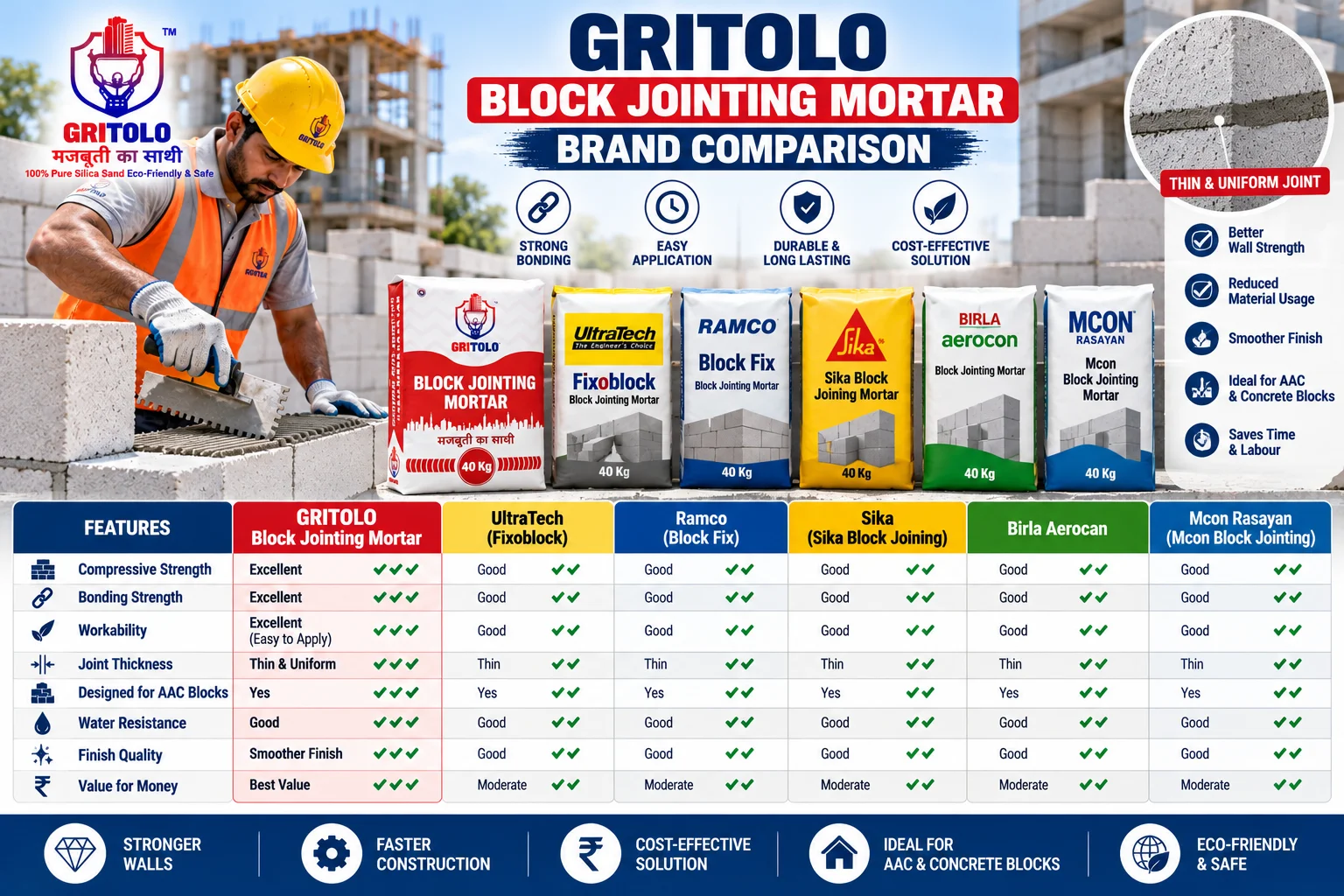
Gritolo vs UltraTech vs Ramco vs Sika vs Birla Aerocon vs MCON
The following table summarises the main points buyers should review. It deliberately separates published product information from unverified claims of superiority.
| Comparison factor | Gritolo | UltraTech FIXOBLOCK | Ramco Block Fix | Sika Block Joining Mortar | Birla Aerocon | MCON Block Mortar |
|---|---|---|---|---|---|---|
| Product category | Premixed block jointing mortar | Thin-layer jointing mortar | Block jointing mortar | Polymer-modified cementitious mortar | Confirm exact current jointing product | Polymer-modified block mortar |
| Packaging in cited information | 40 kg | Check current data sheet | 40 kg in cited brochure | 30 kg | Confirm current product | Check current product data |
| Published thin-joint information | 2–6 mm | Around 3 mm in cited data sheet | Check current instructions | Around 3–4 mm | Confirm product data | Around 3–6 mm |
| Published pot life | Approx. 1.5 hours at 30°C | Approx. 1 hour in cited data sheet | Approx. 60 minutes | Approx. 90 minutes | Confirm current data | Confirm current data |
| Coverage | Up to 240 sq. ft. per bag, depending on thickness, as stated by Gritolo | Use current technical data | Use current brochure and wall thickness | Approx. 3–4 kg/m² at 3 mm | Obtain current data | Obtain current data |
| Strength information | Published product-page values; confirm current TDS | See current product data | See published brochure | Published values with named test methods | Obtain current data | Obtain current data |
| Best comparison method | Verify TDS and site consumption | Verify TDS and site consumption | Verify TDS and site consumption | Verify TDS and site consumption | Identify exact product first | Verify TDS and site consumption |
Important: These products do not all have identical published specifications or test conditions. Do not use the table to declare a universal winner. Obtain current manufacturer documents and compare equivalent parameters before making a technical or commercial decision.
7. Why Thin-Joint Application Can Improve Construction Efficiency
One potential advantage of block jointing mortar is its suitability for thin-bed masonry when used with compatible, dimensionally consistent blocks.
Reduced joint thickness
Conventional masonry mortar often uses thicker joints. A suitable thin-bed mortar can use less material at the joint, provided the blocks are sufficiently even and the wall design permits the specified application.
Simplified material preparation
Factory-prepared dry mortar eliminates the need to measure cement and sand separately for the jointing mixture. Workers still need to add the correct amount of water and mix according to instructions.
Cleaner handling
Bagged dry mix can reduce the need for loose sand storage and separate ingredient handling at the point of use. Good storage and housekeeping are still essential.
Repeatable application
A suitable trowel and a defined application procedure can help create more consistent joints. Results depend on the masonry team’s training and the accuracy of the blocks.
Potential labour savings
Reduced preparation steps may improve productivity. The actual time saved depends on block size, wall layout, worker experience, equipment and site logistics.
These advantages apply to the thin-bed mortar approach generally. They should not be represented as unique to Gritolo unless a documented comparison demonstrates a specific advantage.
8. How to Compare Total Cost Per Square Foot
The price per bag is only one part of the cost of block masonry.
To compare Gritolo with competing products, calculate the cost of completing the same wall area with the same block type and joint thickness.
Use this framework:
Total masonry jointing cost = mortar cost + labour cost + mixing and application costs + wastage + any required surface preparation.
For a useful comparison:
- Measure the wall area.
- Record the block dimensions and thickness.
- Establish the specified joint thickness.
- Obtain the manufacturer’s consumption rate for each mortar.
- Calculate the required quantity of powder.
- Include realistic wastage.
- Add delivery and labour costs.
- Compare the total cost for the completed wall.
Do not assume that a thin-joint mortar will always be cheaper under every condition. Uneven blocks, poor workmanship, excess mortar application and incorrect water measurement can increase consumption.
For large projects, a small trial wall can provide a more realistic estimate of consumption and labour productivity than a general coverage claim.
9. Correct Application of Gritolo Block Jointing Mortar
Following the manufacturer’s instructions is essential for achieving the intended performance.
Step 1: Inspect the blocks
Check block dimensions, alignment and condition. Remove loose material and dust from the surfaces that will receive mortar.
Step 2: Prepare the substrate
Follow Gritolo’s current instructions for surface preparation and moisture conditioning. Do not automatically soak every block or apply water without checking the product guidance and site conditions.
Step 3: Measure the water
Use the specified quantity of clean water. Gritolo’s product page lists a water-to-powder ratio of approximately 20–22% by weight, but the current approved technical data sheet should take precedence.
Step 4: Mix thoroughly
Add the powder and water according to the stated procedure. Use suitable mixing equipment and mix until the material is uniform. Avoid adding excess water to improve spreadability.
Step 5: Apply the mortar
Use the recommended trowel or application tool. Apply the specified thickness evenly to the required bed and contact surfaces.
Step 6: Position the blocks
Place each block carefully and adjust it to the required line and level. Follow the block system’s installation procedure.
Step 7: Remove excess material
Clean excess mortar in accordance with the product instructions. Keep joints uniform and avoid disturbing blocks after they have begun to set.
Step 8: Follow setting and curing guidance
Do not assume that all products have identical curing requirements. Gritolo’s published product information states that separate water curing is not required, but the latest product instructions should be followed.
Do not confuse the absence of a separate curing requirement with permission to ignore temperature, moisture, protection or setting-time requirements.
10. Common Mistakes to Avoid
Even a suitable block jointing mortar can perform poorly if it is used incorrectly.
Using the wrong product: Confirm that the mortar is approved for the selected block type.
Applying an excessively thick layer: Thin-bed products are not necessarily designed to compensate for uneven masonry or large dimensional variations.
Adding too much water: Excess water can change the mix’s consistency and performance.
Using dusty blocks: Dust and loose particles can interfere with contact between the mortar and masonry unit.
Ignoring working time: Prepare only the amount that can be used within the manufacturer’s specified pot life.
Re-tempering the mix incorrectly: Do not add extra water to material that has begun to set unless the instructions expressly permit it.
Ignoring site conditions: Temperature, wind, humidity and substrate absorption can influence application.
Comparing prices without consumption: A lower bag price is not proof of lower cost per square foot.
Assuming all mortars are waterproof: Block jointing mortar is not a replacement for a complete waterproofing system where one is required.
Skipping quality checks: For larger projects, inspect trial areas and maintain records of material use and workmanship.
Frequently Asked Questions
1. Is Gritolo Block Jointing Mortar better than UltraTech FIXOBLOCK?
A universal superiority claim cannot be established from product descriptions alone. Compare current technical data sheets, strength and adhesion test results, coverage, working time and total installed cost for your project.
2. Is Gritolo better than Ramco Block Fix?
Gritolo may be a suitable choice if its verified technical performance, availability and total installed cost match the project requirements. Compare consumption at the same joint thickness and use equivalent test conditions before drawing a conclusion.
3. How does Gritolo compare with Sika Block Joining Mortar?
Compare the products’ approved applications, bond strength, compressive strength, working time, consumption and mixing instructions. Use the current product data sheets because published strength figures may use different test methods.
4. Can Gritolo compete with Birla Aerocon products?
First identify the exact Birla Aerocon jointing product available for the project. Compare its current specifications and approved applications with Gritolo’s technical documentation before considering a substitution.
5. Is Gritolo better than MCON Block Mortar?
The answer depends on the project specification, product consumption, application conditions, verified performance and delivered cost. A controlled site trial can help establish which product is more suitable.
6. How much area does one 40 kg bag of Gritolo Block Jointing Mortar cover?
Gritolo’s product page lists coverage of up to 240 square feet depending on application thickness. Actual coverage may differ significantly with the specified thickness, block size, substrate and wastage. Confirm the current technical data and verify consumption on site.
7. Does block jointing mortar require water curing?
Some products are described as self-curing or as not requiring separate water curing. Follow the instructions for the exact product being used. Do not assume that all mortars have the same curing requirements.
8. Can block jointing mortar be used for every type of brick?
No. Thin-bed jointing mortars are designed for specific masonry units and joint thicknesses. Check compatibility with the exact brick or block. Uneven units may require a different mortar or a different construction method.
9. Does thin-joint mortar eliminate cracks?
No mortar can guarantee that cracks will never occur. Cracking can result from block movement, structural movement, poor workmanship, substrate conditions, drying, inadequate detailing or other causes.
10. What should builders check before buying Gritolo Block Jointing Mortar?
Review the current technical data sheet, approved block types, joint thickness, water requirement, coverage, pot life, strength data, storage conditions, curing instructions and total installed cost.
Conclusion: Is Gritolo Block Jointing Mortar the Right Choice?
Gritolo Block Jointing Mortar deserves consideration alongside UltraTech FIXOBLOCK, Ramco Block Fix, Sika Block Joining Mortar, Birla Aerocon products and MCON Block Mortar.
Its published product information highlights a premixed formulation, thin-joint application and defined technical parameters that buyers can use as a starting point for evaluation. These characteristics may support efficient masonry work when the mortar is compatible with the selected blocks and applied correctly.
However, choosing the best mortar requires more than a brand comparison. Buyers should confirm current technical documentation, compare performance using equivalent test methods, evaluate material consumption and calculate total installed cost.
For contractors and developers, a trial wall can help verify practical coverage, workability, application speed and material wastage. For architects and engineers, the selected mortar should meet the project’s specification and be approved for the intended masonry system.
Considering Gritolo for your next masonry project? Review the Gritolo Block Jointing Mortar product page and discuss your block type, application conditions and estimated consumption with the supplier before finalising the purchase.
The best block jointing mortar is the product that meets the required technical specification, fits the project conditions and delivers reliable results when used according to the manufacturer’s instructions.