Gritolo T3 vs Weber Tile Adhesive: Large-Format Tile Installation Compared
Large-format tiles have become increasingly popular in residential, commercial and architectural construction. Homeowners and designers prefer them because they create a spacious appearance, reduce the number of visible grout joints and offer a clean, contemporary finish. However, installing large-format tiles requires more attention than installing standard ceramic tiles. The adhesive must be suitable for the tile material, dimensions, weight, substrate and installation environment.
Selecting an unsuitable tile adhesive can contribute to problems such as hollow-sounding tiles, poor adhesive transfer, tile movement, debonding and cracking. This makes the choice of a suitable high-performance adhesive especially important for large vitrified tiles, porcelain tiles, natural stones and exterior installations.
Two products worth examining for these applications are Gritolo TA–M300 [T3] and Weber weberset flex. Both manufacturers describe their products for demanding tile-fixing applications, including large-format installations. However, their technical specifications, application recommendations and coverage information must be evaluated individually.
This guide compares Gritolo T3 vs Weber Tile Adhesive, focusing on large-format tile installation. It covers product features, technical information, applications, flexibility, substrate preparation, coverage, installation methods, common mistakes and selection considerations.
The objective is to help contractors, builders, architects, tile installers, dealers and homeowners understand how to select an appropriate tile adhesive based on project requirements rather than brand name alone.
Why Large-Format Tiles Need Specialised Tile Adhesive
Large-format tiles are generally tiles with dimensions greater than conventional small and medium formats. Examples include 800 × 800 mm, 1000 × 1000 mm, 1200 × 1200 mm and large rectangular slabs.
These tiles are used in:
- Modern residential flooring.
- Hotel lobbies and reception areas.
- Shopping centres and commercial buildings.
- Office interiors.
- Exterior wall cladding.
- Premium bathrooms.
- Large living rooms.
- Architectural feature walls.
Large tiles have specific installation requirements because of their dimensions, weight and relatively low number of grout joints.
Greater tile dimensions
A large tile covers a bigger surface area. If the substrate is uneven or the adhesive is distributed incorrectly, it can be difficult to achieve consistent contact across the entire tile.
The installer must use an appropriate trowel, apply adhesive evenly and inspect adhesive transfer during installation.
Greater importance of substrate flatness
A large tile cannot easily follow significant variations in the substrate. Even small surface irregularities can create uneven support beneath the tile.
Before installation, the floor or wall should be checked for flatness. Major variations should be corrected using a suitable levelling or repair system.
Thermal movement
Tiles and building substrates can expand and contract as temperatures change. Exterior installations are particularly exposed to sunlight, rain and changing environmental conditions.
A suitable deformable adhesive can help accommodate certain movements within the limits of its classification and manufacturer’s recommendations.
Adhesive transfer and coverage
Large tiles require careful adhesive distribution. Voids beneath tiles can increase the risk of localised stress and damage.
The installer should follow the appropriate application method, including back-buttering where required, and periodically lift freshly placed tiles to inspect adhesive transfer.
Vertical installation requirements
Large-format tiles used on walls and facades introduce additional considerations. The adhesive must be suitable for the tile weight and vertical application, with appropriate slip resistance.
For high-rise facades or heavy stone cladding, the project designer must also assess whether mechanical fixing or additional safety measures are required. Adhesive should not automatically be treated as a replacement for mechanical support.
Introduction to Gritolo TA–M300 [T3] Tile Adhesive
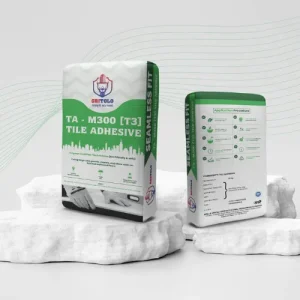
Gritolo TA–M300 [T3] is a high-polymer-modified cementitious tile adhesive developed for demanding tile installation applications. According to the manufacturer’s product information, it is intended for large-format vitrified tiles, porcelain, natural stones and other specified tile materials.
The product is positioned for interior and exterior applications, including selected vertical installations, tile-on-tile work and external cladding.
Its published classification references IS 15477:2019 Type 3 and EN 12004 C2TES1.
Key features of Gritolo T3
1. High-polymer-modified formulation
Gritolo TA–M300 is described as a high-polymer-modified adhesive. Its formulation is designed for applications requiring strong adhesion and deformability.
2. Large-format tile applications
The product is intended for large-format tiles where suitable adhesive coverage, substrate preparation and installation technique are essential.
3. Vertical slip resistance
The manufacturer describes the product as having a non-sag formulation for vertical tile applications. Its published slip-resistance figure is less than 0.5 mm.
4. Deformability
The product page identifies S1 deformability. Deformability is an important property when selecting adhesives for substrates and installations that experience certain movements.
5. Extended open time
The manufacturer publishes an open time greater than 30 minutes. Actual working time on site depends on environmental conditions, substrate absorption and application technique.
6. Interior and exterior use
The product is described for selected interior and exterior installations, including external cladding. Project-specific substrate and exposure conditions must still be checked.
7. Tile-on-tile applications
The manufacturer lists tile-on-tile work among its intended applications. Existing tiles must be stable, clean and properly assessed before covering them.
Published technical information for Gritolo TA–M300 [T3]
| Parameter | Published information |
|---|---|
| Product | TA–M300 [T3] |
| Product base | Cement-based, high-polymer modified |
| Standard reference | IS 15477:2019 Type 3 |
| EN classification stated | C2TES1 |
| Appearance | Grey / White powder |
| Water-to-powder ratio | Approximately 25–28% by weight |
| Open time | Greater than 30 minutes |
| Pot life | Approximately 3 hours at 30°C |
| Application temperature | 5°C to 40°C |
| Tensile adhesion strength | Greater than 1.5 N/mm² at 28 days, as published |
| Shear adhesion strength | Greater than 1.5 N/mm² at 28 days, as published |
| Deformability | S1 |
| Vertical slip resistance | Less than 0.5 mm |
| Trafficable / grouting time | Approximately 24 hours |
These values are taken from the manufacturer’s published product page. Confirm the latest TDS and test conditions before using the figures in a project specification.
Introduction to Weber weberset flex Tile Adhesive
Weber, part of Saint-Gobain, offers a range of tile and stone fixing solutions for residential, commercial and specialised construction applications.
For large-format tile installation, one relevant product is weberset flex.
Weber’s India tiling brochure describes weberset flex as a high-polymer-modified adhesive for fixing large-format tiles and natural stones on walls and floors. It is intended for installations where structural movement is expected and is recommended for external cladding according to the brochure.
The brochure identifies the product with C2TES1 classification and lists grey and white variants.
Key features of Weber weberset flex
1. Large-format tile suitability
The product is specifically described for large-format tiles and natural stones. This makes it relevant to projects involving large floor and wall tiles.
2. High-polymer-modified formulation
Weber describes the adhesive as high-polymer modified. The formulation is intended to provide adhesion and flexibility for the stated applications.
3. Vertical application
The brochure describes the product as having no slip observed on vertical applications. Actual suitability should be confirmed for the weight and dimensions of the selected tile.
4. Flexibility
The published C2TES1 classification indicates a deformable cementitious adhesive with specified performance characteristics. The exact application should still be checked against the manufacturer’s substrate recommendations.
5. External cladding
Weber recommends weberset flex for external cladding in its brochure. Exterior installation requires appropriate design, surface preparation, movement joints and safety provisions.
6. Range of compatible substrates
The brochure lists cementitious screed, plaster, concrete masonry, blocks, RCC, self-levelling screeds, cementitious waterproofing, gypsum plaster, tile-on-tile and tile-on-stone among the recommended substrates. These applications remain subject to the manufacturer’s detailed substrate instructions.
Published information for Weber weberset flex
| Parameter | Available manufacturer information |
|---|---|
| Product | weberset flex |
| Product base | High-polymer-modified adhesive |
| Classification | C2TES1 |
| Colours | Grey and White |
| Application | Large-format tiles and natural stones |
| Installation | Interior and exterior, walls and floors |
| Recommended substrates | As listed in Weber’s brochure |
| Coverage | Approximately 4.05–4.35 kg/m² at 3 mm bed thickness |
| Pack size | 20 kg |
| Pot life | Refer to current product TDS |
| Open time | Refer to current product TDS |
| Mixing ratio | Refer to current product TDS |
The available brochure does not provide every technical parameter required for a complete numerical comparison. Obtain the latest weberset flex TDS from Weber before relying on values for water ratio, open time, pot life or adhesion strength.
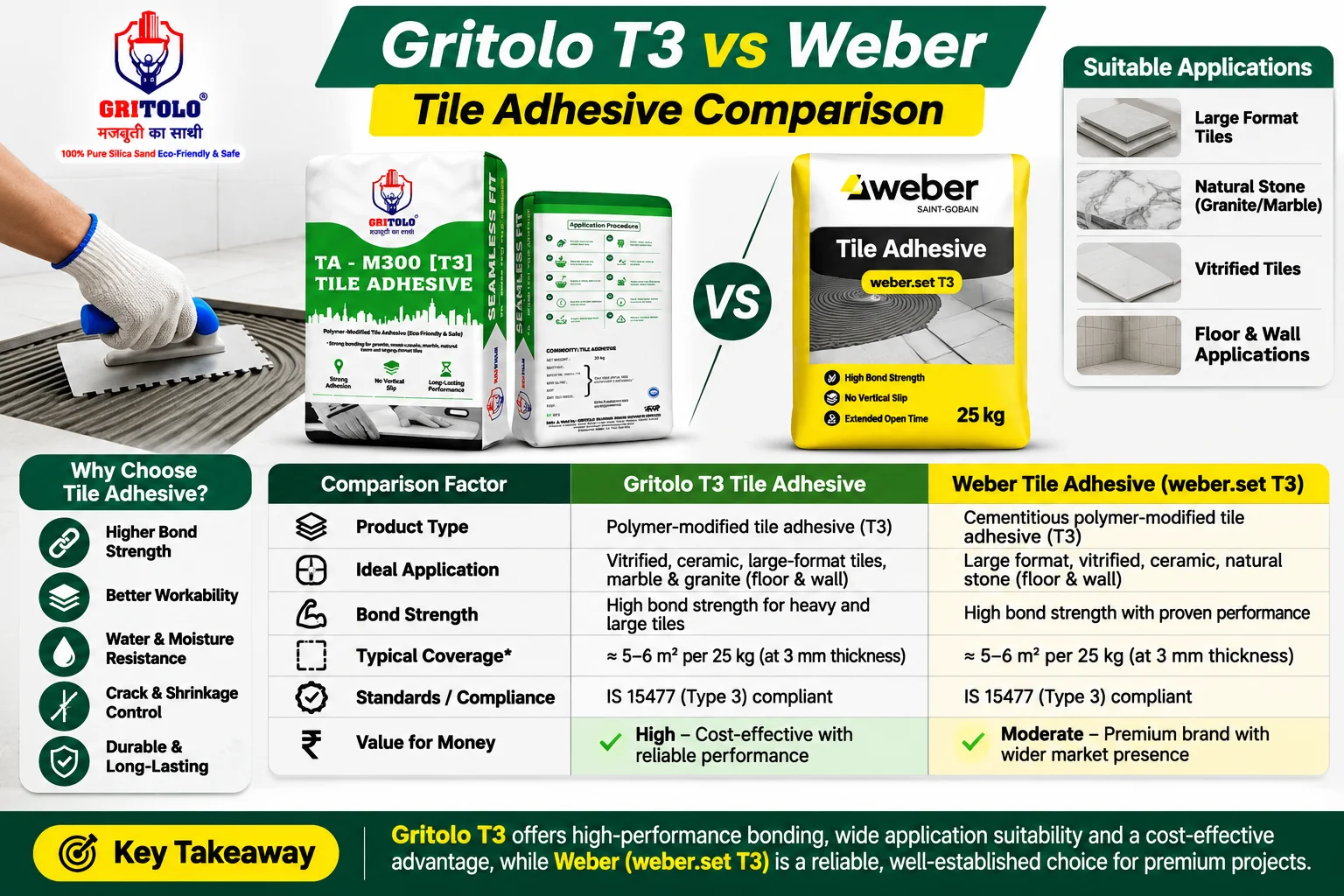
Gritolo T3 vs Weber Tile Adhesive: Feature Comparison
A comparison of large-format tile adhesives should consider classification, intended application, flexibility, slip resistance, coverage and installation requirements.
The following table summarises the information available from the two manufacturers.
| Comparison factor | Gritolo TA–M300 [T3] | Weber weberset flex |
|---|---|---|
| Product category | High-polymer-modified cementitious adhesive | High-polymer-modified adhesive |
| Indian classification stated | Type 3 under IS 15477:2019 | Confirm current Indian TDS |
| EN classification stated | C2TES1 | C2TES1 |
| Large-format tiles | Yes, as published | Yes, as published |
| Natural stones | Listed applications | Listed applications |
| Wall application | Yes, subject to tile and substrate suitability | Yes, as published |
| Floor application | Yes | Yes |
| External cladding | Listed application | Recommended in brochure |
| Tile-on-tile | Listed application | Listed substrate in brochure |
| Deformability | S1 | S1 through C2TES1 classification |
| Vertical slip | Less than 0.5 mm, as published | No slip observed, as described in brochure |
| Open time | Greater than 30 minutes, as published | Confirm current TDS |
| Pot life | Approximately 3 hours at 30°C | Confirm current TDS |
| Coverage at 3 mm | Depends on the selected trowel and application; see product coverage table | 4.05–4.35 kg/m² |
| Pack size | 20 kg and 40 kg coverage information published | 20 kg |
| Main selection factor | Published T3 specification and application range | Large-format and stone-fixing recommendations |
What does the comparison indicate?
Both products are positioned for large-format tile applications and have C2TES1 classification information in the available documents.
However, the available information is not sufficient to establish that one product has higher performance in every parameter.
Gritolo publishes several numerical technical values, including open time, pot life, adhesion strength and slip resistance. Weber’s brochure provides useful application and coverage information, but some detailed figures require confirmation from the current TDS.
A fair decision should therefore be based on the complete product documentation, project requirements, availability, price and technical support.
Understanding C2TES1 Classification
The classification C2TES1 is useful when comparing high-performance cementitious tile adhesives.
The letters and numbers indicate different performance characteristics under the relevant European classification system.
- C: Cementitious adhesive.
- 2: Improved performance.
- T: Reduced slip.
- E: Extended open time.
- S1: Deformable adhesive.
The classification provides a useful basis for comparing products, but it does not mean every product with this designation has identical values for every property.
Other factors such as tile dimensions, substrate, application thickness, environmental exposure and installation technique remain important.
When comparing Gritolo TA–M300 and Weber weberset flex, confirm the classification on the latest packaging and manufacturer-issued technical documents.
Applications of Gritolo T3 and Weber weberset flex
The products are intended for several demanding applications. The following sections explain the main project types where a suitable high-performance adhesive may be considered.
Large-format vitrified tile flooring
Large-format vitrified tiles are commonly used in living rooms, hotel lobbies, showrooms and commercial buildings.
Their relatively low porosity means the adhesive must be appropriate for the tile material and installation conditions.
Both products are described for large-format tile applications. Before selecting either one, check the tile manufacturer’s installation recommendations and the adhesive’s approved tile range.
Large-format wall tiles
Large wall tiles require careful installation because of their weight and vertical position.
The installer must use an adhesive with suitable slip resistance and ensure that the substrate is stable and correctly prepared.
The tile weight, dimensions, installation height and any additional fixing requirements should be considered before installation.
Exterior wall cladding
Exterior tile installations are exposed to sunlight, rain and changing temperatures.
These conditions can create movement within the building materials and place additional demands on the adhesive system.
Gritolo TA–M300 and Weber weberset flex both have published information supporting selected exterior cladding applications. However, external cladding should be designed as a complete system rather than treated as an adhesive-only decision.
For high-rise buildings and heavy external stone or tile installations, consult the project engineer and relevant technical teams about mechanical fixing, wind loads, movement joints and safety requirements.
Tile-on-tile renovation
Tile-on-tile renovation can reduce demolition work, dust and disposal requirements.
However, the existing tile surface must be inspected carefully. Loose, cracked or hollow tiles should not simply be covered with a new layer.
The installer must confirm that the selected adhesive is approved for tile-on-tile use and follow the required cleaning and surface preparation procedure.
Gritolo lists tile-on-tile among the applications for TA–M300. Weber’s brochure lists tile-on-tile as a recommended substrate for weberset flex. Confirm the exact application requirements with each manufacturer.
Natural stone installation
Natural stones such as granite and marble may have different absorption characteristics, weights and sensitivity to moisture.
The adhesive must be compatible with the particular stone. Light-coloured and moisture-sensitive stones may require a white adhesive or a specialised product.
Always conduct a compatibility check where staining, warping or discolouration is a concern.
Commercial and hospitality projects
Large-format tiles are widely used in hotels, offices, shopping centres and showrooms.
These projects often involve large surface areas and higher installation demands. Material planning, substrate flatness, movement joints and consistent workmanship are particularly important.
The adhesive should be selected based on the design specification and actual site conditions.
How to Select Between Gritolo T3 and Weber weberset flex
Choosing the right product requires more than comparing the classification printed on the bag.
Step 1: Identify the tile size
Determine the tile dimensions and thickness. An 800 × 800 mm tile, a 1200 × 1200 mm tile and a thin large-format slab may have different handling and installation requirements.
Step 2: Identify the tile material
Confirm whether the tile is vitrified, porcelain, ceramic, natural stone or another material.
Check whether the adhesive manufacturer approves the selected material and its surface characteristics.
Step 3: Identify the installation surface
Determine whether the adhesive will be applied to concrete, cement plaster, screed, existing tiles or another substrate.
Check whether that surface is included in the manufacturer’s approved substrate list.
Step 4: Identify the location
A dry interior floor, exterior wall, bathroom, terrace and commercial lobby do not have identical installation requirements.
Consider moisture, temperature changes, structural movement and traffic conditions.
Step 5: Review flexibility requirements
Where movement is expected, check the deformability classification and the manufacturer’s application recommendations.
C2TES1 classification information is relevant to both products discussed here, but the project still needs a suitable overall installation design.
Step 6: Compare coverage
Coverage affects the quantity of material required and the final installation cost.
Compare coverage only when the bed thickness, trowel, tile-back profile and measurement conditions are equivalent.
Step 7: Compare the current TDS
Obtain the latest technical data sheet for both products. Review mixing instructions, open time, pot life, application temperature, bed thickness and adhesion performance.
Step 8: Check availability and support
Confirm the availability of fresh stock, technical support, local distribution and project-specific recommendations.
A technically appropriate product must also be available in sufficient quantity for the project.
Large-Format Tile Installation: Step-by-Step Method
Correct installation is just as important as adhesive selection. Even a high-performance product may not perform as expected if the substrate or application method is unsuitable.
Step 1: Inspect the substrate
Check the surface for cracks, loose material, dust, oil, paint and other contaminants.
The substrate must be structurally sound and sufficiently cured. Follow the adhesive manufacturer’s requirements for moisture and surface preparation.
Step 2: Check surface flatness
Use a suitable straightedge or levelling tool to assess the substrate.
Correct significant unevenness with an appropriate levelling compound or screed before beginning tile installation.
Do not use tile adhesive as a general-purpose floor levelling material unless its TDS specifically allows the intended thickness and application.
Step 3: Plan tile positioning
Before mixing adhesive, establish the tile layout and joint positions.
Plan cuts, edges, corners and transitions. Large-format tiles can be difficult to reposition after installation, so planning helps reduce errors.
Step 4: Measure water and mix correctly
Use the water-to-powder ratio specified in the current TDS.
Add the powder gradually while mixing with a suitable mechanical mixer. Mix until the material reaches a consistent, lump-free condition.
Follow the manufacturer’s instructions for resting and remixing, if applicable.
Step 5: Apply adhesive to the substrate
Spread adhesive over a manageable area using the recommended notched trowel.
Comb the adhesive ridges consistently in one direction. Avoid spreading more material than can be covered within the actual open time.
Step 6: Back-butter the tile where required
Back-buttering involves applying a suitable layer of adhesive to the back of the tile in addition to the adhesive on the substrate.
It can help improve contact and reduce voids, particularly with large-format tiles.
Follow the adhesive and tile manufacturers’ installation instructions.
Step 7: Position and press the tile
Place the tile carefully and move it slightly across the adhesive ridges to collapse them and achieve suitable contact.
Use appropriate lifting and handling equipment for large or heavy tiles.
Step 8: Check adhesive transfer
Lift a freshly placed tile periodically to inspect the adhesive transfer.
If coverage is inadequate, adjust the trowel size, adhesive application or substrate preparation.
Step 9: Maintain grout joints
Use appropriate spacers or levelling systems where required.
Maintain the movement and perimeter joints specified by the project design. Do not fill movement joints with ordinary cementitious grout when a suitable flexible sealant is required.
Step 10: Allow the adhesive to set
Protect the installation from disturbance during the initial setting period.
Follow the product’s instructions for grouting, foot traffic and subsequent loading.
Coverage and Material Quantity Calculation
Coverage is an important consideration when comparing tile adhesives for large-format projects.
Gritolo publishes different coverage estimates for TA–M300 depending on the bed thickness and trowel notch. Weber’s brochure gives coverage of approximately 4.05–4.35 kg/m² at a 3 mm bed thickness for weberset flex.
Published coverage information for Gritolo TA–M300
| Bag size | Bed thickness | Trowel notch | Approximate coverage |
|---|---|---|---|
| 20 kg | 3–4 mm | 6 × 6 mm | 40–45 sq. ft. |
| 20 kg | 6–8 mm | 10 × 10 mm | 25–30 sq. ft. |
| 20 kg | 10–12 mm | Large-format trowel | 18–22 sq. ft. |
| 40 kg | 3–4 mm | 6 × 6 mm | 80–90 sq. ft. |
| 40 kg | 6–8 mm | 10 × 10 mm | 50–60 sq. ft. |
These are the manufacturer’s approximate coverage figures. Actual consumption depends on substrate flatness, tile-back profile, trowel angle, application technique and wastage.
Weber weberset flex coverage
Weber’s India brochure indicates approximately 4.05–4.35 kg/m² for a 3 mm bed thickness.
Use the current product TDS and site conditions to calculate the actual quantity required.
Example quantity calculation
Suppose a project involves 1,000 sq. ft. of large-format tile installation.
First convert the area:
1,000 sq. ft. ÷ 10.764 = approximately 92.9 m².
If the verified material consumption is 4.2 kg/m²:
92.9 × 4.2 = approximately 390 kg.
This is a theoretical quantity based on the example consumption rate. Additional material may be required depending on the substrate, tile-back profile, trowel and installation method.
Always prepare a project-specific material estimate before ordering.
Common Large-Format Tile Installation Mistakes
Using an unsuitable adhesive grade
Not every tile adhesive is suitable for large-format tiles.
Select the product based on tile material, size, substrate and exposure conditions.
Ignoring substrate flatness
Uneven substrates make it difficult to achieve consistent adhesive contact.
Correct surface variations before tiling.
Skipping back-buttering when required
Large tiles may need adhesive applied to both the substrate and the tile back.
Follow the recommended method to achieve suitable coverage.
Applying adhesive over too large an area
Exposed adhesive can form a skin, reducing its ability to bond effectively.
Spread manageable sections and observe actual site conditions.
Incorrect water measurement
Too much or too little water can change the intended consistency and working properties.
Follow the TDS and measure water accurately.
Not checking adhesive transfer
Installers should periodically lift freshly placed tiles to verify coverage.
This helps identify problems before the adhesive sets.
Ignoring movement joints
Large tiled areas and exterior installations need suitable movement joints.
The joint design should follow the project specification and relevant technical recommendations.
Walking on tiles too early
Premature loading can disturb tiles before the adhesive has developed sufficient strength.
Follow the manufacturer’s recommended waiting time.
Price Comparison: What Should Buyers Evaluate?
Price is important when purchasing construction materials, but the cost per bag does not provide a complete comparison.
For Gritolo TA–M300 and Weber weberset flex, obtain current quotations and compare:
- Price per bag.
- Bag weight.
- Actual consumption per square metre.
- Required adhesive-bed thickness.
- Wastage allowance.
- Transport and delivery costs.
- Product availability.
- Technical support.
- Warranty or written project recommendations, where applicable.
A product with a lower price per bag may not necessarily produce a lower installed cost if consumption differs.
Similarly, a higher-priced product should not automatically be assumed to provide better performance. Use equivalent technical information and project-specific calculations.
Gritolo T3 vs Weber: Which Product Should You Choose?
There is no universal winner for every large-format tile installation.
Gritolo TA–M300 [T3] is worth evaluating when the project requires a Type 3 product with published information covering large-format tiles, vertical slip resistance, deformability, tile-on-tile work and exterior cladding.
Weber weberset flex is worth evaluating when the project requirements align with Weber’s published recommendations for large-format tiles and natural stones, including selected external cladding applications.
The selection should depend on:
- Tile material and dimensions.
- Weight and installation orientation.
- Substrate type and condition.
- Interior or exterior exposure.
- Required flexibility.
- Adhesive transfer and coverage requirements.
- Current TDS specifications.
- Project cost and availability.
- Technical support.
For large-format tiles on walls or facades, obtain a written recommendation from the manufacturer or project technical consultant, particularly where the installation involves significant height, heavy tiles or unusual substrates.
Why Consider Gritolo TA–M300 [T3]?
Gritolo TA–M300 [T3] is designed for applications that require a high-performance cementitious tile adhesive.
Its published product information includes:
- Type 3 classification under IS 15477:2019.
- C2TES1 classification reference.
- Large-format tile applications.
- Natural stone applications.
- Exterior cladding applications.
- Tile-on-tile applications.
- Published open time greater than 30 minutes.
- Published S1 deformability.
- Published vertical slip-resistance information.
These features make it a product worth evaluating for projects that fall within the manufacturer’s recommended application range.
Before purchasing, review the latest TDS and confirm compatibility with the selected tile and substrate.
Visit the Gritolo TA–M300 [T3] product page to explore the product details and technical information.
Frequently Asked Questions
1. Which is better for large-format tiles: Gritolo T3 or Weber weberset flex?
Both products have published information for large-format tile applications and C2TES1 classification references. The better choice depends on the tile, substrate, installation environment, current technical specifications, availability and project requirements. Neither should be declared universally superior without comparable test evidence.
2. What is Gritolo TA–M300 [T3] used for?
Gritolo TA–M300 [T3] is intended for specified large-format tile, natural stone, exterior cladding and tile-on-tile applications. Check its latest TDS for the approved tile types, substrates and installation limitations.
3. Is Weber weberset flex suitable for large-format tiles?
Yes. Weber’s India brochure describes weberset flex as a high-polymer-modified adhesive for large-format tiles and natural stones on walls and floors.
4. What does C2TES1 mean in tile adhesive?
C2 indicates improved cementitious adhesive performance, T indicates reduced slip, E indicates extended open time and S1 indicates deformability. The classification is a useful comparison tool, but the complete TDS must still be reviewed.
5. Can T3 tile adhesive be used for exterior walls?
A T3 product may be suitable for specified exterior wall applications when the manufacturer approves the tile, substrate and installation conditions. Exterior cladding also requires suitable movement joints and project-specific safety considerations.
6. Is back-buttering necessary for large-format tiles?
Back-buttering is commonly recommended for large-format tiles to help achieve adequate adhesive contact. Follow the tile and adhesive manufacturers’ instructions and inspect adhesive transfer during installation.
7. How much tile adhesive is required per square metre?
Consumption depends on bed thickness, trowel size, substrate flatness, tile-back profile and application method. Weber’s brochure indicates approximately 4.05–4.35 kg/m² for weberset flex at 3 mm. Gritolo publishes coverage by bag size and bed thickness for TA–M300.
8. Can Gritolo T3 be used for tile-on-tile installation?
Gritolo lists tile-on-tile applications for TA–M300 [T3]. The existing tiles must be stable and properly prepared. Follow the manufacturer’s current application instructions.
9. Can Weber weberset flex be used for natural stones?
Weber’s brochure describes weberset flex for large-format tiles and natural stones. Confirm compatibility with the specific stone, particularly if it is light-coloured or moisture-sensitive.
10. What is the difference between T3 and T2 tile adhesive?
T3 and T2 refer to different adhesive classifications under the relevant Indian standard. Product selection depends on the tile, substrate and application. Large-format and demanding installations may require a higher-performance product, but the actual classification and application approval should always be verified.
11. Does large-format tile installation require movement joints?
Movement joints are an important part of tile installation, especially over large areas and in exterior locations. Their placement and spacing should follow the project design and applicable technical guidance.
12. Where can I find Gritolo T3 technical specifications?
You can visit the Gritolo TA–M300 [T3] product page to review its published technical details, applications and coverage information. Request the latest TDS for project specification and installation guidance.
Conclusion
Large-format tile installation requires careful adhesive selection, proper substrate preparation and skilled application. Gritolo TA–M300 [T3] and Weber weberset flex are two products worth considering for applications involving large-format tiles and natural stones.
Both have published C2TES1 classification information, but the available technical documents do not establish that every performance parameter is identical. Gritolo publishes specific figures for open time, pot life, adhesion and slip resistance, while Weber’s brochure provides application guidance and coverage information.
The correct product should be selected by comparing the latest manufacturer-issued technical data sheets, checking tile and substrate compatibility, and considering the actual installation environment.
For a successful large-format tiling project, the adhesive, substrate preparation, back-buttering, movement-joint design and installation technique must work together. A carefully specified and correctly installed tiling system is more important than choosing a product based on brand name alone.