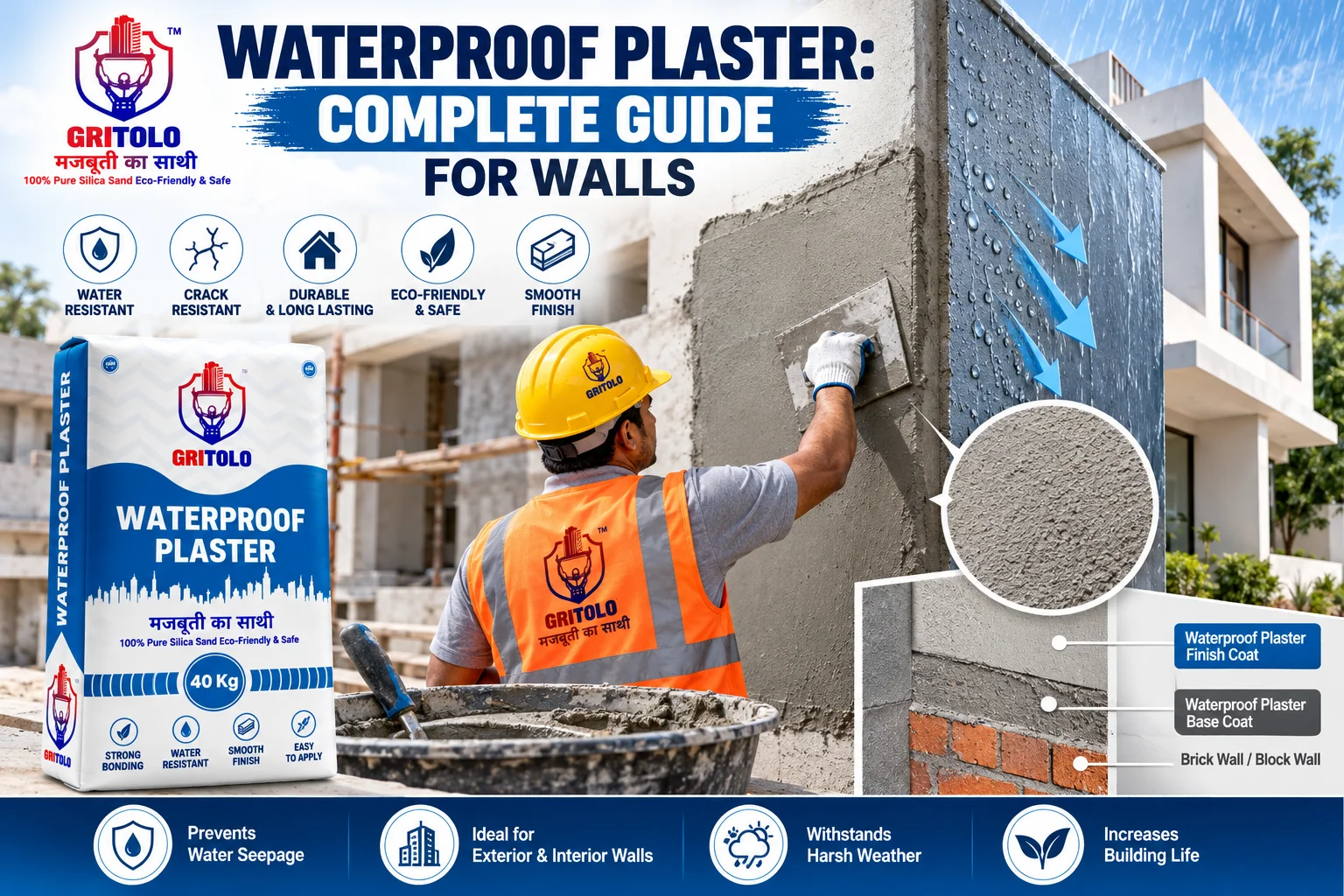
Waterproof Plaster: Complete Guide for Walls
Water damage is one of the most common challenges in building maintenance. Exterior walls face rain, humidity and changing temperatures, while interior walls may be exposed to moisture from bathrooms, kitchens, plumbing systems and adjacent wet areas. When water enters a wall, it can contribute to damp patches, peeling paint, efflorescence, surface deterioration and recurring repair costs.
Choosing the right plaster is an important part of protecting walls against moisture. Waterproof plaster is a specially formulated plaster designed to reduce water penetration and improve the moisture resistance of a wall surface. Depending on its composition, it may contain waterproofing admixtures, polymer modifiers or other additives that help reduce water absorption.
For Indian buildings, selecting an appropriate plaster system is particularly important because monsoon rainfall, humidity, intense sunlight and temperature variations can place considerable demands on exterior walls.
This guide explains what waterproof plaster is, how it works, the types available, its benefits, applications, installation process, cost factors, maintenance requirements and the mistakes to avoid when choosing a waterproof plaster solution.
What Is Waterproof Plaster?
Waterproof plaster is a cement-based or specially formulated plaster designed to provide greater resistance to moisture penetration than a conventional plaster system.
Traditional cement-sand plaster provides a protective and decorative layer over masonry. However, cementitious materials can contain pores and may develop cracks through which water can penetrate. Waterproof plaster formulations are designed to reduce moisture absorption through appropriate additives and material engineering.
Depending on the product, these formulations may include:
- Cementitious binders
- Carefully graded sand or mineral aggregates
- Integral waterproofing compounds
- Polymer additives
- Water-repellent ingredients
- Workability-enhancing additives
- Other performance-modifying components
The exact formulation varies by manufacturer and intended application.
Waterproof plaster is commonly considered for exterior walls, bathrooms, kitchens, utility rooms and other areas where improved moisture resistance is required.
However, waterproof plaster should not automatically be treated as a complete waterproofing membrane. Areas exposed to standing water, sustained water pressure or significant leakage may require a separate waterproofing system.
Why Is Waterproof Plaster Important for Walls?
Walls protect the building interior, support finishes and contribute to the overall appearance of a property. Moisture penetration can damage these functions over time.
When water enters a wall, the effects may include:
- Damp patches on interior surfaces
- Peeling or blistering paint
- White salt deposits known as efflorescence
- Deterioration of plaster
- Mould growth where moisture and other conditions support it
- Repeated repainting and maintenance
- Damage to decorative finishes
- Reduced durability of the affected surface
Waterproof plaster can help reduce water absorption through the plaster layer when the material is appropriate for the application and correctly installed.
It is especially relevant for buildings exposed to heavy rainfall, wind-driven rain, humid conditions and repeated wetting and drying.
Nevertheless, selecting a moisture-resistant plaster is only one part of a complete wall-protection strategy. Proper drainage, roof detailing, joint treatment, plumbing maintenance and suitable surface coatings may also be necessary.
How Does Waterproof Plaster Work?
Waterproof plaster can reduce water penetration through several mechanisms, depending on its formulation.
1. Reducing Capillary Water Absorption
Cement-based materials contain pores that can allow water to move through capillary pathways. Certain waterproofing additives help reduce water absorption by modifying the pore structure or making the material less susceptible to water uptake.
The effectiveness depends on the specific product and its installation.
2. Improving Material Density
A well-formulated plaster with suitable aggregate grading and correct water proportions can develop a more consistent structure.
Proper mixing, application and curing are important for achieving the intended performance.
3. Improving Bonding
Some polymer-modified formulations improve adhesion to suitable substrates. Better bonding can help reduce defects caused by debonding, although the result depends on the substrate, preparation and installation method.
4. Helping Control Cracking
Certain formulations may improve workability or help manage shrinkage-related performance. However, no plaster should be assumed to prevent every crack.
Cracks can also result from structural movement, thermal expansion, poor detailing, substrate movement and inadequate curing.
5. Working With Other Protective Layers
Waterproof plaster may form part of a wider wall-protection system that includes compatible primers, exterior coatings, sealants and properly detailed junctions.
The complete system should be selected according to the source of moisture and the building’s exposure conditions.
Types of Waterproof Plaster
Waterproof plaster is available in several forms. Understanding their differences helps builders and homeowners select the right solution.
1. Ready Mix Waterproof Plaster
Ready mix waterproof plaster is a factory-prepared material supplied in bags with selected ingredients blended in controlled proportions.
Depending on the product, waterproofing additives and performance modifiers may already be included. The user generally adds the specified amount of clean water and mixes according to the manufacturer’s instructions.
Potential benefits include:
- Consistent ingredient proportions
- Reduced manual batching
- Convenient material handling
- Simplified site preparation
- More predictable workability when correctly mixed
- Reduced risk of incorrect additive dosing
Ready mix products are useful for projects where consistency, speed and material management are important.
Before purchasing, verify that the particular product is specifically designed for the intended waterproofing application. Not every ready mix plaster is waterproof plaster.
2. Site-Mixed Waterproof Plaster
Site-mixed waterproof plaster is prepared using cement, sand, water and a compatible waterproofing compound.
The waterproofing additive may be supplied as a liquid or powder. Its dosage must follow the manufacturer’s instructions.
The performance of site-mixed plaster depends heavily on the quality of the raw materials, the mixing proportions and the consistency of site practices.
Incorrect dosing, excessive water, poor sand quality or inadequate curing can affect the final result.
3. Polymer-Modified Waterproof Plaster
Polymer-modified plaster contains selected polymers that can improve bonding and modify other performance characteristics.
Depending on the formulation, polymer modification may support adhesion, workability and resistance to certain types of cracking.
Such products may be considered for demanding wall applications, including exterior surfaces exposed to changing weather conditions.
The product’s technical documentation should specify whether it is suitable for the particular substrate and exposure.
4. Integral Waterproofing Plaster
Integral waterproofing plaster incorporates a compatible waterproofing admixture into the plaster mix.
The objective is to reduce water penetration through the material itself rather than relying entirely on a surface coating.
The admixture must be compatible with the cementitious material and used at the specified dosage.
5. Specialised Cementitious Waterproofing Systems
Some applications require a combination of cementitious repair materials, waterproofing coatings, reinforcement and protective finishes rather than ordinary plaster alone.
These systems may be considered for particular wet areas or moisture-exposed structures.
Where water pressure, continuous immersion or severe leakage is involved, a specialist waterproofing design is important.
Waterproof Plaster vs Normal Plaster
Waterproof plaster and normal plaster may share a cementitious base, but they are not necessarily formulated for the same performance requirements.
| Feature | Normal Cement Plaster | Waterproof Plaster |
|---|---|---|
| Main purpose | Surface levelling and finishing | Surface levelling with improved moisture resistance |
| Formulation | Usually cement, sand and water | May include integral waterproofing additives or polymers |
| Water absorption | Depends on material and workmanship | Designed to reduce water absorption |
| Suitable applications | General interior and exterior plastering | Moisture-exposed walls when product-approved |
| Site preparation | Requires suitable substrate preparation | Also requires suitable substrate preparation |
| Curing | Must follow the applicable specification | Must follow the product-specific instructions |
| Waterproofing membrane replacement | No | Not automatically |
| Cost | Depends on materials and labour | May cost more depending on formulation and system |
The correct comparison should be based on the actual products being evaluated, their technical specifications and the intended application.
A waterproof plaster may help reduce moisture penetration, but it cannot compensate for major cracks, defective plumbing, leaking roofs or missing waterproofing at critical junctions.
Where Can Waterproof Plaster Be Used?
Exterior Walls
Exterior walls face direct rain, sunlight, wind and changing temperatures. Water may enter through porous surfaces, cracks, poorly sealed openings and defective junctions.
A suitable waterproof plaster can help improve the moisture resistance of an exterior wall.
It is especially worth evaluating for:
- Residential buildings
- Apartment complexes
- Commercial buildings
- Industrial facilities
- Boundary walls
- Exposed facades
- Walls in high-rainfall locations
The wall should also have suitable coping, sill, drainage and sealant details.
Interior Walls
Interior waterproof plaster may be appropriate where a wall needs improved resistance to moisture.
Examples include selected utility areas, damp-prone locations and interior walls adjoining wet areas.
However, first identify the moisture source. If water is entering from a leaking pipe or a failed external waterproofing layer, the source must be repaired before the wall is refinished.
Bathroom Walls
Bathrooms experience frequent splashing, condensation and elevated humidity.
Waterproof plaster may form part of the wall-finishing system, but tiled shower areas and other locations exposed to regular direct water contact may require a dedicated waterproofing membrane beneath the tile installation.
The plaster, waterproofing layer, tile adhesive and sealant must be compatible.
Kitchen Walls
Kitchens may experience splashes, steam and repeated cleaning. A suitable moisture-resistant plaster can help create a durable substrate for the intended finish.
Areas around sinks and plumbing should receive particular attention.
Utility Rooms and Wash Areas
Laundry rooms, wash areas and similar spaces may benefit from appropriate moisture-resistant materials.
Where floors are frequently wet or water can collect at wall-floor junctions, consider a complete waterproofing detail rather than relying on plaster alone.
Ground-Floor and Basement Walls
Ground-level and basement walls require careful diagnosis because moisture may originate from groundwater, poor drainage, rising damp or water pressure.
Waterproof plaster by itself may not solve these problems.
Depending on the conditions, treatment may require external waterproofing, drainage, damp-proofing measures, crack repair or a designed internal waterproofing system.
Benefits of Waterproof Plaster
1. Improved Moisture Resistance
A suitable waterproof plaster formulation can reduce water absorption through the treated surface.
This can be valuable for exterior walls and other moisture-exposed applications.
2. Protection Against Weather Exposure
Exterior plaster must withstand rain and repeated changes in temperature and humidity.
Using an appropriate moisture-resistant plaster may improve the performance of the wall surface when combined with good detailing and workmanship.
3. Support for Durable Finishes
Persistent moisture can damage paint and other finishes. Controlling water penetration helps provide a more suitable base for finishing materials.
The wall must be sufficiently dry and prepared before applying paint or decorative coatings.
4. Reduced Risk of Moisture-Related Surface Damage
When the product and installation are appropriate, waterproof plaster can help reduce some problems associated with water absorption.
It cannot eliminate every cause of dampness, and ongoing moisture should always be investigated.
5. Convenient Application With Ready Mix Products
Factory-prepared waterproof plaster can reduce the need to measure and combine multiple dry ingredients at the site.
This can help simplify construction operations and improve consistency between batches.
6. Potentially Lower Maintenance Requirements
A well-designed wall-protection system can reduce the frequency of moisture-related surface repairs.
Actual maintenance needs depend on the building, exposure, product performance and quality of installation.
7. Compatibility With Suitable Wall Finishes
Depending on the product, waterproof plaster may accept compatible primers, paints and decorative finishes.
Always check the recommended finishing system before application.
How to Choose the Right Waterproof Plaster
Choosing the correct product requires more than comparing the price per bag.
1. Identify the Source of Moisture
First determine whether the problem comes from rain, plumbing, groundwater, condensation or another source.
Different causes require different solutions.
2. Determine the Application Area
Establish whether the plaster will be used on an exterior facade, interior wall, bathroom, utility room or another location.
A product suitable for one application may not be suitable for another.
3. Check Substrate Compatibility
Walls may be made from fired-clay bricks, AAC blocks, concrete blocks, stone or reinforced concrete.
The selected plaster should be suitable for the substrate and any required bonding treatment.
4. Review Technical Documentation
Ask for the product technical data sheet and check:
- Intended applications
- Substrate requirements
- Mixing instructions
- Application thickness
- Coverage and consumption
- Pot life and working time
- Curing requirements
- Water-resistance information
- Compatibility with primers and coatings
- Storage conditions
5. Consider Local Climate
Buildings exposed to heavy monsoon rain, high humidity or coastal conditions may require careful material selection and additional facade detailing.
The complete system should reflect local exposure.
6. Evaluate Application Support
Correct workmanship is essential. Choose a product for which clear application instructions and appropriate technical support are available.
Waterproof Plaster Application: Step-by-Step Guide
Correct application is essential to achieving the intended performance. The following steps provide a general overview; the product-specific instructions take priority.
Step 1: Inspect the Wall
Identify cracks, loose plaster, efflorescence, water stains, damaged masonry and other defects.
If dampness is recurring, investigate its source before starting the work.
Step 2: Remove Loose Material
Remove dust, loose mortar, flaking coatings, weak plaster and other contaminants that may interfere with bonding.
The substrate must be sound and appropriate for the selected product.
Step 3: Repair Defects
Repair suitable non-structural defects using compatible repair materials.
Cracks caused by structural movement or significant settlement should be assessed by a qualified professional before they are covered.
Step 4: Prepare the Substrate
Follow the manufacturer’s instructions for cleaning and dampening the wall.
Some cementitious systems require a dampened substrate, while other products may have different requirements. Avoid leaving standing water unless the product explicitly permits the relevant condition.
Step 5: Apply a Bonding Treatment if Required
Certain substrates or plaster systems require a bonding slurry, primer or other preparatory treatment.
Use only compatible products and follow the recommended application sequence.
Step 6: Mix the Waterproof Plaster
Measure clean water according to the specified ratio.
Gradually add the dry plaster and mix using suitable equipment until the required consistency is achieved.
Avoid adding excess water to improve workability. Do not introduce additional cement, sand or other additives unless permitted by the manufacturer.
Step 7: Apply the Plaster
Apply the material using the recommended tools and method.
Maintain the specified thickness and work the material evenly across the surface. Where multiple coats are required, follow the specified sequence and timing.
Step 8: Finish the Surface
Use suitable tools to achieve the required level and texture.
Avoid finishing practices that weaken the surface or introduce excess water.
Step 9: Cure the Plaster
Curing is important for cement-based plaster systems.
Follow the product instructions for curing method and duration. Do not assume that every waterproof plaster requires exactly the same curing period.
Step 10: Protect the Finished Wall
Protect the surface from premature drying, rain damage, impact and other conditions that may affect the developing plaster.
Apply paint or other finishes only after the surface meets the specified drying and curing requirements.
Waterproof Plaster Thickness and Coverage
There is no single thickness or coverage rate that applies to every waterproof plaster.
The required thickness depends on the product, substrate, wall unevenness, application method and project specification.
Similarly, coverage depends on:
- Product density
- Application thickness
- Surface texture
- Wall flatness
- Number of coats
- Mixing and application losses
- Manufacturer’s stated consumption rate
How to Estimate Material Quantity
Use the following general calculation:
Required plaster quantity = Wall area × Product consumption per square metre
For example, suppose a wall has an area of 100 square metres and the selected product’s technical data sheet specifies a consumption of 18 kg/m² at the required application thickness.
The theoretical requirement would be:
100 × 18 = 1,800 kg
This example illustrates the calculation only. It is not a universal consumption recommendation. Use the actual consumption rate stated for the product and thickness you select.
For more accurate planning, deduct openings where appropriate and account for surface irregularities, packaging sizes and reasonable site wastage.
Waterproof Plaster Cost in India
The cost of waterproof plaster varies by product, location, wall condition and project requirements.
The total cost may include:
- Plaster material
- Waterproofing admixtures, where separately required
- Surface preparation
- Crack and defect repairs
- Labour
- Scaffolding or access equipment
- Bonding treatment
- Curing
- Protective coatings
- Waste and transport
Ready mix waterproof plaster may have a higher material price than a basic cement-sand mix, but it can simplify batching and material handling. Whether it reduces total project cost depends on the specific product, labour rates and site conditions.
How to Compare Quotes
When comparing contractor quotations, confirm that each quote includes the same scope of work.
Ask whether the price covers preparation, repairs, plaster application, curing, waterproofing at junctions, finishing and any specified coating.
Comparing only the price per bag can be misleading because different products may have different coverage rates and performance requirements.
Common Waterproof Plaster Problems and Mistakes
1. Treating the Symptom Instead of the Cause
Applying waterproof plaster over a leaking pipe or defective roof does not repair the underlying problem.
Identify and correct the source of moisture first.
2. Poor Surface Preparation
Dust, loose material, old coatings and weak plaster can interfere with bonding.
A clean, sound substrate is essential.
3. Incorrect Mixing
Too much or too little water can affect workability and performance.
Use the recommended mixing ratio and suitable equipment.
4. Applying the Wrong Thickness
An incorrect thickness can compromise the finish and performance.
Follow the product instructions rather than relying on a generic rule.
5. Inadequate Curing
Insufficient curing can affect cementitious plaster development.
Follow the prescribed curing procedure for the selected product.
6. Ignoring Cracks and Joints
Cracks and poorly sealed junctions can provide direct pathways for water.
Pay special attention to window frames, parapets, pipe penetrations, roof-wall junctions and wall-floor connections.
7. Painting Too Early
Applying paint before the plaster is ready can contribute to finishing problems.
Follow the specified drying, curing and moisture requirements for the coating system.
8. Using Incompatible Products
A plaster, primer, waterproofing membrane and paint should work together as a system.
Check compatibility before combining products from different manufacturers.
Waterproof Plaster vs Waterproof Paint
Waterproof plaster and waterproof paint serve different purposes.
Waterproof plaster is applied as a plaster layer and is intended to improve the surface’s moisture resistance while levelling the wall.
Waterproof paint or a specialist exterior coating is applied over a suitable prepared surface to provide a protective finish.
| Feature | Waterproof Plaster | Waterproof Paint or Coating |
|---|---|---|
| Main role | Plastering and moisture resistance | Surface protection and finishing |
| Application stage | During wall plastering or repair | Over a suitably prepared surface |
| Surface levelling | Yes, within its specified limits | Generally limited |
| Crack accommodation | Product dependent | Depends on coating formulation |
| Replacement for structural repairs | No | No |
| Use with other systems | May be combined with compatible coatings | May be used over compatible plaster |
In many projects, these products can complement each other. The correct sequence depends on the manufacturer’s instructions and the moisture problem being addressed.
Waterproof Plaster for Exterior Walls in India
Exterior walls in India can experience intense sunlight, seasonal rainfall, high humidity and repeated wetting and drying.
A suitable exterior wall system should consider both the plaster material and the way water moves across the facade.
Important details include:
- Properly prepared masonry
- Compatible plaster
- Suitable thickness
- Appropriate curing
- Correct window and door detailing
- Effective sill and coping details
- Sealed service penetrations
- Proper drainage
- Compatible exterior paint or coating
For buildings in high-rainfall areas, particular attention should be given to exposed walls and junctions where water can collect or enter.
A moisture-resistant plaster is useful only when it is part of a well-designed and correctly installed system.
Waterproof Plaster for Interior Walls
Interior waterproof plaster should be selected according to the moisture conditions and intended finish.
For ordinary dry rooms, a standard plaster system may be sufficient. For damp-prone locations or walls adjoining wet areas, a moisture-resistant formulation may be appropriate.
Before treating an interior wall, inspect for:
- Plumbing leaks
- Roof or facade leakage
- Ground moisture
- Condensation
- Poor ventilation
- Moisture entering from an adjoining bathroom
The cause should be corrected before the wall is repaired and refinished.
Quality Checklist Before Buying Waterproof Plaster
Use this checklist when evaluating a product or contractor:
- Confirm the exact intended application.
- Verify substrate compatibility.
- Request the technical data sheet.
- Check the stated consumption rate.
- Confirm the required thickness.
- Verify the mixing ratio.
- Understand the curing procedure.
- Check compatibility with paint and coatings.
- Confirm how cracks and junctions will be treated.
- Review the contractor’s preparation and application process.
- Obtain a clear scope of work and quotation.
- Retain product batch and purchase information.
This process helps reduce avoidable errors and improves the likelihood that the chosen system will meet project requirements.
Waterproof Plaster Solutions from Gritolo
GRITOLO GLOBAL INDIA PRIVATE LIMITED provides construction material solutions for modern building requirements, including ready mix plaster, tile adhesive, block jointing mortar and other construction products.
When selecting plaster for a residential, commercial or industrial project, consider the wall substrate, moisture exposure, intended finish and the complete installation process.
If you are evaluating waterproof plaster, confirm the exact product specification and intended use before purchase. Do not assume that every ready mix plaster is formulated for waterproofing or that a plaster product can replace a dedicated membrane in every application.
Gritolo’s existing guide, Waterproof Plaster for Exterior Walls in India: Complete Guide (2026), can provide additional context for exterior wall applications. Link this article to the relevant Gritolo product and contact pages so readers can move from learning about waterproof plaster to evaluating suitable solutions.
Frequently Asked Questions About Waterproof Plaster
What is waterproof plaster?
Waterproof plaster is a specially formulated plaster designed to reduce water penetration and improve the moisture resistance of walls. Its performance depends on the formulation, substrate preparation, application and curing.
Is waterproof plaster better than normal plaster?
Waterproof plaster may be more suitable where improved moisture resistance is required. For dry interior walls, normal plaster may be sufficient. The choice depends on the location, exposure and product specifications.
Can waterproof plaster be used on exterior walls?
Yes, suitable waterproof plaster products can be used on exterior walls when approved for that application. Correct facade detailing, surface preparation, curing and compatible finishing are also important.
Can waterproof plaster be used in bathrooms?
Some products are suitable for bathroom walls. However, areas exposed to direct and frequent water contact may require a dedicated waterproofing membrane beneath the final finish.
Does waterproof plaster stop every type of leakage?
No. It may reduce water penetration through the plaster layer, but it cannot automatically resolve roof leaks, plumbing failures, rising damp, structural cracks or water pressure behind walls.
Is ready mix plaster always waterproof?
No. Ready mix plaster describes a factory-prepared product format, not necessarily a waterproofing performance category. Check whether the specific formulation is designed for moisture resistance.
How thick should waterproof plaster be?
The required thickness depends on the product, substrate and project specification. Always follow the manufacturer’s technical data sheet and avoid using a universal thickness for every application.
How much waterproof plaster is required per square metre?
The quantity depends on the product’s consumption rate and the required thickness. Multiply the wall area by the stated consumption rate to estimate the theoretical quantity.
Can waterproof plaster be painted?
Many waterproof plaster products can receive compatible paint or coatings once the surface has reached the required condition. Follow the plaster and paint manufacturers’ preparation and drying instructions.
How long does waterproof plaster last?
There is no universal service life. Durability depends on product quality, wall conditions, water exposure, workmanship, curing, maintenance and the performance of associated waterproofing details.
Can waterproof plaster prevent damp patches?
It may help where dampness is caused by water entering through the plastered surface. If the source is a leaking pipe, groundwater, condensation or a structural defect, that issue must also be addressed.
What is the difference between waterproof plaster and a waterproofing membrane?
Waterproof plaster is a plastering material designed to improve moisture resistance. A waterproofing membrane is a separate protective layer designed for specific waterproofing applications. They are not automatically interchangeable.
Conclusion
Waterproof plaster is an important option for walls that need improved resistance to moisture. It can be particularly useful for exterior facades, damp-prone areas and selected interior applications when the product is properly specified and installed.
The best results depend on choosing the right formulation, preparing the substrate, following the recommended mixing and application process, allowing proper curing and addressing cracks and junctions correctly.
Most importantly, waterproof plaster should be selected according to the actual source of moisture. A plaster product can help reduce water absorption, but a complete waterproofing solution may also require drainage improvements, plumbing repairs, joint treatment, membranes or protective coatings.
For builders, contractors and homeowners, the goal should be a durable wall system rather than a quick surface repair. With suitable materials, correct workmanship and appropriate maintenance, walls can be better protected against moisture-related deterioration.