Tile Adhesive Price in India: The Ultimate Cost-Benefit Analysis 2025
The cost of tile adhesive in the Indian market is perhaps the single most confusing metric for contractors, builders, and homeowners. Prices can range wildly, from ₹250 to over ₹1,200 per 20kg bag, and that’s before considering specialized products like epoxy or high-polymer flexibles.
Why such a massive price difference? The simple answer is performance and risk mitigation. You’re not just buying a bag of cement; you’re buying guaranteed adhesion that protects a much more expensive asset: your tiles and your reputation.
This definitive guide, brought to you by the construction chemical experts at Gritolo Global, will empower you to move beyond the sticker price. We’ll break down the true cost of tiling by covering:
- The primary price brackets and what they buy you (T1, T2, T3 grades).
- Six critical factors that inflate the price (polymer, color, packaging).
- The hidden cost of cheap adhesive (failure rate and rework).
- A detailed calculation of the True Project Cost (material cost per square foot).
Price Breakdown by Performance Grade (Per 20kg Bag)
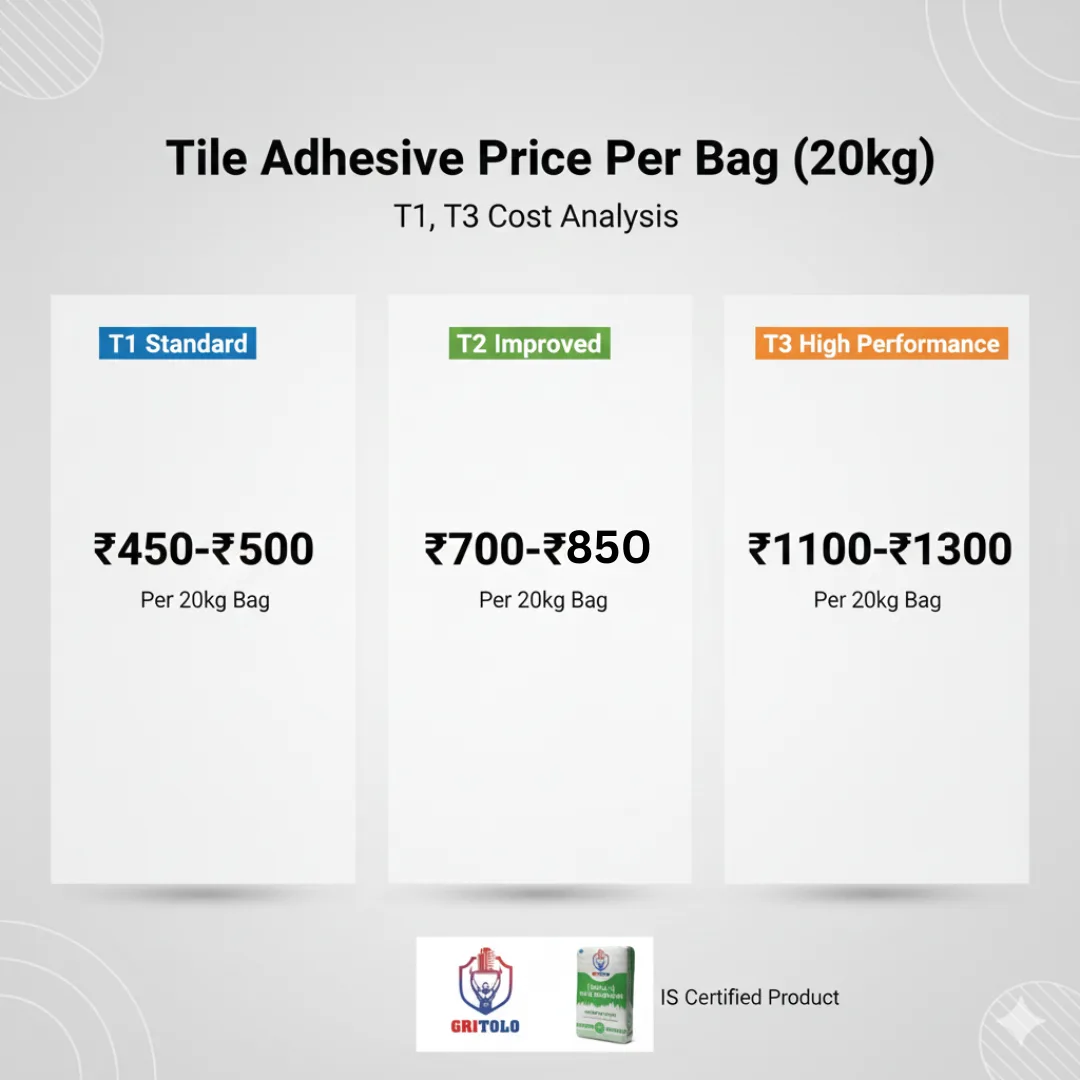
The Indian Standard IS 15477 classification system is the best indicator of the price you should expect to pay. As you move from a basic T1 to a high-performance T3 adhesive, the cost increases because the polymer content—the core ingredient that prevents failure—rises significantly.
The Three Core Price Tiers (Approximate Market Rates for 20kg Bag)
| Performance Grade | Price Range (Approx. ₹) | Application / Tile Type | Gritolo Equivalency |
|---|---|---|---|
| T1 (Standard) | ₹300 – ₹550 | Basic interior ceramic tiles (porous only). | [Gritolo TileFix Standard] |
| T2 (Improved) | ₹550 – ₹850 | Vitrified, porcelain, and exterior applications. Recommended minimum for modern homes. | [Gritolo TileFix Plus] |
| T3 (High Performance) | ₹850 – ₹1,200+ | Large Format Tiles (LHT), tile-on-tile, high-traffic commercial floors. | [Gritolo TileFix Extreme] |
| Specialized (Epoxy / S2) | ₹1,800 – ₹4,000+ | Glass, metal, industrial applications, swimming pools, facade cladding. | [Gritolo Specialized Solutions] |
What the Price Jump Buys You
The price difference between a cheap T1 and a necessary T2 (or T3) adhesive is not profit padding—it’s technology:
- T1: Primarily cement and fillers. Low polymer. Best for porous tiles on porous substrates.
- T2/T3: High concentration of Redispersible Polymer Powder (RDP), which gives the adhesive its flexibility (deformability) and water resistance. This RDP is the single most expensive raw material, driving up the price but simultaneously guaranteeing the bond on non-porous tiles.
Six Critical Factors That Inflate Tile Adhesive Price
Understanding what you are paying for allows you to budget accurately and avoid overpaying for unnecessary features.
The Performance Grade (T and S Classification)
As covered above, this is the main driver. The inclusion of the Deformability rating (S1 or S2) will drastically increase the price, often pushing the product into the ₹1,000+ per bag category.
- Why it costs more: S1 and S2 adhesives contain special additives that allow the adhesive to stretch and move with the substrate (e.g., when a balcony heats up or a wooden floor expands). This is a non-negotiable cost for high-risk applications.
Color (Grey vs. White Adhesives)
White tile adhesive is always more expensive than grey.
- Why it costs more: White adhesive uses expensive white cement and special fine fillers instead of standard Portland cement. It is necessary for:
- Fixing light-colored, translucent stones like marble, granite, or light-colored glass mosaics to prevent the grey color from bleeding through and discoloring the stone.
Specialized Composition (Epoxy and Ready-Mix)
The price hierarchy jumps sharply when you move away from cementitious powder products.
- Epoxy Adhesives (R): These are two-part, high-strength systems. They cost 5x to 10x more per kg than cementitious options. They are only used for chemical resistance, metal-to-tile bonding, or in extreme industrial environments.
- Ready-Mix/Dispersion Adhesives (D): These are paste-form, ready-to-use products that cost more due to their complex chemical formula and specialized packaging. They are typically used only for interior wall tiling with small tiles.
Additives (Fast-Setting vs. Extended Open Time)
If an adhesive has an F (Fast Setting) or E (Extended Open Time) designation, it uses specialized chemicals to control the setting process, increasing the base cost.
- Fast-Setting F: Pricier due to quick-reacting accelerators. Essential for projects requiring immediate use (e.g., hospital corridors, quick repairs).
- Extended Open Time (E): Pricier due to chemical retarders that allow the product to remain workable longer, especially useful in India’s hot, dry regions.
Packaging Size and Format
While the price per kg is the best comparison, expect to pay more per kg for smaller packaging sizes (e.g., a 5kg bag costs proportionally more than a 20kg bag) due to packaging and handling overheads.
Brand and Logistics
Established, high-quality brands like Gritolo invest heavily in R&D, quality control, and testing to meet global standards (like EN 12004 and IS 15477). This expertise is factored into the price. Regional price variations also occur due to:
- Transportation Cost: Areas far from manufacturing hubs (like high-altitude or remote regions) will naturally see higher prices.
- Local Dealer Margins: Pricing can vary slightly between distributors and retailers.
The Hidden Cost of Cheap Adhesives: Risk vs. Value
The biggest mistake a consumer can make is buying the lowest-priced T1 adhesive for a modern project involving non-porous vitrified tiles.
| Risk Factor | Hidden Cost of Failure | Why the Cheap Adhesive Fails |
|---|---|---|
| Tile Debonding (Hollow Sound) | Cost of new tiles, demolition, labor for removal, and installation labor for the second time. | T1 lacks the polymer content necessary to create a chemical bond with the glass-like back surface of vitrified tiles. |
| Water Damage | Leakage through grouts/cracks, mildew growth, and damage to the underlying concrete or neighboring flats. | Cheap adhesives are often porous and lack the necessary water-resistant polymers required for bathrooms, balconies, and exterior walls. |
| Rework Delay | Project delays, penalty clauses, and reputation damage (especially for contractors). | The T1 bond may fail weeks or months after project completion, forcing immediate, costly rework. |
The Cost of Rework Formula:
Total Rework Cost = (New Material Cost) + (Demolition Labor) + (New Installation Labor)
In most cases, the cost of replacing the failed tile and adhesive is 5 to 10 times higher than the initial saving made by buying a cheap adhesive.
Calculating the True Project Cost: ₹/Sq Ft
Instead of comparing the price per bag, professionals compare the True Cost per Square Foot (or Square Meter). This is how you correctly budget.
Determine Coverage Area (The Great Deceiver)
The coverage area is not constant. It varies based on the adhesive’s composition, the tile size, and the trowel notch size.
| Tile Size/Application | Trowel Notch Size (mm) | Approximate Coverage per 20kg Bag |
|---|---|---|
| Small Ceramic Tiles (e.g., 300x300mm) | 3mm V-Notch | approx 60 – 70 sq. ft. |
| Standard Tiles (e.g., 600x600mm) | 6mm U-Notch | approx 45 – 55 sq. ft. |
| Large Format Tiles (LFT) | 12mm Square Notch | approx 25 – 35 sq. ft. |
Coverage Formula (General Estimate):
Coverage Area = Bag Weight\Adhesive Density X Thickness
Gritolo Global India Pvt. Ltd. provides a transparent pricing structure directly linked to the performance specifications of our tile adhesives. By investing slightly more per square foot in the right grade, you are buying peace of mind and guaranteeing
Contact us on Gritolo.com