Block Jointing Mortar vs. Thick Bed Mortar for AAC Blocks: The Ultimate Comparison for Modern Construction
The Indian construction landscape has undergone a seismic shift in the last decade. The heavy, uneven Red Clay Bricks are rapidly being replaced by lightweight, precision-cut Autoclaved Aerated Concrete (AAC) Blocks.
AAC blocks are a marvel of modern engineering—they are thermally insulating, lightweight, and eco-friendly. However, a common mistake haunts many construction sites: Using old-school mortar on new-age blocks.
Many contractors and homeowners still rely on “Thick Bed Mortar” (the traditional sand-cement mix) to join these high-tech blocks. This is equivalent to putting a steam engine inside a Tesla. It simply doesn’t work efficiently.
If you are looking to optimize your construction project, you must understand the battle of Block Jointing Mortar vs Thick Bed Mortar for AAC blocks.
At Gritolo Global India Pvt Ltd, we believe in building with resilience and innovation. In this extensive guide, we will dismantle the myths, crunch the numbers, and explain why Thin Bed Technology (Block Jointing Mortar) is the only logical choice for AAC masonry.
Defining the Contenders
Before we dive into the comparison, let’s clearly define the two methods being used on sites today.
The Old Guard: Thick Bed Mortar (Traditional)
This is the conventional mix prepared on-site.
- Composition: Cement + River Sand + Water.
- Ratio: Usually 1:6 (1 part cement, 6 parts sand).
- Thickness: Applied in layers of 10mm to 15mm between blocks.
- Method: Relies on volume to level out uneven bricks.
The Innovator: Block Jointing Mortar (Thin Bed)
This is the specialized adhesive (like Gritolo’s range) designed specifically for AAC blocks.
- Composition: Factory-premixed cement, graded sand, and proprietary polymers.
- Ratio: Just add water.
- Thickness: Applied in ultra-thin layers of 2mm to 3mm.
- Method: Relies on chemical bonding and precision.
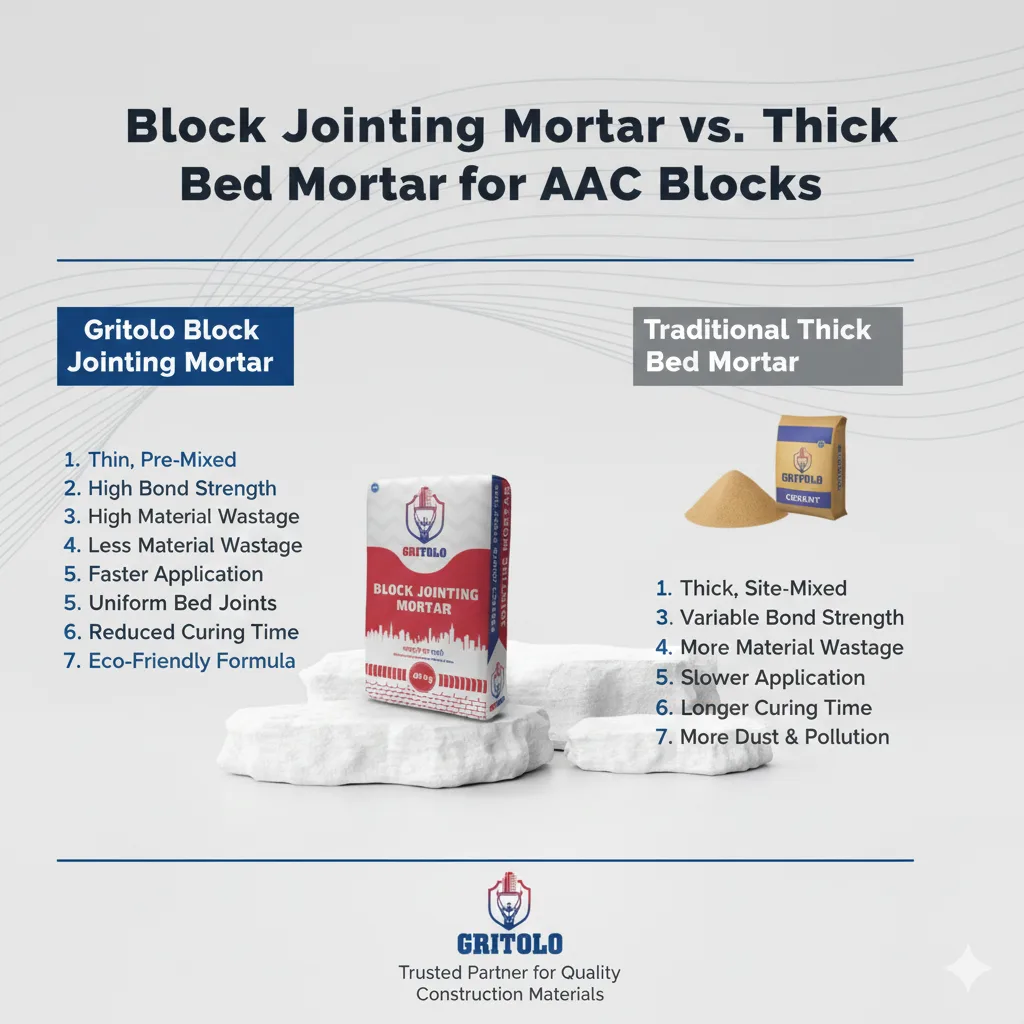
Now, let’s analyze Block Jointing Mortar vs Thick Bed Mortar for AAC blocks across seven critical dimensions.
Adhesion and Bond Strength
The primary job of mortar is to stick two blocks together.
Thick Bed Mortar:
Traditional mortar relies on “mechanical interlocking.” It fills the rough surface of red bricks to create friction. However, AAC blocks are smooth. Traditional mortar struggles to grip the smooth surface effectively.
Furthermore, AAC blocks have high suction. If you put a thick layer of cement mortar (15mm) on an AAC block, the block sucks the water out of the mortar before the cement can hydrate properly. This leads to dehydration of the mortar, resulting in a weak, powdery bond that crumbles easily.
Block Jointing Mortar (Gritolo):
Gritolo’s mortar is Polymer Modified. It relies on chemical bonding, not just mechanical friction. The polymers retain water, preventing the AAC block from sucking the moisture out too quickly.
Even at a thickness of just 3mm, the Tensile Adhesion Strength is significantly higher than a 15mm layer of traditional mortar. The wall becomes a monolithic structure rather than a stack of blocks.
Winner: Block Jointing Mortar (By a landslide).
The Thermal Bridge Effect (Insulation)
One of the main reasons you buy AAC blocks is for insulation—to keep the heat out in summer and the cold out in winter.
Thick Bed Mortar:
Cement is a poor insulator. It conducts heat. When you use 15mm thick joints of sand-cement mortar between every block, you are essentially creating hundreds of “Thermal Bridges” or heat highways. Heat travels through these thick mortar joints, bypassing the insulation of the AAC block and entering your room. This defeats the purpose of buying expensive AAC blocks.
Block Jointing Mortar (Gritolo):
Because the joint is only 2mm to 3mm thick, the surface area for heat transfer is reduced by nearly 80%. The thin joint minimizes thermal bridging, ensuring that the thermal efficiency of the AAC block is maintained.
- Result: Lower electricity bills for air conditioning.
Winner: Block Jointing Mortar.
Curing (The Water Usage)
In a world facing water scarcity, construction methods matter.
Thick Bed Mortar:
Traditional mortar is thirsty. Once the wall is built, it requires water curing for 7 to 14 days.
- This wastes thousands of liters of water.
- It requires labor dedicated solely to holding a hose pipe.
- If you miss a day of curing, the wall cracks.
Block Jointing Mortar (Gritolo):
Gritolo Block Jointing Mortar is Self-Curing. The specialized additives inside the mix hold onto water molecules, allowing the cement to hydrate internally.
- Zero water needed for curing the joints.
- You save water.
- You save the salary of the “curing labor.”
- You eliminate the risk of cracking due to lack of water.
Winner: Block Jointing Mortar (Eco-friendly & Cost-effective).
Speed of Construction
Time is money. Every day a project is delayed, the builder loses interest on capital, and the homeowner waits longer.
Thick Bed Mortar:
- Prep Time: Sand must be sieved to remove stones. Cement bags must be opened and mixed manually.
- Application: The mason has to apply a heavy 15mm chunk of mortar, level it, place the block, and tap it vigorously.
- Clean Up: High rebound loss (mortar falling on the floor) requires daily cleanup.
Block Jointing Mortar (Gritolo):
- Prep Time: Open bag -> Add water -> Mix. Ready in 5 minutes.
- Application: Using a Notched Trowel, the mason spreads the adhesive in seconds. The blocks are placed instantly.
- Setting Time: It sets faster, allowing masons to build higher walls in a single day without the fresh mortar “slumping” or squashing under the weight.
Winner: Block Jointing Mortar (Increases speed by ~30%).
Material Logistics & Storage
Space is often a constraint on sites in Pune and other metros.
Thick Bed Mortar:
To build a wall, you need huge volumes of material.
- For 1 cubic meter of AAC work, you need substantial sand storage.
- Sand piles block driveways and get washed away by rain.
- Sand blowing in the wind creates dust pollution.
Block Jointing Mortar (Gritolo):
Because the layer is so thin (3mm vs 15mm), the volume of material required is drastically lower.
- One bag of Gritolo Jointing Mortar (40kg) replaces multiple bags of cement and a mountain of sand.
- You can store the bags neatly in a dry room.
- Logistic costs (transporting material to upper floors) are reduced by 75%.
Winner: Block Jointing Mortar.
The Cost Analysis: The Biggest Myth
This is where most people get confused in the Block Jointing Mortar vs Thick Bed Mortar for AAC blocks debate.
- The Myth: “Block Jointing Mortar is expensive because one bag costs ₹XXX, while a cement bag costs less.”
- The Reality: You cannot compare Bag Price vs Bag Price. You must compare Cost Per Square Foot of Wall.
Let’s break it down:
| Cost Factor | Thick Bed Mortar (15mm) | Block Jointing Mortar (3mm) |
|---|---|---|
| Material Volume | Huge (High consumption) | Tiny (75% less volume used) |
| Sand Cost | High (and rising daily) | Included in the bag |
| Labor (Sieving) | Expensive | Zero |
| Labor (Curing) | Expensive (7 days) | Zero |
| Wastage | 20-30% | < 2% |
| Transport | High (Moving tons of sand) | Low (Moving few bags) |
The End: When you add up the labor, water, transport, and wastage, using Gritolo Block Jointing Mortar is actually 10% to 15% cheaper per square foot than traditional site-mix mortar.
Why Thick Bed Mortar Causes Cracks in AAC
One of the most common complaints with AAC blocks is wall cracking. Most people blame the blocks, but the culprit is usually the Thick Bed Mortar.
Here is the science:
AAC Blocks are rigid. Cement-sand mortar shrinks as it dries.
When you have a thick 15mm layer of mortar shrinking between every block, it creates tension. Since the bond isn’t perfect (due to suction issues mentioned earlier), the mortar pulls away from the block, creating “separation cracks.”
Furthermore, AAC blocks have different thermal expansion properties than thick cement mortar. As the temperature changes, the mortar and block expand at different rates. A thick joint cannot accommodate this stress, leading to diagonal cracks in the plaster later on.
Gritolo’s Thin Bed Solution:
A 3mm layer has negligible shrinkage. The polymers provide flexibility (Modulus of Elasticity) that allows the wall to absorb minor movements without cracking.
How to Use Block Jointing Mortar Correctly
To get the benefits of the thin-bed method, you must change your application technique. You cannot use a regular trowel.
The Golden Tool: The Notched Trowel
You must use a trowel with “teeth” (notches).
- It ensures exactly 3mm thickness.
- It spreads the adhesive over 100% of the block surface.
- It prevents wastage.
Application Steps:
- Clean: Ensure AAC blocks are dust-free.
- Mix: Mix Gritolo powder with approx. 25-30% water. Stir until creamy.
- Spread: Scoop mortar with the notched trowel. Pull it across the block to create “ribs” of mortar.
- Place: Place the next block and press down. The “ribs” will collapse, creating a perfect, full-coverage 3mm bed.
- Check: Ensure mortar oozes out slightly from the sides—this proves a full bond.
Why Gritolo is the Professional’s Choice
In the debate of Block Jointing Mortar vs Thick Bed Mortar for AAC blocks, Gritolo stands out as a market leader.
Who We Are:
Gritolo Global India Pvt Ltd is founded on grit and innovation. We don’t just import generic formulas; we engineer solutions for the Indian construction environment.
Our Product Advantages:
- High Polymer Content: Superior stickiness and open time.
- Graded Sand: We use sand that is washed, dried, and sieved to micron-level precision. No silt, no salts.
- Quality Control: Every batch is tested in our labs to ensure consistent compressive and tensile strength.
- Availability: We supply across Pune and major construction hubs with reliable logistics.
The battle of Block Jointing Mortar vs Thick Bed Mortar for AAC blocks has a clear winner.
Thick Bed Mortar is a relic of the past—it is wasteful, heavy, slow, and technically incompatible with modern AAC blocks.
Block Jointing Mortar is the standard of the future. It is:
- Stronger (Chemical bonding).
- Faster (No curing, ready to use).
- Cheaper (When calculated per sq. ft. applied cost).
- Greener (Saves water and sand).
If you are building a modern home or commercial space, do not compromise the structure by using outdated methods. Choose the adhesive that matches the quality of your blocks.
Build with confidence. Build with the right bond.
Ready to use Block jointing mortar ?
Get the best prices on high-performance Block Jointing Mortar in Pune and across India.
📞 Call Gritolo Experts: +91 7397985754
🌐 Visit: www.gritolo.com