The Best Option for Quicker, Sturdier, and More Intelligent Construction: Ready Mix Plaster
Written : Gritolo
Ready Mix Plaster is leading this change in the continuously changing construction industry. Time delays and uneven plaster quality are key annoyances for architects, builders, and contractors. Project bottlenecks result from the 40% greater time and labor costs associated with traditional plastering techniques.
With a pre-mixed, high-strength formula that guarantees consistent application, quicker execution, and long-lasting durability, GRITOLO’s Ready Mix Plaster removes these difficulties. This creative method is revolutionizing Pan-India construction, regardless of whether you’re working on residential, commercial, or industrial projects.
Ready Mix Plaster: What Is It?
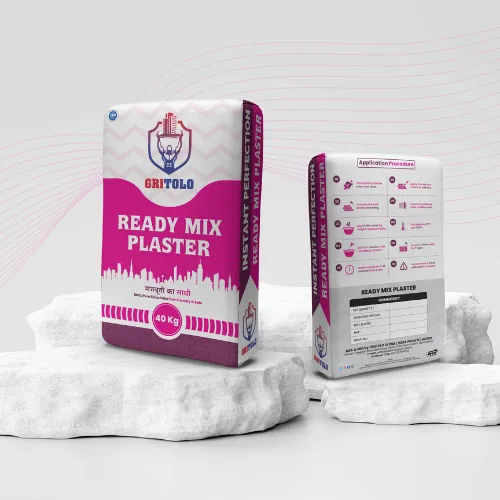
Ready Mix Plaster is a pre-blended plaster that is manufactured in a factory and activates simply with water. Unlike typical sand-cement plaster, it comes with precise ratios of cement, polymers, and additives, ensuring:
- No mistakes in on-site mixing
- Reliability in quality
- Lower labor expenses
- Quicker implementation
Why Opt for Ready Mix Plaster Instead of Conventional Plaster?
| Feature | Traditional Plaster | Ready Mix Plaster |
|---|---|---|
| Mixing Time | 30–60 minutes | Instant (Just add water) |
| Curing Time | 7–14 days | 3–5 days |
| Crack Risk | High (Shrinkage) | Low (Polymer-enhanced) |
| Labor Cost | High (Skilled workers needed) | Low (Easy application) |
The 5 Greatest Advantages of Ready Mix Plaster
- Time-saving: Apply three times quicker than with conventional plaster.
- Cost-effective: 30% less material and labor is wasted.
- Superior Adhesion: Forms a solid bond with concrete, blocks, and bricks.
- Crack Resistance: Shrinkage cracks are avoided by polymer additions.
- Environmentally friendly: less carbon footprint than traditional plaster.
Visit our online store. Click on me!
What it is and the significance of it
Fundamentally, Ready Mix Plaster is a dry cement-based blend that is factory-engineered to provide consistent performance across projects and regions. It is also known as premix plaster, dry mix plaster, or ready manufactured plaster in several markets. Your workers open the bag, add measured water, and produce a consistent, excellent finish—day after day—instead of balancing sand quality, cement ratios, and on-site mixing conditions.
What you acquire:
- Grain size and additive consistency for superior workability and adhesion
- Decreased cracking as a result of regulated shrinkage properties
- Quicker application, which frees up workers for other important duties
- Sites that are tidy, effective, and produce less dust and trash
Gains from each project
Your crews can complete walls more quickly, do less rework, and adhere to schedules when they use Ready Mix Plaster. The assurance of a reliable, expert wall finishing experience while controlling total cost of ownership is valued by buyers in the residential, commercial, and industrial sectors.
Important advantages you can offer stakeholders:
- You can rely on consistency because all bags are the same, thus there are no surprises from different ratios of sand.
- Speed at scale: Reduced stoppages and retries; increased production per mason
- Improved completion, reduced rework: Better coverage, a stronger connection to substrates, and smooth trowelability
- Reduce overall costs by reducing work time, water use, and waste—materials aren’t everything.
- Sites that are safer and cleaner: less dust and mess; no loose sand piles
- Stock-ready logistics: Palletized bags make inventory planning, storage, and transportation easier.
Where appropriate: business, industrial, and residential
For both exterior and interior walls, use ready-mix plaster:
- Townships and residential towers: expedite handover while maintaining a uniform building finish.
- Deliver consistency across floors with strict timeframes in commercial offices and shopping centers.
- High-quality finishes, clean application, and minimal dust are priorities in hospitals, lodging facilities, and educational institutions.
- Warehouses and industrial sheds: consistent performance on enormous surface areas
- Public buildings and infrastructure: streamlined logistics for projects involving many locations or remote work
Materials that go well with it:
- AAC blocks, brickwork, and RCC
- Applications for concrete ceilings and surfaces (with appropriate priming when necessary)
- Gypsum and drywall board (use the appropriate primers and compatible systems as directed)
What’s inside and how it functions: the engineered difference
High-quality dry mix plasters are constructed using:
- Blends of cement that are tailored for adhesion and bond strength
- River sand’s unpredictability is eliminated with graded sand’s uniform particle size distribution.
- Workability, water retention, crack resistance, and open time are examples of performance additives.
- Fibers that are optional can assist manage microcracking on difficult substrates.
Why it’s important
- Reduced hollows and debonding events indicate a stronger relationship.
- Improved workability: faster finishing and smoother spread
- Controlled drying: reduces cracks caused by shrinking in plastic
- More workable surface before initial set due to longer open time
Application Guide: from preparation to flawless completion
The key to creating a fantastic wall is adhering to a defined, repeatable process. This is a tried-and-true process that your teams can use consistently.
Test the substrate’s soundness, remove any loose debris, and moisten the surface to a saturated surface dry (SSD) condition before applying Ready Mix Plaster. Use an appropriate splash coat or bonding agent for particularly smooth surfaces or solid concrete.
Visit our online store. Click on me!
- Preparing the surface
- Clean: Get rid of loose particles, grease, dust, and laitance.
- Repair: Patch any holes or cracks; if necessary, chip polished concrete for a mechanical key.
- Prime: For dense or low-absorption substrates, use the suggested primers or bonding agents.
- Mixing
- Always adhere to the product’s TDS when adding water; the usual range is 16–22% by weight.
- Method: For optimal dispersion, use a slow-speed paddle mixer; let the mixture rest (maturate) for two to three minutes, then quickly remix.
- Pot life: Work within the indicated pot life; remixing without adding more water helps retain consistency
- Application
- First pass: Use a trowel or throw to level; maintain a consistent thickness according to the specifications.
- Leveling: Fill low sections right away using an aluminum straightedge or screed to create a plane.
- Second pass/finish: sponge float for texture if necessary; steel trowel for a smooth finish
- Layers and thickness
- For single-coat interior walls, the typical thickness is 10 to 15 mm; external or uneven walls may need more.
- Multiple coats: Keep interfaces keyed for adhesion and let the first coat to set before the second.
- Curing
- After the initial set (as shown in the TDS), start light curing.
- To lessen shrinkage cracks, continue curing for at least three to five days, depending on the surrounding circumstances.
- Handling and safety
- PPE: mask, goggles, and gloves
- Storage: Use older stock first and keep bags on pallets in a dry, protected area.
Pro tip: Before scaling, standardize a modest on-site mockup and obtain stakeholder acceptance. It saves time downstream and helps match expectations at the completion level.
Cost and coverage: creating budgets that work
One of the best levers for cost control is coverage. Depending on the thickness and substrate roughness, two jobs with the same square footage may use rather different quantities.
The thickness, method, and substrate condition all affect how much Ready Mix Plaster is covered. For organizing:
- Coverage estimation: On a normal stone substrate, a 40 kg bag may cover approximately 18 to 22 square feet at a thickness of 12 mm. Always double-check using product-specific information.
- Substrate factor: Uneven brickwork and rough AAC blocks use more water; increased suction can also have an impact.
- Thickness control: Plaster coverage and finish are significantly enhanced by regular screeding and straightedge inspection.
Material + labor + time total cost view:
- Material: A predictable ratio of bag to area minimizes surprises.
- Work: A quicker application results in fewer man-hours per 1,000 square feet.
- Time: Shorter timescales might lower holding and overhead expenses.
- Rework: Here’s where the true savings show up: less patching, fewer callbacks
Advice: Keep tabs on “bags per floor” or “bags per 10,000 sq ft” throughout your locations. The productivity increases brought forth by standardized plaster will be evident to you very soon.
Which is better in the actual world, site mix or ready mix?
Contractors frequently argue between ready mix and site mix. The useful comparison that stakeholders are interested in is as follows:
- QA and consistency
- Site mix: Extremely erratic because to batching, wetness, and sand quality
- Dry mix: composition and grading managed in the factory for consistent performance
- Work and speed
- Site mix: More time spent on procurement, sifting, weighing, and blending
- Dry mix: quickly and reproducibly open the bag, add water, mix, and apply.
- Final product quality
- Site mix: More susceptible to hollow places, fractures, and honeycombing
- Dry mix: Improved adhesion, smoother finishing, and fewer problems with shrinkage
- Storage and logistics
- Site mix: Needs sand and cement reserves; site dust and debris
- Dry mix: Palletized and bagged; less waste and cleaner sites
- Cost assurance
- Site mix: Unexpected expenses for waste, delays, and rework
- Dry mix: Easy to benchmark and budget for; predictable consumption
Ready Mix Plaster offers greater workability, controlled setting, and consistent gradation as compared to site-prepared mortar, enabling repeatable quality at scale.
Visit our online store. Click on me!
Sustainability: quantifiable benefits at no additional expense
Selecting Ready Mix Plaster helps create more hygienic and conscientious building practices:
- Water conservation: Regulated water addition minimizes waste
- Reduced wasting of materials: Specific-bag dosage restrictions excessive blending and disposal
- Less transportation impact: Bulk sand is not transported from various sources to every location.
- Cleaner air: Employee comfort and safety are enhanced when there is less dust on the job site.
Sustainability is more than simply a checkbox; it’s a long-term cost and brand advantage, particularly for customers who value cleaner operations and green building certifications.
Construct the entire system, including the flooring, grout, mortars, and adhesives.
An excellent wall finish is only one component of a high-performance construction. Align comparable materials across the project for a strong, comprehensive outcome:
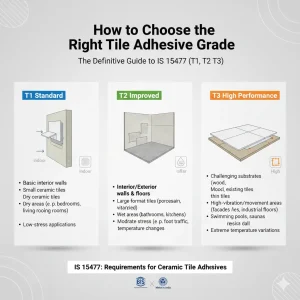
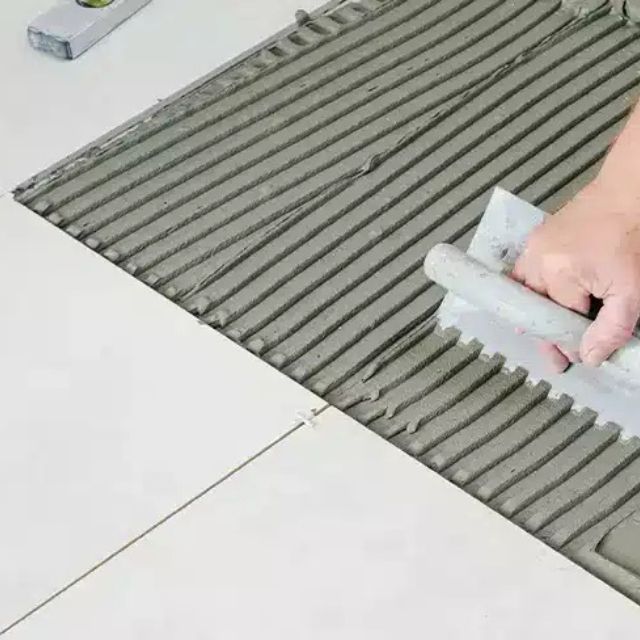
- Tile glue
- Based on tile size, weight, and area exposure, select grades (C1/C2 and T/E/S1 classes according to international standards) for the wall or floor.
- Benefits include excellent bond strength, resistance to slippage, and prolonged open time—all of which are essential for large-format stone and tiles.
- Block jointing mortar
- For AAC blocks and other lightweight masonry systems, thin-bed adhesive
- Reduces the thickness of the plaster downstream by delivering straighter walls with thinner seams.
- Grout
- For joints, cementitious grout provides water resistance, stain resistance, and color constancy.
- Enhances longevity and hygienic conditions in damp or busy regions
- Hardener for floors
- Systems that use trowels or dry shake to increase abrasion resistance and lessen dusting on parking, commercial, and industrial floors
- Closes the gap between long-term facility durability and civil works
To create a seamless, value-engineered system from substrate to finish, combine Ready Mix Plaster with high-quality tile adhesive, block jointing mortar, high-performance grout, and a long-lasting floor hardener for a whole building envelope.
Typical problems and ways to avoid them
The proper on-site procedures are necessary for even engineered materials. Teach groups to stay clear of these pitfalls:
- After tapping, hollow noises
- Cause: Inadequate key, improper substrate preparation, or neglected priming on dense concrete
- Fix: Make sure you have the right troweling pressure, use compatible bonding agents when necessary, and improve surface preparation.
- Crying or cracking lines
- Causes: Include excessive thickness in a single layer, poor curing, and rapid drying.
- Fix: Use scheduled curing, adhere to thickness recommendations, and refrain from applying hot or windy materials without protection.
- High usage and inadequate coverage
- Cause: Poor screeding and uneven substrates
- Fix: Maintain thickness tolerance, plan ahead for leveling coatings, and use straightedges frequently.
- Weak surface or powdering
- Cause: Using too much water during mixing or troweling
- Fix: Adhere to water ratios, avoid re-tempering with additional water, and closely monitor the TDS.
Project scenarios: effective pitching techniques
- Commercial fit-outs that go quickly
- Pitch: Reduced need for follow-up teams for rework, quicker completion, and consistent handover dates
- Residential high-rises
- Pitch: Easy inventory management; more seamless quality audits; uniform quality throughout towers and floors
- Education and hospitals
- Pitch: Smoother walls for sanitary paint systems, cleaner operations, and less dust on the site
- Manufacturing and storage
- Pitch: Integrated floor hardener for long-term durability, dependable curing schedules, and large-area productivity
Documentation and quality control
- Technical Data Sheets (TDS): Train supervisors on important parameters and maintain the most recent version on hand.
- Method statements: Create a standardized “application guide” to ensure consistent outcomes across websites.
- Mockups and approvals: Protect timelines and costs by aligning early.
- Batch traceability: Utilize bag/batch records to ensure supply chain and quality assurance personnel are held accountable.
Why pick a partner rather than a product?
A partner that provides you with training, application audits, TDS/SDS documentation, coverage planning, and on-call technical assistance will yield the greatest outcomes. By doing this, you may reduce delivery risk, safeguard profits, and maintain client satisfaction during each handover.
Visit our Instagram page.
Call to action: request a site demo, TDS, samples, or pricing.
Are you prepared to raise the standard of wall finishing throughout India? Our sales and technical teams are available to assist you.
- Provide your BOQ and project schedules to request a quote.
- Request product TDS/SDS and free samples.
- Schedule a crew training and site demonstration.
- Ask about dealer and distributor programs.
Complete the contact form, and we will respond as soon as possible.