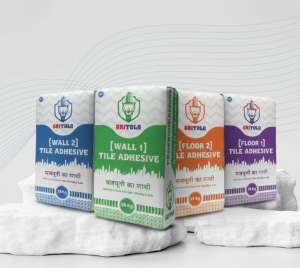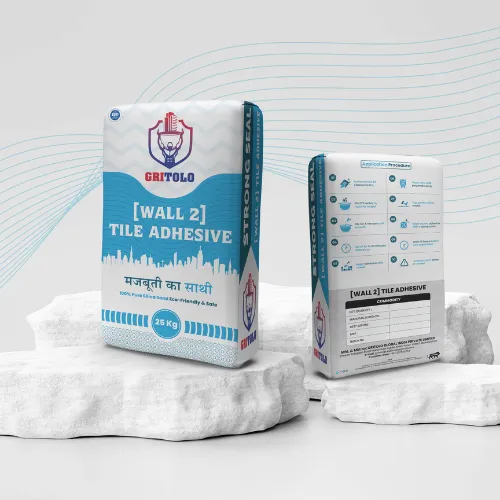
Why Traditional Cement Fails and How to Choose the Right ‘T’ Grade (T1, T2, T3, T4)
Imagine this scenario: You have just spent a fortune on premium Italian marble or large-format vitrified Tile Adhesive Selection for your new commercial complex or dream home. The finish looks spectacular. But six months later, you hear a hollow sound when you walk. A week after that, a tile cracks. Eventually, the tiles start “popping up” or tenting.
This is the nightmare of every contractor, builder, and homeowner.
For decades, the construction industry in India relied on a simple mixture of sand, cement, and water to fix tiles. However, the tiles of the 1990s are not the tiles of today. As tile technology has evolved from porous ceramic to non-porous vitrified and engineered stone, the bonding material must evolve too.
At GRITOLO GLOBAL, we believe that a building is only as strong as its smallest bond. In this comprehensive guide, we will break down exactly why traditional methods fail and how to navigate the technical world of T1, T2, T3, and T4 adhesives to ensure your flooring lasts a lifetime.
The “Sand-Cement” Myth: Why It No Longer Works
To understand why you need specialized adhesives, you first need to understand how adhesion works.
Mechanical Bonding vs. Chemical Bonding
In the past, we used clay or ceramic tiles. These Tile Adhesive Selection were porous (they had tiny holes like a sponge). When you applied a wet slurry of cement and sand, the cement water would seep into the pores of the tile. As the cement cured and hardened, it created a “mechanical grip,” locking the tile in place.
Enter modern Vitrified Tiles.
Modern manufacturing creates tiles that are incredibly dense to make them stain-resistant and durable. They have almost zero porosity. If you apply traditional cement to a vitrified tile, the cement has no “pores” to grab onto. It’s like trying to stick scotch tape to a wet window—it might hold for a moment, but gravity and time will eventually pull it off.
This is why modern construction demands Polymer Modified Adhesives (PMA). These adhesives contain chemicals that create a chemical bond with the surface, eliminating the need for the Tile Adhesive Selection to absorb water.
Decoding the Standards: IS 15477:2019
In India, the quality of Tile Adhesive Selection is governed by the Bureau of Indian Standards (IS 15477:2019). This standard categorizes adhesives based on their performance, specifically their Shear Adhesion Strength and Tensile Adhesion Strength.
Choosing the wrong grade is the #1 reason for project failure. You cannot use a T1 adhesive for a glass mosaic in a swimming pool, and you don’t need a T4 adhesive for a small bathroom floor.
The General Purpose Solution
- Product Reference: Gritolo TA – C100
What is it?
Type 1 adhesives are the entry-level into polymer-modified bonding. They are significantly stronger than site-mixed cement but are designed for standard applications. They generally have a pull-out strength of roughly 0.5 N/mm².
When to use it:
- Ceramic Tiles: Perfect for standard clay or ceramic tiles which still have some porosity.
- Small Formats: Ideal for tiles sized 300x300mm or smaller.
- Flooring (Internal): Great for residential bedroom or living room flooring on cement screed.
When NOT to use it:
Do not use T1 for vertical wall cladding with heavy tiles or for exterior use. It lacks the “grab” required to hold heavy weights against gravity.
The High-Performance Workhorse
- Product Reference: Gritolo SmartFix T2 / TA-V200
What is it?
This is where the real strength begins. T2 adhesives usually have double the bonding strength of T1 (approx 1.0 N/mm²). They are formulated with higher polymer content, making them water-resistant and capable of holding non-porous surfaces.
When to use it:
- Vitrified Tiles: The standard choice for polished vitrified tiles (PVT) and double-charged tiles.
- Large Formats: Suitable for standard 600x600mm or 800x800mm tiles.
- Wet Areas: Essential for bathrooms, kitchens, and wash areas where water resistance is key.
- Stone: Good for Granite and Marble flooring (ensure the stone isn’t moisture-sensitive).
Why Contractors Love It:
Gritolo’s T2 offers a longer “Open Time.” This means after spreading the adhesive, the mason has about 20-25 minutes to adjust the tiles before the glue dries. This increases speed and reduces wastage.
Vertical Strength and Exterior Cladding
- Product Reference: Gritolo TA – M300
What is it?
Gravity is the enemy of wall tiling. T3 adhesives are engineered with Slip Resistance. If you stick a heavy tile on a wall with T1, it might slide down before it dries. T3 holds it firmly in place immediately. Furthermore, T3 adhesives are designed to handle Tile-on-Tile applications.
The “Tile-on-Tile” Revolution
Renovating a house used to mean noisy jackhammers breaking up old floors for days. With a T3 adhesive, you can roughen the existing tile surface and paste the new tile directly over it. This saves time, labor costs, and debris removal.
Critical Applications:
- External Facades: Buildings expand in the sun and shrink in the cold. T3 adhesives have the flexibility to absorb this thermal shock without cracking.
- Swimming Pools: The constant pressure of water and harsh chemicals (chlorine) requires the superior bonding of T3.
- Glass Mosaics: Glass is notoriously difficult to bond. T3 is the standard requirement here.
The Specialist for “Difficult” Surfaces
- Product Reference: Gritolo TA – G400
What is it?
T4 is the elite special forces of the adhesive world. It is classified as Highly Deformable (S2). This means the adhesive layer can actually bend and flex significantly without breaking the bond.
The Problem with Drywalls and Plywood
In modern commercial offices and high-rises, we often tile over Gypsum board partitions (Drywall) or Plywood. The problem? These materials vibrate. When a door slams, the wall shakes. If you use rigid cement, the tile will pop off. T4 adhesive acts like a shock absorber.
Areas of Implementation:
- Drywall Partitions: Gypsum or Fiber Cement Boards.
- Metal Substrates: Adhering tiles to iron or aluminum surfaces (e.g., lift lobbies).
- Engineered Wood: Plywood or Bison panels.
- Vibration Zones: Factories with heavy machinery or areas near railway tracks.
The Hidden Benefits of Switching to Gritolo Adhesives
Beyond just “strength,” switching from site-mix cement to Gritolo’s range offers operational advantages that save money in the long run.
- No Curing Required: Traditional cement needs water curing for 7 days. Gritolo adhesives are self-curing. You save thousands of liters of water and a week of waiting time.
- Thinner Beds: Cement mortar requires a 20-25mm thick layer. Adhesives only need 3-6mm. This reduces the “Dead Load” on the building structure, which is crucial for high-rise engineering.
- Speed: A mason can lay tiles 3x faster using a notched trowel and adhesive compared to the traditional heap-and-press method.
- Aesthetics: Adhesives ensure a perfectly flat surface (zero lippage) because the thin bed doesn’t shrink unevenly like a thick cement bed does.
5 Pro-Tips for a Flawless Installation
Even the best adhesive (like our TA-G400) can fail if applied incorrectly. Here are expert tips from the Gritolo technical team:
- Use the Right Trowel: Never spot-bond (apply blobs of glue). Always use a Notched Trowel to create ridges. This ensures 100% coverage under the tile. Air gaps under tiles lead to cracking.
- Back-Buttering: For any tile larger than 2×2 feet, apply a thin layer of adhesive on the back of the tile as well as the floor.
- Check the Expiry: Adhesives contain active chemicals. Always use fresh bags (Gritolo ensures 12-month shelf life stability).
- Surface Prep is Key: The floor must be clean. Dust is a bond-breaker. A quick sweep isn’t enough; vacuum or wash the substrate before application.
- Respect the Joints: Never butt-joint tiles (touching edge-to-edge). Always leave a minimum 2-3mm spacer gap and fill it with a high-quality grout like Powergrout GT2. This allows for thermal expansion.
Building the Future with GRITOLO
The construction industry is moving towards precision, speed, and sustainability. At GRITOLO GLOBAL INDIA PVT LTD, we don’t just sell bags of powder; we provide engineered solutions for modern infrastructure with Tile Adhesive Selection.
Whether you are a homeowner doing a bathroom renovation or a developer constructing a 50-story tower, the “Grit” in our name represents the resilience of our bond.
Unsure which adhesive is right for your project?
Don’t guess. Consult the experts.
📞 Call Now: +91 7397985754
Or visit our product page to explore the full technical specifications of our T1, T2, T3, and T4 ranges.
Build Stronger. Build Smarter. Build with Gritolo.